Exam 2 AP study guide-1
 Note
Note Call Kai
 Learn
Learn Practice Test
 Spaced Repetition
 Match
Match Flashcards
 Knowt Play
1/118

There's no tags or description
Looks like no tags are added yet.
Name | Mastery | Learn | Test | Matching | Spaced | Call with Kai | Chat |
|---|
No analytics yet
Send a link to your students to track their progress
119 Terms
What term means within the cell?
intracellular
What term means between cells?
extracellular
What is the term for what happens in a cell between the binding of a ligand to a receptor and the final response in the cell?
signal transduction
What is the term for a drug that can bind to a receptor and trigger signal transduction?
agonist
What receptor signaling pathway involves a cascade of phosphorylations?
receptor tyrosine kinase
What enzyme converts cAMP into AMP, thus inactivating it?
cAMP phosphodiesterase
State two type of receptors that are themselves enzymes.
guanylyl cyclase receptor
receptor tyrosine kinase
What are the substrate and products of the reaction catalyzed by guanylyl cyclase? Be sure to say which is the substate and which are the products.
substrate: GTP
products: cGMP = 2 inorganic phosphates
What is the advantage of having so many steps in the signal transduction pathway of many of the receptors?
it allows for amplification of the response
Draw a flow chart for the steps of signal transduction in the Gs protein-coupled receptor pathway. Include all the steps from lecture. Start with ligand binds to G protein-coupled receptor.
add
Protein receptors for intercellular messengers have the same four characteristics of protein binding sites (chemical specificity, saturation, affinity, and competition).
false
The number of protein receptors in the plasma membrane of a cell is very stable over time.
true
Intercellular messengers that bind to intracellular receptors are
lipophilic
The JAK protein often phosphorylates what transcription factor as discussed in lecture? (use abbreviation)
STAT
What was the general name given in lecture for drugs that can bind to a protein receptor but do not activate signal transduction.
antagonist
Most intracellular receptors are transcription factors
true
Most intercellular messengers bind to
Membrane-bound receptors
Ion channel receptors are
Ligand-gated ion channels
What effect does the alpha subunit of the Gi protein have on adenylyl cyclase?
Decrease its activity
The movement of charge is called
current
The difference in charge between two location is called the
voltage/electrical potential
What chemicals are produced when cyclooxygenase enzymes are activated?
prostaglandins
What enzyme liberates arachidonic acid from a membrane phospholipid?
phospholipase A2
What protein, discussed in lecture, does calcium bind to in order to activate a specific protein kinase?
calmodulin
What are the organs of the central nervous system?
brain, spinal cord
What two organ systems are involved in coordinating the functions of cells to maintain homeostasis? Which of these two systems acts more specifically and quickly?
nervous system- quicker and more specific
endocrine system
What are the two sources for the calcium that can enter the cytosol of cells?
smooth endoplasmic reticulum (smooth ER)
extracellular fluid
What are the three components of a synapse?
presynaptic axon terminal
synaptic cleft
post synaptic density
What are the three types of synapses based on the location of the synapse on the post-synaptic cell?
axosomatic synapses
axodendritic synapses
axoaxonic synapses
How does the concentration of first messenger at a receptor decrease over time?
diffusion of the messanger out of local area
enzymes degrade the messanger
reuptake by releasing cell or uptake by after cell
receptor mediated endocytosis
How does phosphorylation of receptors reduce the activity of the signal transduction pathway?
phosphorylation of the receptor can decrease the receptors’ affinity for the first messenger and its second messangers. Phosphorylationcan also target the receptor for endocytosis
Draw a neuron and label the parts
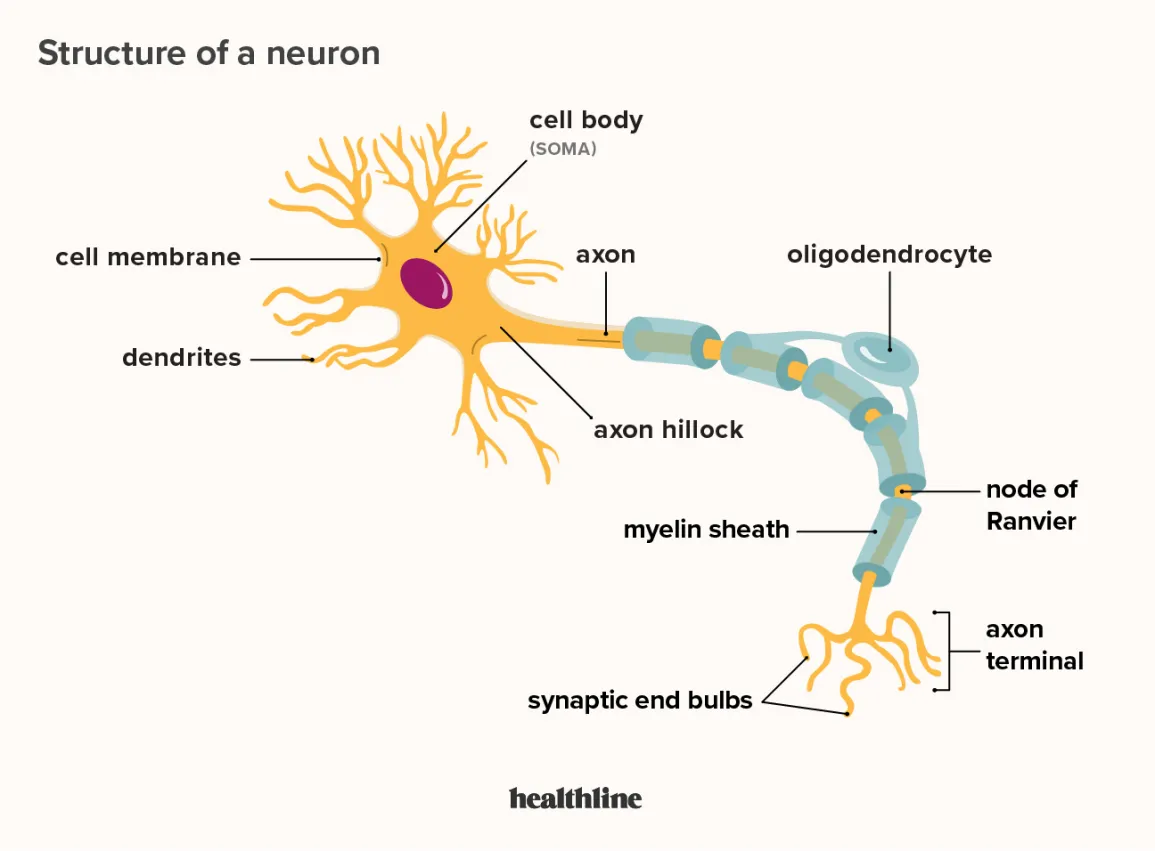
List the five types of glial cells
oligodendrocyte
Schwann cell
astrocytes
microglia
ependymal cells
oligodendrocyte
makes myelin in the central nervous system
Schwann cell
makes myelin in peripheral nervous system
astrocytes
regulate concentration of neurotransmitters nutrients, ions in the cerebrospinal fluid help form the blood brain barrier
microglia
immune function for central nervou system
ependymal cells
line ventricals and make cerebral spinal fluid
Which of the following are second messengers?
cAMP
IP3
Calcium
Protein kinase A
Alpha subunits of G proteins
DAG
G protein coupled receptors
Adenylyl cyclase
Gs and Gi protein-coupled receptors would not both be present in the same cell.
false
Neurons usually use ________ for intracellular communication, and _________ for intercellular communication.
electrical signals, chemical signals
The excess negative change in cells is
only along the membrane
What proteins are involved in anterograde transport in axons
kinesins
A solution containing 200 mM of a permeable solute and 300 mM of a non-permeable solute would be
hypersomotic
A solution containing 200 mM of a permeable solute and 300 mM of a non-permeable solute would be
isotonic
what proteins ar involved in retrograde transport in axons?
dyneins
A collection of neuronal cell bodies outside the central nervous system is called a
ganglion
A collection of neuronal axons inside the central nervous system is called a
tract
which type of neurons are most numerous?
interneurons
A single neuron can be both pre-synaptic and post-synaptic
true
A single neuron msy be post-synaptic to thousands of pre-synaptic neurons
true
What protein uses the most ATP in the brain?
sodium potassium pump
What two factors determine the driving force for ions?
concentration gradient
electrical potential (voltage)
What is the name of the equation that can be used to determine the equilibrium potential for an ion?
Nerst equation
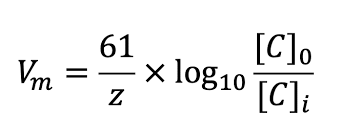
What equation was given in lecture for the flux of an ion?
J=g(Vm-Veq)
A trivalent cation has an intracellular concentration of 0.1 mM and an extracellular
concentration of 10 mM. What is the equilibrium potential of this cation?
(1/3)62log(10/.1)=41.33 mV
If you decrease the extracellular concentration of the above cation, what will happen to its equilibrium potential?
less positive
What happens to potassium’s equilibrium potential if you increase the amount of potassium in the cell?
It becomes more negative
What happens to sodium’s equilibrium potential if you increase the amount of sodium outside the cell?
It becomes more positive
If an anion has a higher concentration outside the cell than inside the cell, the anion’s equilibrium potential will be
negative
At the resting membrane potential, which ion has the greater driving force?
sodium
Assuming the only permeable ions across the plasma membrane are sodium and potassium, at the resting membrane potential
The inward flux of sodium equals the outward flux of potassium
If more potassium leaves the cell than sodium comes in, assuming those two are the only permeable ions, then the membrane potential will
Become more negative
If the membrane potential becomes more negative, what happens to the driving force for sodium?
Increase
If the membrane potential becomes more negative, what happens to the driving force for potassium?
decrease
Assuming the membrane is only permeable to sodium and potassium, at the resting membrane potential, the flux of sodium into the cell equals the flux of potassium out of the cell.
false
If you have two chambers separated by a semi-permeable membrane that is only permeable to potassium, and you put 10 mM of potassium chloride in one chamber, and 1 mM of potassium chloride and 9 mM of sodium chloride in the other chamber, potassium will flux across the membrane until the concentration of potassium is the same on both sides.
false
What protein uses the most ATP in the brain?
sodium potassium pump
If the concentration of a monovalent anion is 3mM inside the cell and 30mM outside the cell, what is the equilibrium potential of the anion in mV?
-62
The excess negative charge in a cell is
only next to the membrane
Potassium’s equilibrium potential is
negative
sodium’s equilibrium potential is
positive
only an extremely small percentage of the K+ in the cell has to leak out to cause a 80 mV change in potential
true
which ion is more permeable at rest?
potassium
__________ have equilibrium potentials
ions
A solution that contains 400 mM of a non-permeable solute and 200 mM of a permeable solute would be
hypertonic
A solution that contains 400 mM of a non-permeable solute and 200 mM of permeable solute would be
hyperosomotic
If a cell does not regulate chloride concentrations, then the equilibrium potential for chloride equals the resting membrane potential in that cell.
true
The concentration of potassium is the same in the cerebrospinal fluid and the blood.
false (blood brain barrier)
If you increase the potassium permeability, what will happen to the membrane
potential?
Hyperpolarize
If you increase the intracellular concentration of sodium chloride, what will happen to the membrane potential?
Hyperpolarize
If you increase the intracellular concentration of potassium chloride, what will happen to the membrane potential?
Hyperpolarize
Changing the extracellular concentration of __________________ has a bigger impact
on the resting membrane potential.
potassium
Given the following:
extracellular sodium concentration = 100 mM
intracellular sodium concentration =10 mM
extracellular potassium concentration = 10 mM
intracellular potassium concentration = 100 mM
the only permeable ions across the plasma membrane are sodium and potassium
sodium and potassium have the same permeability across the membrane
What is the membrane potential? (Remember, a number without units is meaningless.)
0 mV
If there are no active transport mechanisms for chloride in a cell, the concentration of chloride will be
the same inside and outside the cell
If you increase the sodium permeability, what will happen to the membrane potential?
depolarize
If you increase the extracellular concentration of sodium chloride, what will happen to the membrane potential?
depolarize
If you increase the extracellular concentration of potassium chloride, what will happen to the membrane potential?
depolarize
Depolarization ______________ the driving force for potassium to leave the cell.
increases
increasing the extracellular concentration of sodium chloride will cause the cell to
depolarize
Increasing the extracellular concentration of potassium chloride would cause the cell to
depolarize
decresing the extracellular concentration of potassium chloride wouls cause the cell to
hyperpolarize
decreasing the intracellular concentration of the sodium chloride would cause the cell to
depolarize
decreasing a cell’s permeability to sodium will cause the cell to
hyperpolarize
decreasing a cell’s permeability to potassium will cause the cell to
depolarize
A solution that contains 100 mM of non-permeable solute and 200 mM of permeable solute is
iso-osmtic
a solution that contains 100 mM of non-permeable solute and 200 mM of permeable solute is
hypotonic
The movement of charge in neurons is faster than the diffusion of ions.
true
When a sodium channel opens in a graded potential, this causes the flux of potassium out of the cell to increase.
true
At the resting membrane potential, (select all that apply)
The voltage-gated potassium channel is closed
The voltage-gated sodium channel is closed