TPP1/POT1 Paper
 Call Kai
 Learn
Learn Practice Test
 Spaced Repetition
 Match
Match Flashcards
 Knowt Play
1/30

There's no tags or description
Looks like no tags are added yet.
Name | Mastery | Learn | Test | Matching | Spaced | Call with Kai |
|---|
No analytics yet
Send a link to your students to track their progress
31 Terms
Main goal of the paper
To propose a new modular model of how TPP1/POT1 work together to manage telomeres, to challenge the open/closed system
What is the open/closed model?
In the closed state the telomere is protected but inaccessible to telomerase.
In the open state the telomere is accessible but unprotected.
What is the big main discovery of the paper?
Telomerase recruitment and end protection are independent mechanisms.
Which function does TPP1 manage?
The recruitment of telomerase
What function does POT1 manage?
The protection of the telomere ends
What is a heterodimer?
A molecular complex consisting of two different molecules linked together
What domain does TPP1 use to bind to POT1?
RD domain
What is a RD domain?
Recruitment Domain
Where is the RD domain located?
In the middle of TPP1, separates the N and C terminal
What does the N terminal OB fold of TPP1 do?
Recruits telomerase
What does the C terminal of TPP1 do?
Bind TIN2
Why do textbooks usually term TPP1 as POT1s cofactor?
It increases POT1s affinity for DNA and increases telomerase processivity
Processivity
An enzyme's ability to catalyze consecutive reactions, such as adding nucleotides to a growing DNA strand, without releasing its template substrate
TPP1 full name
TIN2 and POT1 protein 1
POT1 full name
Protection of Telomeres 1
How does TPP1 recruit telomerase?
Via its TEL patch residues
What overhang does POT1 bind too?
The single stranded G overhang
What do TPP1 and POT1 recruit together?
CST complex
What does the CST complex do?
Mediates the termination of telomerase activity and promotes fill in synthesis of the C strand
Nucleoprotein
Protein that is closely linked to DNA or RNA in its structure
TERT vs TERC
TERT = Telomerase Reverse Transcriptase
TERC = Telomerase RNA
Why has there previously been a challenge to do functional studies like this one?
The resolution limits of available assays to detect telomerase activity where to low
What single cell assay was created for this study?
iTAP
iTAP stands for
Inducible Telomerase Activity Probing
How does iTAP work?
It uses a DOX inducible mutant telomerase RNA (mutTR) that introduces mutant telomeric repeats (TTTGGG) instead of (TTAGGG)
What does it mean to be DOX inducible?
The mutant telomerase introduced in the cells would remain silent until DOX was introduced putting the gene into action
How exactly does DOX activate the mutant?
The silent telomerase is part of the Tet-On inducible system
When the mutTR is transfected into the cells it is placed under the control of a promoter that is normally off
In the cells the rtTA (reverse tertacycline transactivator) is produced but it cannot bind to the DNA promoter of the mutTR so it remains silent until DOX
When DOX enters the cell it binds directly to the rtTA protein
Once bound to DOX the rtTA protein gains the ability to bind to specific DNA sequences called Tet Operator (TetO)
Once bound to TetO rtTA recruits the cells transcription machinery to produce the mutTR
3 main takeaways of the study
Cells without TPP1 are viable but they can’t elongate telomeres
Cells without POT1 go through rapid ATR induced repair death
Without POT1 telomerase activity increases slightly suggesting that it normally restricts enzyme engagement (telomerase) instead of helping
What were the advantages of using a DOX inducible system?
prevents toxicity, high levels of mutant RNA is not good long term
easily trackable over a 64 hour window
easy to compare cell activity before and after induction on the same flask
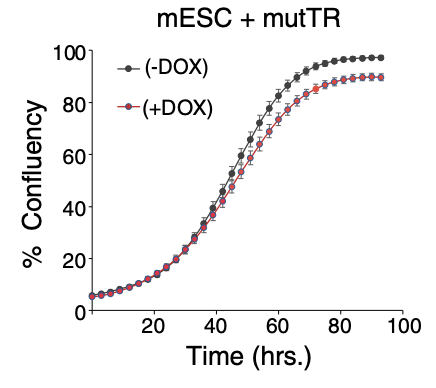
Interpretate Figure 1a
There isn’t a large difference between the cell growth of those treated with DOX and those that weren’t treated with DOX
Proves that inducing cells with mutant telomerase RNA is not destructive to the cells and does not contribute to cell death
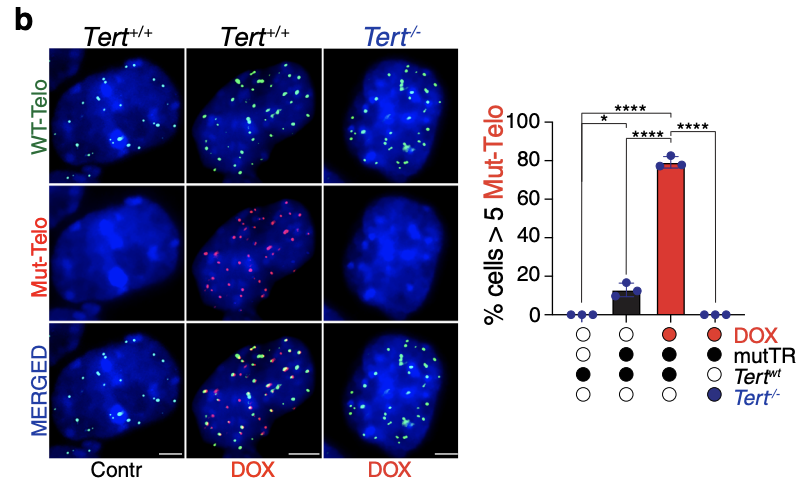
Interpretate Figure 1b
In wild type cells (Tert+/+) treated with DOX red spots appear indicating telomerase is active.
Cells without telomerase had no red spots appear even after DOX meaning that telomerase was not active
Proves red signal is specific to telomerase activity

