Bio Exam 4
 Call Kai
 Learn
Learn Practice Test
 Spaced Repetition
 Match
Match Flashcards
 Knowt Play
1/33

There's no tags or description
Looks like no tags are added yet.
Name | Mastery | Learn | Test | Matching | Spaced | Call with Kai |
|---|
No analytics yet
Send a link to your students to track their progress
34 Terms
What is a fungus? How do fungi obtain nutrition?
eukaryotic, most are sessile (not moving), have chitin in cell walls (like insects), reproduce asexually and sexually, disperse by spores
heterotrophs (depend on performed organic molecules for carbon and energy) — use absorptive heterotrophy to obtain nutrition
What is absorptive heterotrophy?
fungi secrete enzymes breaking down organic material that is absorbed into the cell
What are hyphae? What is a mycelium? For a fungus, what is an advantage of having a body (thallus) made up of numerous, slender filaments?
h: highly branched multicellular filaments, strengthened by chitin (complex polysaccharides) in cell wall
m: The network of branching hyphae that forms the body of a fungus
having a large body made up of filaments allows for a large surface area to absorb nutrients, also results in water loss which is why fungi exist in moist environments
What are septa? Differentiate between a septate and aseptate hyphae.
s: walls that divide hyphae into distinct cellular compartments, providing structural support and separating cells while often allowing cytoplasm, nutrients, and organelles to move through central pores along the hypha
as: coenocytic, have multiple nuclei, hyphae are continuous tubes with multiple nuclei freely flowing through the cytoplasm — no divisions!
What are yeasts? Molds?
Y: Single-celled , free-living fungi, Hyphae development has been lost independently several times (does not produce hyphae), yeast is not monophyletic or taxonomic, live in liquid or moist environments, Rapid growth and ease of culture make them a model organism for laboratory studies
M: a type of microscopic fungus that grows in multicellular filaments called hyphae, forming colonies on organic matter in damp, warm environments — produces spores
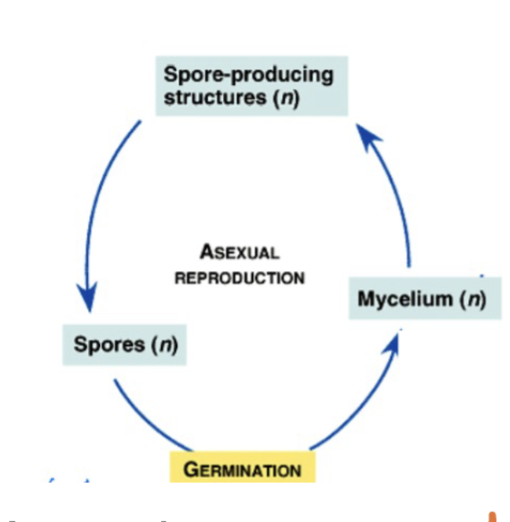
Patterns of asexual reproduction in filamentous fungi
Long distance spore dispersal (via air, water, animals), Fungi in aquatic environments have flagellated spores, On land, spores have a thick wall that provides protection and prevents water loss, whole cycle is haploid
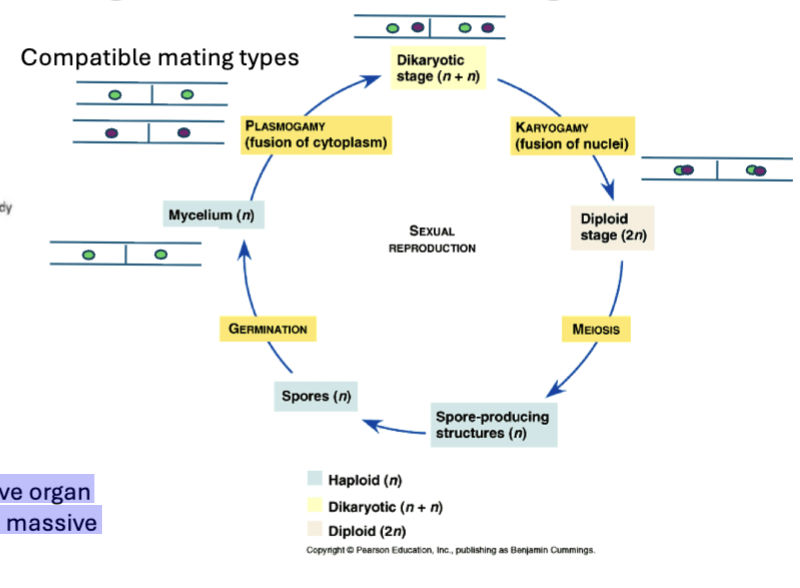
Patterns of sexual reproduction in mushroom producing filamentous? What does the term dikaryotic mean? What does karyogamy mean?
The mushroom is a short-lived reproductive organ that enables nuclear fusion, meiosis, and massive spore dispersal, in mushrooms there is no sperm and egg: there are compatible mating types → go into plasmogamy (fusion of cytoplasms) → become dikaryotic (fungal cell with 2 nuclei, 1 cytoplasm) → karyogamy (fusion of nuclei)
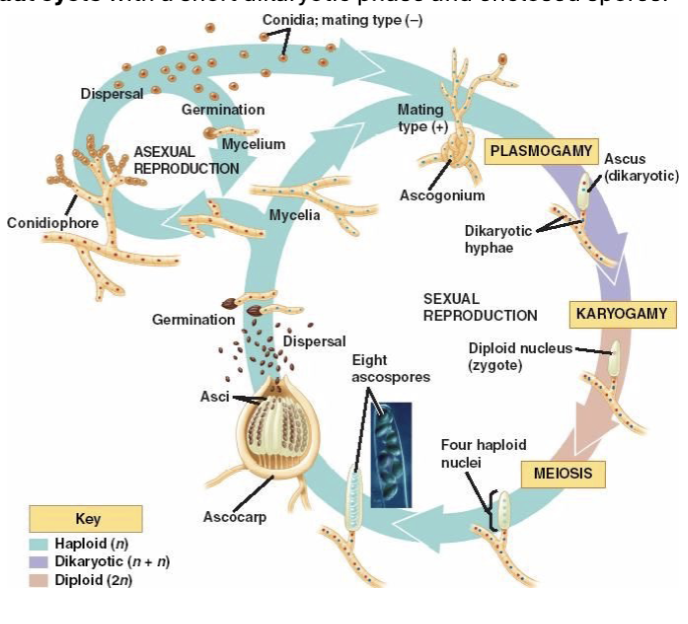
Patterns of sexual reproduction in sac-producing fungi
Brief dikaryotic stage: Limited to specialized reproductive hyphae
Karyogamy: occurs in the ascus Asci are the site of nuclear fusion
Meiosis + mitosis → ascospores Spores form inside the ascus
Smaller or varied fruiting bodies Ascocarps (e.g., morels, cup fungi) are often less massive than mushrooms
What are fruiting bodies?
Above ground mushrooms are spore producing fruiting bodies
Occur in Basidiomycota ("true mushrooms") and Ascomycota (mushroom-like forms)
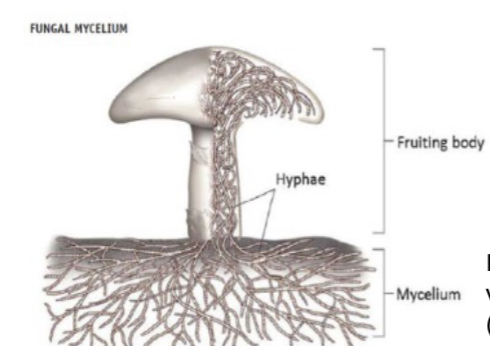
What are Basidiomycota and Ascomycota?
b: “true mushrooms”, garics, boletes, puffballs, shelf fungi, Spores produced on basidia, Fruiting body = basidiocarp, Long-lived dikaryotic (n + n) stage
a: “mushroom-like forms”, Morels, cup fungi, truffles, Spores produced in asci, Fruiting body = ascocarp, Brief dikaryotic stage
Why are fungi considered saprotrophs?
saprotrophs = decomposers
Most fungi use dead organic material for energy and nutrition (absorptive heterotrophy) (examples: leaf litter, wood, paint, leather,
petroleum)
On land, organic material in dead tissues in and within soils exceeds the living biomass
Fungi are critical to the carbon cycle and for retuning nutrients to the soils
What are cellulose and lignin? What role to fungi play in breaking down these compounds?
c: Principle component of plant cell walls, Polymer of the sugar glucose (rich in carbon and energy)
l: found in wood
Fungi secrete enzymes that hydrolyze cellulose to individual glucose molecules, which are absorbed and metabolized, Some fungi produce enzymes that degrade lignin, In nature, fungi account for most of the decomposition of wood
Compare and contrast the terms: symbiosis, mutualism, commensalism, parasitism. Provide a fungal example of each
s: two or more organisms living in close association — m, c, p are all a type of symbiosis
m: increased fitness for both partners (+/+) (example: Lichens – a fungus and green alga and/or cyanobacterium, lichen provides protection, Green algae and cyanobacteria are photosynthetic and provide carbohydrates (food) to lichen)
c: Fitness benefit to one partner / neutral for other (+/0) (example: Endophytes: fungi living with plants; do not cause disease)
p: beneficial to one partner, negative to other (+/-) (example: Rusts- fungi (crop pathogen) that infect small range of plants, may have 5 different spore types and very complicated life cycles, most harmful pathogen in agriculture/horticulture)
Provide examples of the economical uses of fungi.
Edible fruiting bodies: cultivated or wild, Fermentation used in food/beverage production, Production of antibiotics, stains/dyes, biofuels, Fabrication of building materials (like on Mars), Religious and spiritual cultural practices
What phyla (members) are in the supergroup Opisthokonta?
animals, choanoflagellates, fungi
What tools are used to study the evolution of animals?
fossils provide record of now extinct species
Molecular data – genes and genomes
morphological characteristics (homologous, examples of convergent evolution)
What are fossil records?
shells and bones (mineralized body parts) can form fossils — fossil record provides an estimated time of appearance, but the record is biased because not everything fossilizes
Why are fossils like those found in the Burgess Shale important in understanding the evolution of animals?
because these Cambrian fossils provided numerous well-preserved fossils, Animals were buried in an underwater avalanche of fine mud that preserved exceptionally delicate details of the structure of their soft parts. A diversity of animals was captured in the fossil record.
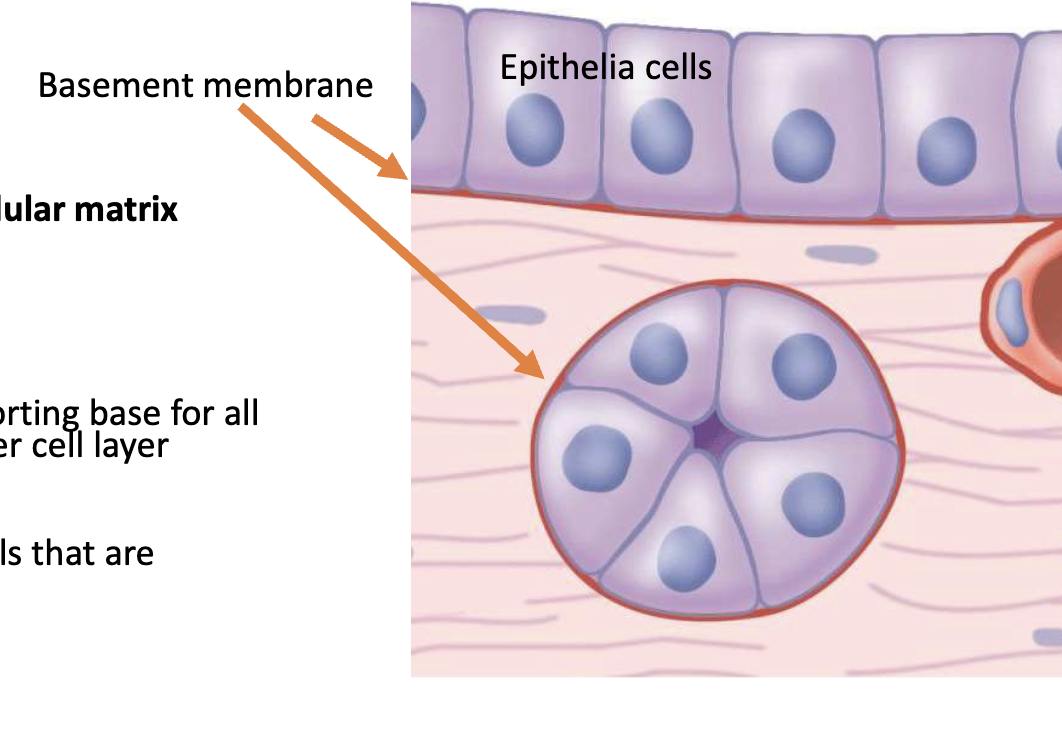
Define the following: epithelium and basement membrane
e: (broad sense) continuous sheet of cells that are connected to each other by cell junctions
b: thin sheets of extracellular matrix (ECM) that surround most animal tissues, flexible, strong, forms sheet-like structure that provides a supporting base for all types of epithelial tissue, separates it from another cell layer
Define: skeleton, when is rigid vs. aquatic skeleton required? What are antagonistic muscles?
s: solid or fluid system that allows muscles to be stretched by to their original length following a contraction, Nearly all multicellular animals require a skeleton for movement, Muscles shorten or relax; do not actively extend
Rigid skeleton systems essential in terrestrial environments
Aquatic organisms supported by water, a rigid skeleton is not required
antagonistic muscles: muscles make repeated movement possible
What is a hydrostatic skeleton? Give an example of animal that has it.
Hydrostatic skeletons are common in invertebrate animals and require:
A fluid filled cavity that is surrounded by a flexible membrane, fluid is not compressible
example: starfish
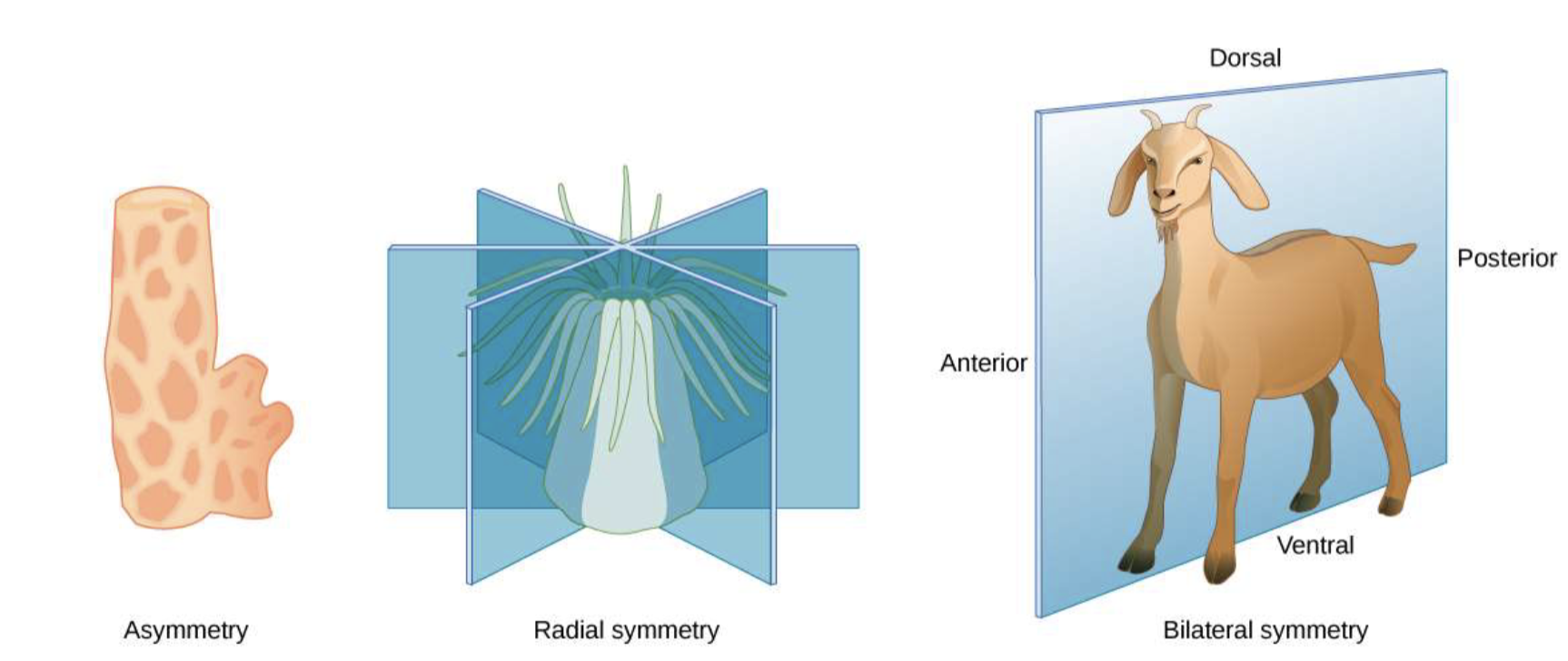
Define: asymmetry, radial symmetry, bilateral symmetry, rotational symmetry (give an example of rotational)
a: if split in half, halves not identical
radial: if cut into like a piece of pie, all pie pieces identical
bs: if cut in half, halves are identical
rotational: if rotated by 180 degrees and cut in half, halves are identical (example: Ctenophores (comb jellies))
Define neurons and nerve nets
Neurons (nerve cells) Allow for sensing, communication, movement, etc., are present in Ctenophores, Cnidarians and Bilateria; absent in Sponges (Porifera)
Never nets: nerve cells in one concentrated area of the body only (Ctenophores, Cnidarians)
Define mesoderm, differentiate diploblastic vs. triploblastic animals
m: third germ tissue, called the mesoderm, differentiates along with the ectoderm and endoderm, mesoderm evolved after endoderm and ectoderm
d: inner endoderm and the outer ectoderm layers give rise to the adult body
t: endoderm, ectoderm and mesoderm

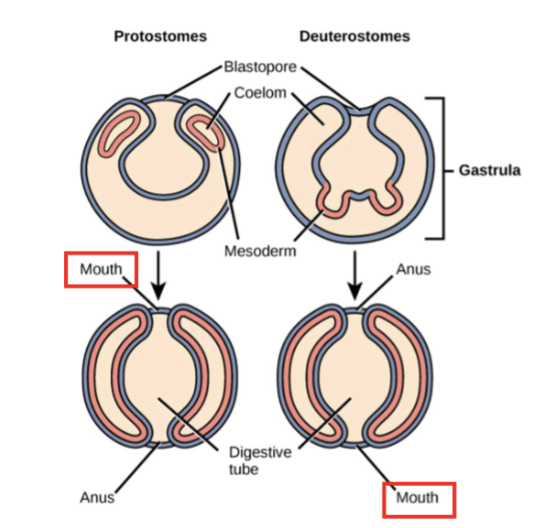
differentiate between protostomes and deuterostomes
both occur in embryonic development of mouth in bilaterians
p: mouth first (Platyhelminthes, Annelida, Mollusca, Arthropoda, Nematoda)
d: mouth second (Echinodermata, Chordata)
What type of skeleton is observed in cnidaria and ctenophores? What other animals have this type of skeleton?
hydrostatic skeleton
Echinodermata, Platyhelminthes, Annelida, Mollusca
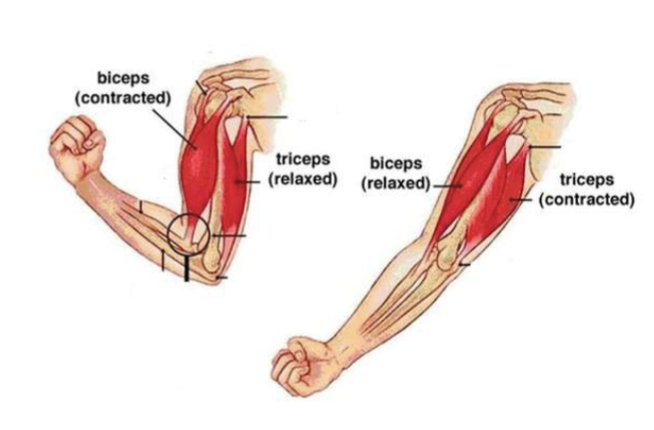
Explain how antagonistic muscles make repeated movement possible.
by working in opposing pairs—one contracting (agonist) while the other relaxes (antagonist)—to move joints back and forth. They enable cyclical motions by acting as alternating force producers; the biceps flexes the elbow while the triceps extends it.
Describe the pattern of body symmetry observed in ctenophores, cnidaria, and bilaterian animals.
cte: rotational
cni: radial
bilaterian: bilateral
Which groups of organisms have neurons (nerves cells, nerve nets)? What does the term cephalization mean?
Ctenophores, Cnidarians and Bilateria
cephalization: at anterior (front) end forming a distinct head and brain — centralized nervous systems and brains (bilaterians)
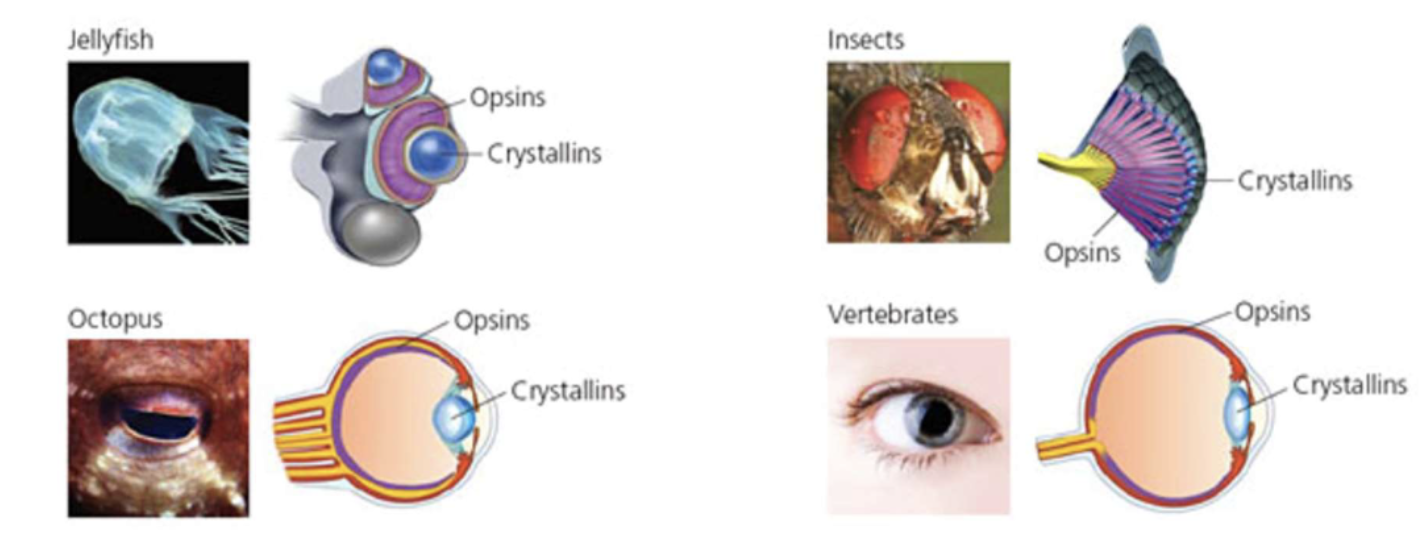
What are opsins and crystallins? Summarize the evidence that image forming eyes evolved independently at least four times during the evolution of animals.
o: when activated by light they trigger a series of chemical reactions that stimulate photoreceptor, found photoreceptor cells of retina, shared evolutionary history
c: water-soluble structural proteins located in the vertebrate eye lens and cornea that ensure transparency and refractive power, evolution of the lens was key to the evolution of image forming eye. Different proteins have been recruited to serve same function
evidence: animals formed similar structures and similar functions independently — check image
How do fungi primarily obtain nutrients?
absorption after decomposing outside of fungus
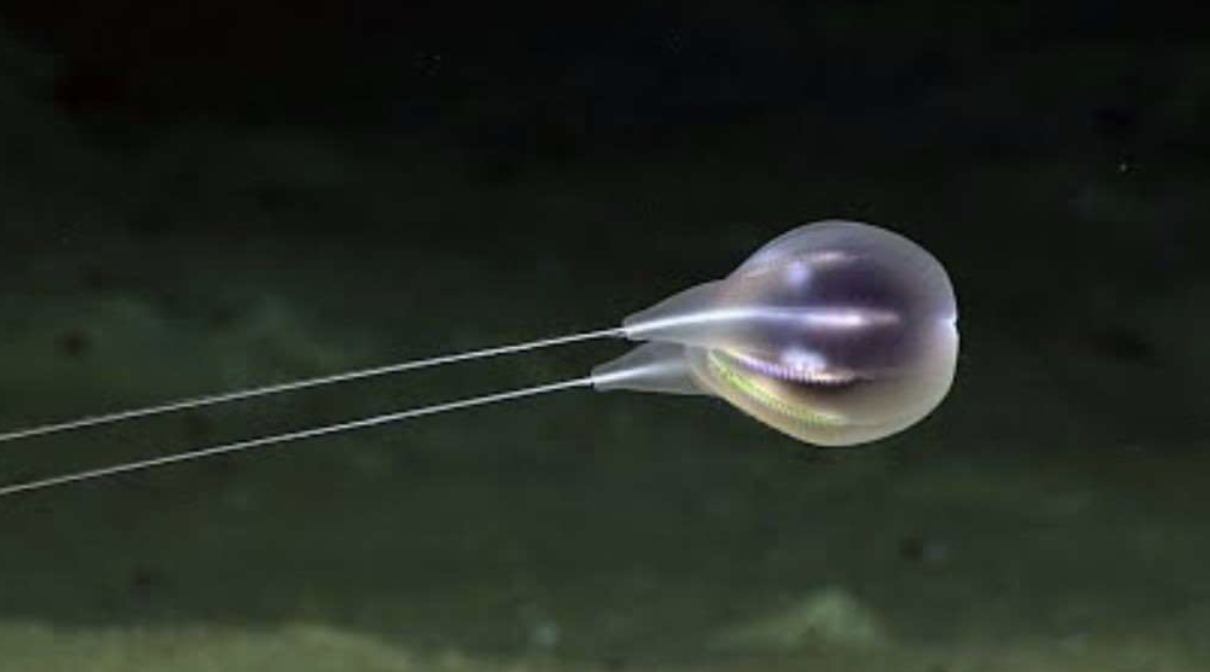
Summarize the characteristics of Ctenophores.
comb jellies!
basement-membrane, hydrostatic skeleton, rotational symmetry, nerves, diploblastic (two tissue layers), found in marine habitats, Rows on cilia are used for locomotion and refract light, many species are bioluminescent
Colloblasts: sticky cells that capture prey
Summarize the characteristics of sponges (Porifera).
What functions do the following serve:
a. collagen and spicules
basement membrane
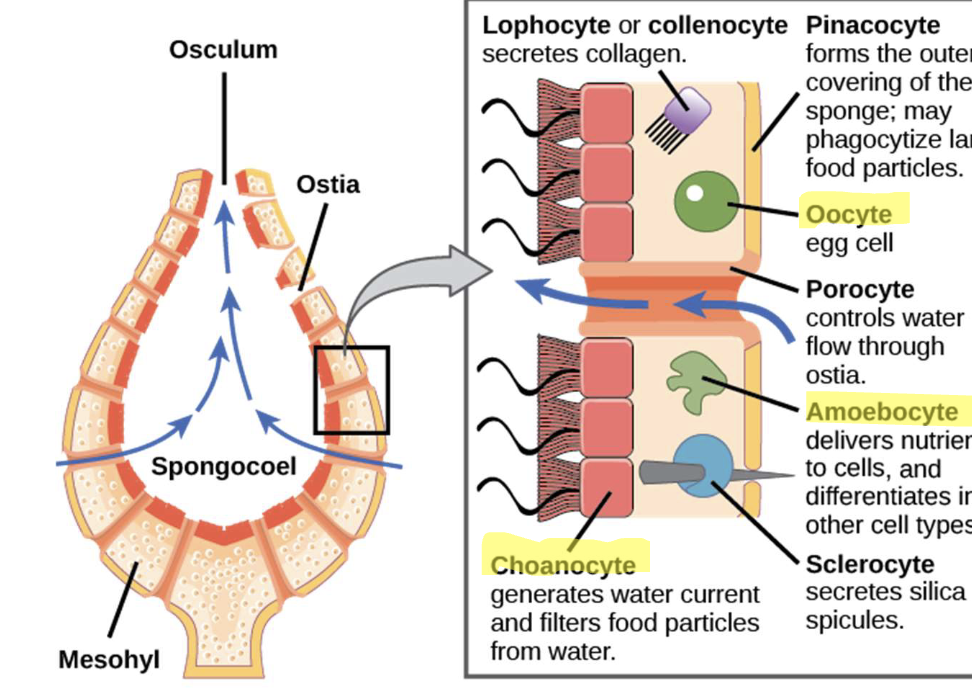
Multicellular, no distinct embryonic cell layers, lack tissues and organs — replaced by 6 specialized cells
Collagen (a protein) and spicules helps hold cells together and provide
support
Filter feeders; choanocytes move water through pores (ostia) through central atrium (spongocoel) and out through the osculum.
What does sexual reproduction look like for sponges? Define choanocytes and amoebocytes.
Sexual reproduction: oocytes produce eggs and choanocytes (some) transform into sperm
choanocytes generate water current and filters food particles from water
amoebocytes delivers nutrients to cells and differentiates into other cell types