Ecology/Evolution 2
 Studied by 0 people
 Call Kai
 Learn
Learn Practice Test
 Spaced Repetition
 Match
Match Flashcards
 Knowt Play
1/78

There's no tags or description
Looks like no tags are added yet.
Name | Mastery | Learn | Test | Matching | Spaced | Call with Kai |
|---|
No analytics yet
Send a link to your students to track their progress
79 Terms
Species concept
The criteria that determine what constitutes a "good species"
About 2 million species have been described, but there are more estimated.
Why is there uncertainty about the number of species?
1) Many groups are poorly studied (notably microorganisms and parasites)
2) Many environments are poorly sampled (tropical environments)
3) Molecular approaches are identifying more and more cryptic species
Cryptic species
Species that are indistinguishable from another at the morphological level, but distinguishable genetically
Morphological species concept
a group of individuals that differ from other groups by possessing constant diagnostic characteristics. Based on collecting and describing a type specimen for a given species.
Pros: applicable to living and extinct organisms and to organisms no matter their reproductive mechanism
Cons: Inconsistent and not always practical (ex: cryptic species or polymorphism b/w sex)
Biological species concept
Groups of potentially interbreeding natural populations which are reproductively isolated from other such groups. Widely accepted and used.
Pros: embraces the idea of lack of gene flow
Cons: extinct, asexual, hybrid species cannot be studied
Phylogenetic species concept
Species are the smallest groups that can be distinguished as sharing a common ancestor and by their unique, derived, characteristics.
Pros: widely applicable (asexual, fossils) clearly evolutionary
Cons: not practical and could double the number of species
Process of speciation
1) Geographic isolation of populations
2) Divergence in traits
3) Reproductive isolation
Vicariance event
Formation of mountain ranges, changes in climate that alter habitat(new rivers, drying rivers, etc.) and split populations
Isolation
colonization, dispersal, vicariance events, geographical isolation (patric)
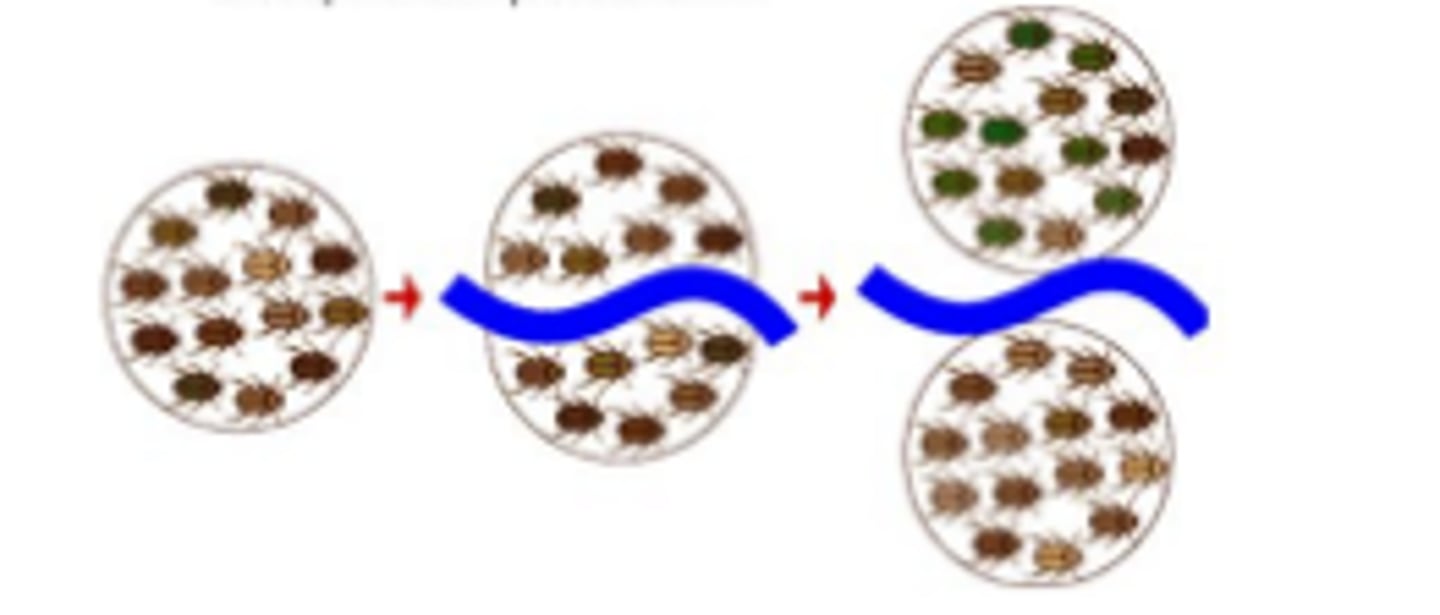
Allopatric
allo=other. Geographically isolated populations
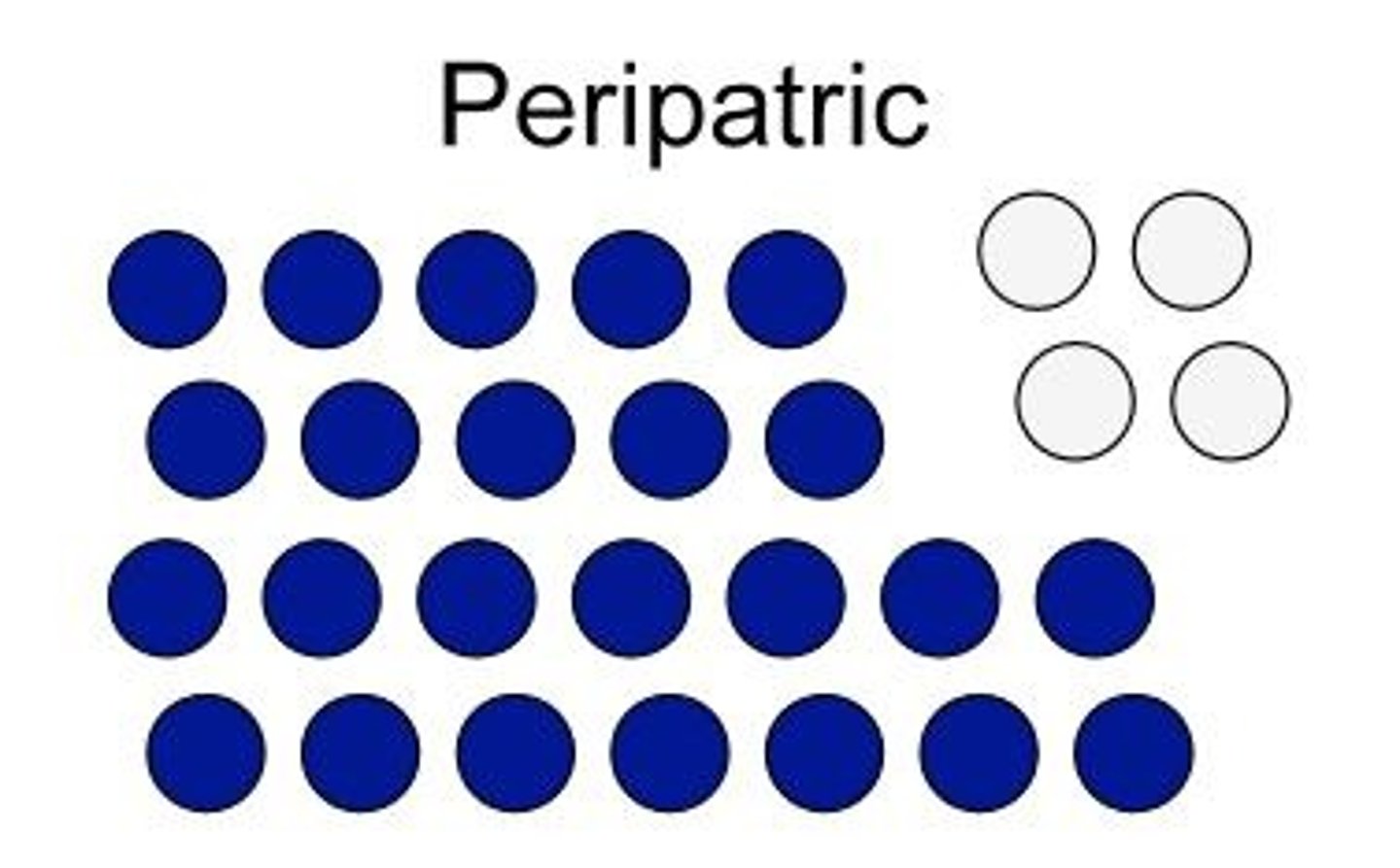
Peripatric
peri=near. A small population isolated at the edge of a larger population
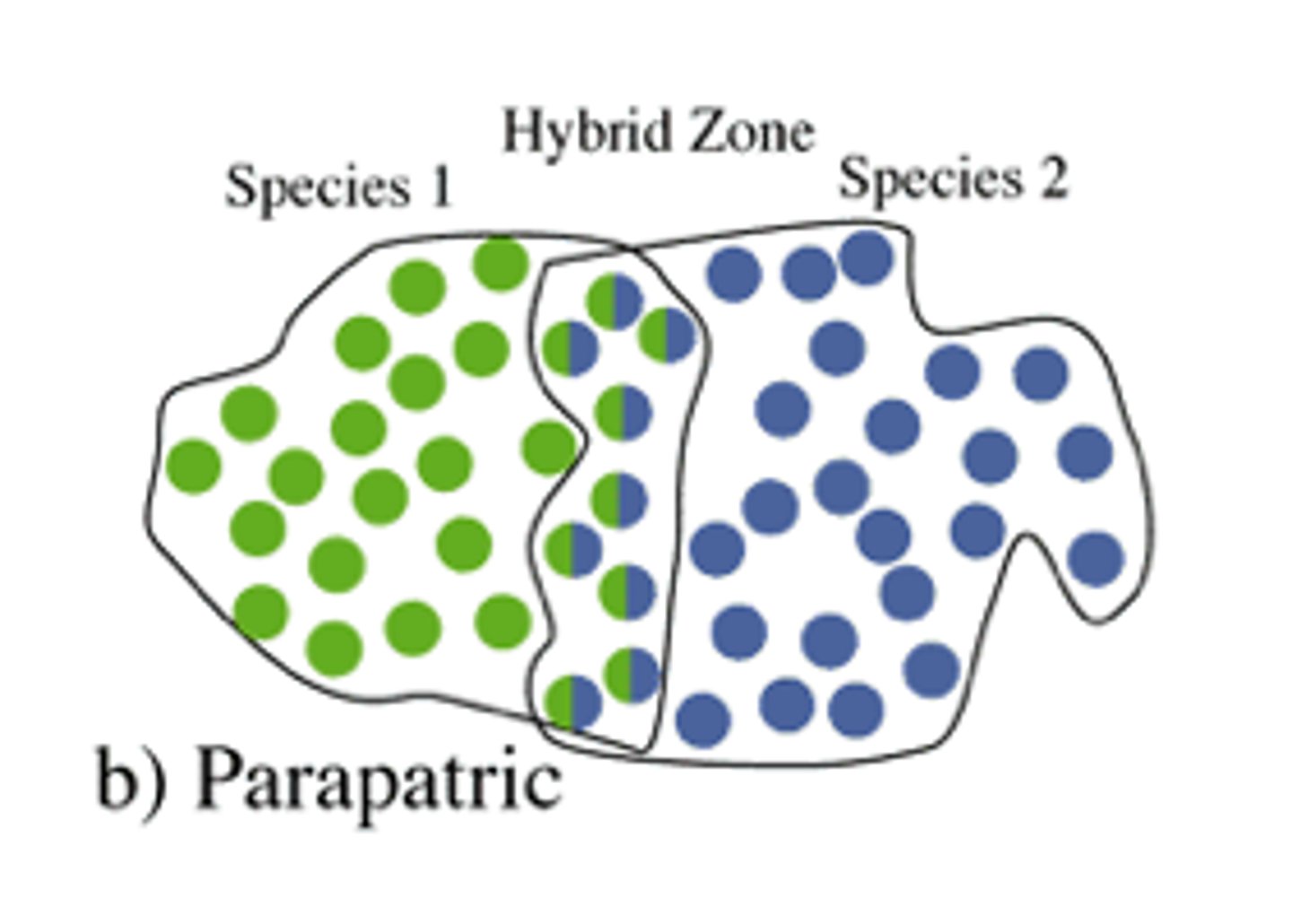
Parapatric
para=beside. A continuously distributed population. (ex: an elevational or latitudinal cline)
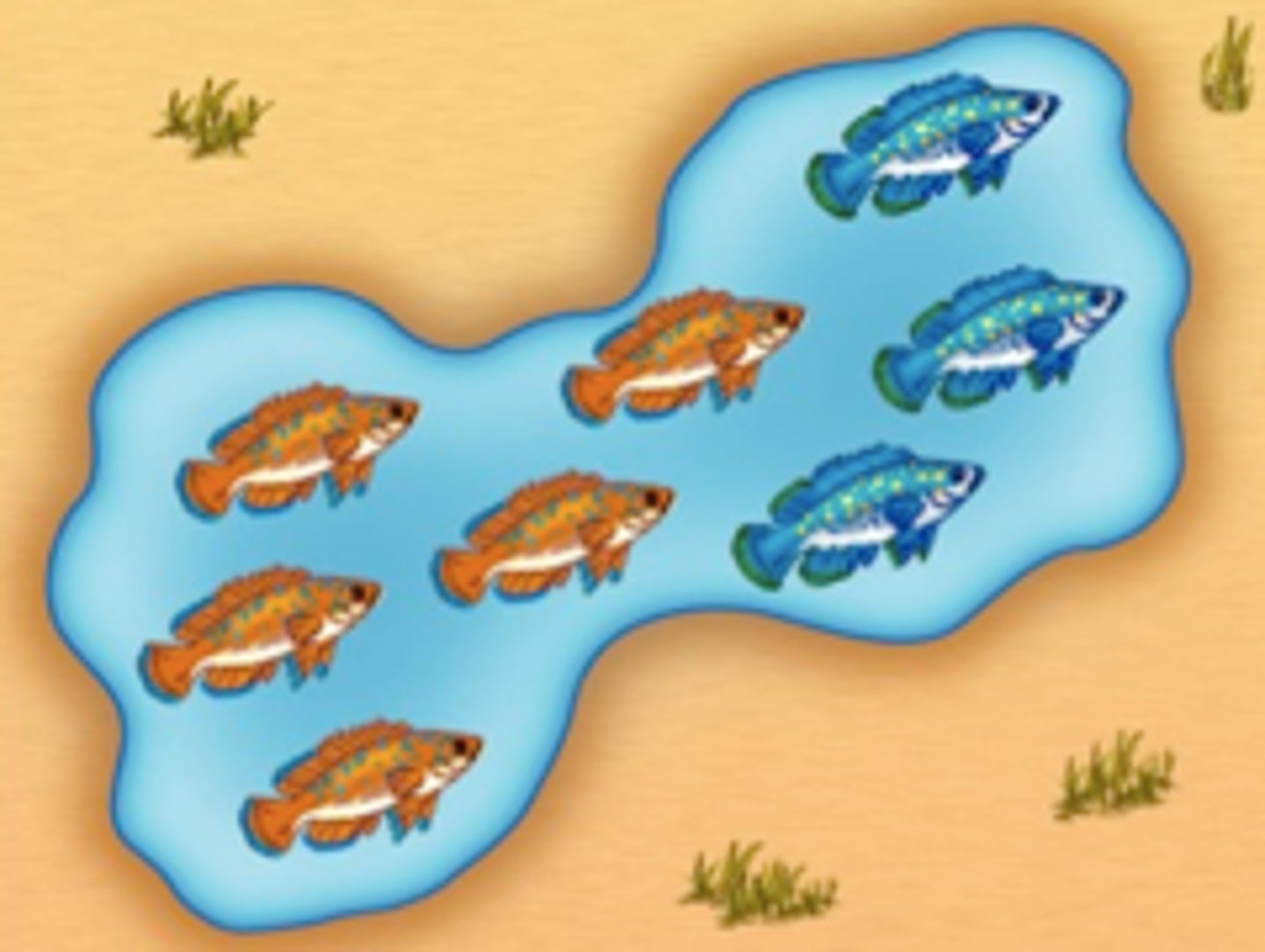
Sympatric
sym=same. Within the range of the ancestral population (ex: temporal isolation, sub-habitat isolation, polyploidy)
Divergence
genetic drift, natural selection
Post-zygotic isolation
hybrids are infertile, inviable, or generally less fit
Pre-zygotic isolation
mechanisms that keep individuals from the two incipient species from mating in the first place
What happens when incipient species come into contact? (Prezygotic reinforcement)
If hybrids have lower fitness that either parental population, then natural selection would favor mechanisms that prevent matings between the different parental types
Adaptive radiations
the spreading of populations into different environments accompanied by divergent adaptive changes of the populations. Occurs when a population finds itself in an environment free of competition
Macroevolution
The processes that result in the formation of different species (speciation); the generation of the diversity of life. These processes follow from the microevolutionary processes. And, the inevitable result is that life also has a history
Anagenesis
The evolution of a trait within the population has not resulted in a split in the population, rather over time, one form has just gradually replaced another
Cladogenesis
This colonization event has split the original ancestral population into two descendant populations and the potential for speciation is now there
Phylogeny/Phylogenetic tree
From greek "phyle" meaning "tribe" and "geneia" meaning "origin" Evolutionary relationships among species represented conceptually as trees
Taxonomic classification
the organization and naming of organisms into groups(taxa). It doesnt have to be based on evolutionary relationships
(Kingon, phylum, class, order, family, genus, species)
Phylogenetic systematics
the process of determining evolutionary relationships and the basis for phylogenetic classification
Tips on an evolutionary tree
groups, such as species or higher level taxa
Nodes on an evolutionary tree
common ancestors
Branches of an evolutionary tree
between nodes and tips that show the common traits passed down
Monophyletic groups/Sister taxa
groups based on synapomorphies. contains organisms descended from a common ancestor and that common ancestor (ex: mammals). An ancestor and all of its descendants
Synapomorphy
shared, derived traits
Goal of phylogenetics
to construct trees that reflect true monophyletic groups
Paraphyletic
an ancestor and only some of its descendants (ex: foxes with respect to dogs, wolves, etc.)
Polyphyletic
a group that doesn't include the common ancestor and all descendants
Declaration of an outgroup
allows us to determine the ancestral states of the characters for the root of the part of the tree we need to resolve
Ecology
the scientific study of the relationships between organisms and their environment. Included both biotic and abiotic factors
Population
a group of individuals of the same species with a particular spatio-temporal location. Where evoultion occurs
Populations are described in terms of
1) Dispersion
2) Distribution/geographical ranges
3) Size (number of individuals)
4) Density
5) Age structure
6) Demography (changes in abundance, density)
Capture-mark-release-recapture (Lincoln Index)
Used to estimate population size.
1) Our desired but unknown population parameter is N
2) #of individuals captured, marked, and released the first time= nm1
3) #of individuals captured second time that are already marked =nm2
4) #of individuals captured second time=n2
nm1/N=nm2/n2
or
N=(nm1 x n2)/nm2
Mark-recapture assumptions
1) The marking will not harm the individual
2) The marking will not make it more susceptible to predation
3) The marking will not make it more susceptible to being recaptured
4) The marking will cause it to learn and avoid recapture
Population age structure
proportions of individuals in each age class. How fast a population grows depends on this
Life table
a classic tool for evaluating the behavior of age structured populations. Basic data required are age specific survivorship and reproduction
x (life table)
age
Nx (life table)
number of individuals alive of age x
lx (life table)
Nx/N0
survivorship; proportion of original cohort surviving
Lx (life table)
(Nx + Nx+1)/2
average # of individuals alive in the age interval x to x+1
Tx (life table)
sum of all subsequent Lx
total organism years to be lived by all in age x
ex (life table)
Tx/Nx
average further life expectancy at age x
bx (life table)
number of offspring born to females of age x
mx (life table)
bx/Nx
age specific birth rate. The average number of female offspring born to a female alive in age class x
R0 (life table)
the sum of all lxmx
net reproductive rate. The mean number of female offspring per female over her lifetime
R0=1: Replacement
R0>1: Population is growing
R0<1: population is shrinking
T (life table)
the sum of lxmx/Ro
Generation time: average time from birth of a female until the birth of her daughters
Model of geometric population growth
Nt = lambda^t(N0)
The size of a population in the future (Nt) depends on where the population starts (N0), how fast is growing (lambda) and how long its growing (t).
The finite rate of increase
lambda
discrete generations
growth compounding at constant intervals
1
The model of population growth is unrealistic
It would assume that there are periods when no individuals are reproducing and this in turn means that population growth is being compounded at each time interval
But in may organisms, generations overlap and at any given time, at least some individuals are reproducing
b and d
b= # of births per individual per unit of time
d= instantaneous death rate
This means the actual number of births (and deaths) over any given time period will be due to the number of births per individual per unit time and the number of individuals there are to have those births (and deaths).
bN > dN: population is growing
bN = dN: stable
bN < dN: shrinking
r (The exponential population growth model)
the intrinsic growth rate
Population change= rN
r=(b-d)N
continuous generations
0
ln(lambda)
Nt=N0^e^rt (integrated)
The size of a population in the future (Nt) depends on where the population starts (N0), how fast it's growing (r) and how long it's growing (t).
Density independent
assumes that b and d do not change as the population gets larger
Density dependent
(more realistic) assumes b declines with growing N and d increases with growing N
k
carrying capacity: the population size where growth is zero
Logistic population growth
If N is very small then growth=rN(1-(N/K)) is almost just rN
1)Populations above K will decrease to K
2)Changes in K will determine where the population levels off
3)Changes in r will determine how quickly the population reaches K
4)The population is growing the fastest at N = K/2
Other evolutionary mechanisms important in shaping populations
movement, immigration, emigration
r= b + i -d - e
Metapopulations
populations of populations tied together by movement.
Populations may experience occasional local extinction (via demographic stochasticity) but may be saved or recolonized by movement from another population.
Life cycles
series of stages that individuals go through in their life
Life history
the combination of development and growth, the life span, and the timing and quantity of reproduction
Life history strategies are...
1) Characterized by sex and death
2) Evolutionary responses to many factors including physical conditions, food supply, predators, and competition
3) Not deliberate and are the evolved responses to what provides the highest fitness given the ecological conditions of the organisms
Maturity
age at first reproduction
Parity
number of reproductive episodes
Fecundity
number/size of offspring per reproductive episode
Aging
total length of life
Principle of allocation (trade offs)
organisms only have so much energy to devote to maintenance, growth, and reproduction. Thus, allocating energy to one area means less for another
Darwinian Demon
1) Matures instantly at a large size
2) Has many offspring that are also large and require no parental care
3) Does not age and keeps reproducing
Semelparity
One shot reproduction
Iteoparity
multiple reproductive bouts in a life time
R selected species (Rabbit)
generally known as colonizers as they can capitalize on habitat space made available by disturbance. They can colonize the area rapidly due to their high growth rates.
Short lifespan, short maturation time, many offspring, one reproductive bout, small offspring, little parental care
K selected species (Kangaroo)
known as competitors as they can persist in stable environments by surviving and out competing other species, but are limited by their carrying capacities
Long lifespan, long maturation time, few offspring, several reproductive bouts, large offspring, extensive parental care.
Incipient species
populations that will eventually become different species. If they come together and cannot reproduce, they are different species
What prevents reproduction?
1) incompatibility in fertilization
2) Problems in development
3) cannot physically mate
4) Sexual selection may have changed
5) Offspring are infertile
6) Offspring are maladapted
Parsimonious
The least complicated explanation, limiting ecological steps
Sessile
Populations that don't really move
 Note
Note  Flashcards (64)