biodiversity of vertebrates midterm
 View linked note
 Call Kai
 Learn
Learn Practice Test
 Spaced Repetition
 Match
Match Flashcards
 Knowt Play
1/184

Earn XP
Name | Mastery | Learn | Test | Matching | Spaced | Call with Kai | Chat |
|---|
No analytics yet
Send a link to your students to track their progress
185 Terms
Evolution
The process by which living organisms have changed and diversified over time through genetic variation, heredity, and natural selection.
Variation
Differences in traits within a population that arise from genetic mutations, recombination, and gene flow.
Heredity
The transmission of traits from one generation to the next through genetic information passed from parents to offspring.
Natural selection
The process by which certain traits become more or less common in a population over successive generations due to the survival and reproductive success of individuals with well-suited traits.
Adaptation
The process by which populations become better suited to their environment over time through natural selection acting on advantageous variations.
Speciation
The formation of new species through reproductive isolation and genetic divergence.
Extinction
The complete disappearance of a species due to environmental changes, competition, predation, or the inability to adapt to new conditions.
Phylogenetics
The study of evolutionary relationships between different species or groups of organisms through the construction of phylogenetic trees.
Common ancestry
The concept that all living organisms share a common origin, represented by the branching patterns in phylogenetic trees.
Taxonomic units
Organisms organized into taxonomic units, such as species, genera, families, etc., represented as nodes or branches on a phylogenetic tree.
Nodes and branches
Nodes represent common ancestors, where branches split apart, and each node represents a hypothetical common ancestor.
Branch lengths
The lengths of branches in a phylogenetic tree represent factors such as time or genetic divergence.
Homologous traits
Shared characteristics inherited from a common ancestor and used in constructing phylogenetic trees.
Cladistics
A method used to construct phylogenetic trees based on shared derived traits and identifying the most recent common ancestor for each group.
Skeletal system
The framework of structures made of bones and cartilage that support and protect the body.
Axial skeleton parts
Includes the skull, vertebrae, ribs, and sternum.
Appendicular skeleton parts
Includes the fore and hind limbs.
Classification of bones
Short bone, flat bone, irregular bone, sesamoid, and long bone.
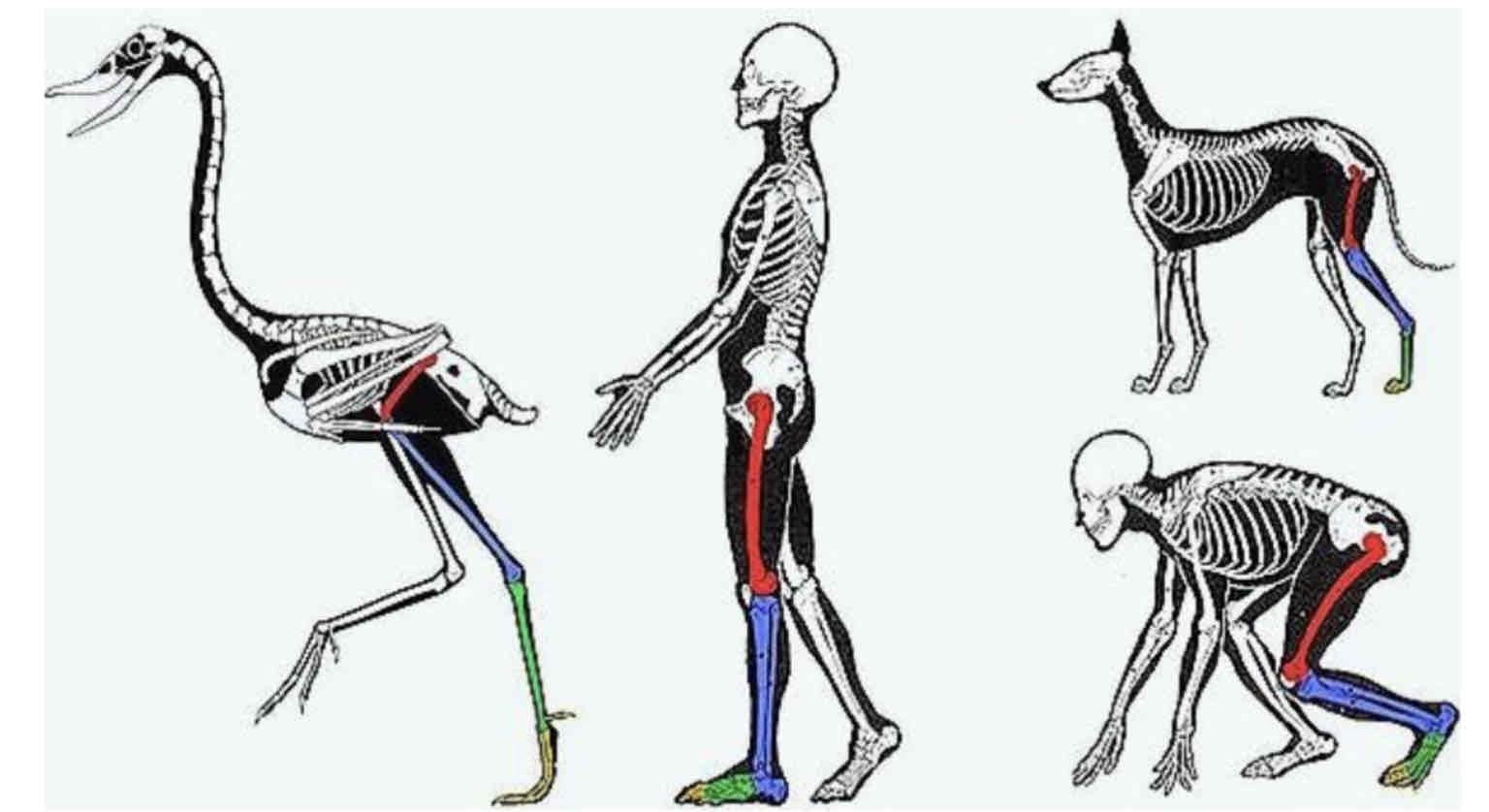
Appendicular forelimb
Scapula, clavicle, humerus, ulna, radius, carpus, metacarpals.
Appendicular hindlimb
Pelvis, femur, patella, tibia, fibula, tarsus, metatarsal.
Types of muscle
Skeletal muscle, cardiac muscle, smooth muscle.
Muscle movement
Agonist, antagonist, abduction, adduction, flexion, and extension.
Description/function of muscles
Masseter, trapezius, latissimus dorsi, abdominal obliques, gluteals, biceps femoris, biceps brachii, triceps brachii, pectorals, serratus ventralis.
Functions of the nervous system
Detects and processes information, formulates responses, and coordinates and controls bodily activity.
Parts of a neuron
Cell body, dendrite, axon, synapse, myelin.
Types of neurons
Sensory neurons, connecting neurons, motor neurons.
Central nervous system
Consists of the brain and spinal cord.
Parts of the Brain
Meninges, cerebrum, cerebellum, brainstem, medulla oblongata, thalamus, hypothalamus, pituitary gland.
Spinal cord
Pathway for all impulses going to and from the brain, connects to the medulla oblongata.
Alveoli
Grape-like clusters at ends of bronchioles where exchange of oxygen and carbon dioxide gases occur.
Bronchi
Paired terminal branches of the trachea contained within the lungs.
Bronchioles
Smallest branches of the bronchial tree.
Cilia
Tiny hairs inside nostrils that help to filter air.
Diaphragm
Muscle located below the lungs; contraction causes the lungs to draw in a breath.
Epiglottis
Flap that covers the larynx during swallowing.
Exhalation
Release of a breath.
Inhalation
Drawing in of a breath.
Lungs
Paired major organs of respiration that contain bronchi and are divided into clearly defined lobes.
Mucous membrane
Lining of respiratory tract that secretes mucus.
Mucus
Slimy secretion that warms, moistens, and filters air.
Pharynx
Common passageway for both the respiratory and digestive systems.
Respiration
Exchange of oxygen and carbon dioxide gases with cells.
Trachea
Windpipe; has distinct rings of cartilage.
Notochord
Flexible, rod-like structure found along the length of the body in chordates; provides support and serves as an axis for muscle attachment.
Dorsal Hollow Nerve Cord
Dorsal nerve cord that runs along the back of chordates; develops into the central nervous system.
Pharyngeal Slits or Pouches
Slits or pouches in the pharyngeal region of chordates; serve functions such as filter-feeding or gas exchange.
Post-Anal Tail
Tail extending beyond the anus in chordates; plays various roles such as propulsion for swimming or balance.
Endostyle
Specialized organ found in certain chordates and precursor to the thyroid gland.
Phylogeny
Evolutionary history and relationships among vertebrates that possess a backbone or vertebral column.
Agnatha
Earliest vertebrates that were jawless fishes such as lampreys.
Chondrichthyes
Cartilaginous fishes such as sharks and rays.
Osteichthyes
Bony fishes, the most diverse group of vertebrates.
Tetrapods
Vertebrates with four limbs or their descendants.
Lissamphibia
Amphibians such as frogs, toads, and salamanders.
Amniota
Tetrapods that have evolved specialized adaptations for reproduction on land.
Reptilia
Reptiles including turtles, snakes, lizards, crocodilians, and birds.
Mammals
Amniotes characterized by mammary glands for milk production and hair or fur for insulation.
Cells
Smallest unit of the body that requires oxygen and nutrients from the blood.
Tissue
Collection of cells that all do the same function.
Organ
Collection of different tissues that work together.
Organ system
Organ and everything that is related to that organ.
Organism
Sum of all the organ systems in the body.
Cardiac and circulatory system
Heart, arteries, veins, bone marrow.
Hepatic system
Liver, gall bladder, bile duct.
Respiratory system
Lungs, trachea, bronchioles.
Renal system
Kidneys, ureter, bladder.
Gonadal system
Ovaries/testes, uterus/penis.
Gastrointestinal system
Esophagus, stomach, intestines, pancreas.
Immunological system parts
Spleen, thymus, lymph nodes, appendix.
Dermal system
Epidermis, hypodermis, endodermis.
Muscular-skeletal system
Bones, cartilage, joints, muscles, tendons.
Endocrine system
Hypothalamus, thyroid, adrenals, gonads.
Nervous system
Brain, spinal cord, nerves.
Integumentary system
Skin, hair, nails, sweat glands, oil glands.
Skeletal system
Bones, cartilage, ligaments.
Types of muscles
Skeletal muscles, smooth muscles, cardiac muscle.
Nervous system
Brain, spinal cord, nerves, sensory organs.
Endocrine system
Glands (e.g., pituitary, thyroid, adrenal), hormones.
Cardiovascular system
Heart, blood vessels, blood.
Respiratory system
Lungs, trachea, bronchi, diaphragm.
Digestive system
Mouth, esophagus, stomach, intestines, liver, pancreas.
Urinary system
Kidneys, ureters, bladder, urethra, cloaca.
Reproductive system
Male - testes, penis, accessory glands; Female - ovaries, uterus, fallopian tubes, vagina.
Cranial Skeleton
Cranium, jaws, and dentition.
Jaws and Dentition
The adaptations of jaws and teeth in vertebrate evolution, including movable jaws and diverse tooth shapes, sizes, and functions for different diets.
Sensory Structures
The various sensory structures in the cranial skeleton of vertebrates, such as the eyes, ears, and olfactory organs, which enhance sensory perception and environmental interaction.
Axial Skeleton
The vertebral column and ribs, providing support, flexibility, and protection for the spinal cord and internal organs, with variations in number, shape, and attachment reflecting locomotor and respiratory adaptations.
Locomotor Adaptations
Adaptations in the axial skeleton for different modes of movement, such as elongated vertebral column and limb reduction in snakes, fused neck vertebrae in birds, and limb girdles and limbs in tetrapods.
Postural Adaptations
The role of the axial skeleton in maintaining posture, with adaptations like curved vertebrae in primates for upright posture and specialized vertebrae in fish for buoyancy control.
Agnathans (Jawless Fish)
The cranial and axial skeleton adaptations in jawless fish, including a simple cranial skeleton and a segmented and flexible vertebral column made of cartilage.
Chondrichthyes (Cartilaginous Fish)
The cranial and axial skeleton adaptations in cartilaginous fish, including a well-developed and mineralized cranial skeleton with highly mobile jaws and a cartilaginous vertebral column providing stability and flexibility.
Osteichthyes (Bony Fish)
The cranial and axial skeleton adaptations in bony fish, including a well-developed and mineralized cranial skeleton with jaws and teeth specialized for specific diets, and a mineralized vertebral column providing support and flexibility.
Lissamphibia (Amphibians)
The cranial and axial skeleton adaptations in amphibians, including a skull composed of both bone and cartilage with jaws, and a vertebral column with varying degrees of mineralization and numerous vertebrae for flexibility in aquatic and terrestrial locomotion.
Testudines (Turtles)
The cranial and axial skeleton adaptations in turtles, including a highly modified cranial skeleton with a bony shell, and a highly modified axial skeleton fused to the shell for support and protection.
Lepidosauria (Lizards and Snakes)
The cranial and axial skeleton adaptations in lizards and snakes, including a cranial skeleton composed of bone with well-developed jaws, and a flexible vertebral column with elongated bodies and tails for agility and serpentine locomotion.
Aves (Birds)
The cranial and axial skeleton adaptations in birds, including a lightweight cranial skeleton with fused bones and beaks specialized for feeding, and a rigid and highly modified axial skeleton for flight with specialized vertebrae and a keeled sternum.
Mammals
The cranial and axial skeleton adaptations in mammals, including diverse cranial adaptations reflecting ecological niches and feeding strategies, and a highly specialized axial skeleton with distinct regions, well-developed ribs, and a sternum for mobility, protection, and respiration.
Restraint
Use of mechanical or chemical means to limit an animals movement.
General Principles of Restraint
Principles of handling and restraint for the well-being of wildlife, including minimizing stress, injury risks, and mortality rates during capture, restraint, and handling.
Appendicular skeleton
The bones and structures associated with the limbs in vertebrates, which have undergone modifications and adaptations for different locomotor behaviors, habitats, and functional requirements.