Mitosis and DNA Replication
 Call Kai
 Learn
Learn Practice Test
 Spaced Repetition
 Match
Match Flashcards
 Knowt Play
1/25

Name | Mastery | Learn | Test | Matching | Spaced | Call with Kai | Chat |
|---|
No analytics yet
Send a link to your students to track their progress
26 Terms
DNA helicase
A protein that unwinds DNA and breaks the hydrogen bonds between the two strands.
DNA ligase
An enzyme involved in sealing gaps in the sugar-phosphate backbone of DNA by catalyzing the formation of a phosphodiester bond.
DNA polymerase
An enzyme that adds corresponding DNA nucleotides.
replication fork
During DNA replication, the region where the double helix becomes separated by DNA helicase
semi-conservative model
The model of DNA replication where each of the two daughter DNA molecules contains one old strand of DNA and one newly synthesized strand of DNA.
single-strand DNA-binding (SSB) proteins
A stabilizing protein involved in DNA replication that prevents the separated DNA strands from re-joining or re-coiling during the replication process.
Phases of cell cycle
Mitosis is conventionally divided into five phases:
• Prophase
• Prometaphase
• Metaphase
• Anaphase
• Telophase
• Cytokinesis is well underway by late telophase
Interphase (about 90% of the cell cycle) can be divided into subphases:
• G1 phase ('first gap')
• S phase ('synthesis')
• G2 phase ('second gap')
• The cell grows during all three phases
M Phase
also known as Mitosis
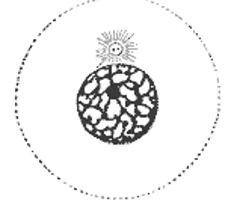
Interphase stages: G1
Creating enzymes for DNA Replication
cellular content duplicates (organelles etc), chromosomes do not duplicate
Interphase stages: S
DNA replication
chromosome duplication (23 pairs)
Interphase stages: G2
cell creates microtubles
rapid cell growth
prepares for mitosis
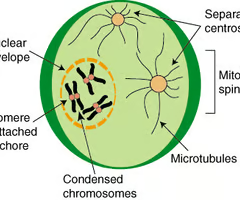
Prophase
DNA condenses to form chromosomes
microtubules move to opposite sides
nuclear envelop dissolves
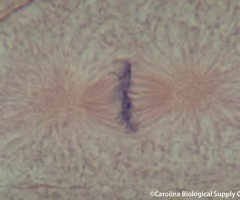
Metaphase
chromosomes line up in middle (metaphase plate)
kinetochores of sister chromatids attach to kinetochore microtubules from opposite poles
Anaphase
the two sister chromatids of each chromosome pair move apart to opposite ends of the cell
Telophase
two daughter nuclei form in cell
nuclear envelopes reform
chromosomes less condensed
one nucleus becomes two (mitosis complete)
Cytokinesis
formation of cleavage furrow
cell divides and separates in two daughter cells
malignant tumor
An abnormal tissue mass that can spread into neighboring tissue and to other parts of the body; a cancerous tumor
benign tumor
An abnormal mass of cells that remains at its original site in the body.
cancer
A disease in which some body cells grow and divide uncontrollably, damaging the parts of the body around them
diploid cell (2n)
A cell that has two sets of chromosomes.
Interphase (pic)
Prophase (pic)
Metaphase (pic)
Anaphase (pic)
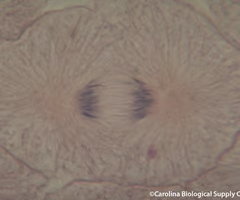
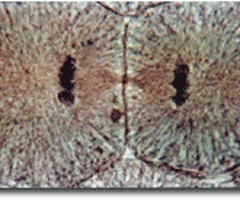
Telophase (pic)