Unit 6 review (monday)
0.0(0)
Studied by 0 people Call Kai
 Learn
Learn Practice Test
 Spaced Repetition
 Match
Match Flashcards
 Knowt Play
Card Sorting
1/38

Earn XP
Description and Tags
Last updated 9:56 PM on 10/27/22
Name | Mastery | Learn | Test | Matching | Spaced | Call with Kai | Chat |
|---|
No analytics yet
Send a link to your students to track their progress
39 Terms
1
New cards
thermodynamics
the study of energy and its transformations
2
New cards
thermochemistry
the study of the relation between chemical reactions and changes in energy
3
New cards
thermochemical equation
balanced stoichiometric chemical equation that includes the enthalpy change, ΔH
4
New cards
thermochemical equilibrium
temp is uniform throughout a material and no energy flows from one point to another
5
New cards
energy
the capacity to do work (potential energy, kinetic, internal, heat [transfer], work [transfer], chemical, thermal, enthalpy)
6
New cards
Law of Conservation of Energy
Energy can't be created or destroyed, just evolved or transferred (potential --> kinetic; chemical --> thermal)
7
New cards
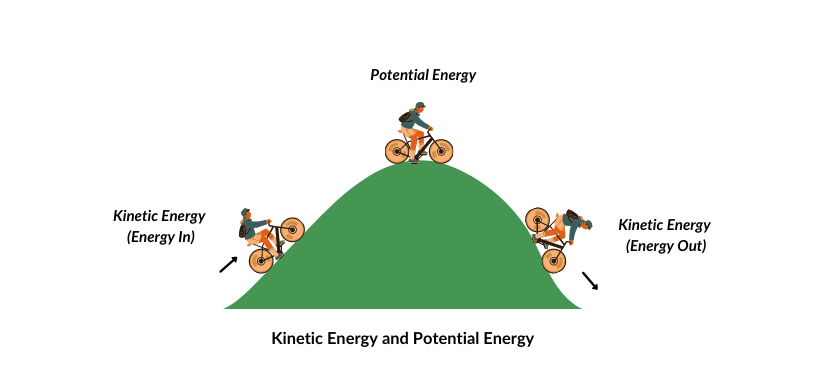
potential energy
dur to position or composition
PE = m*g*h
m = mass
g = acceleration due to gravity
h = vertical distance
PE = m*g*h
m = mass
g = acceleration due to gravity
h = vertical distance
8
New cards
kinetic energy
due to motion of the object
KE = 1/2 mu^2
m = mass
u = velocity
KE = 1/2 mu^2
m = mass
u = velocity
9
New cards
Total energy
Etotal = PE + KE
OR
mgh + 1/2 mu^2
OR
mgh + 1/2 mu^2
10
New cards
state function
depends only on the difference between initial and final state of the system
11
New cards
Potential energy at the molecular level
molecular compounds have covalent bonds form when electrons are shared by the overlapping of orbitals
- as the 2 atoms move closer together, the energy stored within the bond increases
- as the 2 atoms move closer together, the energy stored within the bond increases
12
New cards
Energy of chemical reactions
the potential energy from reactants to products indicates whether energy is gained or lost
- P2 + O2 = P4O10 + energy (energy released, exo)
- energy + Ba(OH)2 +2NH4Cl = BaCla2 +2NH4OH (energy absorbed, endo)
- P2 + O2 = P4O10 + energy (energy released, exo)
- energy + Ba(OH)2 +2NH4Cl = BaCla2 +2NH4OH (energy absorbed, endo)
13
New cards
Kinetic energy at the molecular level
thermal energy, affected by mass, velocity, and number of particles. as t increases, so does KE!
14
New cards
energy and phase change (absorbed heat)
increases kinetic energy of molecules
melting, evaporating, sublimating
melting, evaporating, sublimating
15
New cards
energy and phase change (released heat)
loss of kinetic energy
freezing, condensing, deposition
freezing, condensing, deposition
16
New cards
exothermic
Energy flows out of a system to surroundings
17
New cards
endothermic
energy flows into system from surroundings
18
New cards
first law of thermodynamics
Law of Conservation of
Energy...so energy gained or lost by a system must
equal the energy lost or gained by surroundings
Energy...so energy gained or lost by a system must
equal the energy lost or gained by surroundings
19
New cards
system
the part of the universe that is the focus of a
thermochemical study (isolated /open/closed)
thermochemical study (isolated /open/closed)
20
New cards
surroundings
everything in the universe that is not
part of the system
part of the system
21
New cards
open system
can exchange matter and energy with surroundings
22
New cards
closed system
can exchange only energy with surroundings, not matter
23
New cards
isolated system
does not exchange matter nor energy with surroundings
24
New cards
internal energy
sum of all KE and PE of all particles making up a substance of the system
-different types of molecular motion contribute to overall internal energy (translational, rotational, vibrational)
-different types of molecular motion contribute to overall internal energy (translational, rotational, vibrational)
25
New cards
change in internal energy
ΔE = Efinal – Einitial
energy gained/lost by system has to be lost/gained by surroundings
energy gained/lost by system has to be lost/gained by surroundings
26
New cards
change in internal energy for a closed system
(only energy exchanged with surroundings)
ΔE = q + w
q = heat
w = work
The magnitude of energy changes between system and surroundings are equal magnitutdes by opposite signs (ΔEsys + ΔEsurr = 0)
ΔE = q + w
q = heat
w = work
The magnitude of energy changes between system and surroundings are equal magnitutdes by opposite signs (ΔEsys + ΔEsurr = 0)
27
New cards
heat
the energy transferred between objects because of a difference in their temperatures
-sooooo.... the heat lost by one object is gained by another
-sooooo.... the heat lost by one object is gained by another
28
New cards
pressure-volume work
if pressure of system stays constant, but the volume changes:
w = -PΔV
for gases, if chemical eq is given...
wgas = -ΔnRT
R = 8.314 J/mol·K
T = K
Δn = ngas,prod – ngas,react
w = -PΔV
for gases, if chemical eq is given...
wgas = -ΔnRT
R = 8.314 J/mol·K
T = K
Δn = ngas,prod – ngas,react
29
New cards
enthalpy (H)
EXTENSIVE PROPERTY of a substance that can be used to obtain the heat absorbed or evolved in a chemical reaction. the sum of the internal energy and the p-v product
H = E + PV
H = E + PV
30
New cards
Change in enthalpy
easier to observe
ΔH = Hfinal - Hinitial
if the conditions maintain constant pressure, for one mol of substance, the heat represents the enthalpy
qP = ΔH
ΔH = ΔE + PΔV
ΔH = Hfinal - Hinitial
if the conditions maintain constant pressure, for one mol of substance, the heat represents the enthalpy
qP = ΔH
ΔH = ΔE + PΔV
31
New cards
q = nΔH
units for heat are kJ, units for change in enthalpy are kJ/mol
32
New cards
ΔH > 0
Endothermic
33
New cards
ΔH < 0
Exothermic
34
New cards
thermochemical equation
chemical equation for a reaction (w phase labels) in which the equation is given a molar interpretation, and the enthalpy of reaction for these molar amounts is written directly after the equation
(ex: ΔH = -91.8 kJ)
(ex: ΔH = -91.8 kJ)
35
New cards
Rules of thermochemical equation manipulation
1)when a chemical equation is reversed, the value of ΔH is reversed in sign
2) when a thermochemical equation is multiplied by any factor, the value of ΔH for the new equation is multiplied by that same factor
2) when a thermochemical equation is multiplied by any factor, the value of ΔH for the new equation is multiplied by that same factor
36
New cards
molar heat capacity (cp)
the heat required to raise the temp of 1 mol of a substance by 1C at constant pressure
- q = ncpΔT
(cp units: J / (mol∙°C)
- q = ncpΔT
(cp units: J / (mol∙°C)
37
New cards
specific heat capacity (cs)
the heat required to raise the temp of 1 gram of a substance by 1C at constant pressure
- q = mcsΔT
(cs = J / (g∙°C)
- q = mcsΔT
(cs = J / (g∙°C)
38
New cards
molar heat of fusion
ΔHfus = heat needed to convert 1 mole of a solid at its melting point to 1 mole of liquid
q = nΔHfus
q = nΔHfus
39
New cards
molar heat of vaporization
ΔHvap = heat needed to cobnvert 1 mole of a liquid at its boiling point to 1 mole of vapor
q = nΔHvap
q = nΔHvap