Bio Ch 2: Properties of Water and Functional Groups
 Studied by 0 people
 Call Kai
 Learn
Learn Practice Test
 Spaced Repetition
 Match
Match Flashcards
 Knowt Play
1/34

Name | Mastery | Learn | Test | Matching | Spaced | Call with Kai |
|---|
No analytics yet
Send a link to your students to track their progress
35 Terms
Water is a universal ____
solvent
Hydrophilic
substances that dissolve easily in water
Hydrophobic
Substances that do not dissolve easily in water
Examples of hydrophilic substances
charged, polar molecules
Examples of hydrophobic substances
nonpolar molecules
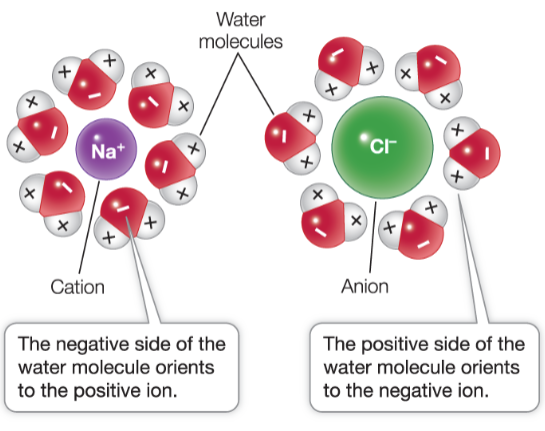
Why do ionic compounds dissolve in water?
The ions become surrounded by water molecules in a hydrogen shell; this does not involve the formation or breaking of covalent bonds
A hydrogen shell surrounding cations and anions:
What is heat capacity/specific heat?
the amount of heat it takes to raise the temperature by one degree Celsius
Why does water have a high specific heat?
Water molecules form multiple hydrogen bonds with each other
What is heat of vaporization?
The amount of heat required to change a substance from a liquid to a gaseous state
Why does water have a high heat of vaporization?
The many hydrogen bonds are broken
What is evaporative cooling?
As water evaporates, heat is removed from the surface of living things
Water in living tissues does what?
reduces temperature fluctuations experienced because of changes in environmental temperature
What is cohesion?
The attraction of water molecules to one another; creates surface tension
What is adhesion?
The attraction of water molecules to different molecules, especially polar molecules
What are functional groups?
small groups of atoms with specific chemical properties
When attached to larger molecules, what do functional groups do?
functional groups give their properties to the larger molecule
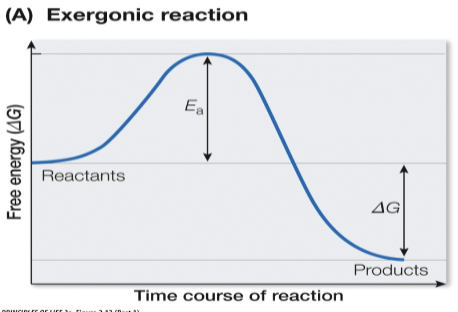
Exergonic Rxn
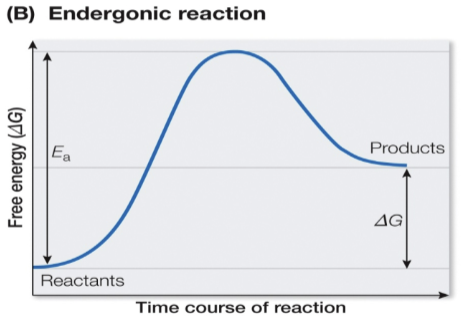
Endergonic Rxn
What helps plants raise water from the roots to the leaves?
cohesion and adhesion
Methyl
Functional group: Methyl
class of compounds and example: Alkyl —> Alanine
Nonpolar, an important modification of proteins and cytosine nucleotide
CH3
Hydroxyl
Functional group: Hydroxyl
class of compounds and example: alcohols —> ethanol
polar, involved in hydrogen bonding. often participates in condensation rxns. required in the side chain for phosphorylation of proteins
OH
Sulfhydryl
Functional group: sulfhydryl
class of compounds and example: thiols —> mercaptothion
polar, can form disulfide bridges to stabilize protein structure
SH
Aldehyde
Functional group: aldehyde
class of compounds and example: aldehydes —> acetaldehyde
polar, very reactive. important in energy-releasing reactions
O=C—H
Polar, very reactive. important in energy-releasing reactions
Keto
Functional group: keto
class of compounds and example: Ketones —> Acetone
polar, important in carbohydrates and in energy reactions
O=C
Carboxyl
functional group: carboxyl
class of compounds and example: carboxylic acids —> acetic acid
charged, acidic, ionizes in living tissues to form —COO- (and H+). reacts with amino group to form peptide bond
O=C—O
Which functional groups are phosphate groups?
Carboxyl, amino, and phosphate
Amino
functional group: amino
class of compounds and example: amines —> methylamine
charged, basic, accepts H+ in living systems to form —NH3+. Reacts with carboxyl group to form peptide bond
H—N—H
phosphate
functional group: phosphate
class of compounds and example: organic phosphates —> 3-phosphoglycerate
charged, acidic, ionizes in living tissues to form —O—P—O32- (and 2 H+). enters into condensation rxns, often with inorganic phosphate, PO43-. when bonded to another phosphate, hydrolysis is strongly exergonic
What is free energy?
the difference in bond energy and the change in entropy that determines whether the total energy change is exergonic or endergonic
Amphipathic
molecules that have both hydrophilic and hydrophobic regions
Most molecules of living things fall into four categories:
carbohydrates
lipids
proteins
nucleic acids
These categories all have carbon backbones (organic chemistry)
Molecular diversity is caused by..
The addition of functional groups —> determine how a molecule interacts with other molecules in the cell, resulting in molecular diversity
All functional groups besides what may be found on the outside of biological molecules?
Methyl
It is nonpolar and would not interact well with the aqueous environment encountered on the outside of biological molecules
What are structural isomers?
compounds that differ in how the atoms and functional groups are joined to one another
They differ because they have the same chemical formula but differ with respect to how the atoms are connected to each other
 Note
Note  Flashcards (26)