LIT
 Note
Note Call Kai
 Learn
Learn Practice Test
 Spaced Repetition
 Match
Match Flashcards
 Knowt Play
1/26

There's no tags or description
Looks like no tags are added yet.
Name | Mastery | Learn | Test | Matching | Spaced | Call with Kai | Chat |
|---|
No analytics yet
Send a link to your students to track their progress
27 Terms
Literary Criticism
The exercise of judgment on works of literature, examining excellencies and defects to evaluate artistic worth.
Importance of Literary Criticism
Helps understand the significance of a text, including its structure, context, and how it affects the reader.
Theory of Forms
Plato's concept that the physical world is dependent on another world of ideas; real-world objects are projections of this ideal world.
Myth of The Cave
Plato’s allegory explaining the Theory of Forms, where people see only shadows of reality rather than the true light.
View of Art (Plato)
Plato believes all art is a copy of reality, and art is twice removed from reality, taking man away from it.
View of Poetry (Plato)
Poets are seen as imitators of imitation and are accused of several faults, including corrupting character.
Accusations Against Poetry (Plato)
Falsity of claims, 2. Appeals to inferior mind, 3. Corrupts character, 4. A form of madness.
Aristotle
A student of Plato who viewed reality within our world and contributed significantly to literary criticism through 'The Poetics'.
The history of Western thought; two main ideas:
- The idealistic Platonic vision : views reality as above and beyond our own world
- Empirical Aristotelian view: which seeks find the reality within our world
Aristotle’s major contribution to literary criticism is
The Poetics
View of Poetry (Aristotle)
Contrarily to Plato, Aristotle sees poetry as having a positive moral and social function in the political state.
Theory of Imitation (Aristotle)
Like plato, Aristotle Believes that poetry is essentially form of
imitation which has a positive role in society. Why? because he sees imitation as a basic human instinct and essential for poetry
Theory of Action (Aristotle)
Aristotle states that action can be represented through narration or dramatic representation.

View of Tragedy (Aristotle)
Defines tragedy as an imitation of a serious action, with the plot being the most important element. The plot is described as “the soul of the tragedy”
Horace's View of Poetry
Believed poetry should teach and delight, and is a craft that requires labor, and that poetry is a painting
Horace’s most influential work remains
Ars Poetica
Decorum (Horace)
The proper relationship between form and content in poetry, ensuring expressiveness in alignment with subject matter.
Theory of Imitation (Horace)

Longinus's The Sublime
Describes a greatness in language that elevates ordinary expression, producing long-lasting effects.
Renaissance
The rebirth of classical values, ethics, and styles of Greece and Rome, emphasizing imitation of earlier writers.
Theory of Imitation (Renaissance)
the imitation of other writers
Sidney's Apologie for Poetrie
written as a defense of poetry against a Puritan attack on poetry entitled The School of Abuse by Stephen Gosson.
Neoclassicism
Movement in literature and art from the 17th century until around 1750, returning to classical models and values.
The charges of made by Stephen Gosson against Sidney’s apolgie for poetry are

Neoclassical Imitation
Refers to imitation of the external world and classical models, emphasizing objectivity and impersonality.
Essay of Dramatic Poesy includes four main debates, concerning:
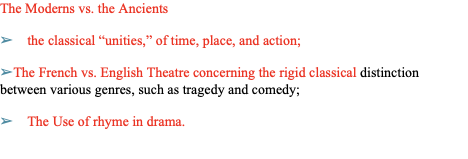
John Dryden
Known as the 'father of English criticism,' he wrote the 'Essay of Dramatic Poesy,' debating various elements of drama.