LIT
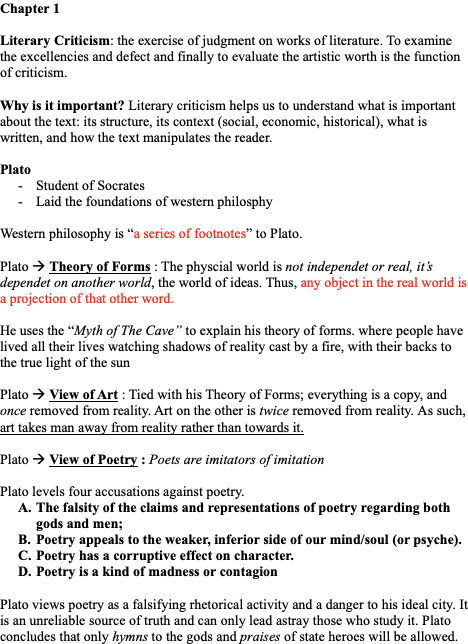
Chapter 1
Literary Criticism: the exercise of judgment on works of literature. To examine the excellencies and defect and finally to evaluate the artistic worth is the function of criticism.
Why is it important? Literary criticism helps us to understand what is important about the text: its structure, its context (social, economic, historical), what is written, and how the text manipulates the reader.
Plato
- Student of Socrates
- Laid the foundations of western philosphy
Western philosophy is “a series of footnotes” to Plato.
Plato Theory of Forms : The physcial world is not independet or real, it’s dependet on another world, the world of ideas. Thus, any object in the real world is a projection of that other word.
He uses the “Myth of The Cave” to explain his theory of forms. where people have lived all their lives watching shadows of reality cast by a fire, with their backs to the true light of the sun
Plato View of Art : Tied with his Theory of Forms; everything is a copy, and once removed from reality. Art on the other is twice removed from reality. As such, art takes man away from reality rather than towards it.
Plato View of Poetry : Poets are imitators of imitation
Plato levels four accusations against poetry.
A. The falsity of the claims and representations of poetry regarding both gods and men;
B. Poetry appeals to the weaker, inferior side of our mind/soul (or psyche).
C. Poetry has a corruptive effect on character.
D. Poetry is a kind of madness or contagion
Plato views poetry as a falsifying rhetorical activity and a danger to his ideal city. It is an unreliable source of truth and can only lead astray those who study it. Plato concludes that only hymns to the gods and praises of state heroes will be allowed.
Chapter 2
Aristotle
- A student of Plato
- Served as Alexander the great’s tutor
The history of Western thought; two main ideas:
- The idealistic Platonic vision: views reality as above and beyond our own world
- Empirical Aristotelian view: which seeks find the reality within our world
Aristotle’s major contribution to literary criticism is The Poetics.
Aristotle View of Poetry
In contrast with Plato, Aristotle sees poetry as having a positive function in the political state. He viewed poetry as having a moral and social function.
Aristotle Theory of Imitation : Like Plato, Aristotle holds that poetry is essentially a mode of imitation. But he believes it has a postivie function in society.
Why does Aristotle believe that imiation is positive? Because he believes that imitation is a basic human instinct
All arts imitate men involved in action.
Aristotle Theory of Action : Aristotle states that action can be represented in only two basic types:
– Narration: the poet speaks in his own person or through a character
– Dramatic representation: the story is performed or acted out
Aristotle View of Tragedy : He defines tragedy as an imitation of an action that is serious, complete and of a certain magnitude
For Aristotle, the plot is the most important of the six elements. Described as “the soul of the tragedy”
Chapter 3
Horace Believed that
- poetry is more like a painting
- Poetry should teach and delight
- Poetry is a craft which requires labor
His most influential work remains Ars Poetica (The Art of Poetry). Which is a
poem.
Horace Theory of Imitation : He recognizes the importance of copying nature but, he emphasizes imitation of the methods of the great classical writers.
Horace sees poetry as a repository of social and religious wisdom.
Horace stresses the moral and social functions of poetry.
Horace: Decourm
decorum calls for a “proper” relationship between form and content, expression and thought, style and subject matter, diction and character.
Whatever the technique there is, the end of poetry should teach and delight.
///
Longinus
The Sublime: a kind of greatness and excellence in language raising the style of the ordinary language. The true sublime will produce a lasting and repeated effect on “a man of sense, well-versed in literature”
The Five sources of the Sublime (two are innate, three are learned)
Chapter 4
Renaissance: It refers to the “rebirth” or rediscovery of the values, ethics, and styles of classical Greece and Rome.
Renaissance Theory of Imitation: the imitation of other writers.
Sir Philip Sidney
Apologie for Poetrie: written as a defence of poetry against a Puritan attack on poetry entitled The School of Abuse by Stephen Gosson.
The charges are:
Poetry is a waste of time.
Poetry is mother of lies.
It is nurse of abuse.
Plato had rightly banished the poets from his ideal world.
Poetry is a “speaking picture.”
Its end is to teach and delight.
According to Sidney, there are three kinds of poetic imitation:
- Religious poetry: Poetry that praises God
- Philosophical poetry: It imparts knowledge of philosophy, history, astronomy etc
- Right or true kind of poetry: It is the first and most noble sort of poetry
Chapter 5
Neoclassicism: refers to a broad tendency in literature and art enduring from the early seventeenth century until around 1750. a return to the classical models, literary styles, and values of ancient Greek and Roman authors.
Unlike Renaissance critics, the neoclassicists were less ambiguous in their emphasis upon the classical values of objectivity, impersonality, rationality,
The neoclassical writers reaffirmed literary composition as a rational and rule-bound process, requiring a great deal of craft, labour, and study.
The believed in the seperation of genres, poetry and prose
Unlike Aristotle, the neoclassicists generally placed the epic above tragedy.
Neoclassical Imitation: Imitation has two senses in the neoclassical criticism
In one sense, it refers to the external world and, primarily, of human action. This sense was a reaffirmation of the ideals of objectivity and impersonality.
It also referred to the imitation of classical models,
These two aspects of imitation were often identified with the concept of “Nature”
John Dryden “the father of English criticism,”
He affirmed that modern English prose begins with Dryden’s Essay of Dramatic Poesy (1668).
Dryden’s Essay of Dramatic Poesy is written as a series of debates on drama.
This compromise includes four main debates, concerning:
➢ The Moderns vs. the Ancients
➢ the classical “unities,” of time, place, and action;
➢The French vs. English Theatre concerning the rigid classical distinction between various genres, such as tragedy and comedy;
➢ The Use of rhyme in drama.