Distillation
 Call Kai
 Learn
Learn Practice Test
 Spaced Repetition
 Match
Match Flashcards
 Knowt Play
1/27

Earn XP
Description and Tags
Name | Mastery | Learn | Test | Matching | Spaced | Call with Kai |
|---|
No analytics yet
Send a link to your students to track their progress
28 Terms
Dalton’s Law
Ptotal = PA + PB
Raoult’s Law
PA = PA° NA
Ptotal = total vapor pressure of the mixture
PA = vapor pressures of pure compounds A
NA = mole fractions of components A
Steps to finding mole fraction from a 50:50 mixture
ex: What is the mole fraction of a 20 ml 50:50 mixture of methyl acetate (MeOAc) and butyl acetate (BuOAc) ?
Solving for MeOAc…
Find the volume of component → methyl acetate in a 20 ml methyl-butyl mixture = 50% of 20 ml
= 10 ml
Convert volume to mass of component
→ volume x density = (10 ml)(0.934 g/cm3)
= 9.34 g
Convert mass to moles of component
→ mass / molar mass = (9.34 g)/(74.08 g/mol) = 0.126 mol
Add moles of both components together to get Ntotal
Divide individual moles by Ntotal
NMeOAc = (0.126)/(0.202) = 0.624
Mole Fraction formula
mole fraction = Nmoles of one component / Ntotal moles of the mixture
Missing pressure value problem
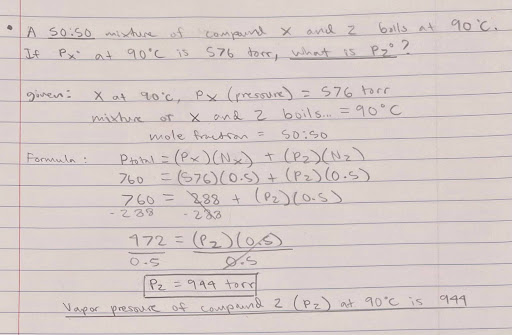
ex: A 50:50 mixture of compound X and Z boils at 90 °C, if PX° at 90 °C is 576 torr what is PZ° at 90 °C?
Boiling point of a mixture problem
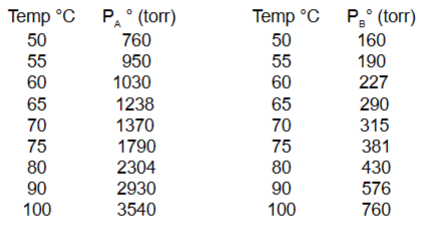
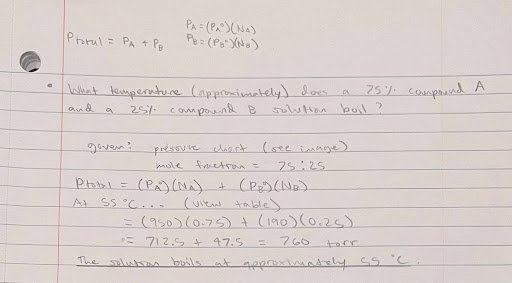
ex: What temperature (approximately) does a 75% A and 25% B solution boil?
Formula: Ptotal = PA + PB
Vapor composition at the boiling point of a mixture problem
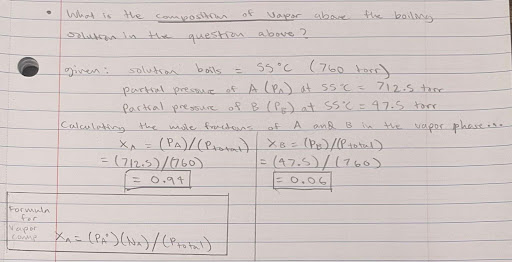
ex: What is the composition of the vapor above the boiling solution in question above?
Formula → XA = PA°NA / Ptotal
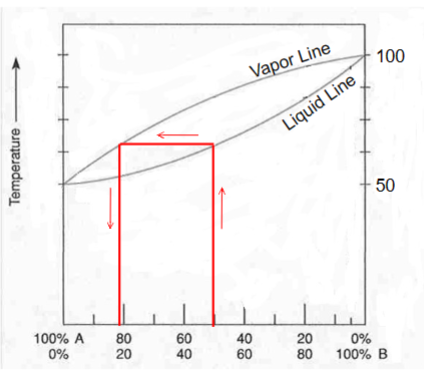
What liquid composition will provide a solution that will boil at 75 °C?
30% compound A, 70% compound B
Theoretical plates
the steps in a ladder in a distillation column; each step representing an evaporation-condensation cycle
(one theoretical plate = one vaporization-condensation cycle)
more plates = more separation efficiency
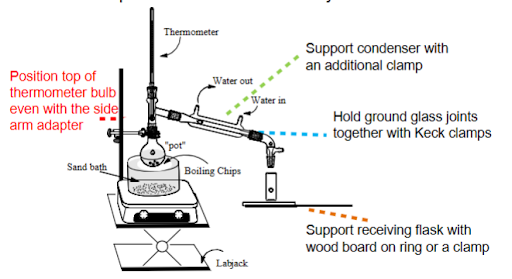
simple distillation
only one vaporization-condensation cycle (less pure than fractional distillation)
works best with big difference in boiling points between the liquids you want to separate.
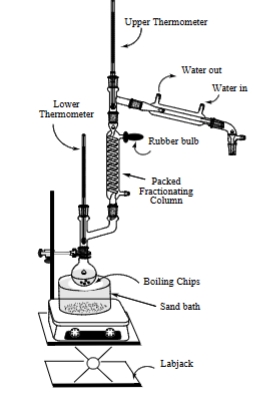
fractional distillation
multiple vaporization-condensation cycles within fractionating column
more efficient for liquids with closer boiling points due to the fractionating column, which enhances separation.
generally more efficient separation of mixture components
What is HETP?
Height of fractionating column Equivalent to one Theoretical Plate
what is reflux ratio?
ratio of the liquid returned to the distillation flask (reflux) to the liquid collected as distillate
what is gas chromatography and how does it work?
technique used to separate and analyze volatile compounds in a mixture
How does it work?
separates compounds based on their distribution between a mobile phase (gas) and a stationary phase (liquid on a solid support)
allows small scale separation of volatile compounds
ideal for determining composition
mobile phase is a gas
what is retention time?
measures the time compounds take to elute from the column
retention times depend on what four factors?
boiling point of compound (can’t change)
column length (can’t change)
flow rate of carrier gas (easy to modify)
oven temperature (easy to modify)
How does a Thermal conductivity detector work?
measuring changes in heat conductivity caused by the presence of different compounds eluting from the chromatography column.
When sample elutes, sample will conduct heat differently than pure He, so we can measure a change in the signal.
How do you calculate a wt/wt percentage using GC data?
wt/wt percentage → (area of individual peak) / (total area)
ex: total area 1502.069, and peak 3 area is 63.179 → 63.179/1502.069 = 4.21 %
What are the steps to calculate a mole fraction, given a volume/volume ratio?
Formula → N = mole fraction / total moles
Start by finding mass by volume x density
Divide mass by molar mass of component
Find N total by adding both components mole fraction together
use formula!

Why should you not clean your glassware with water immediately before conducting your distillation?
Because water can form azeotropic mixtures with many organic compounds.
What is an Azeotrope? (high boiling and low boiling)
a mixture of liquids that boils at a constant temperature with constant composition
azeotropes cannot be further separated by distillation, can’t reach max purity
ex: ethanol being expensive
High boiling azeotrope —> has a boiling point lower than that of any of its components
Low boiling azeotrope —> has a boiling point higher than that of any of its components
When performing a distillation, heating the solution too quickly will…
cause uneven heating and bad component separation
When performing a distillation, opening a cold sample vial will…
cause condensation and affect the purity of the sample
When performing a distillation, not capping a vial tightly will…
cause the sample to evaporate and change composition
When performing a distillation, having the oven temperature too hot on the GC will…
lead to decomposition of the components in the mixture leading to inaccurate results
When performing a distillation, having an air bubble in the syringe when injecting your GC sample will…
bring an air pocket into the sample loop, which effects our accuracy for our injection volume, and our overall gc analysis
atmospheric pressure?
760 mmHg
What two factors determine the vapor composition above a liquid mixture at any given temperature?
Partial pressures (torr) of the individual components in the mixture
Their mole fractions