quiz 2 microbio
0.0(0)
Studied by 1 person Call Kai
 Learn
Learn Practice Test
 Spaced Repetition
 Match
Match Flashcards
 Knowt Play
Card Sorting
1/52

Earn XP
Description and Tags
Last updated 7:33 AM on 3/1/23
Name | Mastery | Learn | Test | Matching | Spaced | Call with Kai | Chat |
|---|
No analytics yet
Send a link to your students to track their progress
53 Terms
1
New cards
Standard plate count PURPOSE
isolate colonies of bacteria from a large population and determine the titer of the stock culture
2
New cards
(Standard plate count) Titer
the number of cells/mL
3
New cards
(Standard plate count) CFU = colony forming unit
the number of colonies that develop on the plate
4
New cards
(Standard plate count) Original cell density (OCD) equation?
CFU / Final Dilution factor (FDF)
\*units will be CFU/mL
\*units will be CFU/mL
5
New cards
(standard plate count) steps of using a micropipette
1. twist dial to desired volume
2. add disposable pipette tip
3. press plunger to first stop
4. insert pipette tip into solution to be transferred
5. slowly release plunger to retrieve liquid
6. move pipette tip into desired tube
7. press plunger past first stop to second stop to transfer liquid, watch liquid stick to wall of tube; remove tip, then release plunger
8. eject tip
6
New cards
What is the max and min for p1000?
Max: 1000
minimum: 100
minimum: 100
7
New cards
What is the max and min for p200?
Max: 200
Min: 20
Min: 20
8
New cards
What is the max and min for p20?
Max: 20
Min: 2
Min: 2
9
New cards
(standard plate count) Should you take out the agar deep all at once?
No, do not take out nutrient agar deep all at once or they will polymerize (solidify) before poured on the plate.
\*pour near flame and do not move it\*
\*pour near flame and do not move it\*
10
New cards
(standard plate count) Why are the colonies different sizes?
because the bacteria that is growing aerobically (on top of the agar where oxygen is available) grows faster than bacteria growing within agar. Bacteria in the middle of agar aren’t getting oxygen and grow slower (anaerobically aka with no oxygen) and only make for fermentation 2 ATP per glucose when they grow aerobically so with oxygen they get 30 and 32 ATP per glucose.
11
New cards
Endospore stain PURPOSE
to stain and visualize endospores and differentiate spore forming cells from non-spore forming cells (a differential stain)
12
New cards
When do endospores form?
when conditions become harsh
13
New cards
What is the process called when an endospore is formed?
sporulation (harsh conditions)
14
New cards
(Endospore stain) what are examples of harsh conditions?
* temperature
* pH
* dehydration
* nutrient loss
* UV
* pH
* dehydration
* nutrient loss
* UV
15
New cards
What is an endospore made of?
keratin (found in skin)
16
New cards
Why are endospores resistant to heat and chemicals?
because of a tough outer covering made of the protein keratin
17
New cards
What is the process when the endospore goes back to a vegetative cell?
germination (favorable conditions)
18
New cards
(Endospore stain) What is steamed?
steam malachite green for 5 minutes
19
New cards
(Endospore stain) Bacillus anthracis
causes anthrax
20
New cards
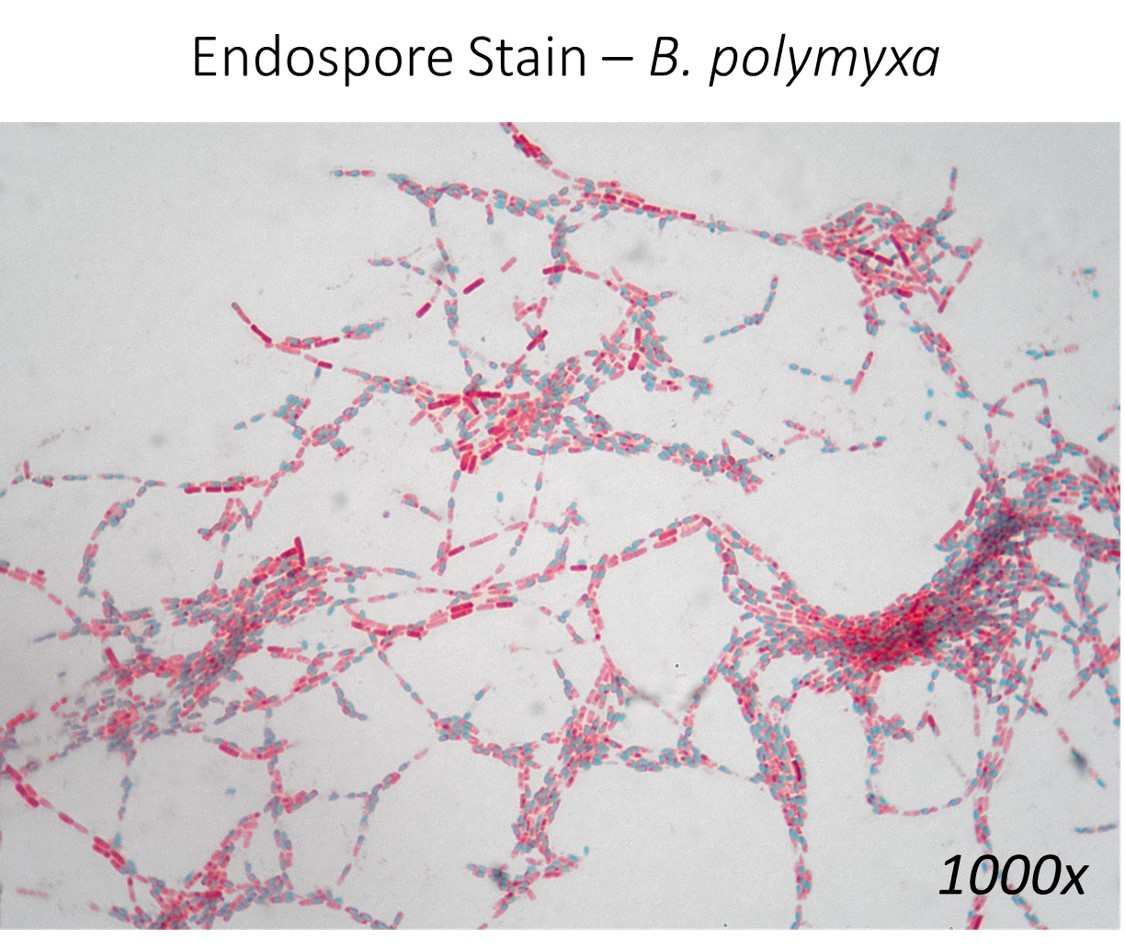
(Endospore stain) B. polymyxa
\-green is the endospore
\-red/pink is vegetative cell
\-red/pink is vegetative cell
21
New cards
(Endospore stain) what are two genus of bacteria that are most commonly gonna have endospores?
* Bacillus (aerobic)
* Clostridium (anaerobic)
^both gram +
* Clostridium (anaerobic)
^both gram +
22
New cards
Acid fast stain PURPOSE
to stain acid fast bacterial cell walls and differentiate acid fast bacteria from non acid fast bacteria (differential stain)
23
New cards
(acid fast stain) Mycobacterium
has a cell wall made of 60% mycolic acid (an adherence factor)
24
New cards
(acid fast stain) sticky/waxy to protect from:
* phagocytic digestion
* dehydration
* mycobacterium can survive on surfaces up to 6 months
* chemicals (antibiotics, disinfectants, etc.)
* dehydration
* mycobacterium can survive on surfaces up to 6 months
* chemicals (antibiotics, disinfectants, etc.)
25
New cards
(acid fast stain) What color will Mycobacterium be? S. epidermidis?
* Mycobacterium will be pink (fuschia)
* S. epidermidis will be blue
* S. epidermidis will be blue
26
New cards
(acid fast stain) Mycobacterium tuberculosis
causes lung TB (tuberculosis)
27
New cards
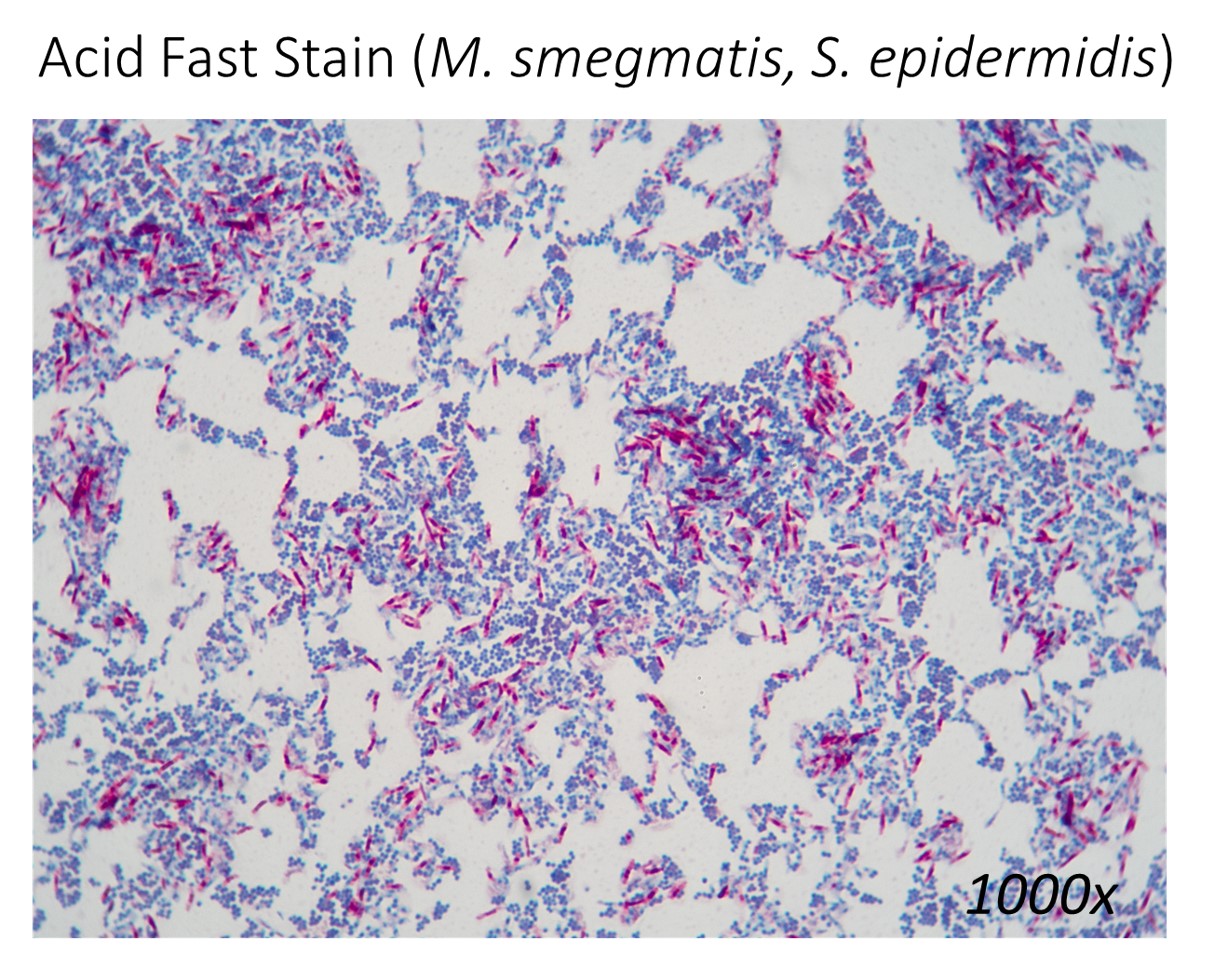
(acid fast stain) M. smegmatis, S. epidermidis
* blue = acid fast (-)
* pink = acid fast (+)
* pink = acid fast (+)
28
New cards
Phenol red broth PURPOSE
to determine if bacteria can ferment a specific carbohydrate
29
New cards
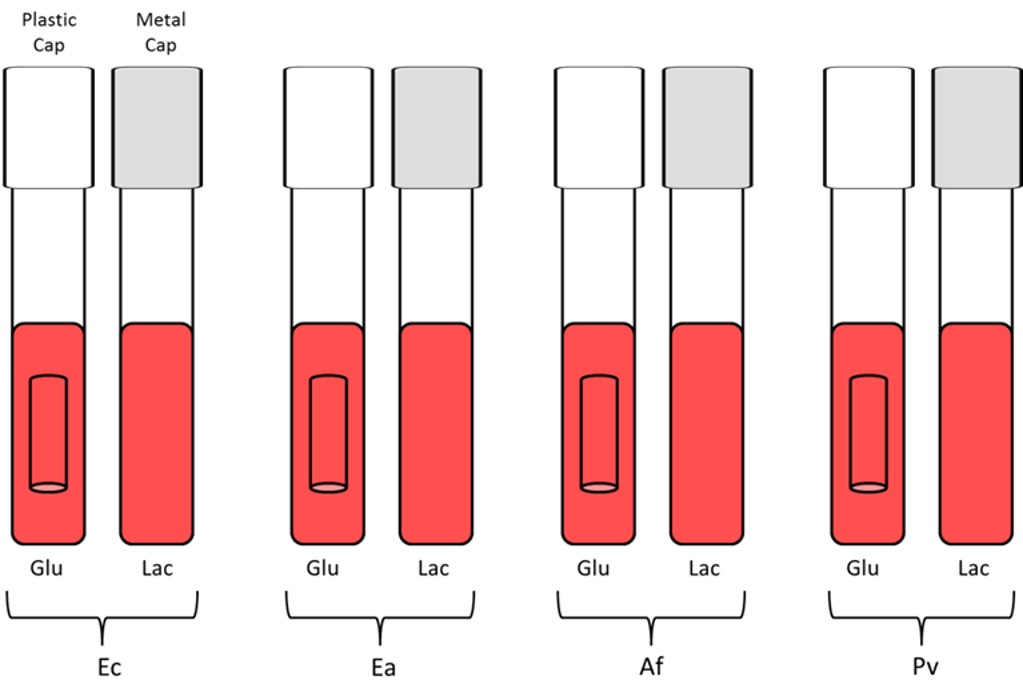
(phenol red broth) What is the purpose of the Durham tube?
it is used to detect production of gas
30
New cards
(phenol red broth) what is the substrate?
carbohydrate
31
New cards
(phenol red broth) what is the enzyme?
various endoenzymes
32
New cards
(phenol red broth) what are the products?
acids, alcohol, +/- gases
33
New cards
(phenol red broth) What are the results (colors) and their meaning?
* yellow (turbid) = + for sugar metabolism, (A/G or A/-)
* red/pink (turbid) = - for sugar metabolism (bacteria use peptones), (K) → alkaline
* no growth (no turbidity) = no result → inconclusive (media is undefined)
\*turbid means bacteria grew
* red/pink (turbid) = - for sugar metabolism (bacteria use peptones), (K) → alkaline
* no growth (no turbidity) = no result → inconclusive (media is undefined)
\*turbid means bacteria grew
34
New cards
(phenol red broth) why must the readout be done between 24-48 hours after inoculation?
because when bacteria are given the choice between metabolizing proteins or sugars if they can’t metabolize the sugar, the sugar will be the preferred food source, and as they do that, they will lower the pH (yellow acidic (+))
essentially bacteria metabolize sugar first and lowers the pH
essentially bacteria metabolize sugar first and lowers the pH
35
New cards
Oxidation/fermentation (O/F) test PURPOSE
determining whether bacteria oxidize and/or ferment glucose
36
New cards
(oxidation/fermentation (O/F) test) what is the substrate?
glucose
37
New cards
(oxidation/fermentation (O/F) test) what are the enzymes?
various endoenzymes
38
New cards
(oxidation/fermentation (O/F) test) what are the products of aerobic (oxidized with oxygen; no oil)?
acids
39
New cards
(oxidation/fermentation (O/F) test) what are the products of anaerobic(fermented without oxygen; mineral oil)?
acids, alcohols, +/- gases
40
New cards
Indole production test PURPOSE
to determine whether bacteria can produce indole from tryptophan (an amino acid)
41
New cards
MRVP purpose
to determine whether bacteria ferment glucose into mixed acids or acetoin
42
New cards
(methyl red) what is the substrate?
glucose
43
New cards
(methyl red) what are the enzymes?
various endoenzymes
44
New cards
(methyl red) what are the products?
mixed acids (pH 4.4)
45
New cards
(Voges-Proskauer) what is the substrate?
glucose
46
New cards
(Voges-Proskauer) what are the enzymes?
various endoenzymes
47
New cards
(Voges-Proskauer) what are the products?
acetoin
48
New cards
Citrate utilization test PURPOSE
to determine whether bacteria can utilize citrate as a sole carbon source
49
New cards
(citrate utilization test) what is the substrate?
citrate
50
New cards
(citrate utilization test) what are the enzymes?
citrate permease
51
New cards
(citrate utilization test) What are the results of a positive test?
* blue (because pH went up)
* green with growth
* green with growth
52
New cards
(citrate utilization test) what are the results of a negative test?
* green with no growth
53
New cards
what were the IMViC results?
Indole
* pink/red = positive
* yellow = negative
MR
* pink/red = positive
* not pink/red (clear ish) = negative
VP
* pink/red = negative
* clearish = positive
Citarte
* green with no growth = negative
* blue or green with growth = positive
* pink/red = positive
* yellow = negative
MR
* pink/red = positive
* not pink/red (clear ish) = negative
VP
* pink/red = negative
* clearish = positive
Citarte
* green with no growth = negative
* blue or green with growth = positive