CPSY 0620 -- MIDTERM #2
 Studied by 1 person
 Call with Kai
 Learn
Learn Practice Test
 Spaced Repetition
 Match
Match Flashcards
 Knowt Play
1/114

There's no tags or description
Looks like no tags are added yet.
Name | Mastery | Learn | Test | Matching | Spaced | Call with Kai |
|---|
No analytics yet
Send a link to your students to track their progress
115 Terms
what is utilitarianism / consequentialism? who is the main person behind it?
Jeremy Bentham
A moral theory that says the right action is the one that produces the greatest overall happiness (or least suffering) for the greatest number of people
Focuses on outcomes rather than intentions – what matters is the consequence of the action
Ex: the train that hits 1 person vs the five is more utilitarianism
what is deontology? who is the person behind that?
Emmanuel Kant
A moral theory that says the rightness of an action depends on whether it follows moral rules or duties, not on its consequences
“The ends can’t justify the means”
Focuses on intentions and principles rather than outcomes
Social rules that help promote social coherence
If everyone could follow a set of principles that everyone would adhere to at every given movement, then we could predict people’s behavior much more accurately
what is virtue ethics? who is it associated with?
associated with Aristotle
A moral theory that focuses on being a good person, not just doing the right thing
Says morality is about developing good character traits (virtues) like honesty, courage, kindness, and fairness
The right action is what a virtuous person would do – someone who acts with wisdom and good character
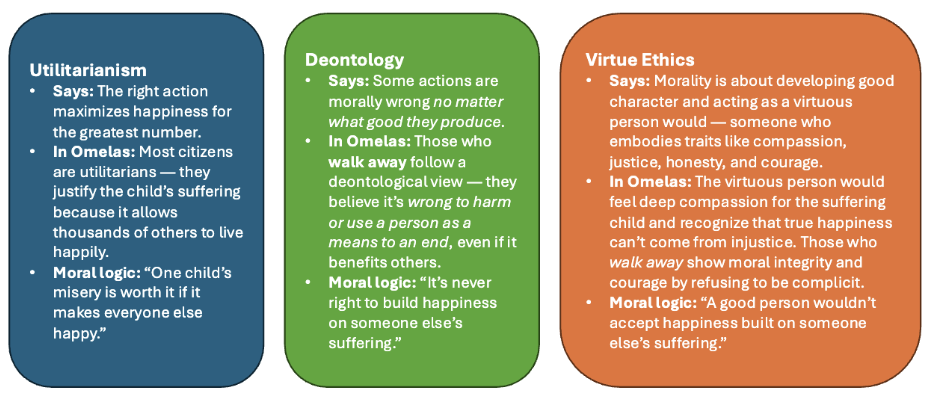
the ones who walk away from omelas is about what? what is the utilitarianism, deontology, and virtue ethics point of view?
Omelas is a beautiful, joyful city – everyone there lives in happiness and peace
But there’s a dark secret:
The city’s happiness depends on the suffering of one child, who is locked in a basement, neglected, and miserable. Everyone in Omelas knows about the child
Most citizens accept it as a necessary trade-off for the greater good
A few, however, walk away from Omelas – refusing to live in a happiness built on someone else’s pain
what is paul bloom’s approach to understanding morality?
“I shall not today attempt further to define the kidneys of material I understand to be embraced within that shorthand description [“hard-core pornography”], and perhaps I could never succeed in intelligibly doing so. But I know it when I see it, and the motion picture involved in this case is not that.” – Justice Potter Stewart
From Ed: Basically what you need to know is that he doesn't really want to a priori (knowledge that can be gained through reason alone, without needing empirical evidence or personal experience) what is a moral issue versus not. His argument is that we kind of just know it when we see it. For example, when we see this woman throw a cat in a trash can, we know this is a moral problem. There is a lot of interesting work on how certain non-moral issues become moralized, but that's a whole separate topic for a whole separate class. For example, when people see behaviors receive punishment, we often infer that that action is morally bad for example. All you need to know is that Paul Bloom isn't committed to a definition of morality, while other folks (Audun Dahl; the next slide) is committed to a definition and thinks it's important to define morality.
what is Audan Dahl’s approach to morality?
He defines morality as “obligatory concerns with others’ welfare, rights, fairness, and justice, as well as the reasoning, judgment, emotions, and actions that spring from those concerns”
what is the naturalistic fallacy?
the mistake of thinking that because something is a certain way in nature, it ought to be that way morally
in other words: confusing facts about the world with moral values
key idea: just because something in natural doesn’t mean it right
what are dual process models (greene and others)? what does it say? what are the moral dilemmas? what is an example?
Says: Moral judgments come from two different psychological systems:
Emotional (automatic) system — fast, intuitive, and driven by feelings.
Rational (controlled) system — slow, deliberate, and based on reasoning.
In moral dilemmas:
The emotional system supports deontological judgments (e.g., “It’s wrong to kill, no matter what”).
The rational system supports utilitarian judgments (e.g., “It’s okay to harm one person if it saves more lives”).
Example:
In the trolley problem:
Most people are okay flipping a switch to divert a trolley (rational/utilitarian).
But not okay pushing someone onto the tracks (emotional/deontological).
Moral logic: Our moral thinking is a tug-of-war between emotion and reason.
what are criticisms of the dual process model approach?
too simple: real moral reasoning blends emotion and reason
rain evidence unclear: fMRI regions aren’t purely emotional or rational
artificial dilemmas: trolley problems don’t capture real life moral complexity
what is Haid’t social intuitionist model? what was their example? *think sickkk*
moral judgments stem largely from intuitions (gut feelings), not deliberate reasoning
reasoning often comes after, to justify decisions
emphasizes the social nature of morality (persuasion, influence, group belonging)
moral dumbfounding
incest story — was it okay for them to make love?
what are criticisms of Haidt’s social intuitionist model?
Underestimates reasoning - critics argue reasoning sometimes play a central role, not just post-hoc justification
Simplifies social influence - the model emphasizes social persuasion but may underplay other factors like deliberation or institutional rules
We can be swayed by reasons and by social rules
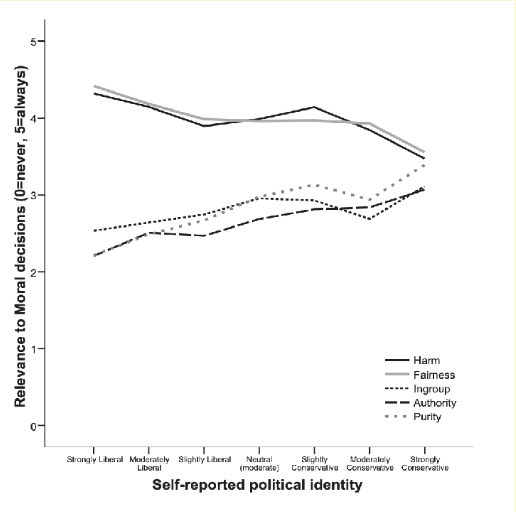
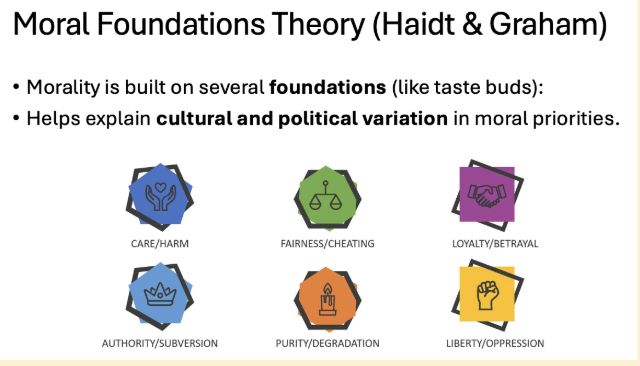
what is the moral foundations theory (Haidt and Graham)?
all humans innately have these “taste buds“ but we all differ in how we prioritize harm, fairness, loyalty, etc.
what are criticisms for the moral foundations theory (Haidt and Graham)?
Foundations may not be universal
Critics argue the proposed moral “foundations” may not capture all culture or moral diversity
Measurement issues
Surveys like the Moral Foundations Questionnaire may bias responses or fail to capture complex moral reasoning
Overemphasis on intuition
MFT focuses on automatic moral intuitions, possibly underestimating reasoning and deliberation
Political overgeneralization
The theory links moral foundations to liberal vs conservative differences, but this may oversimplify individual and contextual variation
what is dyadic morality?
Says: Morality is fundamentally about perceiving harm
Core idea: people judge actions as moral or immoral by seeing them as a victim causing suffering to a wrongdoer – forming a dyad:
Victim → Harm → Perpetrator
Key insight: even when no physical harm exists, moral judgements often center on perceived suffering or vulnerability
what are criticisms to dyadic morality?
Too narrow focus on harm
Critics argue not all moral judgments involve harm (e.g., fairness, loyalty, purity concerns)
Cultural variation
Some societies prioritize norms or duties over harm, challenging the idea that harm is universal in moral judgment
Overemphasis on perception
Moral judgment may involve principles or reasoning, not just intuitive perceptions of victim – perpetrator relationships
Ambiguity in “harm”
Hard to define what counts as real vs perceived harm; subjective interpretations can complicate predictions
what do adult theories like moral foundations theory and dyadic morality have on developmental predictions?
Moral Foundations Theory
Developmental roots of different foundations
Dyadic Morality
Children’s reasoning about harm
In general, these theories are not putting development first
what is piaget’s theory of moral development?
Says: Children’s moral reasoning develops in stages, influenced by cognitive growth and social interaction.
Stages:
Heteronomous morality (ages ~4–7)
Rules are fixed and absolute, handed down by authority.
Focus on consequences, not intentions.
Example: “Breaking 10 cups is worse than breaking 1, even if it was an accident.”
Autonomous morality (ages ~10+)
Rules are flexible and agreed upon.
Focus on intentions and fairness.
Example: “Accidental breaking is less bad than deliberate mischief.”
Key insight: Moral development moves from obedience to authority toward cooperation and understanding intentions.
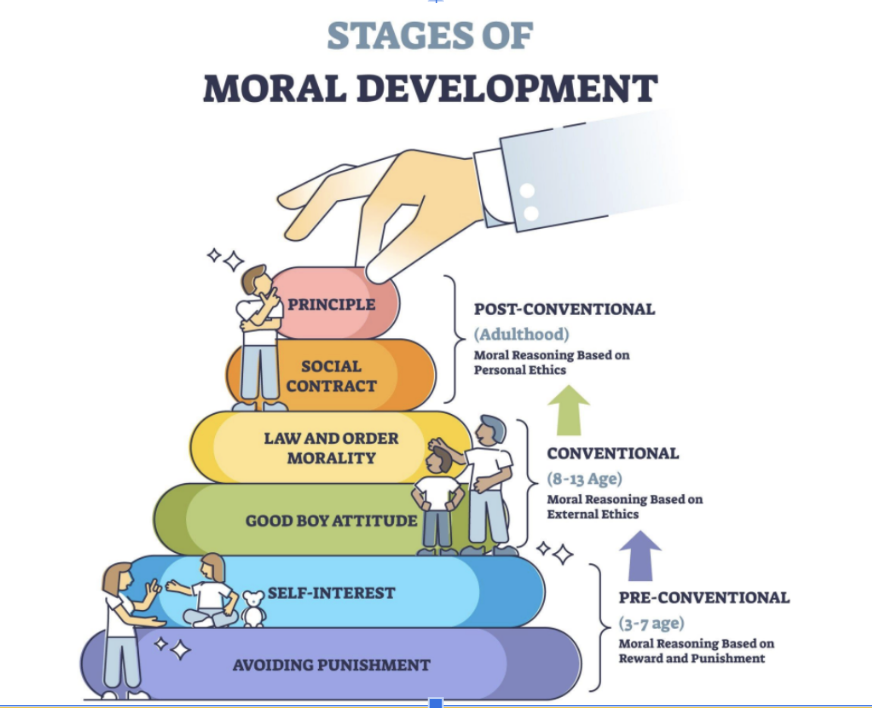
what is kohlberg’s theory of moral development?
Sequential stages from childhood through adulthood
Adults can reach post-conventional reasoning, where morality is based on universal ethical principles, not just social rules
Criticized for being too focused on justice reasoning and culturally narrow
Critics of moral relativism argue against Kohlberg’s theory which is more in tune with moral universalism because he says there are the right reasons that someone could emphasize on someone’s choice while moral relativism says morality is more culturally bound
EMPHASIS ON REASONINGS
what is Heinz Moral Dilemma ? what is the importance of this?
“A woman is dying of a rare cancer. A local druggist has discovered a drug that can save her, but he is charging an exorbitant price ($2,000 for a small dose, though it cost him $1,400 to make). Her husband, Heinz, can only raise half the money, and the druggist refuses to sell it cheaper or allow him to pay later, even after Heinz pleads his wife’s case. Heinz considers stealing the drug to save his wife.” Should Heinz steal the drug?
This idea of thinking through the reasons. Are there different types of appeals that children or adults will make, and do those appeals change throughout the course of development and do those reveal something important about human nature.
what is the example of using Kohlberg’s stages of development on Heinz stealing medicine scenario? kohlberg is very focussed on ?? what are some criticisms of this approach?
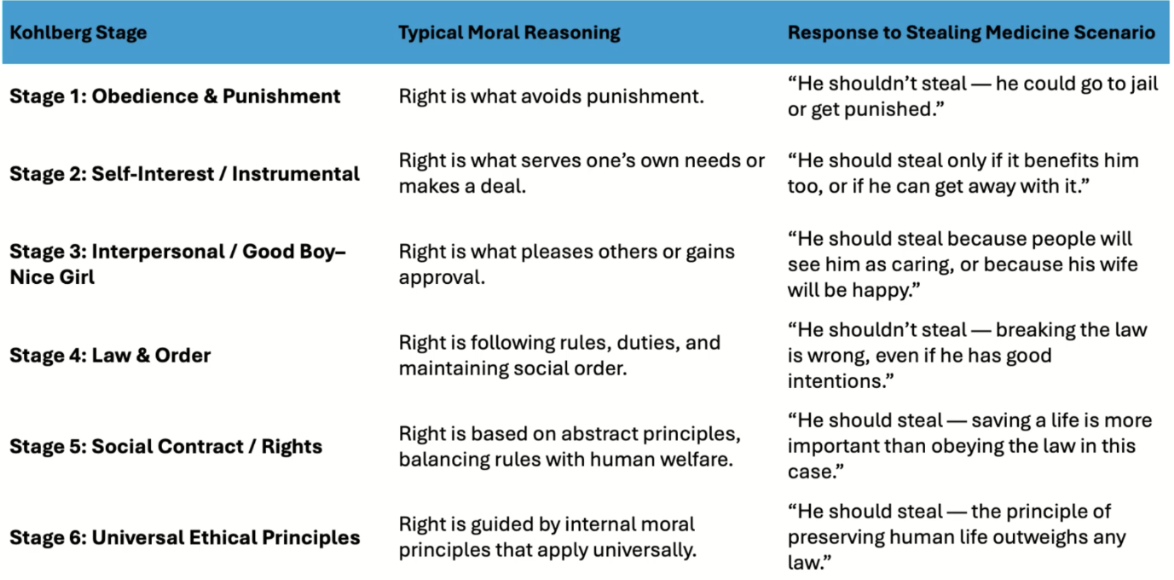
Kohlberg is very focussed on the reasonings
Criticisms is it doesn’t take into past experience, cultural variations, different definitions of justice, apex is this particular type of reasoning that is the best type of reasoning
what is social domain theory? what three things do they distinguish between?
Adults (like kids) distinguish between:
Moral domain (justice, rights, welfare),
Social-conventional domain (customs, norms, etiquette),
Personal domain (individual choices)
Shows that morality is not just about rules but differentiated domains of social knowledge
Not particularly concerned with “starting states”
Very constructivist; children construct a distinction between social convention and morality
what was the yoo and & smetana, 2022 study about? *think pajamas and cookies* what were their results?
they wanted to see if children can distinguish thinks like morality vs social convention? (aka dog vs cat)
provided children two different scenarios one where a child went to school in pajamas and one where a child stole cookies
RESULTS: the results confirmed that children make distinctions between moral and conventional transgressions, with strong distinction effects for criterion judgments than acceptability or punishment judgments. Overall, children’s moral and conventional distinction in criterion judgments emerge by age 3, and the distinction effects get stronger with age.
criterion judgments include authority independence, rule independence, generalizability, interalterability of rules,
what are criticisms of the social development theory (Rottman and Young)?
The distinction between social - conventionality and morality isn’t as clear cut as expected
Non western societies
Western societies
Spanking
Vegetarian children – vegetarian children think it is very problematic to eat meat whereas non vegetarian children don’t think it is very problematic so would you put it in conventional or moral distinctions
Any over-emphasis on reasoning rather than gut intuition
“Victimless crimes”
what are some evolutionary theories and criticisms of evolutionary theories?
Evolutionary theories
Morality seen as an adaptation for cooperation (e.g., reciprocal altruism, kin selection, group selection) —> through a nativism lens
Cultural evolution models suggest moral norms evolve to solve coordination and cooperation problems
Anthropological perspectives highlight variation and flexibility in moral norms across societies
Criticisms of evolutionary theories
Reliance on infant research
Often impossible to falsify
social evaluation — why is the concept of “disinterestedness“ an insight into morality?
Of course it makes sense if I care if I am getting paid fairly or getting treated fairly, but it is a different thing if I care about you getting paid fairly or others getting treated fairly
To some people, what defines morality is caring about what other people do ; it is not always obvious if other animals care about what other animals do and that may differ us from other species
social evaluation by preverbal infants (Hamlin, Wynn, and Bloom, 2007; Nature) — what were the different experiments? how did they test the babies? what were the results?
Helper vs Hinderer : upwards of 80% of babies are choosing the helpful ones
Experiment 1:
object pushed climber up the hill → helper
Object pushed climber down the hill → hinderer
Experiment 2:
Player has a ball and then drops, helper picks it up and gives it back → helper
Player has a ball and then drops, hinderer steals the ball and runs away → hinderer
Experiment 3:
Player tries to open box and then helper helps open it → helper
Player tries to open box and then hinderer sits on it → hinderer
All babies have to choose either helper or hinderer object at the end and upwards of 80% of babies chose helper
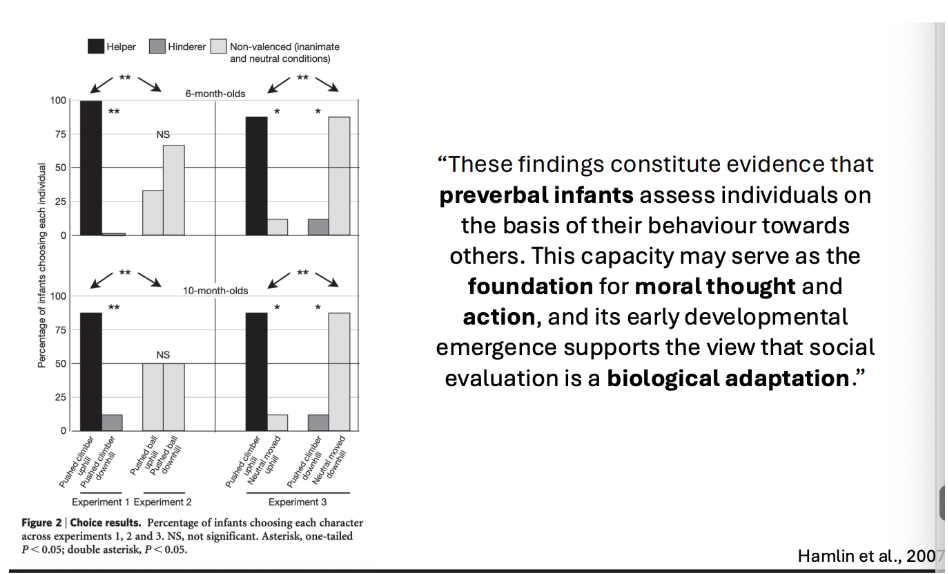
EXTRA NOTES FOR HAMLIN ET AL. PAPER
Biological adaptation is something that happens from evolution
We have evolved in a particular way that has adapted us to have specific type of preferences that has built in at 6 months of age
They definitely think that this propensity to think about other peoples’ interactions is very early emerging or honed or emerged through evolution
What makes something fundamentally moral? You can imagine as an onlooker in a situation, you ought to be disinterested in the outcome of the situation, but what makes something moral is actually expressing interest in a situation when you ought to be disinterested.
Gay marriage: onlookers have some sort of vested interest in the situation despite it not really affecting them.
For example, when we are watching puppets, we shouldn't really have an interest in watching the puppets, we ought to be disinterested, but babies actually show interest in that and have expressed preferences of who they want to choose
It makes sense if I would care if someone pays me back, but if I heard a story and someone didn’t pay someone back, if I felt some sort of emotional reaction to that , that is expressing interestedness in a disinterested situation because why should I care if someone else paid someone back because I have no vested interest in the situation
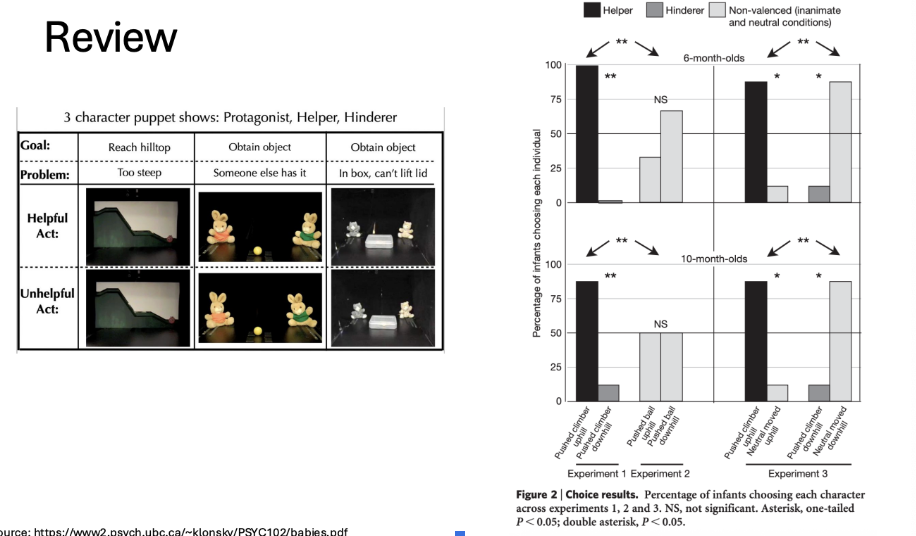
Infants at 6 and 10 months have some sort of preference or interestedness in this process and situation
How Infants and toddlers react to antisocial others — Hamlin, Wynn, Bloom, nad Mahajan, 2001. what were the different phases and results?
phase 1: yellow helper and maroon hinderer
results: babies will express preference to the yellow helper than the maroon hinderer despite any investment in the situation themselves
phase 2: green moose helps a helper (what is called a give event) and orange moose hinders a helper (what is called a “taker“ event)
theory: you want to act nicely towards agents who acted nicely in the past. and you don’t like people that act meanly towards nice agents.
results: they found for all 5,8,19 month olds for the prosocial target conditions so being nice to the nice agent —> all of them preferred the giver
for the antisocial target conditions where the object was mean to the mean agent, 5 months still chose the giver object where as the 8 and 19 month olds chose the taker of the antisocial target —> sort of like eye for an eye, something like someone who was mean should experience someone being mean back
when babies are very little, they just like nice actions, not contingent on if the recipient of the action is a good or nice person
could also be like babies have issues tracking all of these agents
at least an 8 months old, it’s showing they endorse both mean and nice actions depending on situations
what was experiment 4 and 5? what were the results?
EXPERIMENT 4
there was a helper (prosocial) and hinderer (antisocial) and they asked the kids two scenarios:
Look! there’s only one treat left! i think we need to decide who to give it to!
look what i found! i found a puppy who didn’t get a treat! look! his bowl is empty! i think we need to take one of these guys’ treats and give it to him
results: most of the children chose to give a treat to the character in the prosocial action and then chose to take a from the character in the antisocial action
EXPERIMENT 5
there is a puppet show viewing, then button board introduction, free play session where the children can tickle or hit either of the red puppet or the yellow puppet
results: they wanted to act pretty similar to both of the puppets
for the second graph, if you could only choose one of the options for each of the puppets, overwhelming number want to be nice to the nice puppet and then mixed results for the antisocial puppet, meaning kids don’t have an overwhelming desire to hit
referring back to the treat experiment, it may be the fact (because the children were forced to choose which to take it from) to protect the nice puppet rather than the desire to actively hurt the antisocial pupper
this is a different interpretation now: it’s not that they are out in the world and want to see bad things happen to bad people, it is when they are forced to choose whether to harm a good or bad agent, they don’t want to harm good agents
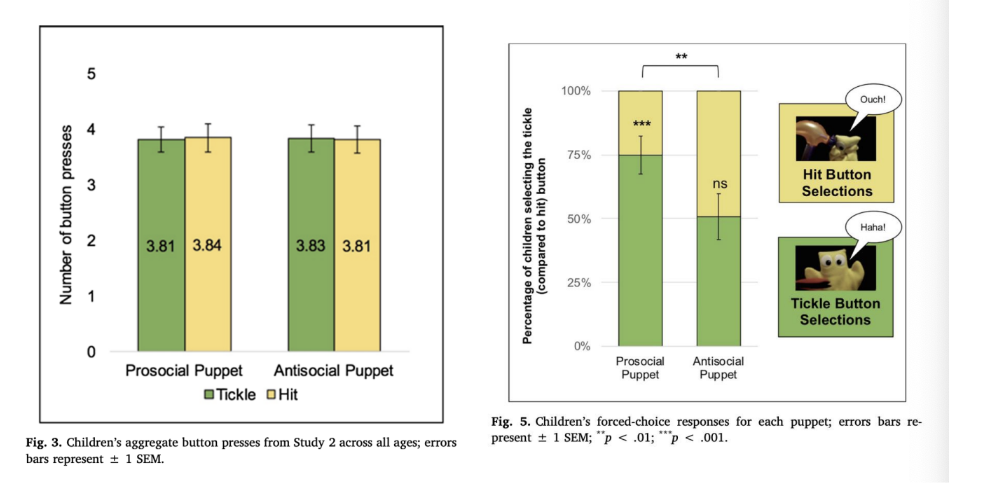
The graph on the left reveals that, when children are free playing, they are not more likely to tickle or hit the prosocial or antisocial puppet. The graph on the right does indicate a difference between the preference for which button to press for the antisocial and prosocial puppet such that children are more likely to select the tickle button for the prosocial puppet.
intentionality — wo et al., 2017; cognition — what was the study? what were the results?
wanted to test accidentally vs on purpose
results: majority of the babies chose the intentional helpers vs the truly accidental helpers ; majority of the babies also chose the truly accidental harmers vs intentional harmers
how are all of the hamlin studies and subsequent studies interpreted? draw from various studies
Hamlin argues that infants have a rudimentary sense of morality: even before language, babies can evaluate social interactions.
Core finding: Infants prefer “helpers” over “hinderers” in simple puppet shows (e.g., someone helping another climb a hill vs. someone pushing them down).
She interprets these preferences as evidence that humans have an innate moral evaluation system, not just learned associations.
Subsequent studies (adjusting for motion and perceptual cues) are seen as supporting the idea that infants judge intentions, not just physical outcomes.
Hamlin emphasizes that this is early, foundational moral cognition, which may later develop into more complex moral reasoning.
how do we square this work with developmental theories of mortality? what are criticisms of this work?
We really don’t know WHY infants respond the way they do
Developmental theories really focus on reasoning but we don’t ask babies questions because they can’t respond
Criticisms of these infant studies in general
We can never know for sure
what are criticisms of this morality development work?
Replication Issues
Some labs fail to replicate the preference for helpers (critics argue if it is contingent on small changes in stimuli then how innate is morality really?)
Suggests the effect may depend on small changes in stimuli or procedure
Alternative explanations
Preferences might be due to associative learning rather than moral judgment
Babies could simply learn: "positive events → approach, negative → avoid”
Cultural and Developmental Differences
Not all infants or cultures show the same patterns (this study was based on infants in New Haven)
Questions the idea that moral evaluation is universal and innate
Ecological Validity Concerns
Puppet and animations are artificial social scenarios
Raises question: Do babies behave this way in real-life social interactions?
what was the main takeaway from the lucca et al paper? what are some notable things about this study? how is was conducted?
the fundamental result from this paper is that a lot of the work done by hamelt and colleagues doesn’t seem to replicate
Sample size was a very impressive
Drawbacks, less individual oversight of every lab doing the experiments
Possible that there is some variation in the procedures being conducted since they didn’t receive videos from every single lab
The large scope of the experiment was that quality control was difficult
Lot of labs had to be paused due to covid, so various time frames of which this could occur which could impact the results
Dr. Hamlin’s explanation for the replication failures in the podcast – in the podcast, during the time of COVID when the lab came back to testing that babies were less likely to be out in public so a lot of kids during that time stayed at home. So babies being tested after or during COVID, they might be different considering they are in a lab and not used to these public settings
what are some explanations to consider for the lucca et al paper?
The original findings were wrong “These findings highlight the importance of considering non-nativist possibilities for the original of morality”
The reliance on the “Hill” paradigm creates issues
Meta analyses have shown that that paradigm has yielded smaller effect sizes
Live events versus video
To standardize the procedures of the hill paradigm were video being played but it could vary because live events could be more preferential – pretty big discontinuity from original work
Lingering effects of the pandemic → shaping how these findings ended up happening
what was the human newborns spontaneously attend to prosocial interactions? *geraci, 2025/2024 — what were the results?
5 day old babies/neonates were given stimuli
shapes of balls designed so babies could see cause their vision is very blurry at that young of age
one event of where one ball is social helping another ball up the hill
second event where one ball is social hindering another ball down the hill
results: babies had a longer looking time for social helping than social hindering
we have really no idea what it means that there is longer looking time for social helping but longer looking time people believe it means they can tell the difference
evidence in favor of early emergence of morality side
what is prosocial behavior?
helping, sharing, comforting, informing
what is the monkey vs people example about?
cooperative behavior is mysterious
the key question is about helping strangers
this propensity to cooperate may be unique to the human species (Hrdy, 2009 — Mothers and Others)
what are the two sides to have social norms exist in our community?
there are social norms that exist in our community. you learn about them through various ways and you learn and follow them because there are consequences to not adhering to them but there is nothing built in the mind that helps this pro social behavior —> nurture side almost
evolutionary time it became beneficial to sort of internalize a biological adaptation to help strangers to improve good fitness for humans and became a fundamental part of us as humans
what is the difference between proximate vs ultimate motivations?
Proximate motivations are the immediate cause of a behavior
We eat cake today because it tastes good and marks us happy – not because we’re trying to survive a famine
Ultimate motivations are the evolutionary functions of a behavior
Humans evolved to like sweet tastes because sweetness signaled high energy foods (important for survival in our evolutionary past)
what was the warneken and tomasello study (altruistic helping in human infants and young chimpanzees)? what was the set up?
The Set - Up
After the experimenter created a small problem (like dropping a marker), each trial had three phases:
Object focus (1–10s): The experimenter looked only at the object.
Alternating gaze (11–20s): The experimenter looked back and forth between the object and the child.
Verbal cue (21–30s): The experimenter said something like “My marker!” while continuing to alternate gaze.
In control trials, the experimenter just looked at the object with a neutral expression for 20 seconds
No rewards or praise were given if the infant helped
Each child did 10 tasks total:
5 in the experimental condition and 5 in the control condition, with the order systematically varied
For each task, 12 children were in the experimental condition and 12 children were in the control condition – making it a between - subjects comparison for each task
Results:
Humans were willing to help with out of reach tasks
The argument they make in this paper is this propensity to help stranger made be bred in the bone or sort of fundamental to humans
Generally speaking, when I say cooperation, I am referring to a whole slew of different types of behaviors and not simply helping a stranger
Getting onto a plane, involves not just helping people, you have to follow social rules, social norms, you have to understand what someone needs to do in that situation, but could also involve helping
In this experiment, it might show that helping strangers could be present in non human primates is present
In like the cabinet case, the non primates won’t help – we don’t know why that’s the case
It seems like helping in humans, it is more widespread in different types of situations relative to chimpanzees where it is limited to these sort of out of reach objects
Chimpanzees also were in the study —> they seemed to help with the out of reach tasks
what about rewards (Warneken, Hare)? *follow up study* —> what were the results?
They did a follow up to see if children or chimpanzees would change their actions depending on if there was a reward or not
For human children the result was they were both equally likely under both situations to help with reward or no reward which speaks to this intrinsic motivation to help, not doing it simply because they think they are going to get some sort of treat → this is for reaching experiment
Argument they are making in this paper, both chimpanzees and children are both willing to help strangers even if they aren’t rewarded
what was the warneken and tomasello study (2008)?
More rigorously testing reward
1. Reward condition:
The experimenter (E1) gave the child a toy cube as a reward for helping.
She emphasized the exchange by saying, “For this, you get a cube.”
2. Praise condition:
E1 did not give a material reward.
Instead, she thanked and praised the child: “Thank you, [child’s name]; that’s really nice!”
3. Neutral condition:
E1 did not reward or acknowledge the child at all.
She simply took the object and continued her task.
This condition served as a baseline to measure children’s spontaneous helping without any rewards.
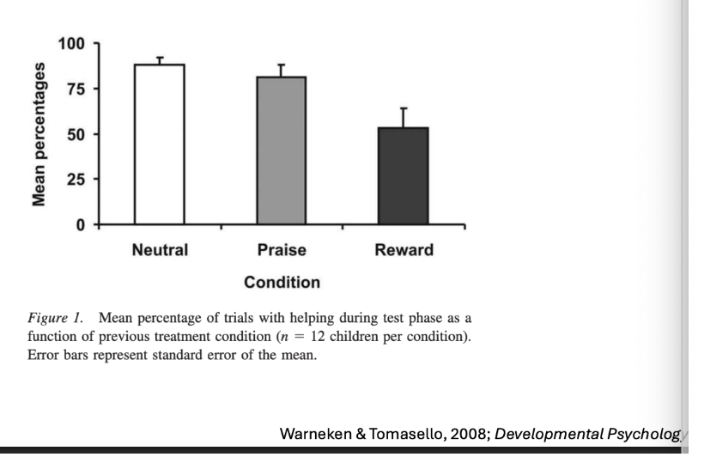
Found that the reward condition decreases helpfulness
Goes against this notion that helping in toddlerhood might be based off of some sort of more selfish desire, in fact, they are most likely to help in the neutral condition
A lot of these studies were conducted in Germany
what was the follow up study on parental presence to see if children would still help? what were the results?
24 month olds
Children could help an unfamiliar adult retrieve an out of reach object
Five conditions tested parental influence:
Parent present but passive
Parent highlighted the problem
Parent actively encouraged
Parent ordered the children to help
Parent absent
Results:
Children helped frequently and equally across all conditions
No difference in helping when parents were absent or in a later test phase
Conclusion:
Toddlers’ helping is spontaneous and intrinsically motivated, but not driven by parental cues or pressure
what was the controversy or study that went against the parent pressure — children helping study?
rethinking natural altruism: simple reciprocal interactions trigger children’s benevolence
rodolfo cortes barragan and carol s. dweck
babies were tested to either just play by themselves with an adult present but not playing with them and then with an adult playing with them
babies were much more likely to help in the reciprocal play condition and were pretty unhelpful in the parallel play condition
this suggests that there is something that reciprocal interaction with someone ahead of time that might sort of warm up kids to be willing to be helpful and they also did this with a sticker task and not just a helpfulness task and they saw a similar sort of results
it is not that toddlers are really inclined to help strangers with no regard to who they are, instead, they are only willing to do it in situations where they had some positive experiences ahead of time
it is the case that toddlers are willing to help strangers in the absence of reciprocity. but if toddlers have the opportunity to have reciprocal play then you see those rates of helpfulness go up even more
what is the evolutionary adaptation versus spandrel (byproduct effect)? give an example
Evolutionary adaptation
Trait selected for because it improved survival or reproduction
Functional and heritable
Ex) Vision: Each component of the eye (lens, retina, etc.) contribute to a functional system that directly increased survival
Spandrel (byproduct)
Trait that arises incidentally from another adaptation
Not directly selected for its current form or function
Ex) Reading: A recent cultural invention; it relies on pre-existing systems (such as vision) that evolved for other reasons
why do we care about judgments about helpfulness?
Reveals moral understandings: Judgements show how children conceptualize helping – what they see as kind, fair, or obligatory – even before they consistently act that way
Separates knowledge from performance: Children may know helping is good but fail to help due to shyness, self-interest, or limited self-control. Judgments tap understanding independent of situational constraints.
what are positive duties? what are negative duties? what is the concept of supererogatory actions?
Positive duties
Involve prosocial acts – providing aid, comfort, or sharing
Often seen as optional or supererogatory (“good to do,” not always “bad not to do”)
Negative duties
Involve avoiding harm, theft, or unfair treatment
Seen as strict moral rules (“wrong to do”)
The concept of supererogatory actions: actions that go above and beyond
what was the miller et. al paper, 1990 about — perceptions of social responsibilities in india and in the united states: moral imperatives or personal decisions? what was it important for? what were the results?
social domain theory derived
american and indian children
college, sixth grade, and second grade
vignettes:
amy is a 30 year old woman who likes to draw. one day she found out than an art store, which was going out of business, was having a big sale. amy wanted to go to the sale to see if she could get any good bargains there. the art store was on banyon street — a street on the other side of town. amy did now know where banyon street was. so amy asked her best friend lisa for directions to banyon street. amy told lista that she wanted to get to the sale early, while there were still lots of art supplies left to buy. but lisa was busy reading an exciting book and did not want to be interrupted. so lisa refused to give her friend directions to banyon street. because of this, by the time amy was finally able to get to the art store, there were few art supplies left.
dependent variables:
was the behavior alright or not alright?
was the behavior extremely desirable (1) or extremely not desirable (9)?
objective obligations: if people do not want to give other people directions in situations like this, do they still have an obligation to give them directions anyway?
sorting:
it is alright to try to stop or punish, in some way, a person acts like this
this is the person’s own business. it is not alright to try to stop or punish, in some way, a person who acts like this
Results:
conclusion: “the evidence also reveals..that marked cross cultural variation exists in the scope of social responsibilities considered as moral and in the criteria applied in judging that such issues constitute moral obligations. specifically, indian subjects were found to maintain an extremely broad view of interpersonal moral duties … we observed that american subjects considered a smaller domain of social responsibilities as moral obligations, and their judgments were affected both by need and role considerations“
do children and adults take social relationship into account when evaluating people’s actions — marshall et al., 2020? what was the study about, what were the results
5 year olds, 9 year olds, and adults
question: how do children evaluate helping behavior in social relationships?
study design :
1. start relationship familiarization — these two boys know each other a lot ; these two boys do not know each other at all.
2. one day the boy realized he forgot his lunch at home and was very hungry ; both boys — the one who knew him and the one who didn’t know him saw that the boy was hungry
3. expectation question —> will the boy who knows him help? will the boy who doesn’t know him help?
4. revelation part 1 —> lets say that both of the boys who saw he was hungry do not help him
5. individual evaluation questions —> was the boy who knew him nice/mean? was the boy who did not know him nice/mean?
6. comparative evaluation —> who is meaner?
7. revelation part 2 —> both of the boys who saw he was hungry do help him
8. individual evaluation questions —> was the boy who knew him nice/mean? was the boy who did not know him nice/mean?
9. comparative evaluation —> who is nicer?
*DID THIS ON A FALLING OFF A SLIDE SCENARIO AND DROPPING A BOOK SCENARIO*
RESULTS:
adults can distinguish that the friend is meaner and even the 9 years old can but the littlest kids cannot distinguish. 2 explanations--> this suggests that the littlest kids don't think that neither of the people have an obligation to help the students which means that they don't care about who is meaner. they construe both of the individuals as both obligated and they can't decide who is more obligated / who is more meaner
How development and culture shape intuitions about prosocial obligations — marshal et al.,2021 —> what was it about? what were some of the questions posed?
questions posed:
how can we better understand the judgments that underlier younger children’s evaluations?
how do children across a broader range of cultures think?
6 year olds, 10 year olds, and adults
children in germany, india, japan, uganda, US
experiment design:
emma and emma’s mom —> emma falls down the slide. do you think that emma’s mom HAS to help emma — yes or no? if participant responds yes, how much do you think she has to?
emma and emma’s friend —> emma falls down the slide. do you think that emma’s friend HAS to help emma — yes or no? if participant responds yes, how much do you think she has to?
emma and stranger —> emma falls down the slide. do you think that the stranger HAS to help emma — yes or no? if participant responds yes, how much do you think she has to?
RESULTS: all children regardless of age, regardless of country think that parents have to help their children. but we get interesting variability for the friend and stranger. at younger ages, children tend to believe we have obligations to help people we don't know but what is changing is if it gets stronger in that belief for example like in Uganda or you stray away from that belief as you get older like in the United States and Germany.
for the ones that responded: for strangers in india and in uganda, you see a higher endorsement in adults versus USA
does distance matter? how physical and social distance shape our perceived obligations to others (marshall and wilks, 2024)? what is the study about? what were the results?
5 year olds to 9 year olds and adults
children in the united states
EXPERIMENT SET UP:
question posed: emma is in need of help, can Maggie help her?
more focussed on the physically far aspect
from mashy on ED: The main takeaway here is that a) younger children in general are more likely to describe bystanders as having an obligation to help another, and b) that younger children are less discerning on the basis of physically close v. physically far. If you notice for older children and adults, they always say that a bystander has a greater obligation to help a physically close other (dark green) more than a physically distant other (light green).
my notes: Younger children believe there is an obligation to help the girls mostly regardless of physical distance. For older children, there is greater variation with many of them thinking that the physically close is obligated and physically far isn't and then adults it is almost like both are not obligated to help at all.
are social groups different? Helping the in group feels better: children’s judgements and emotion attributions in response to prosocial dilemmas — weller and hansen laguttuta, 2012? what was the study? what were the results?
a story about michael and he really wanted to play a game with his friends. the game is about to start and michael has to get there right away or else he definitely won’t be able to play. on the way, michael sees a boy, named Jacob, holding a box of special photographs. suddenly, jacobs slips on the mud and all of jacob’s photos fall on the ground. michael sees that the photographs are getting wet and muddy. michael does not know jacob. he is not sure if jacob needs help. michael thinks about what to do. he knows if he stops and helps jacob, he will definitely not be able to play the game with his friends. but…if he goes to play with his friends, jacob might not ne able to pick up all his photos before they get ruined.
posed questions:
in the situation michael decided to try and help jacob: how much do you think michael felt he needed to do this? —> most people felt that he had a obligation to help
in this ending: michael decided to go play the game with his friends: how OK do you think it was for michael to do this?
RESULTS: so younger children (5-6 year olds) are less likely to distinguish between different severity when determining whether it is permissible or not to not help someone, whereas older kids think it is permissible to not help for low severity situations
how do babies think about fairness? fairness expectations and altruistic sharing in 15 month old human infants — schmidt and sommerville, 2011? what was the study? what were the results?
They would show them these schemas engaging in resource distribution
When we look at D (fair distribution) and E (unfair distribution), do 15 months olds have an expectation of whether or not resources will be distributed fairly
If they sort of have the notion that this person should distribute these four resources equally, then they should be surprised to see the unfair outcome relative to the unfair outcomes
You might imagine that babies might not have this notion of fairness but they might be surprised by asymmetries so they want to rule out the outcomes by taking out the people
Researchers then interpret this to mean that babies have this sort of expectation that all else being equal in the presence of someone distributing resources that people should get those resources fairly
RESULTS:
12 - 15 months old they are looking longer at the unfairness
the 9 months is trending and 6 months doesn’t really differentiate
this means that fairness is something that is learned
not something innate
this is a developmental pattern
what was the follow up study for the distribution study for babies — could it be experience with sharing — Ziv and Sommerville, 2017? what were the results? how did it work?
For children whose parents said that they don’t really share that much with others, you don’t see that much of an expectation difference
When parents rate that their children are actively engaging in sharing actions, then you see a more robust preference
results: highest for those who are reported to share with other individuals and second highest for sharing with primary caregiver == longer looking times to unfair outcomes. for no sharing —> not much of a change in looking time
what was the study for — do infants have a sense of fairness — sloane et al., 2012?
SET UP:
experimental condition - had two puppets and in one situation the person unequally distributed the toys and gave two to one puppet and in the other situation the person equally distributed it and gave one toy to each puppet.
control condition - had two puppets but then had boxes covering what was underneath it. for the unequal event, both boxes were lifted and only one puppet received two toys while the other received none. the other equal event, both boxes were lifted and both puppets got one toy.
RESULTS:
in the experimental condition, they are more surprised by inequality relative to equalness —> through longer looking time at unequal event
in the animal control and cover control, results were mixed
do infants have a sense of fairness — sloane et al., 2012? what was the study? what were the results?
EXPERIMENTAL SET UP:
Both work event: the person says there are toys and they need to clean them up, if they clean them up then you gave have a sticker. both boys cleaned up and both received a sticker.
slacker event: same condition but one person slacks up but still receives a sticker
(1) explicit condition: promise of a sticker
(2) implicit condition: no explicit promise of a sticker
(3) control condition: boxes were opaque such that the middle person couldn’t see the contents
CONCLUSION/RESULTS:
“infants in the explicit and implicit conditions detected a violation when the worked and the slacker were rewarded equally..a prior contract [was] not necessary for infants to hold expectations about the dispensation of rewards…infants showed clear expectations about the experimenter’s actions only when she could determine who had worked and who had not “
the longer looking time effect one the one works event (aka slacker event) is not contingent on the promise of a sticker — the control is mixed meaning that the infant knows that the person can’ts see fi the children are doing it equally amount of work
what is behavioral economics?
simple, controlled tasks used to study social decision - making
participants make choices about sharing, cooperation, or punishment
reveal preferences for fairness, generosity, and norm enforcement
what are the three games that come from behavioral economics?
dictator game - one player divides a resource; the other has no say
measures: pure generosity / fairness preferences
ultimatum game - proposers offers a split; responder can accept or reject (if reject, both get nothing)
measures: fairness + punishment of unfairness
third party punishment game - observer can spend their own resources to punish unfair offers between others
measures: norm enforcement / moral concern
what was the little dictators: a developmental meta analysis of prosocial behavior — ibbotson, 2014? what were the results?
a lot of variation between the many country of the mean offer amount of the dictatorship game, especially as we get older but around the ages of 3-5 there are some similarities of the ballpark of around the mean offer
what are the different types of inequality?
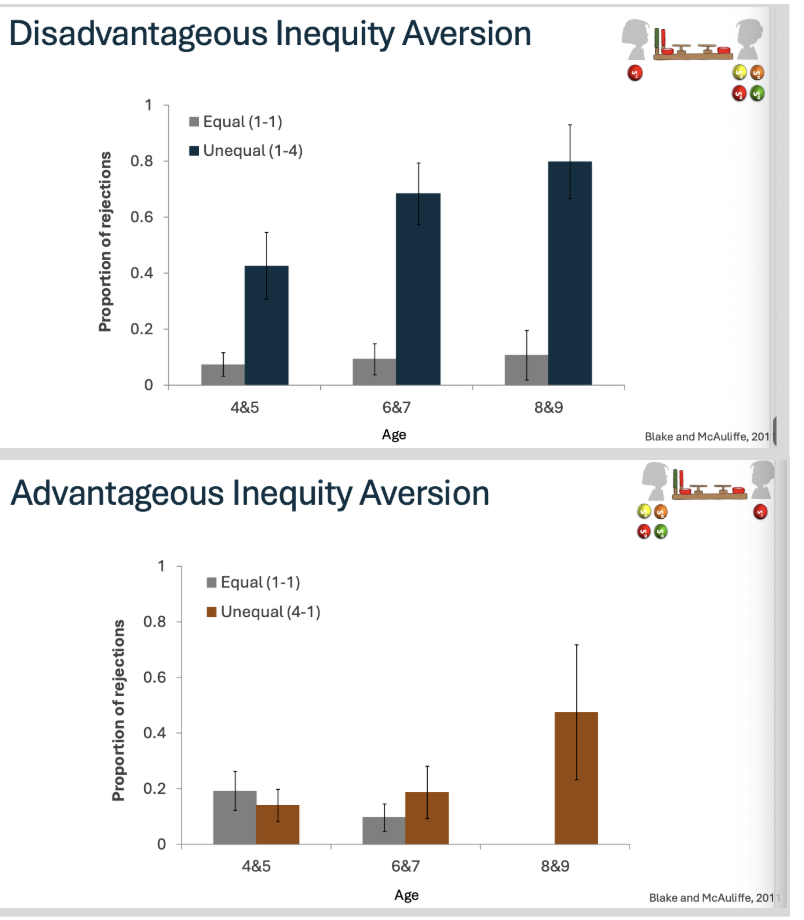
advantageous inequality — where the decider gets 4 and the bystanders gets 1 and it’s unequal but the person that got an advantage chose the inequality
in the superior or favorable position (the one with more)
disadvantageous inequality — the decider gets 1 and the bystander gets 4 and that’s unequal but he gets to make the decision
in an unfavorable position, making success or fairness harder (the one with less)
what was the blake and mcauliffe study, 2011 results and study?
In the disadvantageous inequity condition (where the child received less than a peer), rejection rates were low for equal offers but increased sharply for unequal offers across all ages, with older children (8–9 years) showing the highest rejection of disadvantageous unfairness. This indicates that even young children strongly dislike situations where they receive less. In contrast, advantageous inequity aversion (rejecting unfair offers that benefit the child) emerged later: younger groups (4–7 years) rarely rejected advantageous unfairness, treating equal and unequal offers similarly. Only the oldest children (8–9 years) showed substantial rejection of advantageous inequity. Overall, the findings suggest that aversion to being disadvantaged appears early in childhood, whereas the willingness to reject unfair benefits to oneself—reflecting a more mature, impartial fairness concern—develops much later.
for the ontogeny of fairness in seven societies — blake et al., 2012 — what was the result?
DI outcome — almost no kids regardless of age or country reject equal distribution. for the rejection of disadvantageous outcome (them receiving less and peer receiving more), you see a lot of positive slopes. an increasing rejection of disadvantageous outcomes with age
AI outcome — in majority of society, you are seeing that most children don’'t reject advantageous inequality (they receive more and peers receive less) and only in a subsection like canada, USA, and uganda where they do with increasing age (around ~ 50% of the time)
what was the talk of study and primate work with Dr. Frans de Waal? what were the results?what are the controversies about this work?
Talk of study and primate work with Dr. Frans De Waal
Capuchins reject unequal pay!!!!!
Capuchins – both have to get a rock and one gets cucumber and one gets a grape
one capuchin threw cucumber back at person hehe
Controversies about this work
Frustration, not fairness: rejections may reflect seeing a better food and wanting it (not social comparison) or not similar to equality it to inequality
Mixed replication: some studies find it, others don’t; depends on species, context, and design
Anthropomorphism: critics argue the behavior shows frustration, not moral concern
Unclear mapping to humans: monkeys react only to disadvantageous inequality, unlike humans who also dislike advantageous inequality
REVIEW OF THE ZIV AND SOMMERVILLE, 2017 article —> could it be experience with sharing?
Original study looked at infants’ looking time and expectation at unequal or equal distributions of resources
Infants at 15 months of age looked longer at unequal distribution of a specific person → meaning of infants have an understanding or expectation of fairness
At younger ages of 6 months it is not present and 9 months it is intermediate and there is an argument of that fairness is something that is developing between when you are born to 12-15 months of age
They wanted to see if children’s actual experience with sharing helped to facilitate their sort of expressing of this hypothesis consistent set of looking time data
When babies came into be tested for looking time, they had their parents fill out a survey and asked how much their child is engaging in sharing behavior with others with primary caregiver or with others
The idea is that if the baby at 9 or 10 months is sharing a lot with others, then you see an early emergence of the this hypothesis consistence looking time pattern
what is a key signature of an inequity version in children? what really represents inequality in studies? why? you see little evidence of that in who? what is an example of showing a bystander standing up?
Advantageous inequality is a key signature of an inequity version in children
It makes sense if we reject an inequality if we were at a disadvantage because of course we don’t like things that put as at a “lower” status than others
What really represents inequality or fairness is when you reject something when you receive more than others and that is only emerging in some communities
We see little evidence of that in chimpanzees or capuchins
If you see other people acting in unfair, if you are a bystander and putting yourself on the line to reinforce quality norms, that displays true caring and fairness
Example: protesting
what is punishment? what are the three harms?
punishment - the imposition of harm on an antisocial other
emotional harm - e.g., gossip, social, exclusion
material harm - e.g., fines, removal of resources
physical harm - e.g., corporal punishment
what is the difference between third party punishment ?
Second party punishment is when a victim punishes a wrongdoer while third party punishment is when an uninvolved bystander punishes a wrongdoer
Example is when the transgressor pushes the victim and then the victim hits the transgressor back that is second party punishment
Third party punishment would be when the transgressor pushes the victim and the bystander watches this happens and then punishes the transgressor
toddler’s interventions toward fair and unfair individuals — Ziv, Whiteman, and Sommerville What was the study? what were the results?
button where they could say a person was good or a person was bad. then shown a person equally distributing and unequally distributing —> then press option of which person was which.
button where they could say a person was good or a person was bad. then shown a person taking a cookie away
For the fair distributor they were more likely to say she was good when she distributed it fairly or gave a cookie
For the unfair distributor they were almost equally likely to say she was either good or bad
Not particularly likely to say she was bad for unfairness
Second version of the study for giving a cookie or taking a cookie, children are more likely to engage in positive behaviors giving a cookie to the fair distributor than it comes to engaging with an unfair distributor
This study is with 3-4 year olds
Doesn’t show compelling evidence for punishment of unfairness in the 3-4 year olds
RESULTS: Our studies showed that when given the opportunity to reward or punish an individual who previously distributed resources unfairly, infants respond at random and press both screen sides equally
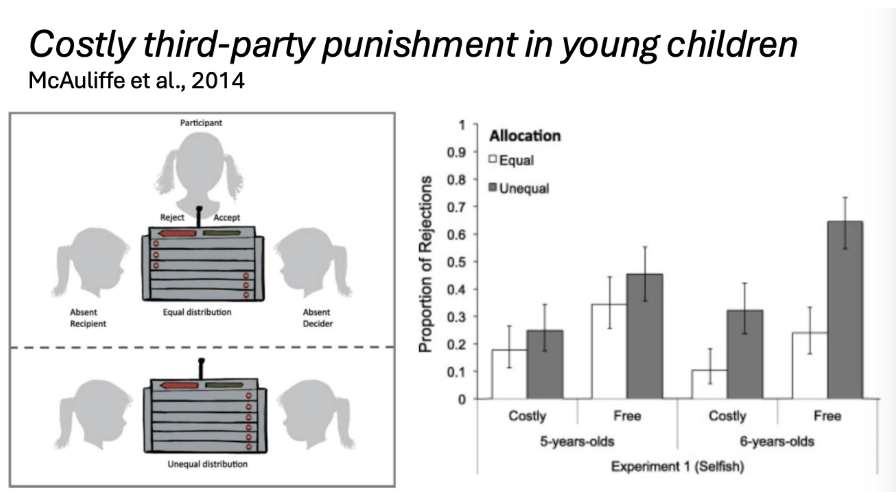
what was the costly third party punishment in young children — mcauliffe et al., 2014? what was the study? what were the results?
In this experiment there is a bystander and there are variations of how the skittles are divided. The participant can decide to accept or reject but if the participant rejects, it comes at the cost of one of their skittles. This experiment has an element of costliness to it mirroring that oftentimes when bystanders step in, there is some sort of repercussion or element of cost involved
Results indicate for five year olds they are no more likely to reject an unequal distribution relative to an equal distribution. Five year olds in this task are not engaging in this costly third party punishment – but at six year olds there is a difference of whether they reject unequal vs equal distributions
Third party punishment exists in six year olds but not five years olds
Six year olds are more likely to reject unequal distributions vs equal distributions
This shows more evidence that punishment is not early emerging because five year olds are not showing evidence of third party punishment
what did the social norms and cultural diversity in the development of third party punishment show — house et al., 2020? what did the “across six societies children engage in costly third party punishment of unfair sharing — mcauliffe et al., 2025“?
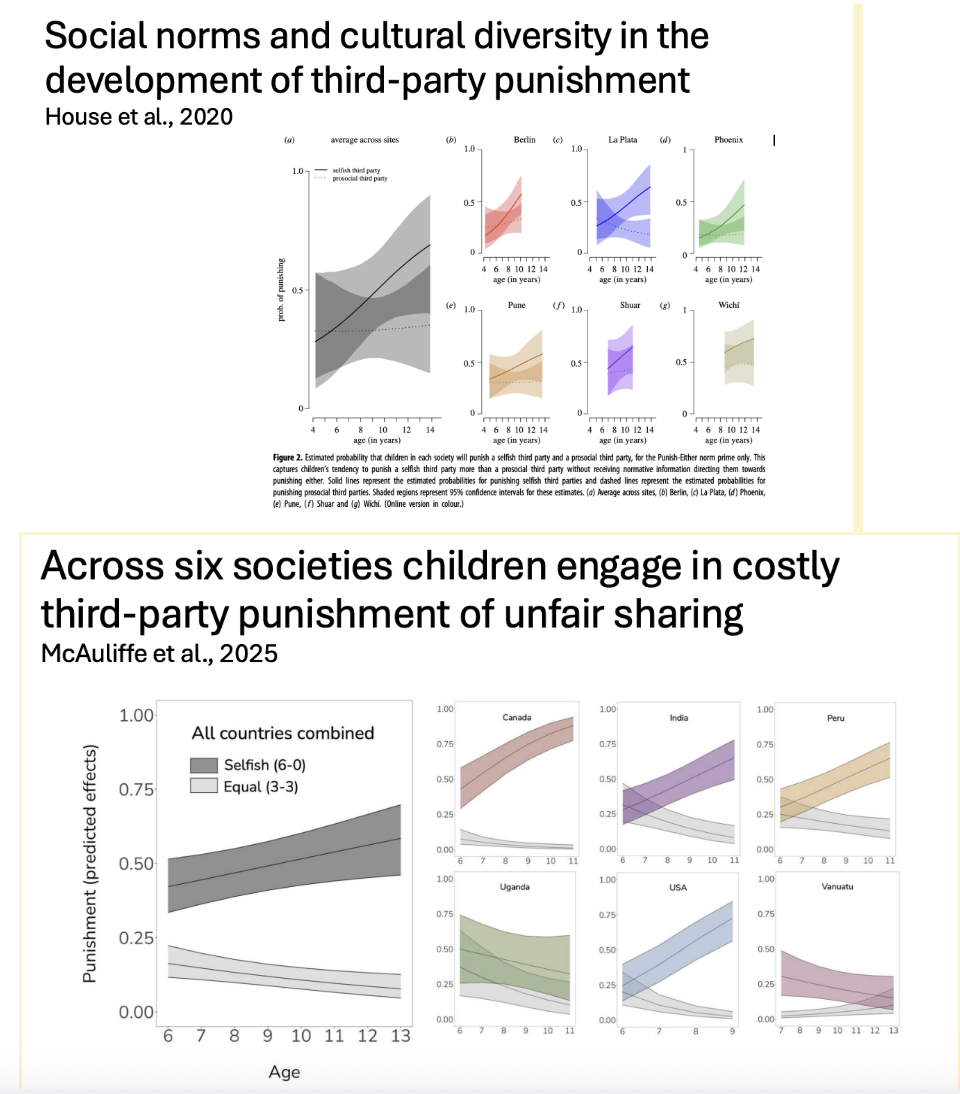
Across many cultures, children increasingly engage in third-party punishment as they get older—meaning they are more willing to punish someone who behaved unfairly, even when they themselves were not harmed and even when punishing is costly to them. This behavior strengthens with age and appears in societies around the world, suggesting that children develop a growing sense of impartial fairness and norm enforcement as they mature.
CHAT BC IDK WHAT MARSHY WAS TALKING ABT
What Each Study Shows 1. House et al. (2020): Cultural Diversity in Third-Party Punishment
Children in six different societies (Berlin, La Plata, Phoenix, Pune, Suhar, and Wixti) were studied.
The general trend:
Preference for prosocial punishment (punishing people who behaved selfishly) increases with age.
Punishing fair actors (who shared equally) decreases with age.
There is variation across cultures: some sites show stronger increases than others, but the overall pattern still holds.
Takeaway:
→ Children everywhere become more selective and more fairness-oriented as they grow.
→ Cultural norms shape the strength of the effect but not the direction.
2. McAuliffe et al. (2025): Costly Third-Party Punishment Across Six Countries
Examines whether children are willing to pay a personal cost to punish unfair sharing.
Across all countries combined, punishment of selfish behavior (6–0) increases with age.
Punishment of fair behavior (3–3) decreases with age (older children correctly ignore fair acts).
The same developmental pattern appears in Canada, India, Peru, Uganda, the USA, and Vanuatu, though with cultural differences in magnitude.
Takeaway:
→ The willingness to enforce fairness norms—even when costly—emerges universally.
→ Older children increasingly understand when punishment is appropriate vs. inappropriate.
What You Should Take Away Overall
Fairness norms develop universally.
Children around the world show a natural tendency to punish unfairness, even when uninvolved.Developmental shift:
Younger children are inconsistent and often punish randomly.
Older children show specific, targeted punishment of unfair behavior.
Third-party punishment = mature fairness.
This behavior shows that children gradually move from self-focused fairness concerns to impartial norm enforcement, a foundation of human cooperation.Cultural context matters, but the broad pattern is shared across societies.
This suggests fairness and norm enforcement are deep, possibly universal aspects of human moral development.
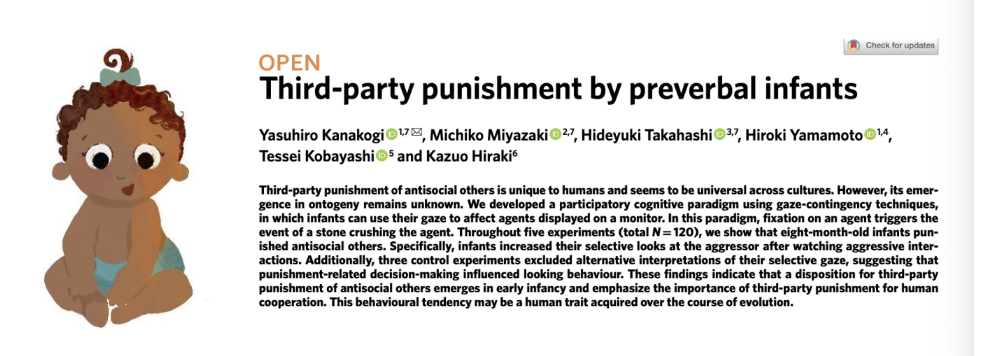
what was third party punishment by preverbal infants about — kanakogi?
We are not seeing evidence of punishment that require numbers until age 6 or 7
Babies could move their eyes in certain ways (gauge contingency) when babies move their eyes certain directions of the screen, certain actions result from that
The pretest involves the baby getting used to that where they move their eyes can determine which square gets punished
The experiment then shows the green square being the bully
Post test is when the baby can decide and move their eyes to either ends of screen if it wants to squish the green square (the bully) or the orange square (the victim) → example of third party punishment of infants
Criticisms → there is a force choice nature here
It could be that they want to avoid smushing the orange so they smush the green square
from finn’s reading notes:
The authors conclude that 8-month-old infants show a disposition for third-party punishment: they selectively direct a punishing event toward an aggressor who harmed another, even though the aggressor did not harm them personally.
They argue that:
This links moral evaluation (disliking aggressors) with moral behavior (punishing them) in preverbal infants.
The behavior seems intrinsically motivated, not driven by rewards, reputation, or explicit teaching, because infants are preverbal and there are no social payoffs in the task.
The tendency for third-party punishment may be a specifically human trait that evolved to support cooperation.
what was the new york manhattan museum study?
There is a study at the New York science museum and they asked kids at the museum the following scenario. There is this mean kid that ripped up another kid’s art work. There is this slide at the museum that everyone really likes going on and the kid is coming back later today to go on it. They then ask the child that they get to decide if they get to close the slide or keep it open – but if they close it, they forgo any opportunity themselves to go on it. To choose the closed sign represents the punishment that is costly.
Results found that children as young as the age of 3, are willing to represent the closed sign for antisocial agents which is much earlier than emergence of third party punishment than what was demonstrated in the fairness literature
This shows that kids are willing to put their money where their mouth is on punishment even when they are not affected by their outcome.
how do we define forgiveness in the philosophy, theology, and psychology way?
Philosophy: giving up of negative emotions, forbearance of negative reactions, and possible restoration of relationship
A lot of forgiveness work is lack of punishment so choosing to forgive someone
Theology: healing of what has been broken; wrongdoings are explained and overcome in effort to restore community
Psychology: prosocial motivational change toward transgressor
what are benefits of forgiveness?
Forgiveness has clear benefits on a societal level:
Repaired social relationships (e.g., Wallace et al., 2008)
Improved cooperation
But forgiveness also has personal benefits:
Improved mental and physical health
Reputational benefits
what is the philosophy of forgiveness? is forgiveness morally good ? morally bad? what is the takeaway?
Is forgiveness morally good?
Augustine: forgiveness as act of mercy
Tied to divine forgiveness
Arendt: forgiveness is obligatory; motivated by love
Is forgiveness morally bad?
Nussbaum: Any anger is bad!
Concern regarding transactional forgiveness
Nietzsche: ressentiment is healthy response to harm
Takeaway: there are various perspectives on whether forgiveness is good or bad
what is forgiveness in adulthood? how is it generally viewed? why are some adults wary of forgiveness?
Forgiveness in Adulthood:
Forgiveness is generally viewed by adults as a prosocial response
Agreeableness, emotional stability, and religiosity predict valuations of forgiveness
Social factors predict forgiveness behavior
Adults are wary of the negative consequences of forgiveness
Associated with reduced self respect and self concept clarity when offender fails to make adequate amends
If there are instances when someone is not adequately remorseful and you forgive them then that is not a good circumstance of forgiveness since you are not respecting yourself
what is forgiveness in childhood?
Forgiveness emerges as a mechanism for relationship repair early in life
Willing to forgive as victims
Sensitive to apology, remorse, and intent
Children also value forgiveness
Prefer forgivers over non forgivers
Expect positive outcomes after forgiveness
what was the oostenbroek and vaish, 2019 article — the emergence of forgiveness in young children? what was the study? what was the results?
research question: do children forgive accidental transgressors?
experimental set up:
anna —> looked remorseful and concerned — tore picture and said I didn’t want that to happen. it is my fault
kelly —> looked neutral — i’ve torn your picture. hmph, I don’t care
how did children react to these two agents
study 1: method (continued)
dependent variables:
whom are you more upset with? anna or kelly
why are you more upset with her?
whom do you like more? anna or kelly?
why do you like her more?
if you fell over, who do you think would help you? anna or kelly?
why do you think she would help you?
if you drew another picture, who do you think would tear it again? anna. or kelly?
why do you think she would tear it again?
key forgiveness question: here are three cloth flowers. later, anna and kelly will look inside their boxes. you can give flowers to anna and kelly hower you like.
RESULTS : Five year olds on average mainly responded to the hypothesized direction whereas the four year olds are not responding in the hypothesized direction. So forgiveness they define is liking people that are remorseful indexed by the flower measure isn’t really present until five so there may be this sort of developmental change we want to investigate.
from finn: 5-year-olds forgave the remorseful transgressor: they liked her more, expected more help from her, and gave her more flowers.
4-year-olds showed no pattern of forgiveness—they treated both transgressors similarly.
Justifications from 5-year-olds often mentioned remorse or moral reasoning (“she said it was her fault”), showing real understanding of remorse.
what was study 2: methods with oostenbroek and vaish? *explicit apologies*
anna —> remorseful —> i’ve torn your picture, I am sorry, I apologize
kelly —> looked neutral —> i have torn your picture. I don’t care
results:
"Our findings thus indicate that during the preschool years, children acquire the ability to forgive those who show remorse after causing them harm. This forgiveness reestablishes children's positive feelings toward their transgressors and fosters reconciliation, thus helping to repair their relationships and uphold cooperation (McCullough, 2008)”
Results: With explicit apologies, 4-year-olds now behaved like 5-year-olds from Study 1—they liked, trusted, and forgave the apologetic transgressor significantly more than the unapologetic one.
what was the children are more forgiving of accidental harms across development — amire et al., 2021 study about and what were the results?
focusing on how 5 - 10 year olds consider intentions in forgiveness
research question: do children forgive accidental and intentional transgressors?
scenario posed : one day, two boys were playing on a playground during recess. one of the boys, ben rode away on a bike that belonged to the other boy, thomas, on purpose. thomas was sad, but after some time he (a) forgave, (b) punishment, and (c) did nothing
12 questions about forgiveness, punishment, and doing nothing
asked with children in the scenario, adolescents, and adults
dependent variables:
empathy, revenge, recidivism, victim, offender
CONCLUSIONS/RESULTS:
Conclusions: “We found that participants from our three age samples displayed significant differences in the consequences associated with forgiveness, punishment, and doing nothing”
That children, adolescents, and adults all distinguish between the consequences of forgiveness, doing nothing, and punishment across a wide range of different dependent variables, including empathy, revenge, and recidivism
what are other ways to rectify injustice?
compensation of victims
private confrontation
fix/cover up
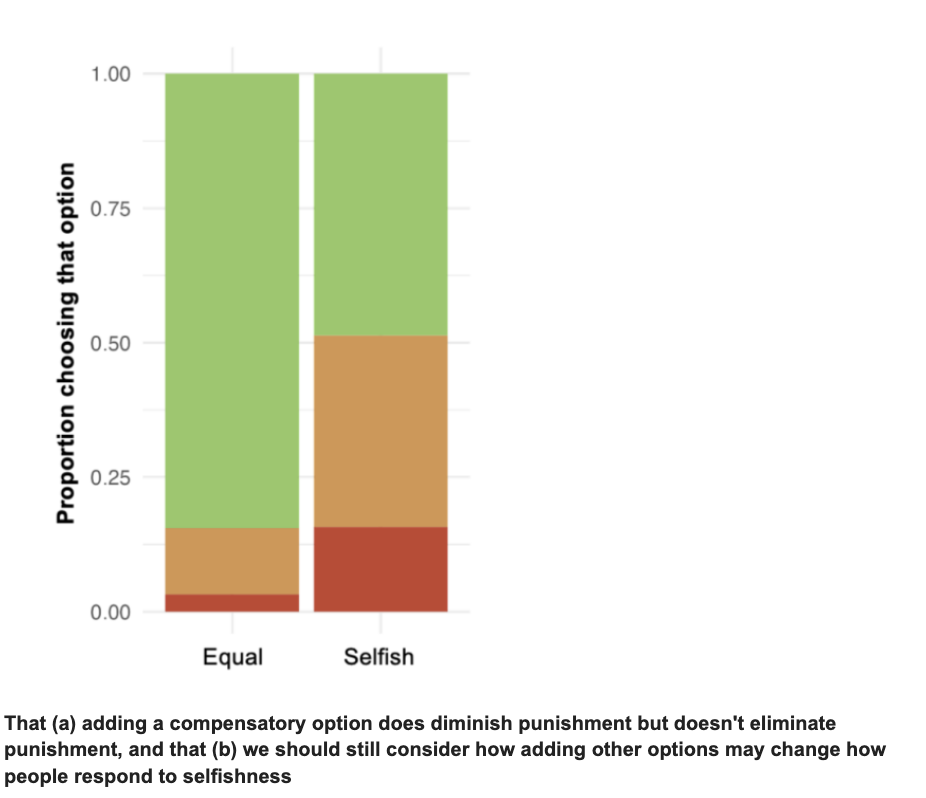
what was the — how intergroup context shapes children’s responses to inequality marshall, drake, gollowitzer, mcauliffer — costliness experiment (aka buckets)
That (a) adding a compensatory option does diminish punishment but doesn't eliminate punishment, and that (b) we should still consider how adding other options may change how people respond to selfishness
what are mechanisms of cooperation?
prosocial behavior like donating or giving something
antisocial behavior like stealing
what is reciprocity?
“The tendency to repay positive and negative behavior to others – is a powerful mechanism to establish cooperation among humans and has been considered an evolutionary advantageous strategy” (Worle & Paulus, 2019)
i’ll scratch your back if you scratch mine
what was the worle and paulus, 2019 study about reciprocity?
Design:
Each child saw three puppet-based scenarios:
Match-High Condition: A puppet reciprocated generously after receiving a lot.
Match-Low Condition: A puppet reciprocated modestly after receiving a little.
Not-Matched Condition: A puppet received a lot but gave back very little (violating reciprocity).
Measures:
Evaluation: Children rated how “good or bad” the puppet’s behavior was using a smiley scale.
Verbal Justifications: Children explained their reasoning.
Affirmation or Protest: Recorded if children praised or objected to the puppet’s actions.
Punishment/Reward Task: Children distributed “tasty” or “disgusting” cookies to reward or punish the puppets.
RESULTS/CONCLUSIONS:
What does this mean?
Children aged 5–6: They exhibited normative reasoning about reciprocity. That is, they judged protagonists who failed to reciprocate (after receiving a large share) more negatively than those who did reciprocate. Their spontaneous comments reflected the view that “you should return a favour”.
Children aged 3–4: They did not clearly apply the reciprocity obligation. Instead, they seemed to value general prosocial behaviour (sharing, helping) but did not show distinct condemnation of failing to reciprocate. They did not treat reciprocity as a norm yet.
Thus, the study concludes that the norm of reciprocity emerges during the preschool years — around age 5. Younger children see generosity as good but don’t yet treat returning the favour as obligatory.
What are limitations to the reciprocity paulus and worle study?
limited to smaller scale because larger scale interactions are much more difficult
Work only with repeated interaction between the same individuals
Requires memory and recognition of past partners
Breaks down easily due to mistakes or misunderstandings
Doesn't scale to large groups or one-time interactions
Can’t explain helping strangers or anonymous giving
what is reputation?
Also referred to as, indirect reciprocity
What is a reputation?
The beliefs or opinions that are generally held about someone or something
We can’t directly observe everyone’s behavior, but we care about who they are and how they will act toward us
Reputations help fill in the gap by acting as a proxy for traits like trustworthiness
This is also one of the reasons we culturally evolved names!
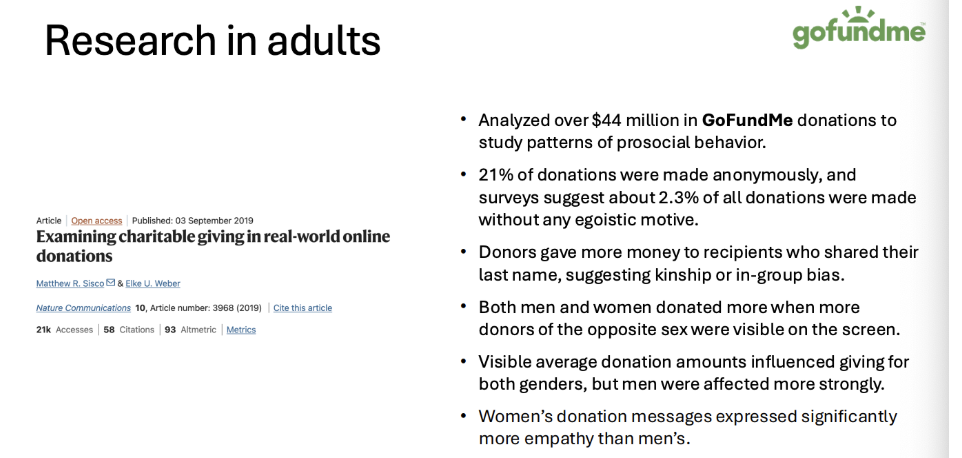
what was research in adults about the go fund me?
A large bulk of the donations given on Go Fund Me are not made anonymously
People are putting their name – to have names – suggests that reputation matters or people are paying attention to that
what was the primary motivation for donating? how was this done? what is the BIG pattern?
recipient needed help was the largest answer
helping feels good — second largest
felt empathy — third largest
felt like better person — fourth largest
asked people why they donated money — how they got results
people are likely to donate to charity and do so with their names attached
what was research in adults for the tragedy of the commons in regards to reputation?
this study shows that people contribute more to a shared resource when their behavior affects their reputation in later interactions. in other words, liking cooperation to future social rewards can prevent the “tragedy of the commons,“ where individuals would otherwise act selfishly and deplete the common good
another example of having your reputation known to others influences your decision in engaging in prosocial behavior
research in adults — leimgruber et al. 2012
There is a very robust finding in adults that you are much more likely to be prosocial if you are being watched, if you are publicly relative to if it is anonymous or there is no consequence for you
what is the early emerging care about one’s reputation?
Before the age of five, kids don’t seem to care as much about appearing prosocial when viewed by others
E.g. Warneken and Tomasello 2012 – parental presence & encouragement do not influence helping in young children
At around age five, kids show first signs of concern about reputation, sharing more when observed by others
Engelmann & Rapp (2017) – “The Influence of Reputational Concerns on Children’s Prosociality” — what is the main takeaway
Engelmann & Rapp – talks about how it is that children come to care about their reputation
In very early prosociality does not seem dictated by reputational concerns such that kids are not more likely to help in the presence of others – showed by felix warrenkin’s work
Age five and onwards children seem to care more
By age 8, kids are more strategic about how they use their reputation and they even give explanations in line with their behavior that underscore the idea that they care about their reputation
Young Children are More Generous When Others Are Aware of Their Actions – Leimgruber et al., 2012 — what is it about? what are the results?
Adults often act more generously when others can see their prosocial behavior, suggesting a concern for reputation
This study explored the early development of such reputation sensitivity in five year olds
Children chose to give one or four stickers to a familiar peer, while researchers manipulated the peer’s knowledge of the child’s actions
When the recipient could see the donation options, children were consistently generous
When the recipient could not see the the options or the child’s actions, children were much less generous
Findings show that five year olds display “strategic prosociality” – they act more generously when their behavior is observable
This suggests that reputation based prosocial behavior emerges early, even before children fully understand complex social reasoning about reputation
They are maximally prosocial when the walls are visible and the container is transparent
Different variability in those decisions
Both cases they are sensitive to when the walls are visible or occluded
Main takeaway: children are sensitive to the visibility of their decisions both to the container or what is at stake in the interaction – in children as young as five
This mean they care about the extent to which the person who they giving to is aware of the decisions and therefore the authors are inferring that children care about their reputation or willing to invest in their reputation
what was the costly fairness in children is influenced by who is watching — mcauliffe et al., 2020?
Advantageous inequity aversion (rejecting unfair advantages) develops relatively late in childhood, and the reasons for this delay are not well understood.
The study tests whether reputational concerns—specifically peer monitoring—encourage children to act more fairly.
Findings suggest that children’s fairness behavior is shaped by a desire to appear fair to those directly affected by their advantage.
results:
If you look at the public condition, when the division is equal (1-1), kids don’t choose to reject regardless of age but as they get older they are far more likely to reject advantageous inequity
But what they find in both the recipient ignorant and private they find the emergence of advantageous inquiry aversion is less strong
You still see the emergence of advantageous inequity aversion cannot fully be explained by reputational mechanisms but definitely plays a part in them
how is gossip a useful tool?
Approximately 2/3 of conversational time among Westerners is devoted to social topics (Dunbar et al. 1997) — likely very cross-cultural
Serves a multitude of functions, especially in regard to indirect reciprocity
So important to our lives, actually, that purposely & fraudulently harming someone’s reputation (defamation) is illegal (slander & libel)
what is the mechanisms of cooperation breakdown chart?
Mechanisms of cooperation:
Antisocial actions
Direct mechanisms
Punish them
Second party punishment (negative reciprocity)
Third party punishment
Indirect mechanisms
Reputation / gossip
Similar in either second or third party cases
Prosocial actions
Direct mechanisms
Praise
Indirect mechanism
Reputation / gossip
what is the history of sampling in psychology?
For the majority of the history in our science, we would recruit a lot of people and children near a university lab
For a small sort of money, free, or for children gifts/toys
This creates a fundamental limitation that people that can do this have more flexible jobs, children who have nannies can take them to labs, or Brown university students can participate in studies for credit
There have been some recent innovations in sampling psychology
For adult psychology, we can now rely on Prolific to sign up for studies that researchers put up online for side money
Researchers do this for more variability
Limited in smaller, more rural areas
For cross cultural work, traveling is a major portion of the work
what is “the WEIRDest people in the world argument“ by henrich?
What is the argument?
Problem: Most behavioral science research is based on people from Western, Educated, Industrialized, Rich, and Democratic (WEIRD) societies.
Assumption: Researchers often assume these populations are representative of all humans or that psychological processes are universal.
Finding: Evidence from across psychology, anthropology, and economics shows substantial variation across human populations; WEIRD samples are actually outliers, not the norm
Evidence for the argument?
Fairness and Cooperation: WEIRD participants behave more “fairly” in economic games (e.g., Ultimatum Game), emphasizing equality and punishment of unfairness.
Perception: WEIRD people are more susceptible to visual illusions like the Müller-Lyer illusion.
Moral Judgment: WEIRD individuals emphasize intentions and universal moral rules over social harmony or outcomes.
Reasoning and Categorization: WEIRD participants favor analytic reasoning (focusing on individuals and categories), whereas many others reason holistically (focusing on relationships and context).
Self-concept: WEIRD people are unusually individualistic and independent, valuing personal autonomy over group ties.
Heritability Estimates: Even measures like IQ heritability vary by social and environmental context, undermining claims of universality.
 Note
Note  Flashcards (31)