Botany (301) - UNIT 2
 Call Kai
 Learn
Learn Practice Test
 Spaced Repetition
 Match
Match Flashcards
 Knowt Play
1/86

Earn XP
Description and Tags
This Unit focuses on tissue systems such as the Dermal, Vascular, and Ground Tissue Systems. Each of these systems play a specific role in a plants overall function from growing shoots, leaves, roots and flower/fruits. These Flash cards will help you review and better understand the parts/cells of each tissue system, their functions, and how they make an impact on our lives.
Name | Mastery | Learn | Test | Matching | Spaced | Call with Kai | Chat |
|---|
No analytics yet
Send a link to your students to track their progress
87 Terms
Intro to Meristems and Development (part 1 of unit 2)
Chapter 22 (pgs 526-530)
What are the two directions plants grow?
Length- primary growth in height and depth (ex: elongation of roots and shoots)
Width- secondary growth in thickness or diameter (ex: widening stems or trunks)
What is the function of a meristem?
A population of cells that continuously divides and supply cells that form the plant body.
What are the two main kind of meristems?
Apical Meristem: primary growth that gives the primary plant structure (roots and shoots)
Lateral Meristem: secondary growth that gives the secondary plant structure (thickening the plant)
What is totipotency?
the ability to continuously divide to generate new cells that will differentiate into the different cell types.
What is the result of cell division and cell enlargement?
Increase in number of cells + increase in size of individual cell = Plant Growth
What is cell differentiation?
The process by which cells become structurally and functionally different from each other. Each cell type is specialized for specific functions.
What does cell differentiation cause?
division of labor between cells
What is the function that causes cell differentiation?
Selective gene expression: specific genes are turned on or off, allowing for specialized functions in various cell types.
How would you describe Morphogenesis?
The biological process that causes an organism to develop its shape and form, involving coordinated growth and cell differentiation to achieve the structure of plant organs and the overall plant body.
How would you describe a tissue in general?
a group of one or more cell types that is organized to perform specific functions.
What is a tissue system?
A combination of different tissue types that are related to one another in terms of their organization and function within the plant, working together to support growth, transport, and protection across different plant organs.
What are the three types of tissue systems present in plant organs?
Vascular, Dermal and Ground tissue system
what does RAM and SAM stand for?
Root Apical Meristem & Shoot Apical Mersitem
What does mitotic mean?
Actively dividing cells
What does undifferentiated mean?
Cells that have not yet specialized into specific types
What does isodiametric mean?
Cells that are roughly equal in all dimensions (normally round or cubic shape)
What are the characteristics of a primary cell wall?
Cells are thin and flexible to easily grow and divide cells
What are the primary meristems that are generated by the apical meristem?
Protoderm, ground meristem, and procambium
What tissue system and primary tissue is apart of the protoderm meristem?
Dermal Tissue System and epidermis is the primary tissue
What tissue system and primary tissue is apart of the ground meristem?
Ground Tissue System and the primary tissue types are parenchyma, sclerenchyma, and collenchyma tissues.
What tissue system and primary tissue is apart of the procambium meristem?
Vascular Tissue System and the primary tissues are the primary xylem and primary phloem.
Lateral meristems causes secondary growth where?
Stem and roots where primary growth reached full length
Not all land plants have lateral meristems such as _______ and some other _______, ______, and ______.
Monocots and some other angiosperm families, lycopods, and ferns
The lateral meristem is made up of what?
Vascular cambium and cork cambium
What type of division do the cambiums belong to?
Bidirectional - new cells generated to the interior of the organ and new cells generated to the exterior of the cambial layer.

What outerlayer is created by the lateral meristem (generated from cork cambium)?
Periderm (outer bark)
Vascular cambium generates what?
Secondary Xylem and Secondary Phloem which is made up of the Vascular Tissue System (VTS).
What does the Cork Cambium generate?
Cork (phellem) & Phelloderm which is made up of the Dermal Tissue System.
What is the other name for Cork Cambium?
Phellogen
The periderm is the outbark which is made up by what exactly?
Phellogen (cork cambium), Phellem (Cork), and Phelloderm (parenchyma cells).
Unit 2 (part 2)
Organization of Tissues and Cells (Ground Tissue System)
What three type of tissues are in the Ground Tissue System?
Parenchyma Tissue, Sclerenchyma Tissue and Collenchyma Tissue
Name the cell type in parenchyma tissue
Parenchyma cells
True or False, All tissues of the ground tissue system are simple (made of one cell type)
True
Cell structure of parenchyma cells:
ALL OF ThE FOLLOWING CARDS/INFO IS IMPORTANT TO UNDERSTAND TISSUE SYSTEMS AS A WHOLE!
most common cell type
often isodiametric (having equal or nearly equal diameters, dimensions, or axes in all directions)
metabolically active
often with large central vacuole
primary cell wall (mostly)
unlignified (mostly)
capable of cell division and differentiating into a different cell type, a new plant organ, or even a “zygote” which will develop into an embryo (totipotent)
Functions of parenchyma cells are:
handling basic metabolic, storage, and healing duties
Sclerenchyma Tissue has what type of cells:
Fibres or Sclereids

What is the cell structure of fibers?
elongate
thick secondary (most often lignified) cell wall
often in bundles in plant parts that have finished elongating
Sclereids cell structure are:
various shapes (not long like fibers)
They have very thick secondary walls rich in lignin, making them hard and inflexible.
The cytoplasm dies after lignin builds up, leaving a tiny hollow center called a lumen or narrow cavity.
Their thick walls contain small channels or simple pits that allow minimal transport before cell death
Sclereid and Fiber functions:
Sclereids are short, compact, and irregularly shaped cells with extremely thick walls that add structural hardness and resist compression
They form the hard outer seed coats of legumes, the stone shells of nuts (like walnuts and coconut endocarps), and the tough coverings of fruit walls.
They create a gritty or stony texture in fruit pulp (such as pears and guavas) and toughen leaves to discourage animals from eating them.
Star-shaped astrosclereids found in the leaves of water lilies provide structural support that helps the plant resist tearing from moving water currents.
Collenchyma Tissue has what cell type:
Collenchyma cells
Cell structure of collenchyma cells:
elongate
unevenly thickened primary cell wall and unlignified
beneath epidermis
able to grow
Functions of Collenchyma cells
They reinforce soft, non-woody plant parts like young stems, petioles, and leaf veins, helping them resist bending and swaying from the wind
Unlike rigid dead cells, living collenchyma cells have unevenly thickened primary cell walls made of cellulose and pectin that stretch and elongate as the plant grows.
They form protective strands or continuous cylinders just beneath the epidermis to cushion inner tissues against physical stress.
which of the tissues in the ground tissue systems are dead at functional maturity?
Sclerenchyma
which of the tissues in the ground tissue systems are alive at functional maturity?
Collenchyma and Parenchyma
Unit 2 (Part 3)
Chapter 23 (pgs 554-553) [Vascular Tissue System]
what two tissues are responsible for vascular tissue system
Xylem and Phloem
True or False: The Xylem and Phloem are complex tissues
True
Functions of the Xylem (in VTS) are….
conduction of water and minerals
water and solute conducting tissue consisting of a series of empty tubes that extend from root to shoot.
support (secondary xylem = wood)
What cells does the xylem consist of (in VTS):
Tracheary Elements – Water/mineral conducting cells - axial
Parenchyma cells –storage, conduction - radial (rays) and axial
Fibres – support - axial
Tracheary Elements are what cell types:
Tracheids and Vessel Elements
Types of Tracheary Elements are:
water conducting cells (of the axial system)
elements of elongation
thick. lignified. secondary cell wall commonly with pits
dead at functional maturity

Tracheids are present with end walls closed and tapered in what type of plants?
Seedless vascular plants
Gymnosperms
Angiosperms (all tracheophytes)
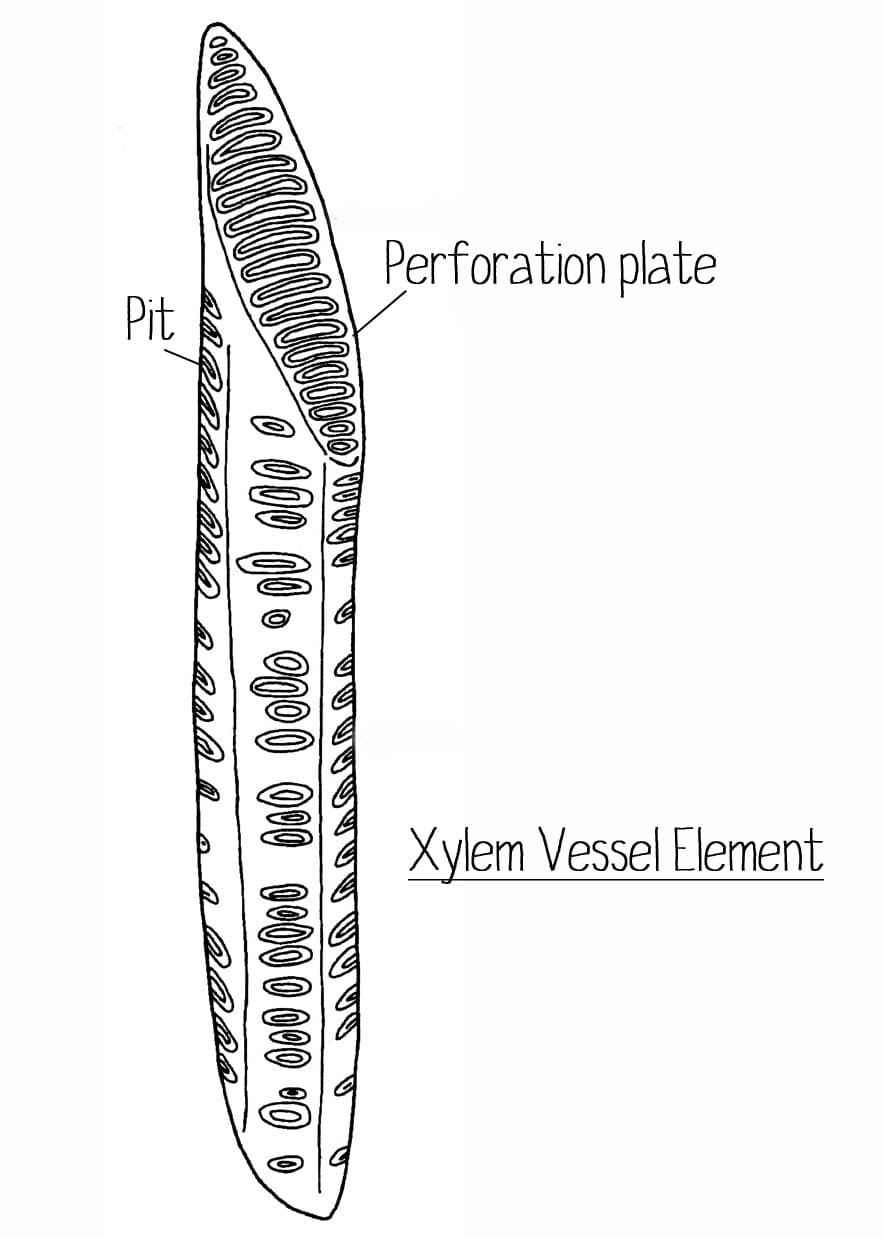
Vessel elements with end walls perforated so vessel elements form long continuous columns like a straw are in what type of plants.
Most angiosperms
Pits are areas where there is only ________________________.
Thin primary cell wall.
Thrashes occur in all _______ plants.
Vascular (hence the name ‘tracheophytes’)
Vessel elements are ____ and much ____ than tracheids. (appear as large holes in cross-section vessels)
Shorter, Wider
True or False: Tracheids evolved after vessels.
False!
Tracheids evolved before vessels!
Conifer is called softwood because……
it is generally easier to cut than angiosperm wood due to it’s uniform composition (mostly tracheids)
Angiosperm wood is harder due to….
presence of lots of fibers and its heterogeneous composition
TRUE OR FALSE : Heterogenous composition in wood means that it is composed of multiple distinct cell types but has the same function
FALSE: Heterogenous composition in wood means that it is composed of multiple distinct cell types with each having specific functions.
apical meristem continuously divided to form primary meristems like the ___________, which then differentiates into the ________ _________. This is all responsible for water transport during plant elongation.
Procambium, Primary Xylem
What is the lateral meristem?
A type of plant tissue that is made of actively dividing cells that cause a plants stem and roots to grow thicker in diameter.
lateral meristem has what type of systems?
Axial and Radical system
Axial system is what type of initials
Fushiform (elongated, spindle-shaped cells, and tapered at both ends).
Radical system has what type of initials?
Ray initials (smaller, more or less rectangular cells, brick shaped).
Fushiform initials give rise to…..
tracheary elements, fibers, and some parenchyma
Ray initials give rise to…..
primary parenchyma
Researchers use ______ cells that can be cultured to differentiate into tracheary elements as a model system to understand ___________ cell wall deposition.
Zinnia, secondary
What is primary growth?
Growth that makes a plant longer.
It is produced mainly by the apical meristem.
What does the apical meristem produce during primary growth?
IWhat is procambium?t produces new cells, including cells that become procambium.
What is procambium?
A primary meristem that develops into the plant's primary vascular tissues.
What does procambium give rise to?
Primary xylem + primary phloem
Protoxylem: When does it form, and what makes its tracheary elements special?
Protoxylem differentiates while the plant organ is still elongating.
Its tracheary elements have spiral or annular thickenings that can stretch as the surrounding tissue elongates.
Metaxylem: When does it form?
Metaxylem differentiates after elongation is complete.
What do “scalariform, reticulate, and pitted” describe in metaxylem?
They describe increasingly continuous patterns of secondary wall deposition:
Scalariform = ladder-like bands
Reticulate = network-like pattern
Pitted = most of the wall is reinforced, leaving small pits/openings
These patterns make the cell more rigid and less able to stretch.
→ Metaxylem = more extensively reinforced, so it doesn't need toaccommodate elongation.
Why does protoxylem have rings/spirals, while metaxylem hasladder/network/pitted patterns?
Protoxylem
→ forms while the organ is elongating
→ needs to stretch
→ secondary wall is deposited in rings/spirals
→ extensible
Metaxylem
→ forms after elongation has largely stopped
→ doesn't need to stretch
→ secondary wall can form ladder/network/pitted patterns
→ much less extensible
What is secondary xylem?
Secondary xylem is xylem tissue produced during secondary growth.
It is added to the plant as the stem or root increases in thickness (girth).
What meristem produces secondary xylem?
The vascular cambium, which is a lateral meristem, produces secondary xylem.
It produces xylem inward and phloem outward.
Where is secondary xylem found?
Secondary xylem is found in woody stems and roots.
These organs undergo secondary growth, which increases their girth/thickness.
A tree trunk gets thicker every year. What tissue is being added, and what produces it?
Secondary xylem is being added.
It is produced by the vascular cambium, a lateral meristem.
Why is lignin important in xylem vessels and tracheids?
Water moving through xylem creates tension that could cause the walls to collapse.
Lignin strengthens the walls, keeping the xylem open.
How does lignin help control water movement through xylem?
Lignin is impermeable to water, so water cannot leak through the cell walls.
Instead, water moves through specific openings connecting neighboring xylem cells or xylem cells to parenchyma.
How does water move from roots to leaves?
he cohesion-adhesion-tension theory explains water movement:
Cohesion → water molecules stick to each other.
Adhesion → water sticks to xylem walls.
Transpiration → water loss from leaves creates tension (pull) in the watercolumn.
→ This pulls water upward through the xylem.
How does water loss from leaves pull water upward from the roots?
Transpiration removes water from the leaves.
Because water molecules are cohesive, they form a continuous column in the xylem.
So when water is pulled out at the top, the tension is transmitted down the water column, pulling more water upward. (like a straw)
Leaves pull → water moves up → roots supply more water.
Why are mature tracheary elements essentially empty tubes with thick, waterproof walls?
They need to form a continuous pathway for water movement.
Empty interior → allows water to flow through.
Thick, lignified walls → prevent collapse under tension.
Waterproof walls → prevent water from leaking through the walls
***Xylem = strong, waterproof tubes for water transport.*****