Retail management midterm ch. 1-4
 Call Kai
 Learn
Learn Practice Test
 Spaced Repetition
 Match
Match Flashcards
 Knowt Play
1/46

There's no tags or description
Looks like no tags are added yet.
Name | Mastery | Learn | Test | Matching | Spaced | Call with Kai |
|---|
No analytics yet
Send a link to your students to track their progress
47 Terms
Retailing
a set of business activities that add value to the products and services sold to consumers for their personal or family use
Retailer
a business that sells products and/or services to final consumers for
personal or family use
retailers provide assortment and reduce number of transactions
Manufacturer → Wholesaler → Retailer → Consumer
Wholesale vs. retail
Wholesale- selling products in larger quantities to businesses at lower prices
Retail- selling products directly to consumers at higher retail prices
Retailer’s role
Attempt to satisfy consumer needs by having:
the right merchandise
at the right price
at the right place
at the right time
Retailer’s functions
Providing an assortment of products and services
Breaking bulk
- consumers purchase products in smaller quantities
Holding inventory
- products are available when consumers want to purchase them
Providing services
- repair services, getting help
Why is retailing a part of marketing?
It involves the management of distribution systems (place)
Breadth and depth of merchandise
Breadth (variety) - number of different product categories
Depth (assortment) - number of different items offered under a product category
Full-line discount stores
provide a broad variety of merchandise with limited service
low prices
selling private brands (Walmart’s Great Value) and national brands
Trends: omni-channels (order online, pick up at stores), expansion of product ranges such as organic and ethically sourced items
ex) Target, Walmart, Kmart
Specialty stores
provide narrow variety (limited merchandise) and high level of service (sales associate expertise)
typically under 8000 sq ft (easy browsing)
focus on specific market segments
ex) Abercrombie, Pottery Barn, Apple
Category killer
category dominance, specialty superstore
offers competitive prices due to category dominance and buying power
ex) Home Depot, Staples, Ikea
3 tiers of department stores
Upscale and high fashion: Bloomingdale’s, Saks, Neiman Marcus
Moderately-priced: Macy’s, Dillards
Value-oriented: Kohl’s, JCPenney
Off-price retailers
inconsistent assortment of brand-name, designer-label merchandise at discounted prices
ex) TJ Maxx, Marshalls
Extreme-value retailers
provides broad variety with shallow assortment of household goods, health and beauty care, groceries
ex) Dollar General, Dollar Tree
Private-label brand vs. National brand
National brand- created and owned by manufacturer/producer
ex) Song, Samsung, Kellogg
Private-label- created and owned by retailer and available only in its store
ex) Walmart’s Great Value brands, Macy’s INC International Concepts
Pros and cons of private brands
Pros
cheaper option for production
more control over pricing than branded products
Cons
lack of brand recognition
harder to build product lines
Pros and cons of national brands
Pros
higher customer loyalty
are seen as more reliable and familiar to consumers
Cons
no exclusive marketing rights
prices may be too high for customers
Intangibility
cannot be seen, tasted, felt or smelled before purchasing
difficult to evaluate before purchasing service
Inseparability (simultaneous production and delivery)
consumed when it is provided and can’t be separated from the provider
importance of service provider
perishability
cannot be saved, stored or restored
Inconsistency of offering (variability)
quality depends on who provides
Services vs. Merchandise
Services don’t have inventory, they sell expertise or skills
Merchandise: supermarkets, wholesalers
Service: airlines, restaurants, banks
Omnichannel retailing
use of multiple channels that provides seamless and synchronized customer experience
ex) store shopping and ordering unavailable items online in store
In-store retailing
touch and smell of products (trying on clothes)
personal service (suggestions from employees)
risk reduction (resolution of defective products)
immediate gratification
entertainment and social experience (social interactions)
cash payment
Internet retailing
deeper and broader selections (no physical store limits, more sizes)
more info available for evaluating merchandise
personalization (live chats for questions, personalize offerings through consumer search behaviors)
expanded market presence
perceived risks (invasion of privacy, security breaches)
Mobile retailing
customers can access retail sites from anywhere (smartphones)
location sensitive (promotion ads of nearby stores)
disadvantage: smaller viewing screen
Showrooming
examining merchandise in retail store and then buying it online at a lower price
bad for retailers bc there is a chance of losing sales to online competitors
Consumer purchase decision process
Need recognition
Information search (internal and external)
Evaluation of alternatives
Purchase decision
Post-purchase evaluation
Purchase decision process: Need Recognition
individual becomes aware of a difference between a desired state and an actual condition
utilitarian vs. hedonic needs
Utilitarian vs. Hedonic needs
Utilitarian- needs for accomplishing a specific task based on logic (functional, practical benefits)
Hedonic- needs for entertaining and recreational experience (induce feelings of excitement and cheerfulness)
Triggers of need recognition
inventory runs out
changing reference groups
dissatisfaction
boredom, novelty seeking
family life cycle changes
Purchase decision process: Information search
sources of information search about retailers, channels, and/or products to satisfy needs
Maximizer
individuals who always aim to make the best possible choice
Conversion rate
percentage of customers who enter a store or access a website and then buy a product from that same store or website
System 1 thinking
Hot cognition
impulse
intuition
feelings
automatic and rapid
rapid decisions for survival
System 2 thinking
Cold cognition
careful calculation/critical analysis
logical thinking
costs and benefits analysis
Multi-attribute models
customers see a retailer, product, or service as a collection of attributes or characteristics (evaluating retailers’ performance)
alternative retailers consumer is considering
characteristic/benefits consumers use when evaluating and choosing a retailer (price, convenience, delivery service, quality)
Non-compensatory attribute processing models
Lexicographic Model
consumers order attributes in terms of importance and compare the options one attribute at a time, starting with the most important
if one alternative dominates that attribute, it is chosen; if there is a tie, then proceed to next most important attribute
want to get brand that does best on attribute(s) most important to me
Cognitive Dissonance
based on the idea that your beliefs are inconsistent with one another or with your actions, which is experienced as unpleasant
when consumers experience inconsistent cognitions, they often do things to reduce the feelings of unpleasantness, discomfort
Loss aversion
losses loom larger than gains
High-involvement purchase
high value/price
serious personal consequences or long-term commitment
high impact on social image, deep emotional attachment
Greater involvement = greater opportunities to affect choice
Ex) cars, smartphones
Low involvement purchase
low cost, frequently purchased products
goal: to get people to buy habitually, without thinking
Familiarity, recognition, exposure are key to habitual purchasing E
Ex) toothpaste, bread
Convenience products
Low involvement
frequent, immediate purchases (candy, fast food, magazines)
low priced, little comparison shopping/effort
locations/distributions are critical (make them readily available)
Shopping products
High involvement
less frequent purchases
involves more effort and comparison bc it costs more than convenience purchases (camera, laptops, furniture)
location is important (fewer outlets, but provides more service and support)
Specialty products
High involvement
unique characteristics that buyer values
buyer makes a special effort to obtain (designer clothes, luxury cars, watches)
can have high brand loyalty (strong brand identification)
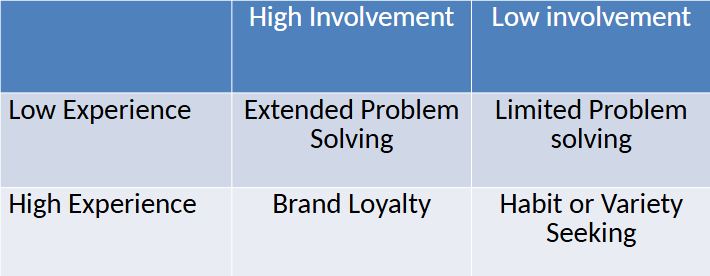
Modes of consumer decision-making by involvement and experience
High involvement, Low experience: Extended problem solving
High involvement, High experience: Brand loyalty
Low involvement, Low experience: Limited problem solving
Low involvement, High experience: Habit or variety seeking
Segmentation variables
Geographic- dividing market into groups based on location or environment
Demographic- personal characteristics; easy to measure (gender, age)
Psychographic- similar characteristics; shared attitudes and behaviors, personality, lifestyles
Behavioral- how consumers use or respond to a product (past purchase behavior)
Customer profiles (personas)
a narrative that captures consumers’ lives (including attitudes and preferences)
personas make segments easy to encode, recall and understand

