ch 7 endocrine system
0.0(0)
Studied by 2 people Call Kai
 Learn
Learn Practice Test
 Spaced Repetition
 Match
Match Flashcards
 Knowt Play
Card Sorting
1/64

Earn XP
Description and Tags
65 Terms
1
New cards
hormones
chemical messengers, secreted by epithelial tissue, that travel through the bloodstream, and act on target tissues
2
New cards
hormones function
control rates of enzymatic reactions, ion transport,
gene expression
gene expression
3
New cards
classic hormones
hormones of the pancreas, thyroid, adrenal glands, pituitary, parathyroid, and gonads
4
New cards
variations on classic hormones: secreted by cells/groups of cells
hormones can also be isolated (ex. immune )
5
New cards
variations on classic hormones: secreted into blood
hormones can also be secreted into surrounding tissue
6
New cards
variations on classic hormones: transport to distal target
some hormones can be paracrine in nature (localized response)
7
New cards
similarity between all hormones
hormones are secreted in low concentrations
8
New cards
hormone receptors
binding sites on target cells; binding elicits varied cellular responses (ex. insulin)
9
New cards
termination of hormone action
3 ways: mechanisms, half-life, or receptor-hormone complexes
10
New cards
mechanisms of hormone termination
reduced secretion (negative feedback); endocytosis; enzymatic degradation into inactive metabolites
11
New cards
half-life
amount of time to reduce the concentration by one-half
12
New cards
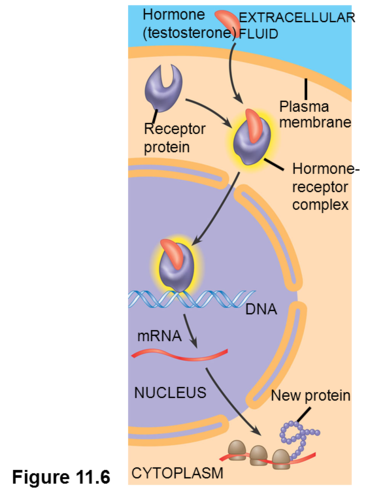
Receptor-hormone complex
enters nucleus and binds to specific region of DNA and helps initiate DNA transcription to produce mRNA which is translated into specific protein
13
New cards
How are hormones classified?
by chemical synthesis/structure
14
New cards
peptide and protein hormones
linked amino acids
15
New cards
steroid hormones
derived from cholesterol
16
New cards
amine hormones
a modified single amino acid molecule of tyrosine or tryptophan
17
New cards
The majority of hormones in the body are
peptide hormones
18
New cards
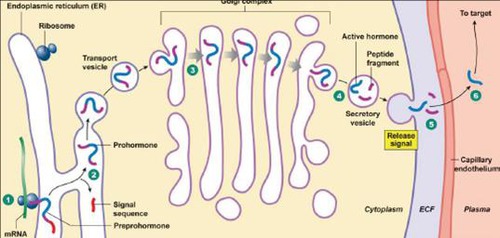
preprohormones
inactive precursor with signal sequence, directing to ER
19
New cards
prohormones
inactive precursor with signal sequence removed; packaged into vesicles; stored until needed
20
New cards
storage, synthesis and release of peptide hormones
1. preprohormone: inactive precursor with signal sequence
2. signal sequence is cleared, becomes pro hormone that is still biologically inactive
3. prohormone is packaged in Golgi into vesicles with enzymes
4. biologically active molecule hormone Is stored in vesicle until needed
2. signal sequence is cleared, becomes pro hormone that is still biologically inactive
3. prohormone is packaged in Golgi into vesicles with enzymes
4. biologically active molecule hormone Is stored in vesicle until needed
21
New cards
why do peptide hormones have short half lives
they are easily degraded because they are water soluble and can dissolve in plasma
they are not bound or protected by carrier proteins; no protective mechanisms in blood
they are not bound or protected by carrier proteins; no protective mechanisms in blood
22
New cards
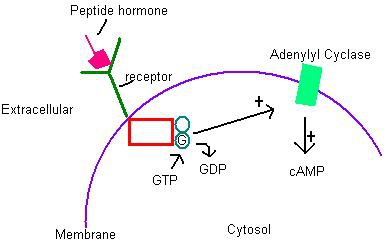
peptide hormones bind to
cell surface receptors
23
New cards
signal transduction pathway
The process by which a signal on a cell's surface is converted into a specific cellular response.
24
New cards
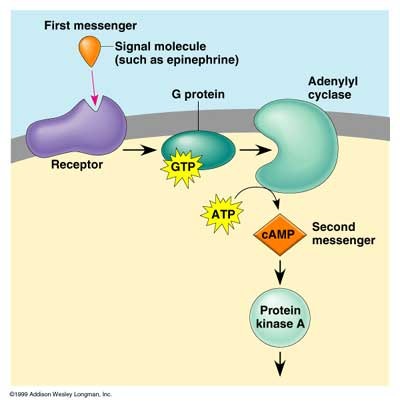
GPCR-cAMP Pathway
Stop signaling pathway
1. hormone binds to receptor (GPCR)
2. GPCR activates G protein
3. G protein separates and activates or inhibits effector enzyme (adenylate cyclase)
4. adenylate cyclase converts ATP to cAMP
5. cAMP activates protein kinases that modify other proteins
6. cAMP is degraded by phosphodiesterase to stop signaling pathway
1. hormone binds to receptor (GPCR)
2. GPCR activates G protein
3. G protein separates and activates or inhibits effector enzyme (adenylate cyclase)
4. adenylate cyclase converts ATP to cAMP
5. cAMP activates protein kinases that modify other proteins
6. cAMP is degraded by phosphodiesterase to stop signaling pathway
25
New cards
tyrosine kinase receptors
membrane receptors that attach phosphates to protein tyrosines
26
New cards
steroid hormones are derived from
cholesterol
27
New cards
Where are steroid hormones produced?
gonads, adrenal cortex, skin, placenta
28
New cards
adrenal cortex (kidneys) hormones
cortisol and aldosterone
29
New cards
Gonads hormones
estrogen, progesterone, testosterone
30
New cards
skin hormones
Vitamin D
31
New cards
How are steroid hormones synthesized?
synthesized on demand from cholesterol; needs signal, but is not waiting in vesicles
32
New cards
How are steroid hormones transported?
since steroid hormones are lipid-soluble they require transport proteins in plasma
33
New cards
lipophilic steroid hormones
move easily through membranes
34
New cards
how do carrier proteins affect steroid hormones
carrier proteins increase solubility and extend half lives of steroid hormones
35
New cards
steroid hormones transport
most steroid hormones have cytoplasmic and/or nuclear receptors to diffuse through the cell membrane
36
New cards
The binding of lipophilic messengers, such as steroid hormones, to their receptors triggers
gene transcription (synthesizing RNA from DNA)
37
New cards
amine hormones
melatonin, catecholamines, thyroid hormones
38
New cards
melatonin
synthesized from tryptophan in pineal gland
regulates circadian rhythm (sleep cycle) and immune function
regulates circadian rhythm (sleep cycle) and immune function
39
New cards
catecholamines
dopamine, norepinephrine, epinephrine
synthesized from tyrosine
synthesized from tyrosine
40
New cards
thyroid hormones
synthesized from tyrosine and iodine
involved in metabolism, growth, development
involved in metabolism, growth, development
41
New cards
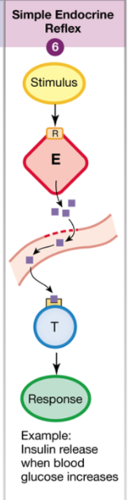
simple endocrine reflex
involves only one hormone
cell acts as sensor, integrator;
hormone is output signal
response is usually negative feedback
cell acts as sensor, integrator;
hormone is output signal
response is usually negative feedback
42
New cards
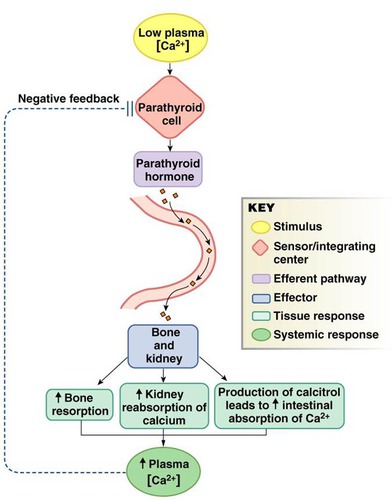
parathyroid hormone (PTH)
secreted from parathyroid glands and is regulated by blood calcium levels
parathyroid cell detects low Ca2+, increases PTH
PTH acts on bone (bone reabsorption), kidneys and intestines to raise blood Ca2+
parathyroid cell detects low Ca2+, increases PTH
PTH acts on bone (bone reabsorption), kidneys and intestines to raise blood Ca2+
43
New cards
insulin secretion
regulated by negative feedback when high blood sugar levels trigger its release from beta cells to reduce blood levels of glucose
44
New cards
neurohormones
chemicals released by neurons into the blood for action at distant targets
include catecholamines, hypothalamic hormones from posterior and anterior pituitary
include catecholamines, hypothalamic hormones from posterior and anterior pituitary
45
New cards
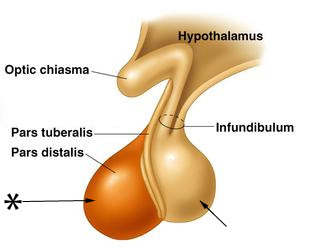
anterior pituitary
epithelial tissue, endocrine organ
aka adenohyphysis
aka adenohyphysis
46
New cards
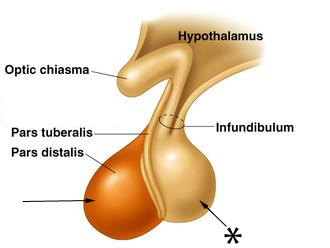
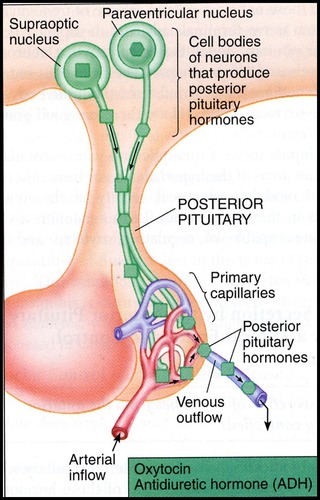
posterior pituitary
extension of the brain that releases hormones produced by the hypothalamus;
aka neurohypophysis
aka neurohypophysis
47
New cards
2 hormones of the posterior pituitary
ADH and oxytocin
48
New cards
antidiuretic hormone (ADH)
regulates water balance in the kidneys by inserting aquaporin water channels (reabsorption)
49
New cards
oxytocin
controls milk ejection during breastfeeding and uterine contraction during childbirth
50
New cards
posterior pituitary hormone release
1. neurohormone made+packaged in cell body of neuron in hypothalamus
2. vesicles transported down the cell
3. vesicles w/ neurohormone are stored in posterior pituitary
4. neurohormone released out vein and into bloodstream
2. vesicles transported down the cell
3. vesicles w/ neurohormone are stored in posterior pituitary
4. neurohormone released out vein and into bloodstream
51
New cards
what is anterior pituitary controlled by
releasing hormones from hypothalamic neurons
52
New cards
trophic hormones
hormones that stimulate other endocrine glands to release hormones; those released from the anterior pituitary= FSH, LH, ATCH,TSH
53
New cards
anterior pituitary hormone release
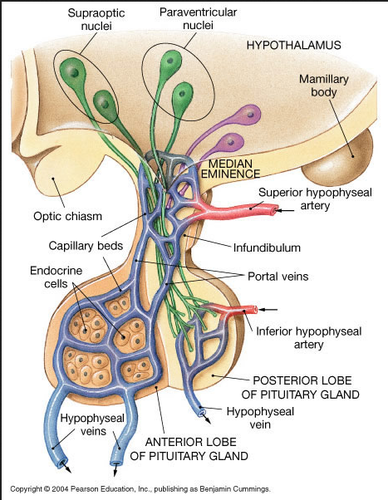
1. in hypothalamus, neurons synthesizing trophic neurohormones release them into capillaries of portal system
2. portal veins carry neurohormones to anterior pituitary, where they act on endocrine cells
3. endocrine cells release their peptide hormones into second set of capillaries to distribute out to body
2. portal veins carry neurohormones to anterior pituitary, where they act on endocrine cells
3. endocrine cells release their peptide hormones into second set of capillaries to distribute out to body
54
New cards
hypothalamic-hypophyseal portal system
two sets of capillaries connecting hypothalamus to anterior pituitary
55
New cards
6 anterior pituitary hormones
Growth hormone (GH)
Thyroid-stimulating hormone (TSH)
Adrenocorticotropic hormone (ACTH)
Follicle-stimulating hormone (FSH)
Luteinizing hormone (LH)
Prolactin
Thyroid-stimulating hormone (TSH)
Adrenocorticotropic hormone (ACTH)
Follicle-stimulating hormone (FSH)
Luteinizing hormone (LH)
Prolactin
56
New cards
prolactin
stimulates milk production
57
New cards
Thyroid Stimulating Hormone (TSH)
stimulates thyroid gland, increases prod of T3 and T4
endocrine target= thyroid gland
hormones secreted= T3 T4
endocrine target= thyroid gland
hormones secreted= T3 T4
58
New cards
Adrenocorticotropic hormone (ACTH)
controls cortisol release
endocrine target= adrenal cortex
hormones secreted= cortisol
endocrine target= adrenal cortex
hormones secreted= cortisol
59
New cards
Growth Hormone (GH)
promotes skeletal and muscular growth
endocrine target = liver
hormones secreted= IGFs (insulin like growth factors)
endocrine target = liver
hormones secreted= IGFs (insulin like growth factors)
60
New cards
Gonadotropin-releasing hormone (GnRH)
Promotes secretion of follicle-stimulating hormone (FSH) and luteinizing hormone (LH)
61
New cards
luteinizing hormone (LH)
secreted by the pituitary gland to promote ovulation
62
New cards
Follicle-stimulating hormone (FSH)
secreted by the pituitary gland to stimulate maturation of the egg cell (ovum)
63
New cards
hypothalamic-pituitary-adrenal (HPA) axis
a body system involved in stress responses
64
New cards
short loop feedback
pituitary hormones feed back to decrease hormone secretion by the hypothalamus
65
New cards
long loop feedback
hormones of target endocrine gland feeds back on hypothalamus and anterior pituitary gland