mexico city case study
 Call Kai
 Learn
Learn Practice Test
 Spaced Repetition
 Match
Match Flashcards
 Knowt Play
1/52

There's no tags or description
Looks like no tags are added yet.
Name | Mastery | Learn | Test | Matching | Spaced | Call with Kai |
|---|
No analytics yet
Send a link to your students to track their progress
53 Terms
what is the site of mexico?
- the city was located on an area of land which used to be lake texcoco but was drained by early settlers during the aztec times
- the city is now located on a flat upland landscape called the central plateau
what is the situation of mexico?
mexico city is surrounded by the cities of toluca and pachuca
what is the regional connectivity of mexico city?
mexico city is served by regional transport services such as buses, coaches and trains
what is the national connectivity of mexico city?
motorways connect to industrial towns such as toluca which means that goods can be transported to the main market
what is the international connectivity of mexico city?
- mexico city has two international airports which links mexico city with europe, usaand south america. this creates an economic and transport hub, encouraging development.
- international routes such as federal highway 57 are important because they link to the usa for trade
state the cultural context for mexico city:
- largest spanish speaking country in the world
- with a population of 21 million, it is the largest metropolitan area in the western hemisphere
- in 2011, the city had a GDP of US$411 billion making it one of the richest urban areas
explain mexico city's CBD:
- main financial hub, characterised by office blocks, government buildings and the mexican stock exchange
- the CBD now attracts high value retailers and shopping malls especially in the santa fe area
explain mexico city's inner city:
- characterised by slums
- "vercindades" are abandoned multi-storey colonial mansions which are converted into cheap tenements and rented out to families
- mix of high quality to mid-quality housing
explain mexico city's suburbs:
- characterised by areas like ciudad satelite with middle class housing mainly built to owners orders
- houses have tight security- walled off parking spaces, barbed wire, electric fences and armed guards
explain mexico city's urban rural fringe
- land use dominated by unregulated shanty towns
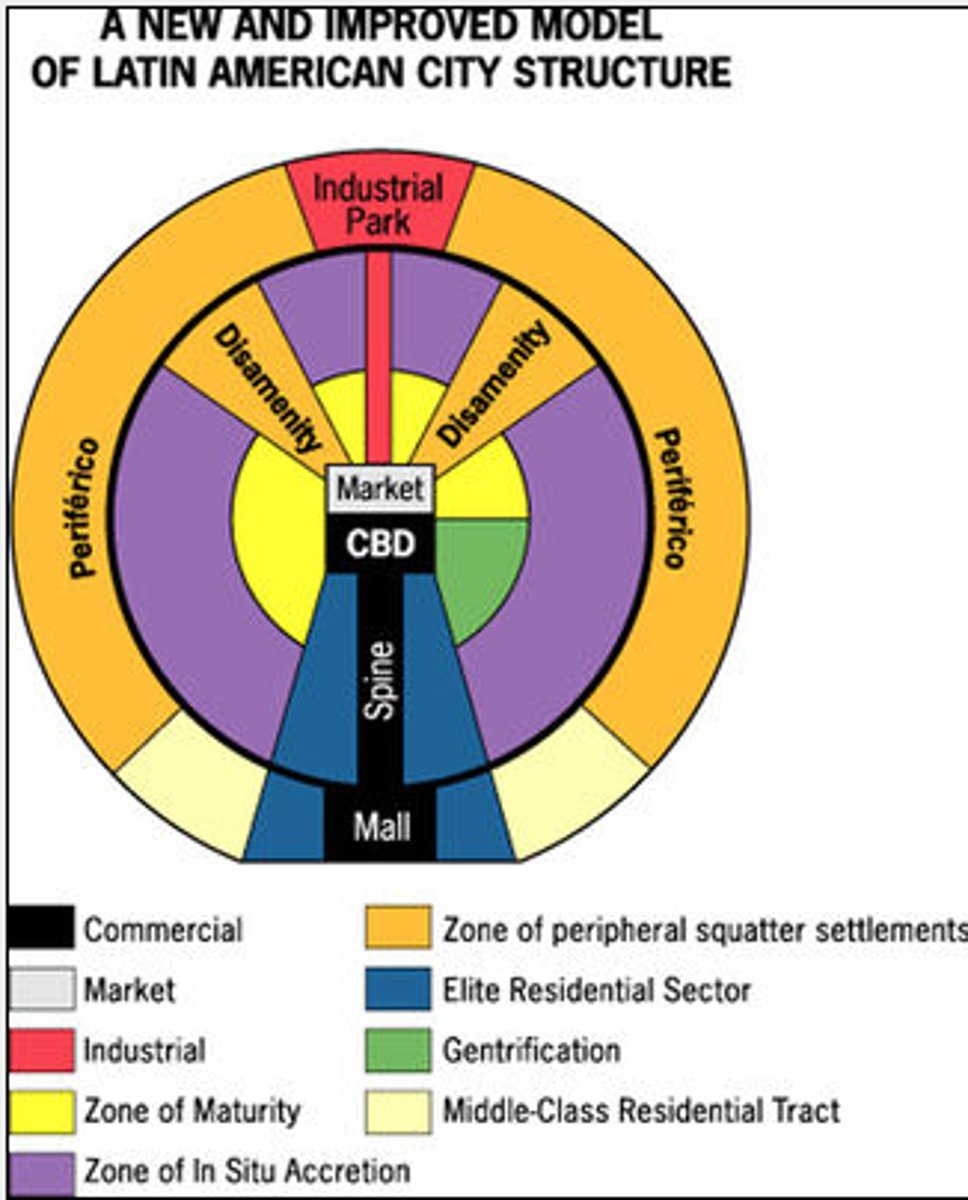
how closely related is mexico city's structure to latin american cities?
mexico city's pattern of land use is similar to the latin american city Model
- the cbd is in the centre and the perifeco is on the outsides
- similarly industrial areas are edging towards the outskirts but not as packed together.
- however unlike the model, squatter settlements exist close to the cbd.
what has the population change of people living in urban areas in mexico city been from 1950 to 2010?
1950: approximately 2million people lived in urban areas
2010: the urban area had a population of approximately 19 million
how did the number of people living in the inner suburbs change from 1950 to 2010?
1950: 2 million
2010: 7 million
how did the number of people living in the boundaries of mexico city change from 1950 to 2010?
1950: 3 million
2010: 1 million
what are the reasons for population growth in mexico city? (3)
1. natural increase
2. economic investment and growth
3. migration
how has natural increase impacted population growth?
during 1950s-1980s, a high birth rate and a fall in death rate due improved healthcare so better treatment and lower infant mortality rate, meant the population grew rapidly.
how has economic investment impacted population growth?
many businesses have invested in projects in the city which has created jobs in factories and offices, attracting migrants to the city.
how has migration impacted population growth?
- rural to urban migration: people left the countryside in search of jobs, better housing, schooling and modern healthcare- wanting to escape the hardship and poverty of parts of the country
- international migration: new job opportunities in factories and offices in the city have attracted people from europe, japan and the USA for example firms such as renault and santander have opened new branches there in recent years
state the 7 impacts migration has on mexico city
1. housing
2. water supply
3. inequality and safety
4. air pollution
5. waste pollution
6. employment
7. age structure
how is housing being impacted due to migration?
- mexico city cannot provide enough housing for its entire population
- the need for homes has led to more self-built housing at the city edge such as shanty towns
- these shanty towns lack access to basics such as clean water and electricity
how are water supplies being impacted due to migration?
- difficulties in supplying clean water with rising demand has put pressure on the city's reservoirs
- as water is extracted, the land sinks and buildings, power lines and sewage pipes are broken
how has inequality and safety been impacted by migration?
- inequality within mexico is growing with the number of poor people rapidly increasing as they move to the city from rural areas to find work
- inequality has caused some issues and in some cases, it has helped lead to a rise in crime
- richer housing areas are increasingly becoming gated communities with security forces as a result of the fears of crime and kidnapping.
how has air pollution been impacted by migration?
- in the 1970s, mexico city had a major air pollution problem with the main source of the pollution being transport exhaust fumes
- rise in car ownership increases both air and noise pollution so people living in the city suffered from health issues like respiratory problems.
- the government have tried to overcome these issues but air pollution is still a problem.
how has waste pollution been impacted by mexico city's migration?
- everyday the people of mexico city produce 13,000 tonnes of rubbish
- the waste disposal system can only remove 9000 tonnes a day
- the rest is dumped in any bit of open ground, street or drains where it clogs the system
- this is now polluting water sources
how has employment been impacted by mexico city's migration?
- the city has grown faster than the number of "proper" jobs available
- this has resulted in unemployment and an increase in informal economy (60% of jobs)
- informal employment is made up of jobs which there is little or no official control e.g. street sellers, unofficial taxis, car cleaners
>> 25% of taxis are unoffical
>> around 25000 street sellers of sweets, cigs and food
- where employees are open to exploitation and low pay
how has the age structure of mexico city been impacted by migration?
- many migrants moving to the city are young adults
- this leads to a rise in the number of younger people living in the city
- but the lack of jobs is also increasing the rate of crime
what is spatial inequality?
the unequal distribution of wealth or resources in a geographic area, so that some places are richer than others
why is there a large gap between the rich and the poor?
many of the people arriving in the city are very poor and there is a lot of competition for jobs which are available, those that are, paying low wages. without a good income, people are unable to provide basic needs for themselves or their families, leading to a negative multiplier. as a result, it is harder to get wealthier
state the 3 places where extreme wealth v extreme poverty can be observed
1. wages
2. education
3. services
what is the difference in wages between the rich and the poor in mexico city?
- minimum wage should be US$4 but 1 in 3 workers are paid less
- the top 20% of people in mexico city earn as much as 13 x more as the bottom 20%
- poorer people also work longer hours- 29% of employees work very long hours compared with an average of 13% in other emerging countries
what is the difference in education between the rich and the poor in mexico city?
- the poorest 10% average only two years or schooling attendance
- the richest 10% average with twelve years
what is the difference in services between the rich and the poor?
- shanty town residents have no running water, electricity or food shops
- residents in wealthier areas live in larger houses with gardens and swimming pools
>> wealthier people are those with political power; they are able to get homes in better parts of the city
state the impacts of rapid urbanisation in mexico city: (5)
- housing shortages
- squatter settlements
- under-employment
- pollution
- inadequate services
how has rapid urbanisation impacted housing shortages?
- many migrants moving to the city are living on garbage dumps, forced to search through the waste to make money.
how has rapid urbanisation impacted squatter settlements?
- migrants from the countryside are forced to illegally build homes made out of waste materials on the edge of the city
- these homes have no running water or electricity
- they grow so rapidly that the authorities do not have the time or finance to connect all the houses to clean water supplies
- this means the water is often polluted with sewage leading to illnesses like typhoid and cholera
how has rapid urbanisation impacted under-employment?
- the city has grown faster than the number of "proper" jobs
- this has resulted in unemployment and an increase in informal economy (60% of jobs)
- informal employment is made up of jobs which there is little or no official control e.g. street sellers, unofficial taxis, car cleaners
>> 25% of taxis are unoffical
>> around 25000 street sellers of sweets, cigs and food
- where employees are open to exploitation and low pay
- minimum wage should be US$4 but 1 in 3 workers are paid less
how has rapid urbanisation impacted pollution?
AIR:
- in the 1970s, mexico city had a major air pollution problem with the main source of the pollution being transport exhaust fumes
- rise in car ownership increases both air and noise pollution so people living in the city suffered from health issues like respiratory problems.
- the government have tried to overcome these issues but air pollution is still a problem.
WASTE:
- everyday the people of mexico city produce 13,000 tonnes of rubbish
- the waste disposal system can only remove 9000 tonnes a day
- the rest is dumped in any bit of open ground, street or drains where it clogs the system
- this is now pollution water sources
name a bottom-up strategy for making mexico city more sustainable
- in neza, there is work to develop the area in an organised way- cultiva ciudad
- bus app
- people use water sparingly
explain the strategy in neza:
- working with local schools to educate children by building schools.
- this has helped to provide learning opportunities for children improving the lives of some of the poorest children and make sure they grow up to lead better lives and so they are able to make areas in the future more sustainable.
- a health centre has been opened and self-build programs have been implemented to help people arriving from the countryside
- in turn this has meant there is less crime as other parts of the city as people feel like they're needs are being met
advantages of bottom-up schemes
- target specific needs of the locals
- do not take a lot of time or money to get going
disadvantages of bottom-up schemes
- usually funded by NGOs so development is slow as there is a great reliance on them
- cannot deal with big problems e.g. air pollution
name two top-down schemes that have tried to help mexico city to become more sustainable
- the metrobus
- the barter market
-the mexicable
how has the metrobus helped mexico city with its sustainability?
- in 2005, mexico city's government introudced the metrobus which is estimated to reduce 35,000 tonnes of carbon dioxide emissions annually and therefore reduce the very high levels of air pollution
- the bus transport system moves approximately 250,000 people per day this benefits commuters as they can get to where they need without paying for fuel
- journey times are reduced by approximately 30 minutes
- this also means that there will be long-term health benefits
disadvantages of the metrobus scheme
the new buses are expensive so fares rise and poorer people will be unable to afford the fares
how has the barter market helped mexico city with its sustainability?
- mexico city produces an estimated 13,000 tonnes of solid waste every day to one landfill site
- the landfill site was eventually shut but the government failed to provide an alternative
- in 2011 to combat this issue, the government introduced a trading system of trash for food
- this involved setting up a "barter market" with people exchanging wasteful vouchers for food
- not only did this scheme help with waste disposal but also improved lives for increase access to food.
advantages of top-down projects
- can access large sums of money
- can benefit 1000s if implemented correctly
- access to latest technology
disadvantages of top-down projects
- many locals may not benefit
- can take a long time to put into action
- funding can come with "strings attached"
the mexicable
20p to ride
completed in 2016
30,000 ppl per day
7 stations, only 3 miles
safer than buses
184 cars
too small scale
Emisor Oriente Tunnel
-94 pumping stations
- completed in 2019
benito juarez v milpa alta
| Benito Juarez | Milpa Alta
----------------------------------------------------
infant
mortality | 11.6 | 20.3
rate
----------------------------------------------------
% in
food | 0.5 | 53
poverty
----------------------------------------------------
% of
houses
with | 98 | 10
piped
water
----------------------------------------------------
average
income | 75100 | 6100
(pesos)
Plan Verde
- air pollution is down 35% compared to 2000
-focuses on public spaces, waste handling, land use and sanitation
-implemented 2007
-metro bus means 7000 fewer cars on the road
-bike rental
-close main road on sunday
Barter Market
A market in Mexico where people exchange recyclable waste for farmers produce e.g. Vegetables
-1400 pounds of rubbish recycled in 2015
1st sunday of the month
Integrated Bus Network
-specific bus lanes - less traffic - quicker - desirable
-70000 less cars a day

