middle childhood, social and developmental
 Call Kai
 Learn
Learn Practice Test
 Spaced Repetition
 Match
Match Flashcards
 Knowt Play
1/44

There's no tags or description
Looks like no tags are added yet.
Name | Mastery | Learn | Test | Matching | Spaced | Call with Kai |
|---|
No analytics yet
Send a link to your students to track their progress
45 Terms
Psychological development
Competence 6-12 yo. focus on efforts to meet the challenges presented by parents, peers, school, etc
success in ivis → feelings of mastery and proficiency and a growing sense of competence
difficulties in ivis → feelings of failure and inadequacy (children may withdraw from academic pursuits and from interactions with peers
Self-understanding during middle childhood
Shifting focus from external to internal characteristics:
they start to view themselves more in terms of psychological traits rather than physical → related to cognitive development
realise they are good at some things and not others
self-concept (divided into personal and academic spheres) and self-esteem continue to develop
Four areas of self evaluation in children
Self concept
physical
emotional
academic
social
Physical self concept
physical ability
physical appearance
Emotional self concept
Particular emotional states
Academic self concept
language
history
math
science
Social self concept
peers
significant others
Social comparison
Used to determine levels of accomplishment
when concrete objective measures of ability are lacking, people turn to social reality to evaluate themselves → children rely on similar others to gauge the correctness of their attitudes , opinions and behaviours
Downward social comparisons
Comparing ourselves with others who are less competent, talented or successful in the domain under consideration can protect our self-esteem
Self-esteem
An individuals overall and specific positive and negative self-evaluation developing in middle childhood trough:
comparing oneself to others
developing their own standards of success
improves during this time
becomes increasingly differentiated → global simple view of themselves or progress to be higher for some areas and lower in others
Summary of self-esteem
generally is high during middle childhood , but it begins to decline around 12
school transition
gradually rises again or is chronically low
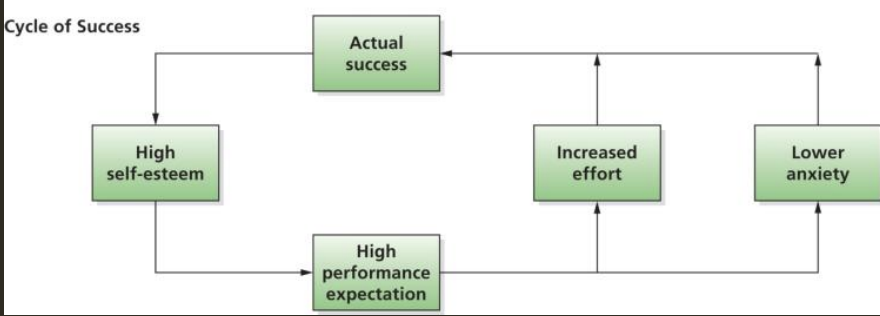
Cycle of low self-esteem (success)
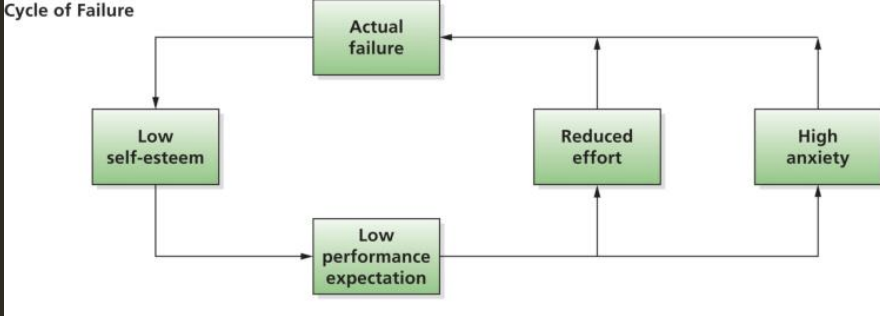
Cycle of low self-esteem (failure)
Moral development
Changes in sense of justice and of what is right and wrong + moral related issues
developmentalists: children’s reasoning about morality, their attitudes toward moral lapses and their behaviour when faced with moral issues
Approaches to moral development
piaget view of moral development
social learning approaches to morality
genetic approaches to morality
Piaget stage 1 of mortality development
Heteronomous morality
4-7
rules seen as invariant, unchangeable and beyond child’s control and influence
may not yet fully grasp game rules: when rules are broken they will be punished instantly
do not take intention into account
believe in immanent justice
Piaget stage 2 of mortality development
7-10
games become more social and learn the rules
children learn the actual formal rules of games, play according to them
there is a ‘right’ way to play
Piaget stage 3 of mortality development
begninning at age 10
become fully aware that rules may and can be modified if people playing agree
Moral development: social learning
Focus: environment produces prosocial behaviour (helping behaviour that benefits others)
moral conduct learned trough reinforcement and modeling → children imitate models who receive reinforcement for their behaviour and ultimately they learn to perform the behaviour themselves
not all models are equally effective: preschoolers more apt to model behaviour of warm, responsive, competent, high-prestige adults and peers
By observing moral conduct, children are reminded of
societiy’s norms about importance of moral behaviour as conveyed by significant others
connections between particular situations and certain kinds of behaviour
abstract modeling: the process in which modeling paves the way for the development of more general rules and principles
Genetic approach
particular genes underline some aspects of moral behaviour
genetic predisposition to behave generously or selfishly
environment also plays a role in determining moral behaviour
Empathy and moral behaviour
Some developmentalists believe that empathy lies at the heart of some kinds of moral behaviour
Aggression and violence
Early preschool years aggression:
often addressed at attaining their goal
declines trough preschool years and does frequently and average length of episodes
Emotional self-regulation
DEF: the capability to adjust emotions to a desired state and level of intensity
improve in this aspect (contributes to decline in aggression)
± age 2 = start of talking about their feelings and engage in regulation strategies
Preschoolers:
develop more effective strategies and sophisticated social skills, learn to better cope with negative emotions
learn to use language to express wishes
become increasingly able to negotiate with others
Aggression is a relatively stable charactaristic
Instrumental aggression
motivated by desire to obtain a concrete goal
Relational aggression
intended to hurt another person’s feelings trough nonphysical means
Explanations for aggressive behaviour
freud: death drive spurs aggressive actions and behaviour
lorenz: fighting instinct found in all animals (to preserve territory, maintian supplies, etc.)
sociobiologists: strenghtening the species drives aggression, strongest survive improving the likelihood of passing one’s genes on to future generations
social-learning: prior learning shapes aggression, bobodoll
cognitive: interpretation of others’ actions influences aggression
Moral development Kohlberg
proposed a series of fixed stages in the development of moral reasoning
used moral dilemmas to asses moral reasoning
provided a good account of moral judgement but inadequate at predicting moral behaviour
Pre-conventional morality
stages 1 and 2
people follow unvarying rules based on rewards and punishments
Conversational morality
stages 3 and 4
people approach problems in terms of their own positions as good, responsible members of society
Post-conventional morality
stages 5 and 6
universal moral principles are invoked and considered broader than a particular society
Criticisms of Kohlberg’s approach
based solely on western observations
theory initially based largely on data from males
Moral development in girls (Carol Gilligan)
the way each gender is rased leads to differences in moral reasoning
suggests Kohlberg’s theory was inadequate as a general description of moral behaviour, placing girls moral reasoning at a lower level than boys
boys → view morality in terms of broad principles, justice or fairness
girls → view mortality in terms of responsibility towards individuals and willingness to sacrifice themselves to help specific individuals within the context of particular relationships
Stages of moral development in girls
orientation toward individual survival
goodness as self-sacrifice
morality of nonviolence
Stages of friendship
Stage 1:
4-7
children see friends as like themselves
children see friends as people to share toys and activities with
children do not take into account personal traits
Stage 2:
8-10
children now begin to take others personal qualities into consideration
friends are viewed in terms of kinds of rewards they provide
friendships are based on mutual trust
Stage 3:
11-15
friendships become based on intimacy and loyalty
friendships involve mutual disclosure and exlusivity
Status among school age children
children’s friendships show clear hierarchies in terms of status
status is the evaluation of a role or person by other relevant members of a group
High status children
form friendships with other high status children
more likely to form exclusive and desirable cliques
tend to play with a greater number of children
have greater access to resources such as games, toys, books and information
Popular children
helpful and cooperative
good sense of humour
good emotional understanding
ask for helo when necessary
not overly reliant on others
adaptive to social situations
social problem-solving skill competence
high in social competence
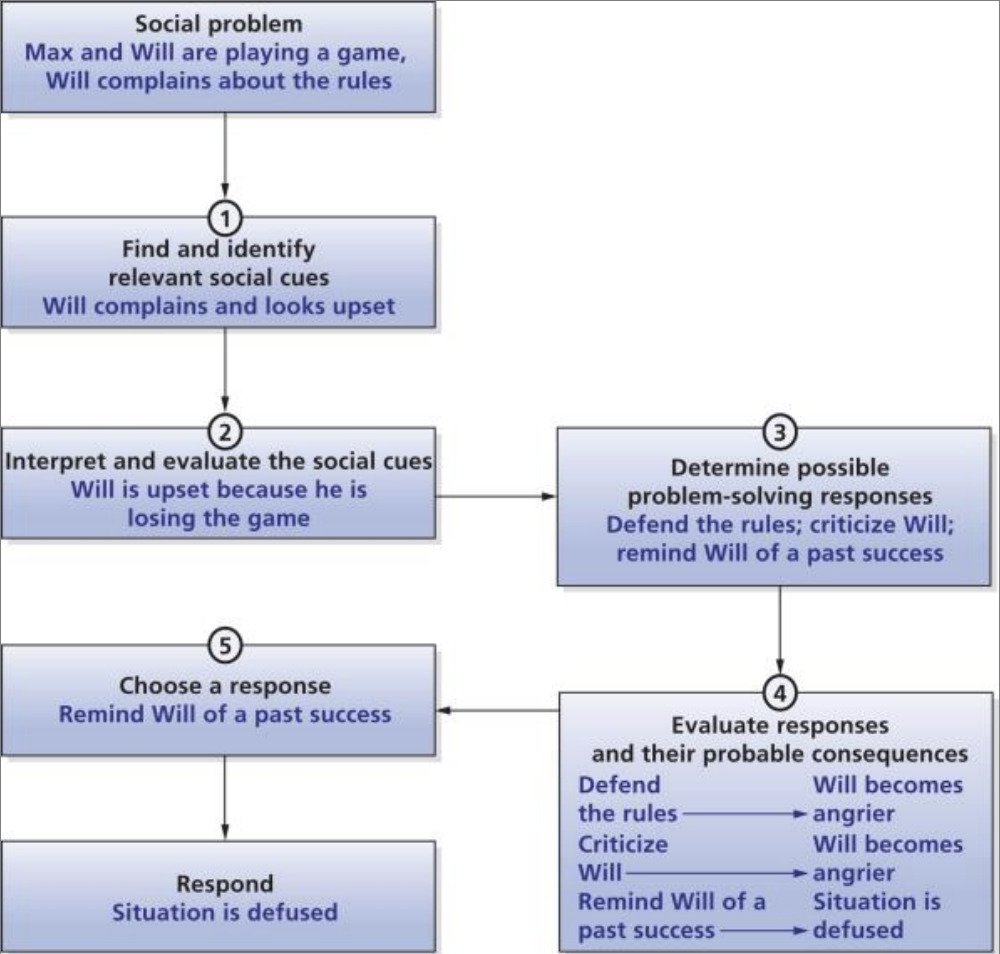
Social problem solving
the use of strategies for solving social conflicts in ways that are satisfactory both to oneself and to others
Social problem solving steps
Families, the changing home enviornemnt
In addition to other changes, children experience:
greater independence
go-regulation with parents = general guidelines for conduct and control over everyday behaviour
sibling relationships and rivarly
Family changes which a child can experience
self-care child
divorce
single-parent family
blended family
nontraditional family
Siblings
relationships are likely to endure across lifespan
early relationships shape how children relate to others and choices made in later life
only children are as well adjusted as others, and in some way even better, often having higher self-esteem and stronger motivation to achieve
Self-care children
youngest who let themselves into their homes after school and wait alone until their parents return from work
consequences of being a self-care child are not all harmful
some children report being lonely
some children develop a sense of independence and competence
some research shows self-care children have higher self-esteem because they are helping family
How children explain academic success and faliure
Attributions:
whether the cause is intentional (dispositional) or external (situational)
whether the cause is stable or unstable
whether the cause is controllable or uncontrollable

