Advanced research methods - Lecture 1
0.0(0)
Studied by 8 people0%Exam Mastery
Build your Mastery score
 AP Practice
Supplemental Materials Call Kai
Call KaiCard Sorting
1/52

Earn XP
Last updated 1:11 PM on 2/1/23
Name | Mastery | Learn | Test | Matching | Spaced | Call with Kai | Chat |
|---|
No analytics yet
Send a link to your students to track their progress
53 Terms
1
New cards
What questions can be asked for assessing causal inference studies?
1. What was the explicit research question?
2. What was the implicit question?
3. What was actually estimated?
* Is the estimate biased or unbiased?
* Is this an estimate of a full or partial effect?
4. Is the estimate really an answer to the research question?
5. How was the analysis designed?
6. Which statistical methods were applied?
7. Were these methods applied correctly?
8. What is the (type of) estimate? Is it big, small, good, bad, etc.?
* How uncertain is the estimate?
9. What do the researchers conclude? Is that conclusion justified?
10. Is the conclusion supported with strong or weak evidence?
11. How does the conclusion compare to what we (already/thought we) knew?
2
New cards
What are potential outcomes approaches in causal inference?
Y = outcome
a = treatment
1 = yes treatment
0 = no treatment
i = individual
=/ does not equal
\
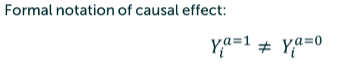
This approach is about thinking about potential outcomes. Only one potential outcome can be observed in reality, but we need information on the potential (or counterfactual) outcome “what would have happened had the women not used the powder”. This cannot be observed. To draw a causal conclusion (i.e. to say X had effect on Y) we therefore need a control group and meet the identificability conditions.
a = treatment
1 = yes treatment
0 = no treatment
i = individual
=/ does not equal
\
This approach is about thinking about potential outcomes. Only one potential outcome can be observed in reality, but we need information on the potential (or counterfactual) outcome “what would have happened had the women not used the powder”. This cannot be observed. To draw a causal conclusion (i.e. to say X had effect on Y) we therefore need a control group and meet the identificability conditions.
3
New cards
What is critical thinking about causal effect estimation?
4
New cards
What is causal effect?
In an individual, a treatment has a causal effect if the outcome under treatment 1 would be different from the outcome under treatmeant 2.
\
To asses, we need information on:
* What would have happened?
* What will happen?
\
To asses, we need information on:
* What would have happened?
* What will happen?
5
New cards
What is consistency?
The treatment (or intervention, exposure) has to be well-defined until meaningsless vagueness is left. (Hernan 2016, does water kill?)
6
New cards
What is positivity?
* Each individual has to have a positive probability of being assigned to each of the treament arms. (i.e. PR(A=a)>0 for all treatment arms).
7
New cards
What is exchangeability?
* The individuals assigned to the different treatment arms have to be similar
* It does not matter who gets treatment A or B
* It does not matter who gets treatment A or B
8
New cards
What problems can there be in research?
* Too small sample size
* Is this always a problem?
* Study performed or financed by commercial company
* Is this always a problem?
* No control group
* Essential omission (weglaten)
* What would happen without treatment?
* Potential regression to the mean
* Is this always a problem?
* Study performed or financed by commercial company
* Is this always a problem?
* No control group
* Essential omission (weglaten)
* What would happen without treatment?
* Potential regression to the mean
9
New cards
What are the identificability conditions?
Average causal effect can be determined if, and only if, three identifiability conditions are met:
* consistency
* positivity
* exchangeability
If all conditions are met (and an association is found in the data) the association between exposure and outcome is an unbiased estimate of a causal effect.
* consistency
* positivity
* exchangeability
If all conditions are met (and an association is found in the data) the association between exposure and outcome is an unbiased estimate of a causal effect.
10
New cards
What means counter the fact?
Counterfactual outcome: potential outcome that is not observed because the subject did not experiencce the treatment (counter the fact). The control group did not receive treatment.
11
New cards
What is a fundamental problem in causal effect?
Individual causal effect cannot be observed, except under extremely strong (and generally unreasonable) assumptions.
Average causal effect (i.e. in a population) cannot be determined based on individual estimates.
* Causal inference as a missing data problem.
Average causal effect (i.e. in a population) cannot be determined based on individual estimates.
* Causal inference as a missing data problem.
12
New cards
How can you meet the exchangeability condition?
1. RCT
2. Matching
3. Stratification
4. Adjustment
\
13
New cards
What is the golden standard for identificability conditions?
RCT
* Individuals are radomly assigned to one of each treatment arms.
* Differences between individuals in the different treatment arms are cancelled out on the sample level
* Differences are independent from the treatment and outcome
* Differences are random, not systematic
* Individuals are radomly assigned to one of each treatment arms.
* Differences between individuals in the different treatment arms are cancelled out on the sample level
* Differences are independent from the treatment and outcome
* Differences are random, not systematic
14
New cards
What is matching?
* For each individual with characteristics x,y,z whp gets treatment A, there is an individual with chracteristics x,y,z who gets treatment B
* Statistical methods can be applied when perfect matching (i.e. use identical twins, triplets) is not possible (e.g. propensity score matching).
* Statistical methods can be applied when perfect matching (i.e. use identical twins, triplets) is not possible (e.g. propensity score matching).
15
New cards
What is propensity score matching?
A statistical matching technique that attempts to setimate the effect of a treatment, policy or other intervention by accounting for the covriates that predict receiving the treatment.
16
New cards
What is stratification?
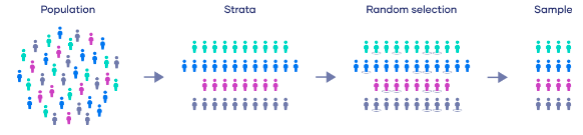
* Randomly select individuals from different subsets (i.e. strata) of the larger population
* Difficult to meet the positivity condition (i.e. individuals in all strata).
* With smoking and carrying a lighter, its hard to find groups that also have other relevant strata (e.g. based on age group, sex, education level)
Stratification becomes quickly infeasible (unworkable)
* Difficult to meet the positivity condition (i.e. individuals in all strata).
* With smoking and carrying a lighter, its hard to find groups that also have other relevant strata (e.g. based on age group, sex, education level)
Stratification becomes quickly infeasible (unworkable)
17
New cards
What is adjustment?
* Control for factors that influence (i.e. bias) the association between the treatment and outcome in regression analysis
* Indivudlas are assigned to all treatment arms within all levels of adjustment factors
* Can also be combined with RCT, stratification, matching
* Complee and correct adjustment leads to exchangeability (directly acyclic graphs, DAGs)
* Indivudlas are assigned to all treatment arms within all levels of adjustment factors
* Can also be combined with RCT, stratification, matching
* Complee and correct adjustment leads to exchangeability (directly acyclic graphs, DAGs)
18
New cards
What is the sidenote on the golden standard?
RCT:
* limited external validity (e.g. controlled setting, efficacy of treatment)
* Ethical and practical considerations
In observations (non-randomised studies):
* real world outcomes (effetiveness of treatment)
* availability of data
* positivity and consistency need close attention
* Internal validity threatened by lack of exchangeability
\
* limited external validity (e.g. controlled setting, efficacy of treatment)
* Ethical and practical considerations
In observations (non-randomised studies):
* real world outcomes (effetiveness of treatment)
* availability of data
* positivity and consistency need close attention
* Internal validity threatened by lack of exchangeability
\
19
New cards
Why is it important to meet the identificability conditions?
* To obtain insight in the quesiton: what would have happend, if …
* Estimate an unbiased effect of an exposure on an outcome
* Estimate an unbiased effect of an exposure on an outcome
20
New cards
What are the assessing causal inference questions?
1. What was the explicit research question?
2. What was the implicit question?
3. What was actually estimated?
1. Is the estimate biased or unbiased?
2. Is this an estimate of a full or partial effect?
4. Is the estimate really an answer to the RQ?
5. How was the analysis designed?
6. Which statistical methods were applied?
7. Were these methodsapplied correctly?
8. What is the type of estimate? Is it big, small good, bad?
1. How uncertain is the estimate?
9. What do the researchers conclude?
1. Is that a justified conclusion?
2. Is the conclusion supported with strong or weak evidence? How does the conclusion compare to what we already thought?
\
21
New cards
How can you use graph theroy to achieve exchangeability?
22
New cards
What are the rules of DAGs?
\
23
New cards
What is a confounder?
Any variable that can be used to remove confounding
24
New cards
What is confounding?
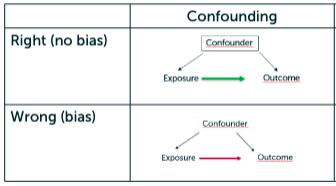
Bias caused by common cause of exposure and outcome (if not adjusted)
25
New cards
Why do we use DAGs?
* Individual causal effect cannot be observed; no information about the counterfactual outcome
* Average causal effect can be estimated if, and only if, all three identifiability condiotons are met
* Average causal effect can be estimated if, and only if, all three identifiability condiotons are met
26
New cards
Why is correlation no causal inference?
Correlation implies association
* A statistical relationship between the treatment and outcome
* Knowing the value of one variable may provide information on the value of another variable, but that does not mean that one caused the other
* Knowing that Zeus died 5 days after a heart traplant does not mean the transplant caused Zeus death (Hernan and Robins, 2020)
* A statistical relationship between the treatment and outcome
* Knowing the value of one variable may provide information on the value of another variable, but that does not mean that one caused the other
* Knowing that Zeus died 5 days after a heart traplant does not mean the transplant caused Zeus death (Hernan and Robins, 2020)
27
New cards
What is a statistical association?
It equals the difference in potential outcomes if, and only if, the identifiability conditions are ment
We need:
* Theory and subject knowledge (previous studies in literature)
* Insight into causal structure underluing the research question
* To meet the positivity, consistency and exchangeability conditions, and hence design the study and analysis accordingly.
We need:
* Theory and subject knowledge (previous studies in literature)
* Insight into causal structure underluing the research question
* To meet the positivity, consistency and exchangeability conditions, and hence design the study and analysis accordingly.
28
New cards
What are problems with traditional designs?
* These methods rely on the available data, rather than on theory.subject knowledge (e.g. omitted variable bias).
* Selected strategy may increase rather than reduce bias
* Setepwise selection may lead to the uncertainty associated.
* Methods are outdated
→ solution: DAGs
* Selected strategy may increase rather than reduce bias
* Setepwise selection may lead to the uncertainty associated.
* Methods are outdated
→ solution: DAGs
29
New cards
What are basic rules of DAGs?
* Arrows represent causal effect
* Variables are all associated in data
* Paths connect variables in a DAG
* A connection transmits association
* Variables are all associated in data
* Paths connect variables in a DAG
* A connection transmits association
30
New cards
What happens if you adjust for a variable?
A path is blocked. It changes the association. By blocking all the connections it removes the association.
31
New cards
What is a path?
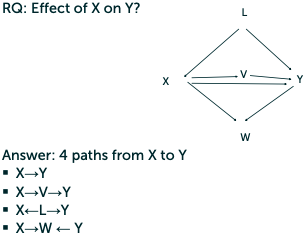
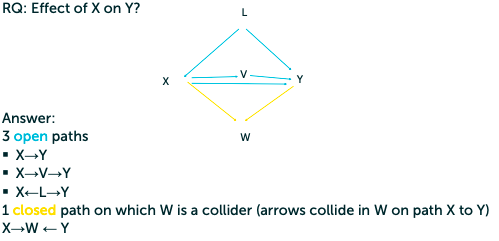
A route between X and Y. It does not have to follow the firection of the arrows.
32
New cards
What is the difference between a causal path and a backdoor path?
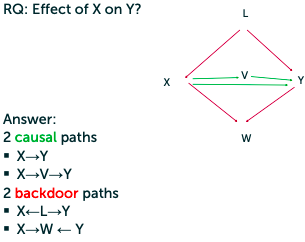
* Causal path: follows direction of the arrows between X and Y
* Backdoor path does not
* Backdoor path does not
33
New cards
What is the difference between an open and a closed path?
All paths are open, unless they collide.
34
New cards
What is adjusting for a variable?
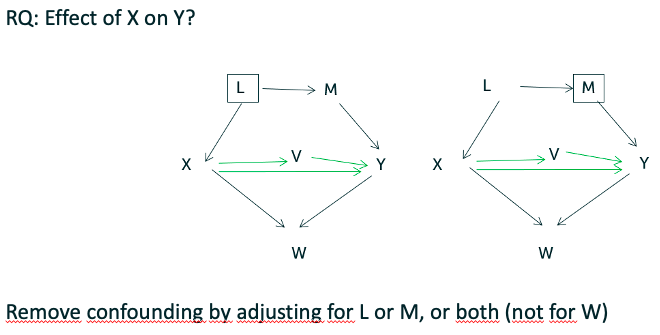
The influence of L is removed on the association between X and Y **by including L in the regression analysis**
35
New cards
What happens if you adjust for a collider?
* When you adjust for a collider (W) you open the blocked path between X and Y that goes through W (we then allow W to influence the association between X and Y by including W in the regression analysis).
36
New cards
How can you remove counding?
Remove confouding by adjusting for L or M, not for both.
37
New cards
What are the causal inference assessment questions?
1. What was the explicit research question?
2. What was the implicit research question?
3. What was actually estimated?
1. Is the estimate biased or unbiased?
2. Is this an estimate of a full or partial effect?
4. Is the estimate really an answer to the RQ?
5. How was the analysis designed?
6. Which statistical methods were applied?
7. Were these methods applied correctly?
8. What is the type of estimate?
1. Is it big, small, good bad?
2. How uncertain is the estimate?
9. What do the researchers conclude?
10. Is the conclusion supported by data?
11. How does the …
38
New cards
What are colliders?
A variable which naturally blocks a backdoor path.
This path does not contribute to association between exposure and outcome. Adjusting for a collider opens a path.
This path does not contribute to association between exposure and outcome. Adjusting for a collider opens a path.
39
New cards
What is confounding bias?
40
New cards
What is selection bias?
Sometimes means sample not representative.
Confounding is sometimes called selection bias.
Confounding is sometimes called selection bias.
41
New cards
What is the role of theory in causal inference; designing the analysis?
42
New cards
What happens is you adjust for a collider?
* It opens the path.
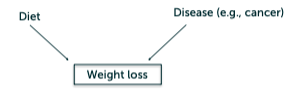
* Adjusting for a collider transmits association between X and Y.
* The association between diet and disease consists of the combination of all open paths between them.
* Assume you have information about a collider. This implies association, but no causation.
* Adjusting for a collider transmits association between X and Y.
* The association between diet and disease consists of the combination of all open paths between them.
* Assume you have information about a collider. This implies association, but no causation.
43
New cards
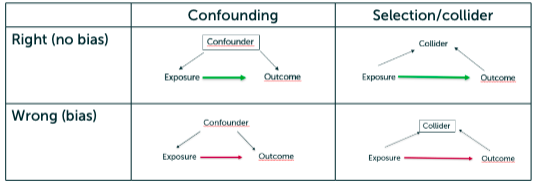
What happens if you adjust for a confounder?
There is no bias.
44
New cards
What happens if you adjust for a collider (selection/collider)
There is bias.
45
New cards
What are disadvantages of RCT?
* Limited generalizability (external validity) due to treatment protocol and patient selection
* Practical, ethical considerations
* Practical, ethical considerations
46
New cards
What are risks of RCT?
* Statistical errors
* Table 2 fallacy
* Chance findings
* Table 2 fallacy
* Chance findings
47
New cards
What are (dis)advantages of observational data?
* Overall good generalizability
* Availability of data is high
* Internal validity threatened by lack of exchangeability
* Positivity and consistency need explicit attention.
* Availability of data is high
* Internal validity threatened by lack of exchangeability
* Positivity and consistency need explicit attention.
48
New cards
What are risks with observational studies?
* Statistical errors
* Table 2 fallacy
* Chance findings
* Confounding bias
* Selection bias
* Lack of consistency
* Table 2 fallacy
* Chance findings
* Confounding bias
* Selection bias
* Lack of consistency
49
New cards
What is moderation?
* Not speciafically part of DAG concept
* Coefficient additional effect in subgroup
* interpretation is easier when you fill out the regression equatiations for subgroeps
* Coefficient additional effect in subgroup
* interpretation is easier when you fill out the regression equatiations for subgroeps
50
New cards
What is mediation?
* Occurs when there is a causal path betwen exposure and outcome which runs through another variable (the mediator)
* When adjusting for a mediator, part of the association is removed. The effect of exposure on outcome would be underestimated (partial causal effect, direct effect).
* When adjusting for a mediator, part of the association is removed. The effect of exposure on outcome would be underestimated (partial causal effect, direct effect).
51
New cards
What is a partial effect?
The solely effect of exposure on outcome. Adjusted for intermediate/mediator.
When there is no association after adjustment, the mediator completely explains the effect.
When there is no association after adjustment, the mediator completely explains the effect.
52
New cards
What is a full effect?
Full causal effect of exposure on outcome, not adjusst for the mediator.
53
New cards
What is mediator outcome confounding?
Occurs when a confounder affects outcome and intermediate. This is a problem when you want to estimate the partial effect of the explanatory variable.
In that case, if you adjust for the mediator, the backdoor path from the confounder to X is opened. This is a biased effect. It is the direct causal effect + something non causal.
You have to adjust for the mediator and the confounder. When not having information on the confounder, you cannot do this as the results will be biased. Thats a problem.
→ We have a biased estimate of the partial effect.
In that case, if you adjust for the mediator, the backdoor path from the confounder to X is opened. This is a biased effect. It is the direct causal effect + something non causal.
You have to adjust for the mediator and the confounder. When not having information on the confounder, you cannot do this as the results will be biased. Thats a problem.
→ We have a biased estimate of the partial effect.