Circuit Dysfunction in Parkinson's Disease
 Call Kai
 Learn
Learn Practice Test
 Spaced Repetition
 Match
Match Flashcards
 Knowt Play
1/9

There's no tags or description
Looks like no tags are added yet.
Name | Mastery | Learn | Test | Matching | Spaced | Call with Kai |
|---|
No analytics yet
Send a link to your students to track their progress
10 Terms
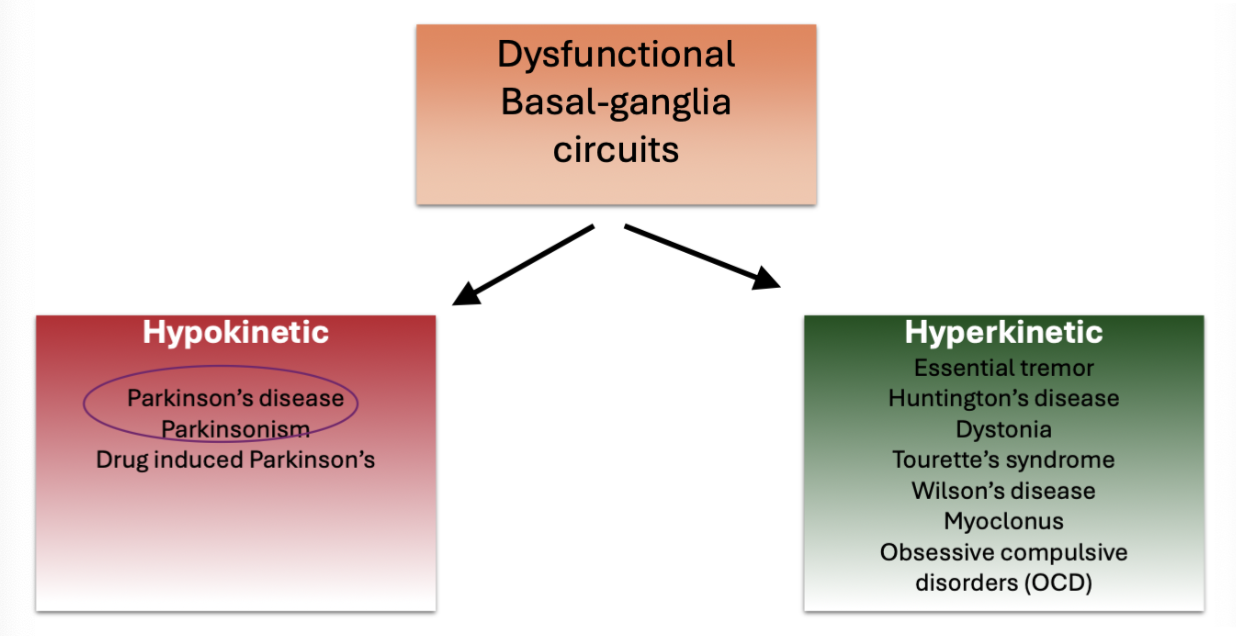
What is the basal ganglia? How do dysfunctional basal ganglia circuits lead to brain disorders?
Describe the pathology and prevalence of PD.
Disease of the motor systems in the brain - neurogeneration of dopaminergic neurons in the nigrostriatal pathway (substance nigra > striatum)
Increased prevalence with age - 1% of over 65s, 4% of over 85s
5% genetic, 95% idiopathic
What are the core symptoms of PD?
Tremors
tremors at rest - 9Hz (early stage), 4-7Hz (late stage)
tremor amplitude decreases upon voluntary movements
Akinesia
lack of voluntary and involuntary movements
Bradykinesia - early phase
slow voluntary movements
Rigidity and postural abnormalities
increased muscular tone
abnormalities in gait
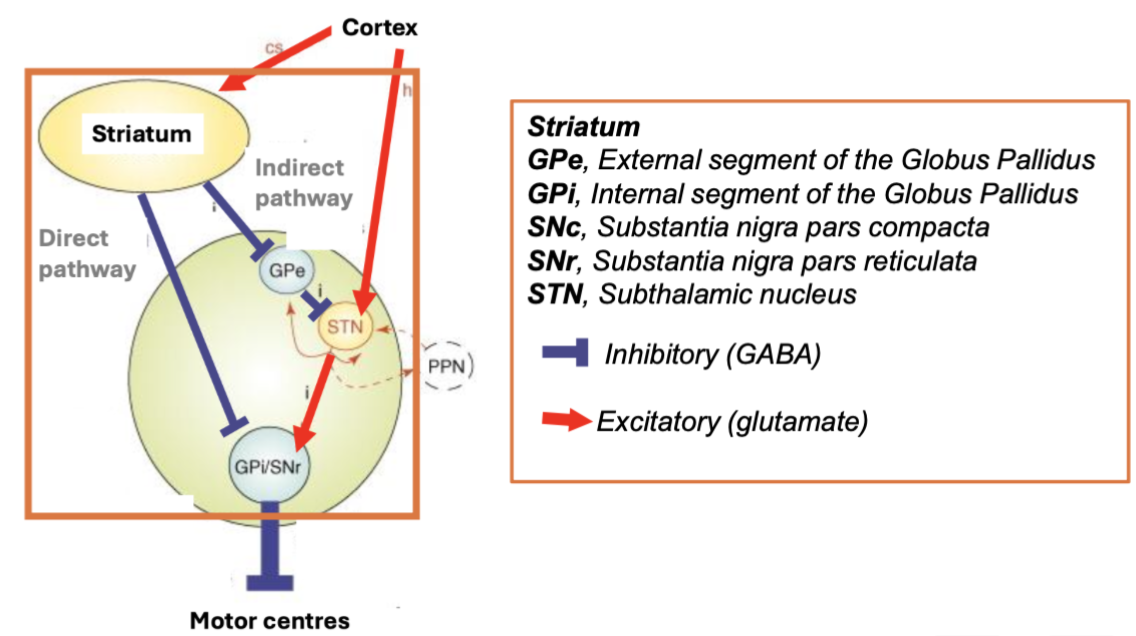
What are the 5 main components of the basal ganglia? Are these E or I? What is the main role of the basal ganglia in normal brains?
Conserved set of inter-connected brain regions/nuclei
Most are GABAergic (I), some are glutamatergic (E)
basal ganglia is driven by excitatory inputs from the cortex - critical tole in movement and motor control
How does the basal ganglia coordinate the initiation of movement under normal conditions?
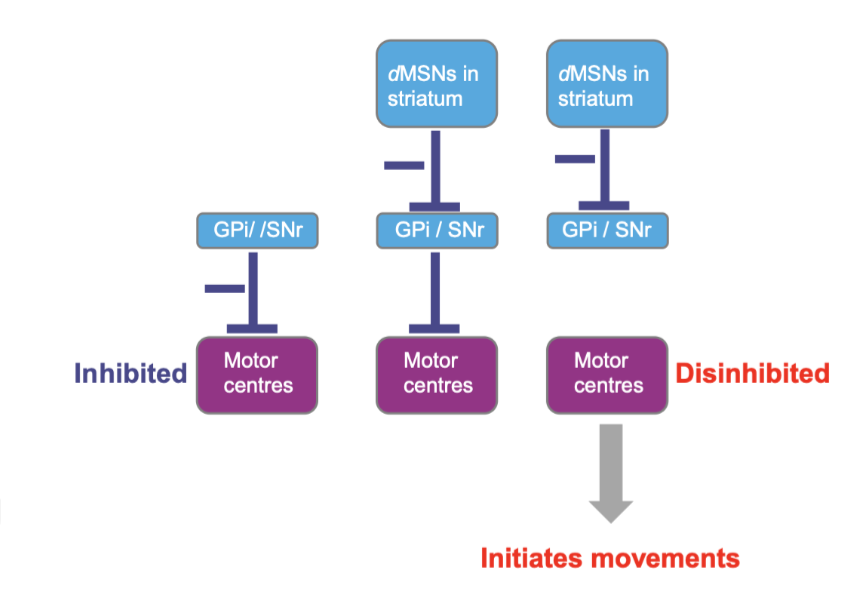
GPi/SNr inhibits brainstem motor centres, therefore no movement is initiated.
When direct pathway neurons in the striatum are active (dMSNs), these neurons inhibit GPi/SNr, motor centres are released from inhibition, allowing movement
How does the basal ganglia coordinate the termination of movement under normal conditions?
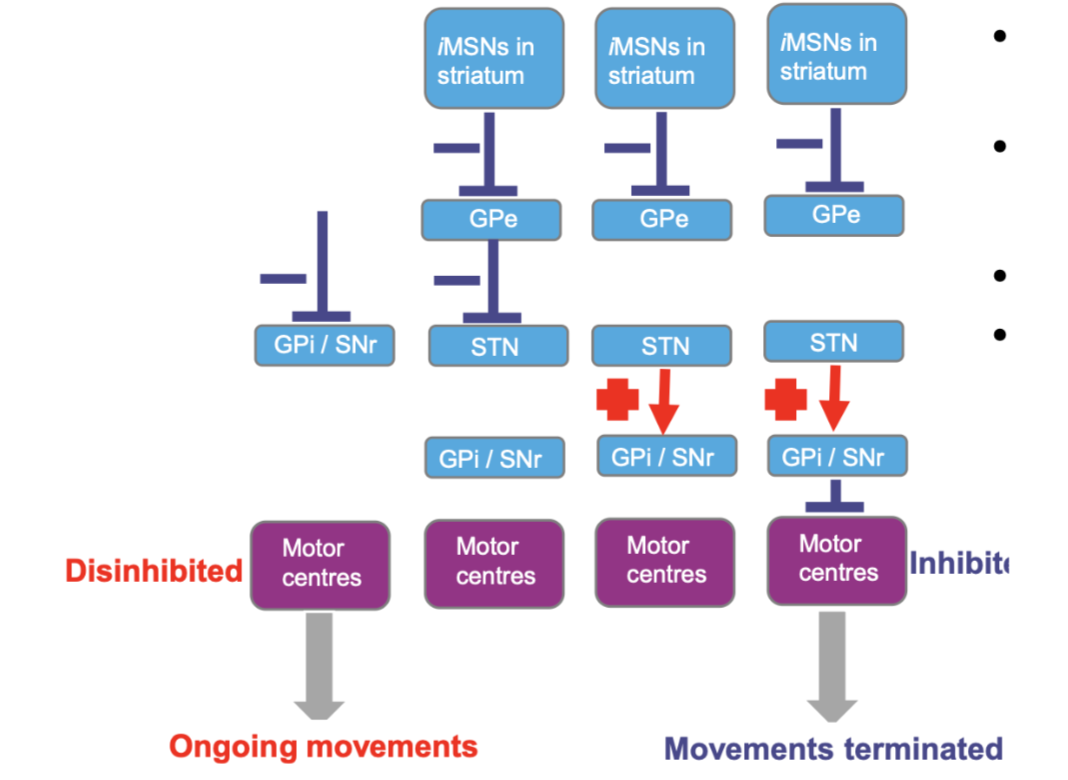
The GPi/SNr remain inhibited during ongoing movement.
When indirect pathway neurons in the striatum are active (iMSNs), these neurons inhibit the GPe.
GPe inhibition disinhibits the STN, activating the GPi/SNr
How does loss of dopaminergic neurons affect movement coordination?
Dopaminergic inputs from the substantial nigra compact modulate the activity of striatal neurons.
Loss of substantia nigra compacta dopaminergic neurons disrupts the functioning of the direct and indirect pathways, and perturbs movement coordination.
How did opioid impurities allow the development of a PD animal model?
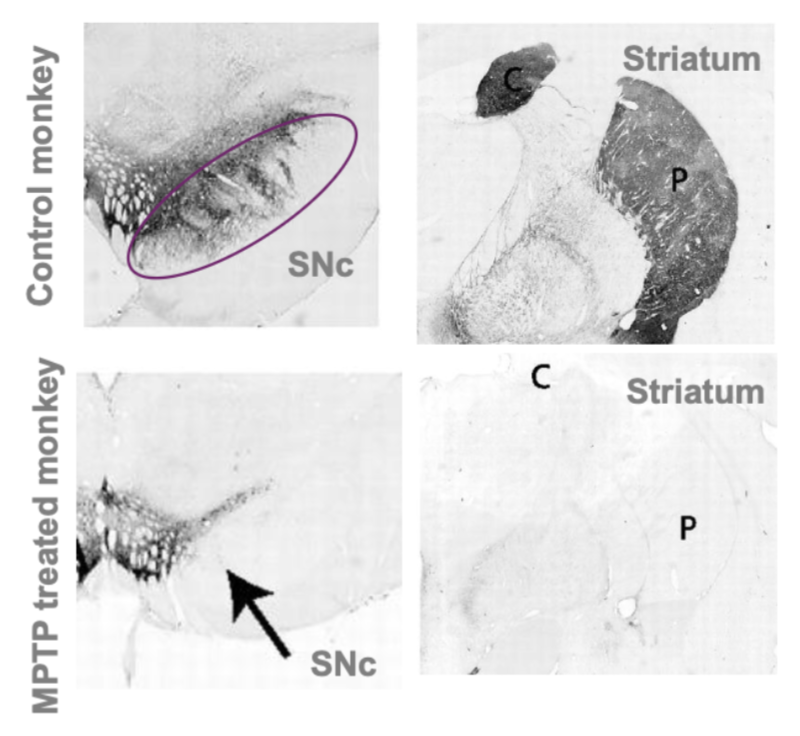
MPTP is an impurity in the synthesis of the opioid desmethylprodine (MPPP)
MPTP selectively ablates dopaminergic neurons in the substantial nigra compacta
In 70s, several young patients presenting with PD-like symptoms as an effect of taking MPPP
Indicated that MPTP could model PD in animals
these models exhibited akinesia, tremors and termination of dopaminergic neurons in the striatum
What is the proposed theory for why akinesia occurs in PD? How can akinesia be ameliorated in these patients?
GPi/SNr inhibits motor centres and prevents movement inhibition
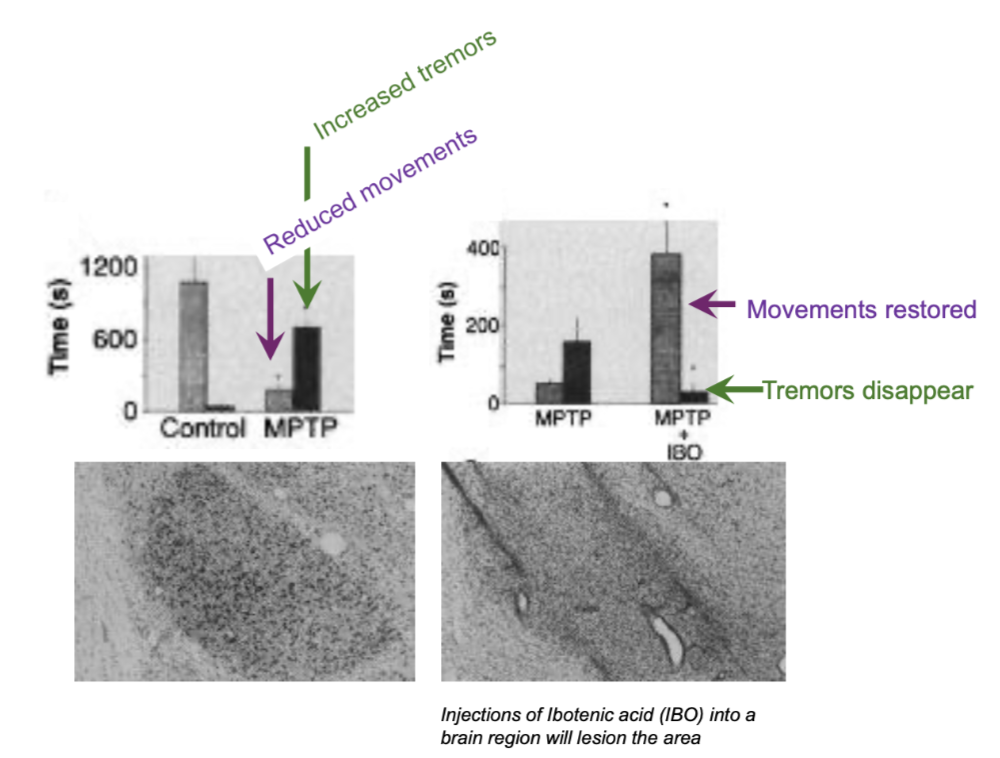
A possible reason for akinesia in PD is hyperactivity in GPi/SNr or the STN
loss of inhibition of motor centres > overactive movement control stimulation
Akinesia and tremors can be ameliorated by selectively lesioning the sub-thalamic nucleus
lesions inhibit GPi, releasing motor centre inhibition
How is deep brain stimulation used in PD? How can deep brain stimulation alleviate akinesia?
Recording and stimulating electrodes were implanted into primary motor cortex (M1) and the GPi respectively
open loop configuration - GPi is stimulated with current pulses at 130 Hz
closed loop configuration - online algorithm detects if action potentials were fired in M1
GPi is stimulated when action potentials are detected in M1
Disrupting action potential firing in GPi during closed-loop DBS can drastically reverse akinesia!!

