Branding
 View linked note
 Call Kai
 Learn
Learn Practice Test
 Spaced Repetition
 Match
Match Flashcards
 Knowt Play
1/21

There's no tags or description
Looks like no tags are added yet.
Name | Mastery | Learn | Test | Matching | Spaced | Call with Kai | Chat |
|---|
No analytics yet
Send a link to your students to track their progress
22 Terms
Branding (Baines)
Creates a position and perception in consumers' minds to differentiate from competitors and become the consumer's immediate associated thought through added value.
Branding Elements
tells a story to create shortcuts in consumer understanding of perceived differences. Can be commercial (shoes, teams, etc) or non-commercial (ideas, people, places, etc)
What Customers Understand (Neumeier)
Customers understand that external factors like name, symbol, design, have a differential advantage, brands positioning in their given sector, brands outward preception
Why It’s Important To Consumers (Neumeier)
Differentiations it from competitors, reduces perceived risks, ability to gauge quality, reduce time search
Branding Importance To Managers ( Neumeier)
Legal protection, builds trust, creation of coherent corporate identity, encourages premium pricing/maximise output
Equity Brandin
Equity Branding
Equity branding refers to the process of creating and maintaining a strong brand image that is associated with positive perceptions of fairness, justice, and equality. It involves aligning a brand's values, messaging, and actions with principles of social responsibility and inclusivity. This can lead to increased customer engagement, market share, and long-term business success.
Value Chain
Framework for tracking investments in branding, using different performance indicators, integrating the two measurements
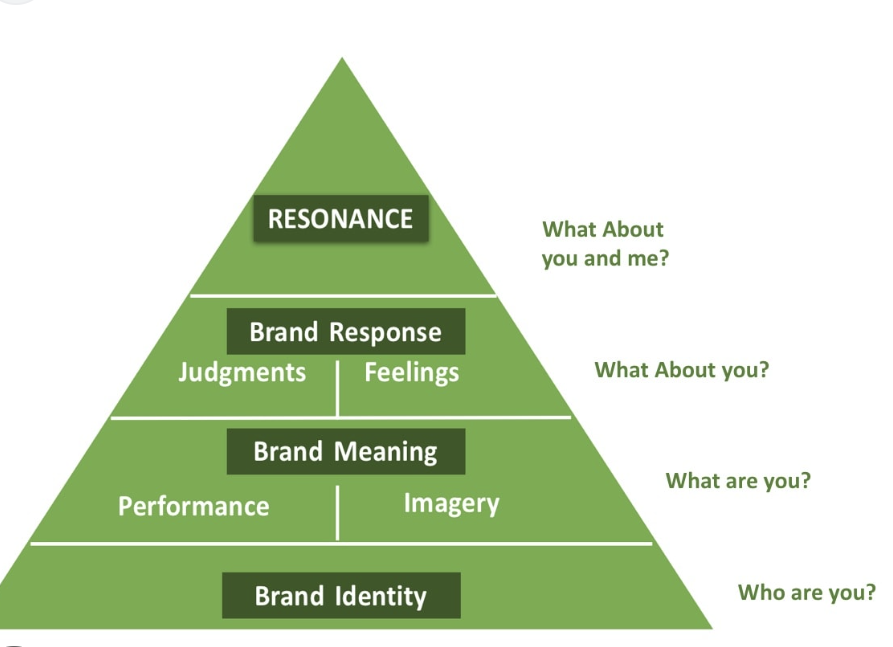
Keller's Brand Pyramid
A framework for developing a successful brand, consisting of identity, meaning, response, and relationships.
3Ps of Branding (Fill & Turnbull 2016)
Promise: functional, emotional, and social benefits of a brand.
Position: association occupied in people’s minds
Performance: communicate promise for awareness and understanding
Brand Elements
Unique associations forming positive judgments, such as senses, logo, pattern, symbol, font, color, tagline, and language. EASILY RECOGNISABLE
Big 5 Personality Dimensions (Aaker 1997)
Sincerity: brands seen as down to earth and honest (Patagonia)
Excitement: brands seen as imaginative and inspiring (Red Bull)
Competence: brands seen as reliable, responsible and intelligent (Apple)
Sophistication: brands seen as upper class, expensive, desirable (Chanel")
Ruggedness: brands seen as outdoorsy, tough and masculine (New Zealand, Land Rover)
Personality Archetype (Bechter 2016)
12 archetypes grouped by freedom, social, ego, order that allow for brands should use archetypes instead of brand personality traits to better connect with consumers
Anthropomorphism (Alvarez 2016)
Attribution of human like characteristics to brands
Why Brand Personalities are used (Brown 2016)
We match brands we consume to fit our own personality; brands bear human-like qualities
Brand Architecture
The organizational structure and hierarchy of brands within a company. It defines the relationships between different brands, including parent brands, sub-brands, and endorsed brands, to create a cohesive brand portfolio. It helps to clarify brand positioning, target markets, brand stretch and brand extensions, ensuring consistency and maximizing brand value.
Brand Extension
expanding WITHIN an industry
Brand stretch
expanding outside of an industry
Brand Positioning
Strategic activity to differentiate and distinguish a brand for consumers to understand and remember it.
Points of Parity
Shared competitor features.
Points of Difference
Reasons we buy, competitive advantage; rational/functional vs emotional; tangible vs intangible
B2B Branding
Branding in the business-to-business context, where employees add to the brand experience and service branding aids customers in understanding the value associated with the service offering.
Multinational Branding
Ensuring a consistent brand image is maintained across different countries for clear understanding and recognition.