Trace evidence and tool marks
 Studied by 0 people
 Call with Kai
 Learn
Learn Practice Test
 Spaced Repetition
 Match
Match Flashcards
 Knowt Play
1/30

There's no tags or description
Looks like no tags are added yet.
Name | Mastery | Learn | Test | Matching | Spaced | Call with Kai |
|---|
No study sessions yet.
31 Terms
trace evidence
- physical evidence found in small amounts at a crime scene
e.g. glass, hairs, fibres, paint, pollen, metal particles, drug residue, firearms
value of trace evidence
Dependent on how common or rare a material or combination of materials is in the environment, the location or circumstance
Rare materials or combinations of materials have a higher evidential value than those commonly found
number of fibres transferred depends on
Nature of donor garment
Texture of recipient garment
Length of contact
Pressure on contact
Number of contacts
number of fibres found on a garment depends on
Whether garment has been washed
Whether it was worn after offense
Length of time it was worn
Texture of the garment
After 4 hrs 20% fibres remain
After 8 hrs 10% remain
After 30hrs 3% remain
As time of wear increases fibre percentage decreases
both visible fibres and fibres that cannot be seen will be found at scene
visible
fibres you cannot see
Use tape on surface, put onto acetate and place into tamper evident bag
fibre lifts
Use low tack adhesive tape
Press tape onto suspect surface
Place onto a cobex/acetate sheet
Use cellotape to secure edges of tape to stop any loose fibres falling out
Endorse sheet with details in indelible ink (5 pieces of info)
Exhibit no
What it is and where from
Date/time
Address
CSI name
car seat fibre tape lift locations
Door panel
Seat base
Seat back
Head rest
Seat belt
All become one exhibit- label with where in car it came from HT/01
Try to separate sections into exhibits
glass
- flat
-Float
-Toughened
-Tempered
-Safety/laminated
-obscured
-patterned
-wired
-mirrors
-containers
glass at crime scene
Small samples- into universal tube then bag
Larger samples - box - seal edges
Window glass - must be from frame - 6 pieces label inside + out
Double glazes units - 6 from out and 6 from inside pane
Samples from each window smashed - separately
Do not recover window glass from floor - if have no choice document where its recovered from
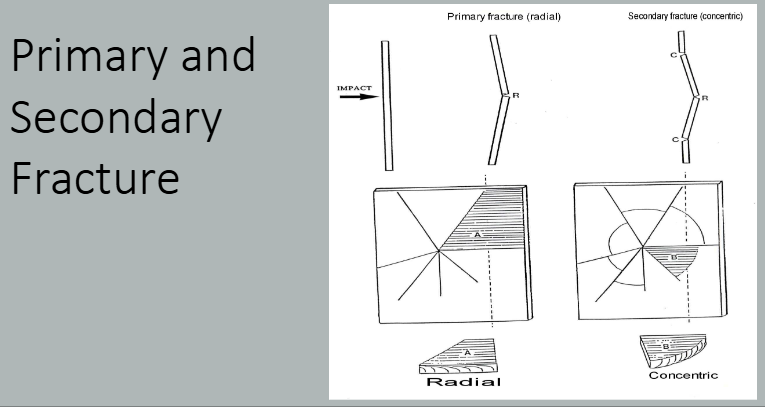
backward fragmentation
If you smash a window - glass will smash backwards coming towards you
Helps think about where glass may be on person
e.g. smashed glass on top of shoe - suspect
Smashed under sole- walked through it
primary - forward
secondary - backward
retention properties of glass
Course knitted jumper good
Fine knitted jumper/tweed
Denim jacket
Tshirt poor
evidential value of glass fragments on suspect/victim
High hair combings
outer clothing (upper)
outer clothing (lower)
pockets and turnups
Low shoe soles
examination of glass in lab
Glass Refractive Index Measurement (GRIM)
Chemical Analysis
Surface Characteristics
Physical Fit (larger fragment)
paint
Can associate a person or vehicle with a crime scene
Traffic incidents - paint transferred from and to vehicle
Burglaries - paint transfer to tools
Vehicles - paint can determine make, model, colour, year
paint transferred by
Forceful contact
Contact with disturbed paint
composition of paint
Composed of:
Binder
Pigment
Additives
Most paint applied in layers
two way transfer
Can provide conclusive evidence
Tool came into contact with a surface
Vehicle was involved in RTA
Clothing came into contact with a surface
BEST PRACTICE
Remove complete article bearing mark or paint sample when possible
sampling paint at scene
Always photograph first
Use sterile new scalpel blade
Sample (scrape) down to bare wood/metal
Approx 2cm square if possible
Seal in paper wrap/ universal tube and plastic bag
Include scalpel blade - secured blade - into original packaging
Label
Take control sample from undamaged area of same item
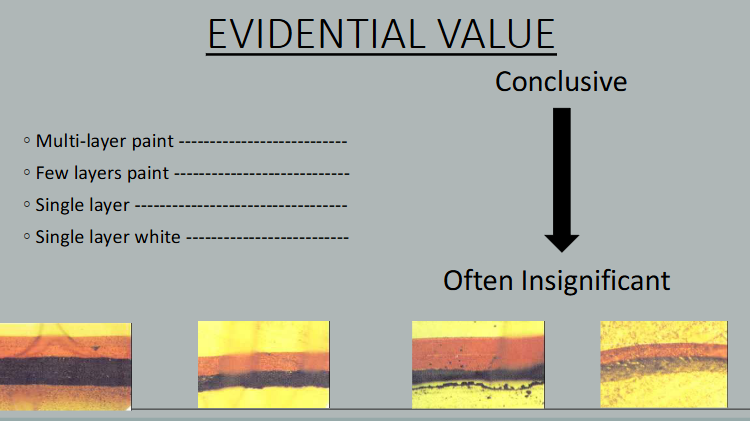
evidential value of paint
more paint layers = more conclusive
tool marks
Any impression, scratch, gouge, cut or abrasion made when tool is brought into contact with another object
types of tool marks
Compression
Most common
Negative impression of tool
Caused by pressure, blow or gouge
Friction
Sliding/scrapping
Leaves striation marks
Created by forced application of tool to surface
Cutting edge
Least common at scene
Combination of two impression types
From tool mark both class and individual characteristics of tool can be identified
levering tools
Jemmys
Screwdrivers
Metal bars
Crowbar
cutting/drilling tools
Scissors
Pliers
Saws
Bolt cutters
types of levered marks
Opposing marks - door/window edge, frame - should match up
Fulcrum/leverage - point about which the tool pivots, not always present or sometimes merged with tip marks
recovery
Recovery whole item bearing mark if possible
Photograph with and without scale and label
Recover end marks and fulcrum mark
Cast early in exam - probil
Package in sealed labelled box or rigid container
Two/three casts = one exhibit but clearly identify which is which e.g. door edge, door frame and fulcrum marks from same tool
drilled holes
Recover whole if possible
Photo with and without scales
Cast early in examination
Package casts in a rigid container
Collect swarf/turnings/shavings
Package in a universal plastic tube or box
packaging levering tools
Rigid container
Weapons tube (don’t over tighten) - tape and sign
Make packaging fit tool - don’t introduce contamination
Shouldn’t move in packaging - friction destroys evidence
what to do with cutting tools
Item shouldn’t move in packaging
Don’t close jaws
Seal in close fitting box - do not introduce contamination
dealing with fencing wire, telephone wire, chain fences
Cut 15cm back along wire
Label and protect with paper
Label 'own cut end' and 'crime cut end'
Seal in box and attach CJA label
 Note
Note  Flashcards (51)