AUENV 231:Midterm #1
 Studied by 0 people
 Call Kai
 Learn
Learn Practice Test
 Spaced Repetition
 Match
Match Flashcards
 Knowt Play
1/76

There's no tags or description
Looks like no tags are added yet.
Name | Mastery | Learn | Test | Matching | Spaced | Call with Kai |
|---|
No analytics yet
Send a link to your students to track their progress
77 Terms
Geography
The science that studies the interdependent relationships among natural systems, geographic areas, society, cultural activities all over space
“geo” - earth
“graphein” - to write
a method not a body of knowledge
holistic, eclectic
uses: spatial analysis, systems science
Key geographic perspectives
Spatial: (where?) most important, locations and patterns (need maps)
Ecological: (why?) interrelationships among variables
Temporal: (when?) changes over time
What are the two sides of geography
physical (climatology, microclimataology, soil
human/ cultural (behavioural geography
Physical geography
the spatial analysis of all the physical elements and processes that make up the environment
System
ordered, interrelated set of things; linked;distinct from outside
They affect each other
Open vs. closed systems
Open - lots of things going back and forth Eg. Energy, water cycle
Closed - has some sort of boundary Eg. Matter because what matter we have on earth is what will be. underground caves that have their own ecosystem
Positive vs. Negative feedback
Positive - initial change is a slight push and it gets faster and faster. Eg. Albedo effect
Negative - initial change is subdued Eg. rivers ability to be resilient
System Equilibrium
everything is interacting in equilibrium
steady-state - lots of minor changes but it stays at the same equilbrium
dynamic - rapid change then finds a new equilibrium Eg. erosion in a river
metastable - stable for a while then finds a new equilibrium
Meteorology
study of the atmosphere and the processes that cause weather
Climatology
study of the weather elements over a long time
Weather
short-term conditions of atmosphere
Climate
long-term conditions (eg. 30yrs) of atmosphere (and variability)
Atmosphere
mixture of gas molecules, suspended particles, and falling precipitation
affects our day-to-day lives
Thickness of atmosphere
density increases rapidly with height
majority of mass is compressed at the surface
Top is undefined
Because of gravity
<2% of earths radius
Density at sea level
1.2 Kg/m³
Composition of the atmosphere
gases and particles are exchanged between the surface and atmosphere
Processes: Carbon, condensation, evaporation, precipitation,
Most common gas is atmosphere is Nitrogen: ammonification, nitrification
Oxygen
Photosynthesis
Respiration - take in and release O2
Permanent gases
constant proportion of mass in time and space
Eg.
Nitrogen (78%)
Oxygen (21%)
Argon
Neon
Helium
Hydrogen
Nitrogen Cycle
Dynamic
released by volcanoes, released into atmosphere, captured by many different things
Density is highest where/
Closest to the earths surface
Variable Gases
Variable concentrations over time
Water vapour
CO2
Water Vapour
most abundant variable gas
hydrologic cycle
Concentration= 0%-4% of air
Important for energy balance and atmospheric processes
Carbon Dioxide
Trace gas
0.04% of air by volume
critical to earths energy balance
Adding processes - Wildfires, cellular respiration, driving
Removing processes - photosynthesis (can be locked away(stored in plant and buried underground))
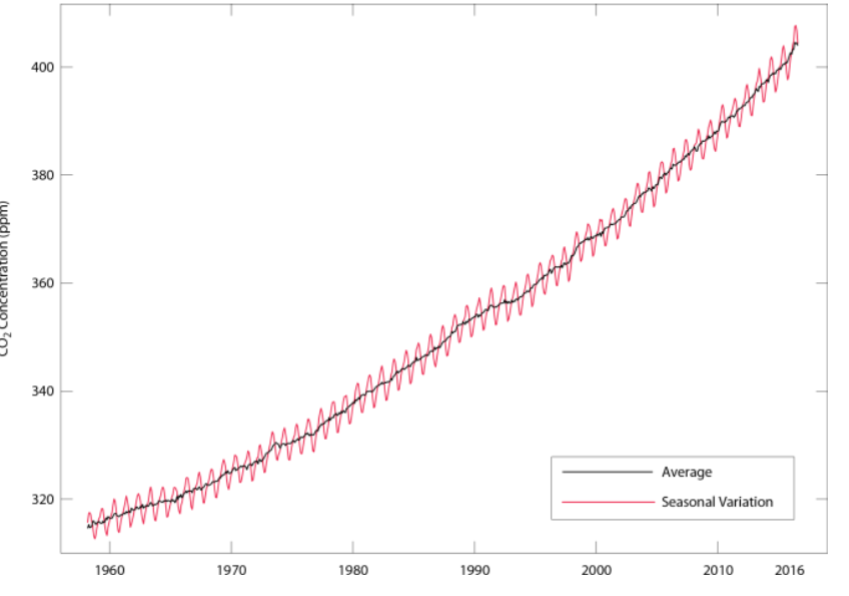
Increasing by 1.8ppm/yr
Photo:
Temporal increases due to human activities
seasonal variations related to biological activity
Methane
0.0002%, but recently increasing
Increasing? burning fossil fuels, livestock digestionm and agriculture cultivation
Effective absorber of terrestrial radiation
affects near surface warming
Ozone
3 atoms of Oxygen
absorbs ultraviolet radiation
chlorofluorocarbons (CFCs) destroy ozone
destruction over southern hemisphere
antarctic circumbpolar vortex
limits latitudinal mixing: leads to an O3 “hole”
It is getting thicker which is great!
What atmospheric gas has the largest residence time? what has the smallest residence time?
Largest: Nitrogen - 1,600,00 years
Smallest: Water Vapour - 10days
Ozone - hours to days
Aerosols (particulates)
airborne solid and/or liquid particles (not water)
natural: sea spray, dust, combustion, volcanoes
Human: combustion, industry
Some long residence times
condensation nuclei: can change what is going on in the atmosphere. Assist with increasing precipitation. Huge clouds within communities with lots of condensation nuclei
Vertical structure of the atmosphere
Density
mass (kg) per unit colume (m³)
near surface air is more denseLay
compressibility
mean free path = avg distance before collision
at surface = 0.0001mm = high density → more friction
At 150km = 10m → higher mean free path
Layers of the atmosphere
Composition
Homosphere (well-mixed), <80km
Heterosphere (not mixed), >80km
Temperature
troposphere, startosphere, mesosphere, thermosphere
Unique properties
Ionsphere (aurora borealis), ozonosphere
Troposphere
goes from 15C to -60C, 10-15km
Rate is -6.5C/km. Exceptions is inversion when there is a layer of warm air over a layer of cold air. Can cause fog. Warm air holds down other layer of “smog”
Virutally all weather processes
80% of atmospheric mass
Stratosphere
-60C to 0C, 50km
Little actual “weather”
ozone layer (20km-30km), little moisture
Temperature inversion
caused by absorption of UV radiation by O3
19.9 atmospheric mass
Stratopause
Mesophere
0C—80C, 70km
Coldest layer
Thermosphere
-80C → 0C, 90km
increasing temperatures
molecular kinetic energy vs. heat content
Tropopause
Top of troposphere
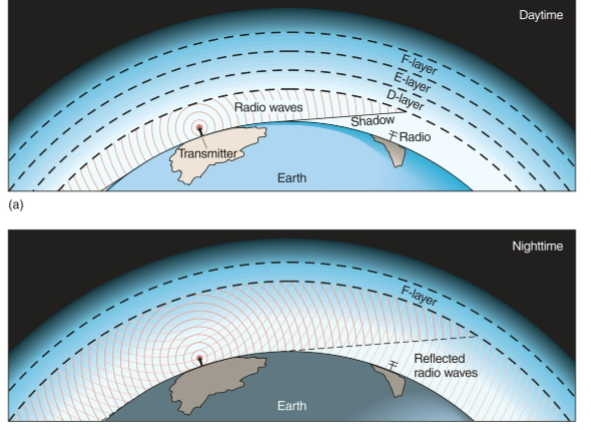
Ionosphere
layer of electrically charged particles (ions)
in mesophere and thermosphere
D-, E-, F-, increasing with height
Interactions with subatomic particles and they absorb radiation making colours. Aurora borealis (northern lights), aurora australis (southern lights)
Atmosphere Evolution
Primordial
4.6-4bya, hydrogen and helium, solar wind
Evolutionary
4-3.3 bya, volcanic outgassing, cloud, comets/meteorites
H2O, CO2, chemosynthetic bacteria
Living
3.3-0.5bya, cyanobacteria, N2, O2 increases
Modern
0.5bya to present
life
Pressure
force exerted per unit areaW
Wind
horizontal movement of air
caused by unequal pressures
having a high pressure zone and a low pressure zone. Going from high to low
Volatile Organic Compounds
Photochemical Smog
NOx and OVCs accumulate during rush hour
Reactions involving solar radiation transform these into ozone and other secondary pollutants
Concentration are hghest in afternoons
most prevalent on clear days
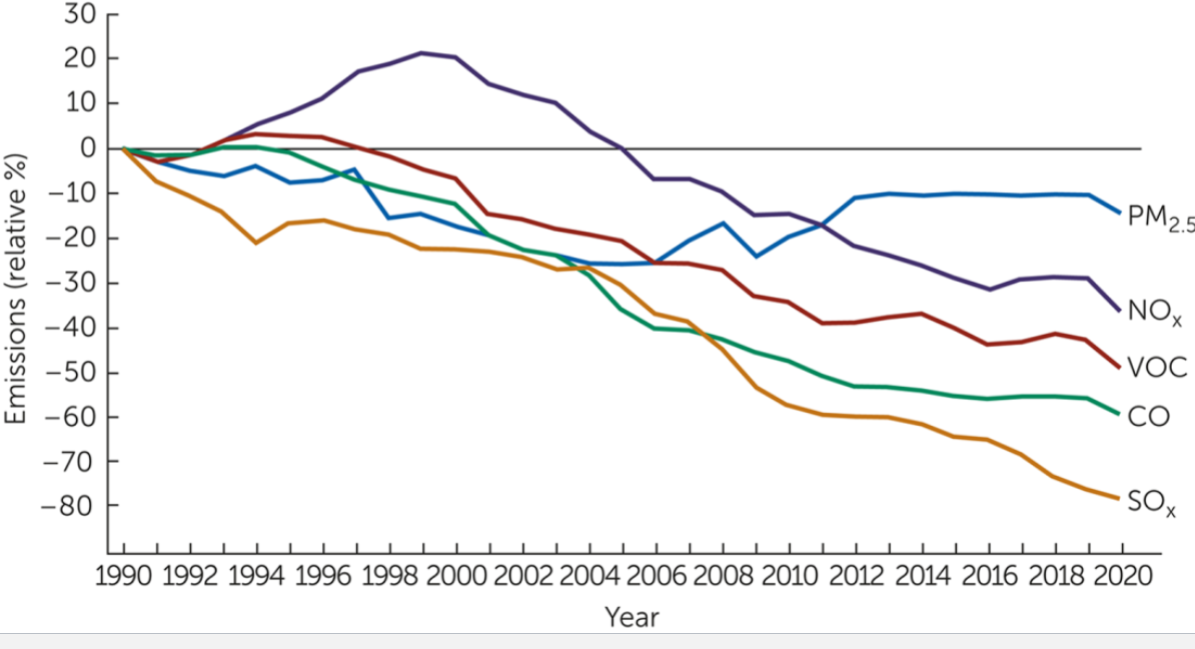
Emission trends in Canada
Making good progress
Dealing with emissions and sources
Fort McMurray tar sands helping
Conditions affecting dispersal of air pollutants
Dilution minimizes the damage caused by pollutants. Eg. Wind can help dilute
Faster wind leads to greater dispersal
Transported downwind more quickly
Increased turbulence causes vertical mixing
Wind and stability control the rate of mixing with clean air
Stable atmosphere restricts vertical motion. Air doesn’t go up or down, which increases pollution
Radiation or subsidence inversions (limits mixing)
Anticylconic conditions: contributes to poor air quality
Light winds; sinking air and subsidence inversions
no precip. to remove pollutants
closed loop land-sea breeze circulations can develop
Topography: mountains trap pollutants in valleys and basins
Air quality assessment
300 air pollution moitring stations across Canada
- mostly in urban areas
Measure CO2, SO2, NOx, VOCs, O3, PM, and heavy metals
Air quality Helath Index (AQHI)
based on O3, PM, PM, NOx
Canadaian Environmental Sustainability In
Depletion of Stratospheric Ozone
Ozone in troposphere is pollutant - want les of it
Ozone in stratosphere is a benefit bc it can absorb UV radiation.
Long-lived substances can circulate to the stratosphere and deplete ozone layer
Choloroflurocarbons (CFCs)
Sun
Energy drives temperature variations
Affects atmospheric pressure. High to low pressure creates winds
Affects air movement and ocean currents
affects the weather and violent weather
Long-term patterns determine climate
affects plants, animals, soil, ecosystem, and humans
Energy
Ability to do work
Kinetic
Potential energy
See energy as light
Feel energy as heat
experience it as movement
Law of conservation of energy
energy can never be created or destroyed but can be transformed from one form/object to another
Energy transferred in two ways
As Heat
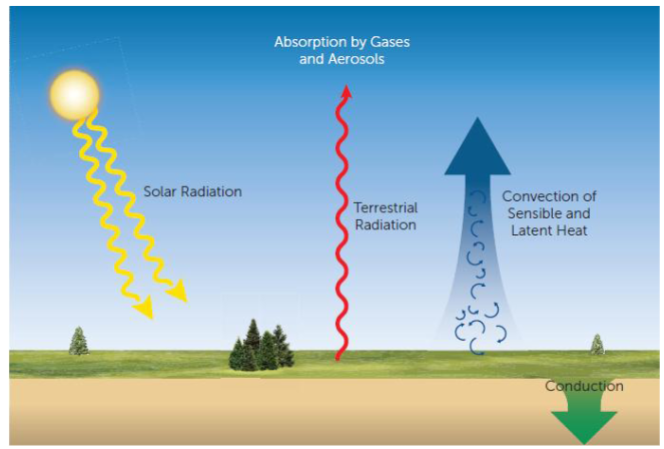
Conduction: transfer energy between molecules in contact. Eg. heating up a frying pan
Convection: transfer energy by vertical motions of a fluid. Eg.
Radiation: transfer by electromagnetic waves. Eg. From sun while tanning,
As work
Heat
energy transfered due to temperature difference
causes molecules to go faster
kinetic energy of molecules increase
temperatire is a measure of the avg speed of molecules
heat energy
Internal Energy: total energy contained in tehe molecules of a substance
Thermal Energy: kinetic energy of molecules, temperature changes
Potential Nergy: attractivce forces between the molecules. Phase changes (solids, liquids, vapour)
Sensible Heat
heat transfer that leads to temperature change
object will feel warmer or colder
Substances warm by different amounts with equal heating
Q=mcT
Eg. asphalt has high specific heat, sand
Latent Heat
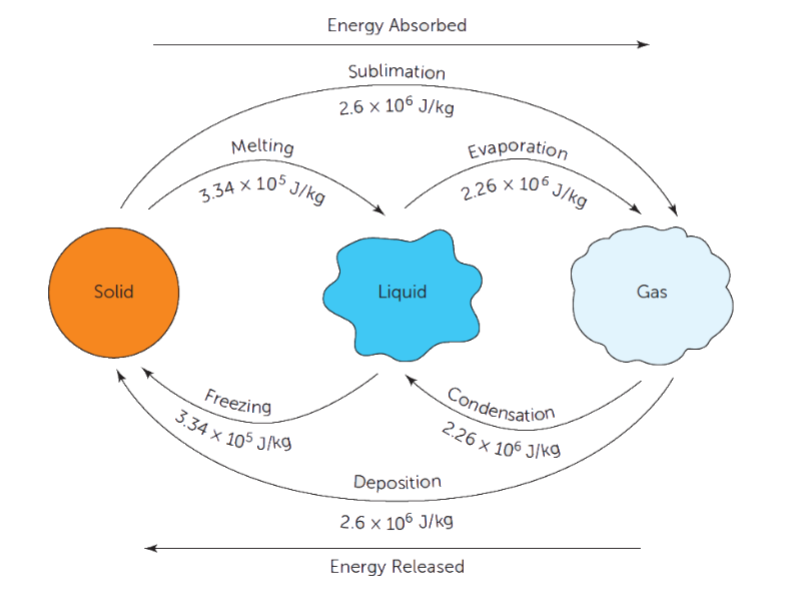
heat absorbed or released by a change in phase
energy is transferred, but no temperature change
temperature is hidden or latent
These processes absorb latent heat: melting, evaporation, sublimation
These processes release latent heat: freezing, condensation, deposition
Latent heat of vaporization
amount of heat involved when a substance changes between liquid or gas
Q=Lvm
Latent heat of fusion
amount of heat involved when a substance changes between Q=Lfm
Work
transfers energy by mechanical means
Eg. person pushing a cart
Work is equal to force multiplied by distance
W=PV
Gases and Work
an expanding gas does work on its surroundings
its internal energy goes down
COmpressing a gas requires work to be done on the gas
its internal energy goes up
P, V, T
Increase pressure, Volume decreases → inversely proportional
Increase Temperature, Volume Increase → proportional
Increase temperature, pressure increases → proportional
First law of thermodynamics
ways to increase temperature of a a gas: add heat, add work
Both will increase the internal energy
Q = change in U + W = mcchange inT + P change in V
All heat transferred to, or from, a gas must be accounted for by a temperature change, work, or both
Constant Pressure
if air is unconfined, some of the added heat foes into expansion, resulting in an increase in temperature and volume
Adiabatic process
temperature change without heat ransfer
driven by a change in pressure
expansion causes cooling
compression causes heating
Presure always decreases with height
vertical movement causes adiabatic temperature change
Eg. Chinooks, air that has gone over mountains and has compressed and heating up
Diabatic process
temperature change caused by heat rransfer
Diabitic processes:
conduction
convection
rasiation
phase change
Some or all of these often opereate simultaneously
Conduction
transfers heat from molecule to molecule
Faster molecules pass energy to slower molecules
Conductivity is highest for solids
Laminar boundar layerboundary
layer of air that is in contact with ground
it receives heat form conduction
only a few millimeters thick.
Convection
transfers heat through moving liquids and gases
heat is redistributed in space
Two types:
Thermal (free convection)
driven by density difference
warm air is less dense and has a tendency to rise on its own
Mechanical (forced convection)
driven by mechanical forces
mixing driven by winds and turbulence
Florida used big winds to save crops
Radiation
energy that travels in electromagnetic waveds
eg. light waves, microwaves, radio waves
everything emits and absorbs radiation
emission transfers energy out
absorption trnsfer energy in
Hotter substances emit more radiation than cooler ones
Daytime vs. nightime
solar radiation warms the surface
some heat is transferred upwards from the surface to the atmosphere and downwards into the ground.
rasiation emission cools the surface
some heat is transferred downwards form the atmosphere to the surface an upwards from the ground
How has Aurora borealis been viewed/ interpreted as in the past
Inspiration: poetry, light show, art
Predictors: borth, death, end of worls
Warnings: illness plague, death
Evidence of battle or games
Aristotle: flames of burning gas
“jumping goats”
Biblical (Ezekiel): Visions of God
Greeks: Apollo the sun god
Greenlanders: Glacier God
Chinese: Predict important events, rarely got them so this is why
Vikings: Evidence of battle
Estonia: Wedding in the sky; guests arrive on the sleighs lit up
Maori: ancestral travelers in cold zones
Australian Aboriginals: feast fires of dream circles
Inuit on aurora borealis
heavenly lights sent by ancestors
guide way for newly dead
visit to moon
game of kickball
Nothing new:
Walt Whitman
careful to know too much
More fun to have interpretations
early theories
firelight reflected from edge of world
sunlight reflecred form arctic ice
sunlight relfected off ice crystals in sky’volcanic eruptions
electricity in clouds
Sunspots
temporary dark regions on tehe sun caused by large magnetic disturnbaces
11 year cycles
Solar flare
a solar disturbance with intense hot flashes
last only for minutes
Magnetosphere
magnetic field surrounding earth
north and south pole
generated by dynamolike motions in earths outer core (molten metals)
protects earth, deflects solar winds
Like a really hot goalie. Weak spot for each goale and that is the north and south pole for this
Solar wind can enter at weak points
polar regions
solar wind (ionized particles) collides with gases in upper atmosphere
gases absorb and then emit energy in the form of visible light
Auroras
Locations
borealis - northern lights
australis - southern lights
Molecules
H2: red, H: green
N2+: blue/purple, No: pink/purplish
Always present, even in daytime. most visible in auroral zone
Yellowknife is best place to see northern lights (243/365 days)
Possible relationships with earth
drought periods coincide with solar minima (few sunspots)
wet periods coincide with solar maxima (more sunspots)
Air pollutant
any substance in the atmosphere that can negatively impact health
Primary vs. Secondaey Pollutant
Primary → emitted directly into the atmosphere
Secondary → forms in the atmosphere as a result of chemical reactions
Types of Air Pollutants
Carbon Monoxide: a toxic gas from incomplete combustion of carbon-based fuels
Sulpher Dioxide: contributes to acid deposition from coal burning, smelters, pulp mills
Nitrogen oxides: contributes to acid deposition through high temperature combustion
Volatile Organic Compounds (VOCs): smog, from evaporation of fuels and solvents
Ozone: eye and lung irritation, vegetation damage, from evaporation of fuels and solvents
 Note
Note  Flashcards (26)