EPOC (HL)
 View linked note
 Call Kai
 Learn
Learn Practice Test
 Spaced Repetition
 Match
Match Flashcards
 Knowt Play
1/12

There's no tags or description
Looks like no tags are added yet.
Name | Mastery | Learn | Test | Matching | Spaced | Call with Kai | Chat |
|---|
No analytics yet
Send a link to your students to track their progress
13 Terms
What is EPOC (Excess post-exercise oxygen consumption)?
The extra oxygen consumed during recovery above resting levels to restore homeostasis after exercise.
What is oxygen deficit?
The difference between the oxygen muscles demand and the oxygen actually supplied at the start of exercise.
What is oxygen debt?
Another term for EPOC; the oxygen required to remove lactic acid and restore energy stores after exercise.
What changes occur in muscle cells during intense exercise?
ATP, phosphocreatine, glycogen, triglycerides, and oxygen/myoglobin stores decrease
Lactic acid, carbon dioxide, and water increase.
The graph
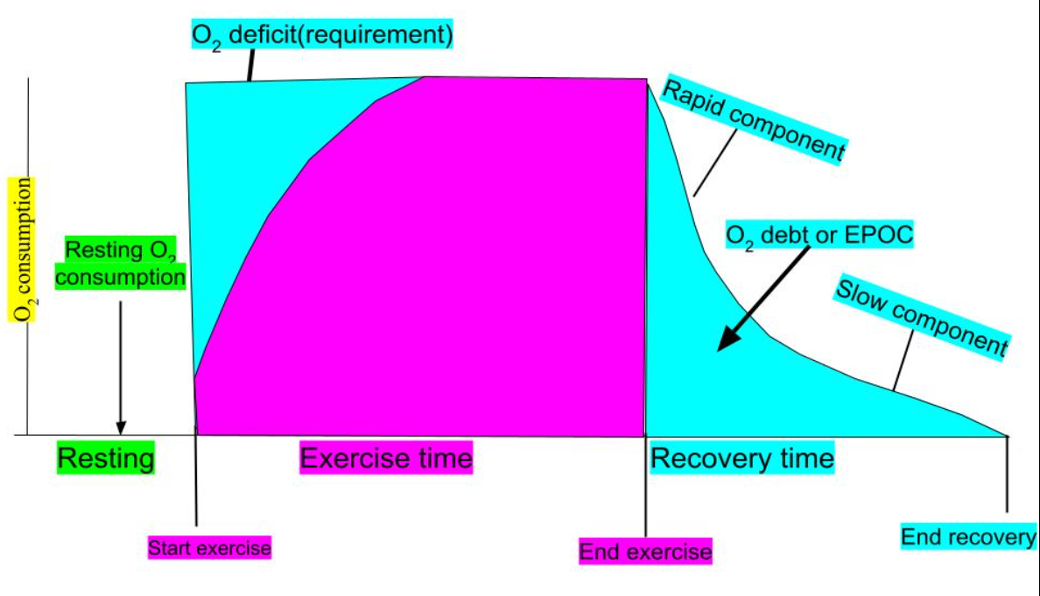
What does the start of the graph show?
Oxygen deficit: at the start, oxygen demand exceeds supply, so anaerobic systems help provide energy.
What does the steady-state exercise show?
Oxygen supply meets demand
What occurs during the EPOC phase after exercise?
Oxygen consumption remains elevated to restore homeostasis.
—> the curve gradually decreases as a recovery progresses
What does a steep initial decline in oxygen consumption represent?
The alactacid phase (fast recovery) after exercise.
What characterizes the slower, prolonged decline in oxygen consumption?
The lactacid phase (slow recovery) after exercise.
When does the alactacid phase occur?
Immediately after exericise
What occurs in the alactacid phase of EPOC?;
First 2–3 min; restores ATP and phosphocreatine stores, resaturates myoglobin with oxyfen, ~10% of total EPOC.
What occurs in the lactacid phase of EPOC?
Minutes to hours; removes lactic acid, restores muscle glycogen, repairs tissues, regulates body temperature, heart rate, and ventilation, ~90% of total EPOC.