EPOC (HL)
EPOC: the amount of oxygen consumed during recovery above tat which would ordinarily have been consumed at rest in the same time
Oxygen deficit: refers to the different between the oxygen that your muscles demand against the oxygen you can actually provide your muscles
Oxygen debt: known as excess post exercise oxygen consumption (EPOC). After prolonged exercise or anaerobic exercise the body accumulates an oxygen dept. During recovery the body needs to repay this dept requiring extra oxygen to remove the lactic acid.
Changes that occur in muscle cells during exercise
ATP: decrease
Phosphocreatine: decrease
Glycogen: decrease
Triglycerides: decrease
Carbon dioxide: increase
Oxygen/myoglobin stores: decrease
Lactic acid: increase
Water: increase
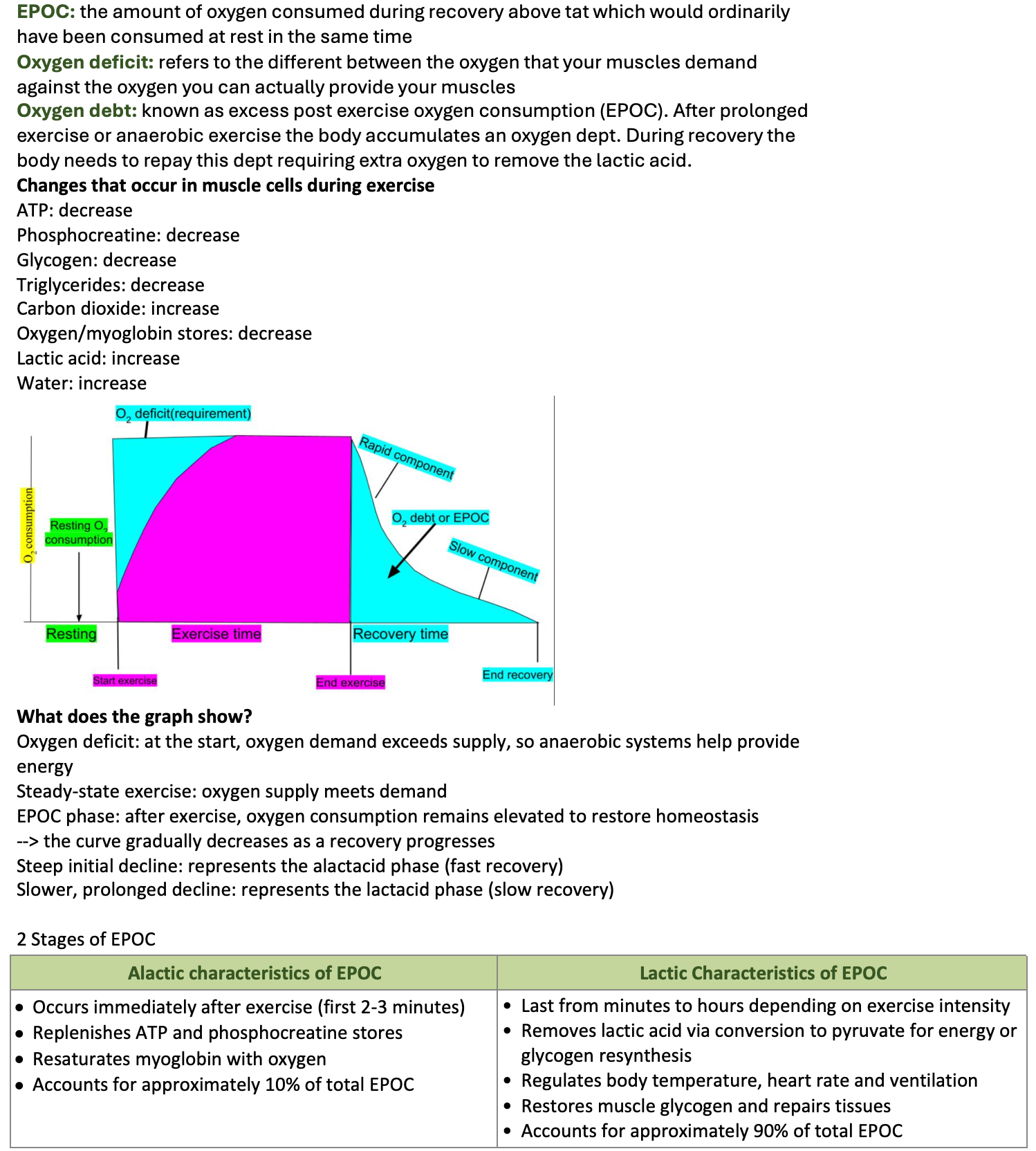
What does the graph show?
Oxygen deficit: at the start, oxygen demand exceeds supply, so anaerobic systems help provide energy
Steady-state exercise: oxygen supply meets demand
EPOC phase: after exercise, oxygen consumption remains elevated to restore homeostasis
--> the curve gradually decreases as a recovery progresses
Steep initial decline: represents the alactacid phase (fast recovery)
Slower, prolonged decline: represents the lactacid phase (slow recovery)
2 Stages of EPOC
Alactic characteristics of EPOC | Lactic Characteristics of EPOC |
|
|