Endocrine System
 View linked note
 Call Kai
 Learn
Learn Practice Test
 Spaced Repetition
 Match
Match Flashcards
1/119

There's no tags or description
Looks like no tags are added yet.
Name | Mastery | Learn | Test | Matching | Spaced | Call with Kai |
|---|
No analytics yet
Send a link to your students to track their progress
120 Terms
Endocrine System
An integrative system that controls an animal’s activities and coordination through hormones.
Endocrine Glands
Small, well-vascularized, ductless glands that release hormones. Pituitary, Thyroid, Pancreas, Adrenals, Testes, and Ovaries.
Hormones
Chemical messengers that initiate a physiological response. Can be local or circulating.
Local Hormones
Hormones that work in a very defined, small space and do not enter the circulatory system (blood vessels), released in small amounts, effective for minutes, the target cell uses up the small amount of hormone really quickly.
Circulating Hormones
Hormones that travel through the cardiovascular system and can be effective for longer periods, released in large amounts, effective until removed by the kidneys or used up but the target cell.
Target Cells
Cells that are affected by the release of a hormone, has the ability to interact with many hormones, any given cell may have receptors for a wide variety of hormones
Receptors
Integral proteins on the surface of a target cell that bind to hormones. Has a lock and key interaction where the shape has to match in order to bind to the hormone.
Up Regulation
Adding active receptors to a target cell surface when hormone levels drop. Adds receptors so that the hormone is more likely to bind to ensure that the process takes place.
Down Regulation
Removing active receptors from a target cell surface when hormone levels are high. Decreasing the rate of contact to maintain optimal rate of binding (prevents burn out of the cell).
What are the effects of hormones?
Change enzymatic activity/alter cellular metabolism
Change membrane permeability (any hormone involved in water conservation or secretion)
Cause other glands to release their own hormones
Nervous System vs. Endocrine System
Nervous system generates immediate changes with an incredibly rapid signal and lasts as long as the action potential (nerve impulse); the endocrine system takes longer for a change to be instigated because the hormone must diffuse first creating a time lag. The effect lasts as long as the hormone is present, could be hours or days.
Water-Soluble Hormones
Protein-based hormones that cannot diffuse through the membrane because they are too large or too polar and bind to receptors on the surface. Produced in the RER. Must bind to a transmembrane protein that acts as a receptor and triggers a cascade of events with a second messenger
second messenger concept
the hormone must rely on a second molecule to alter target cell activity. The hormone is the first messenger and activates the second messenger system in the cytoplasm. Typically the second messenger is cAMP (cyclic adenosine monophosphate)
Water soluble hormone steps
Protein (hormone) travels freely through the blood vessel, leaves the vessel, protein bind to the receptor, activates cAMP, cAMP goes around activating other protein kinases which does other mechanisms (transcription, translation, phosphorylation) which changes activities of the cell.
Lipid-Soluble Hormones
Cholesterol-based hormones that can diffuse through cell membranes. Produced in the SER, must bind to a transport protein (like albumin) to travel through the blood (cannot move through the plasma by itself because it is hydrophobic). Single messenger
Single messenger concept
the hormone is directly involved in altering the target cells activity
Lipid-soluble hormone steps
Hormone is travels through the blood bound to a transport protein (because it is hydrophobic and cannot move on its own), leaves vessel, diffuses through the membrane and binds to nuclear receptors to alter transcription, translation, phosphorylation, etc.
Negative Feedback
A physiological change initiates the release of a hormone that causes a change in the opposite direction. Brought back to homeostasis after you deviated. Most common mechanism in living things. Controlling minor fluctuations in homeostasis. Any deviations are immediately corrected otherwise they result in disease. Relies on antagonistic hormones
Antagonistic hormones
one works to increase value while the other works to bring it back down. They work together to maintain the range
Autonomic nervous system
signals generated by the ANS either increase or decrease hormone production. Have sympathetic and parasympathetic.
Sympathetic
increases production of the hormone
Parasympathetic
decreases the production of the hormone
Tropic cascade
the release of a hormone from one gland triggers the release of another hormone from a second gland. ex) hypothalamus
Positive Feedback
A physiological change in the body causes the release of hormones that amplifies that change. Going away from homeostasis on purpose. Requires a shutoff mechanism and can potentially be dangerous. ex) childbirth
Childbirth positive feedback
oxytocin targets the uterus to contract, baby’s head hits receptors which causes the pituitary gland to release more oxytocin. Only way to shut off the mechanism is when the baby is actually born. Can be dangerous if mom loses too much blood.
Hypothalamus
The master program, center for homeostasis, major integrating center. Knows what is normal for every aspect of the body and is continuously checking to make sure it is in that range. Takes in multiple stimuli and puts it together to make an appropriate response (called a neuroendocrine organ). Part of the thalamus, next to the pituitary gland. Secretes releasing or inhibiting hormones.
Releasing hormones
prompts the release of something else
Inhibiting hormones
inhibits the activity of that gland
Pituitary Gland
The master gland controlled by the hypothalamus (either directly or by hormones), responsible for producing various hormones that regulate a lot of different aspects of anatomy and physiology, part of the diencephalon in the brain, connected to the hypothalamus by the infundibulum (little bridge connecting them). Has anterior and posterior section.
Anterior pituitary gland
Largest portion (75%) of the pituitary gland and produces more hormones. Made completely of endocrine tissue, very vascular capillary bed. Under tropic control of hypothalamus. Lacks true connection to the brain and has a large blood supply (so all hormones can easily diffuse into the capillaries and enter the circulatory system).
Posterior Pituitary gland
Under direct control of the hypothalamus by ANS, dominated by nervous tissue, direct connection of neurons from the hypothalamus, doesn’t make its own hormones, stores the hormones that the hypothalamus makes.
Hormones of the anterior pituitary gland
TSH, FSH, LH, ACTH, GH, Prolactin, and MSH
Thyroid-Stimulating Hormone (TSH) target
thyroid gland
TSH action
stimulate production of thyroid hormones. TSH and the thyroid hormones have negative feedback
FSH target
gonads (in both males and females)
Follicle-Stimulating Hormone (FSH) action
In females it stimulates egg production and causes maturation of oocyte within the follicle. In males it stimulates sperm production, plays a role in spermatogenesis
LH target
gonads
Luteinizing Hormone (LH) action
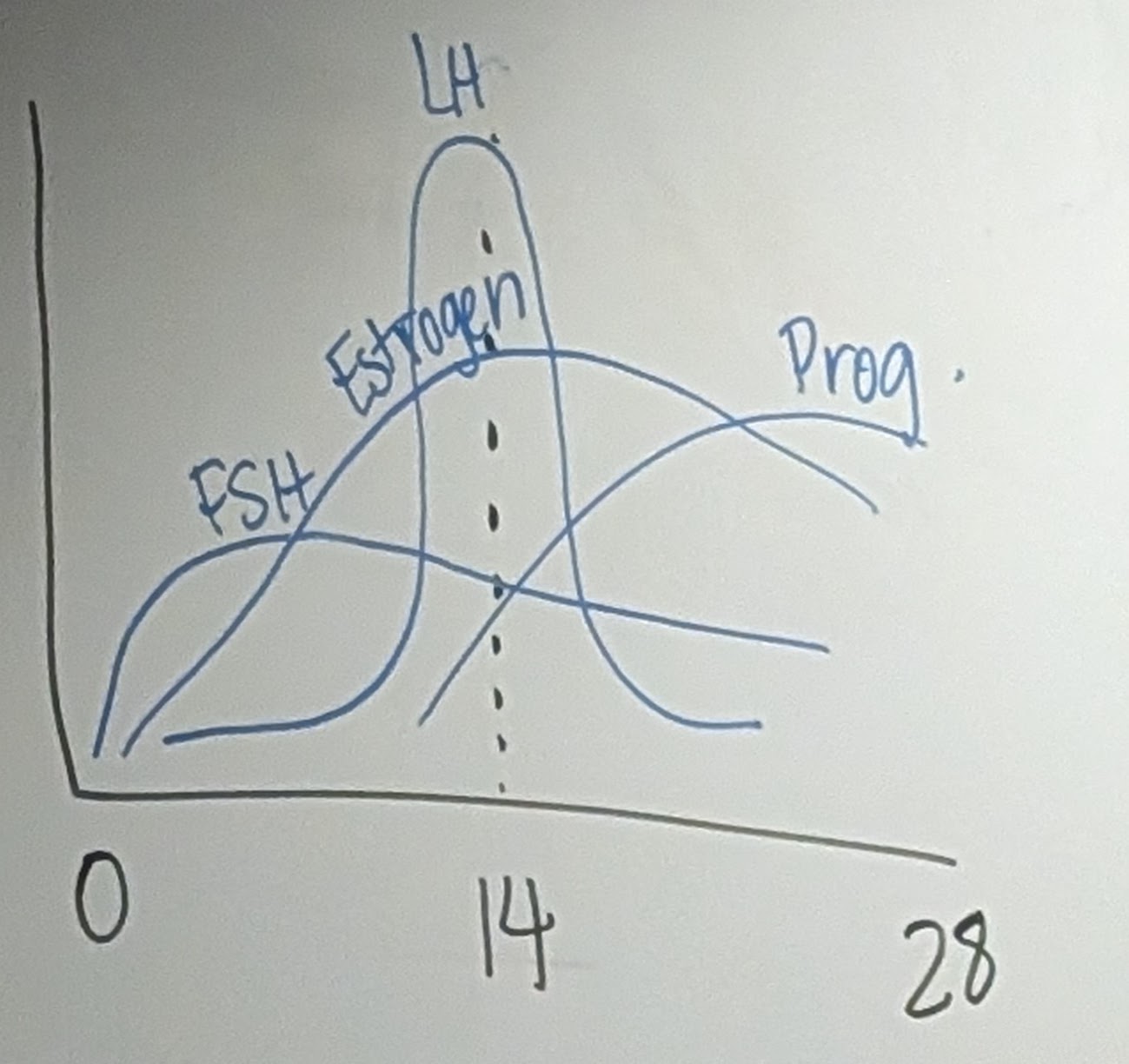
In females it stimulates/promotes ovulation, corpus luteum production, and secretion of female sex steroids (estrogen and progesterone). Related to menstrual cycle and early fetal development. In males it stimulates/promotes production of testosterone.
ACTH target
adrenal cortex
Adrenocorticotropic Hormone (ACTH) action
Increases production of glucocorticoids (all about carbohydrate metabolism). Plays important role in mobilizing resources when needed (fight or flight)
GH targets
cartilage, bone, skeletal muscle, liver
Growth Hormone (GH)/somatotropin action
Stimulates metabolism and cell division directly in cartilage, bone, and skeletal muscle. In the liver it stimulates the secretion of insulin-like growth factor which promotes resources being dumped into the bloodstream, like glycogen, which breaks down into glucose to be released in the bloodstream which also stimulates metabolism and cell division (liver stuff fuels the growth of the other things).
Prolactin target
mammary glands
Prolactin action
promotes and maintains lactation in mammals. In fishes it plays a role in mucus secretion and osmoregulation. In amphibians it plays a role in metamorphosis and development. In birds it plays a role in brooding behavior. It is initially released in response to oxytocin but continues production once oxytocin is gone.
MSH target
melanocytes
Melanocyte-Stimulating Hormone (MSH) action
In fish, amphibians, and nonavian reptiles it promotes the dispersion of pigment (darkens skin). In birds and mammals the physiological function is unclear.
Hormones of the posterior pituitary gland
Oxytocin and ADH
Oxytocin target
smooth muscle of the uterus (in all verts), mammary glands (mammals)
Oxytocin action
Stimulates uterine contractions and in mammals it ejects milk in response to suckling with prolactin, but once baby is out of body, prolactin takes over
ADH target
kidneys (loop of Henle and collecting duct)
Antidiuretic Hormone (ADH)/vasopressin action
Increases water reabsorption (makes it so that you don’t pee as much), concentrated urine/restricted flow
Pineal gland
part of the diencephalon in the thalamus, is called neuroendocrine, activity regulated by light levels, in ectothermic verts it acts as a photoreceptive sensory organ (referred to as the third eye in some (parietal foramen) and can be homologous to the lens of an eye. In birds and mammals it is an entirely glandular structure. It produces melatonin.
Melatonin target
global, targets every single cell in your body (every cell has receptors for it
Melatonin action
Regulates sleep cycle, when light levels are high (during the day), there are low levels of melatonin and vice versa
Pineal gland in nonmammalian verts
maintains circadian rhythms
Pineal gland in mammals
circadian rhythms regulated by part of the hypothalamus but the pineal gland/melatonin reinforces it. Why we are able to do night shifts. Birds and mammals have a photoperiod which regulates seasonal rhythms in reproduction because days get shorter in the winter.
Thyroid gland
large endocrine gland in the neck of all verts, highly vascular, divided into halves (in most verts) with a small connection point in between them, tissue composed of sphere-like units called follicles that produce the hormones T3, T4, and calcitonin. Contains half of the iodine in the body, iodine deficiencies cause metabolism problems.
T3 and T4 target
global
Triiodothyronine (T3) and Thyroxine (T4) action
Promotes growth/development of NS, Regulate metabolism by regulating cell’s ability to use oxygen. Synergists with each other.
Hypothyroidism
under secretion of thyroid hormones, slows metabolic activities. In fish, birds, and mammals, under secretion drastically impairs growth and nervous system development. Malfunction from a very early age causes cretinism in humans (truncated growth). Weight gain occurs if acquired later in age.
Hyperthyroidism
over secretion of thyroid hormones, increases metabolic activities. Causes precocious development in all verts, ramping up development, growth and development takes place too quickly, early maturation, goes through puberty too soon. Effect is most prominent in frogs and fish. Cats commonly have this.
Thyroid hormones and adaptation
thyroid gland promotes adaptation to cold climates (due to heat production), cold adapted animals eat more food in winter than summer, T3 and T4 drop during hibernation (can be 40% drop) to slow metabolism to make sure the food lasts longer.
Calcitonin targets
osteoclasts (bone carving cells, breaks down bones)
Calcitonin action
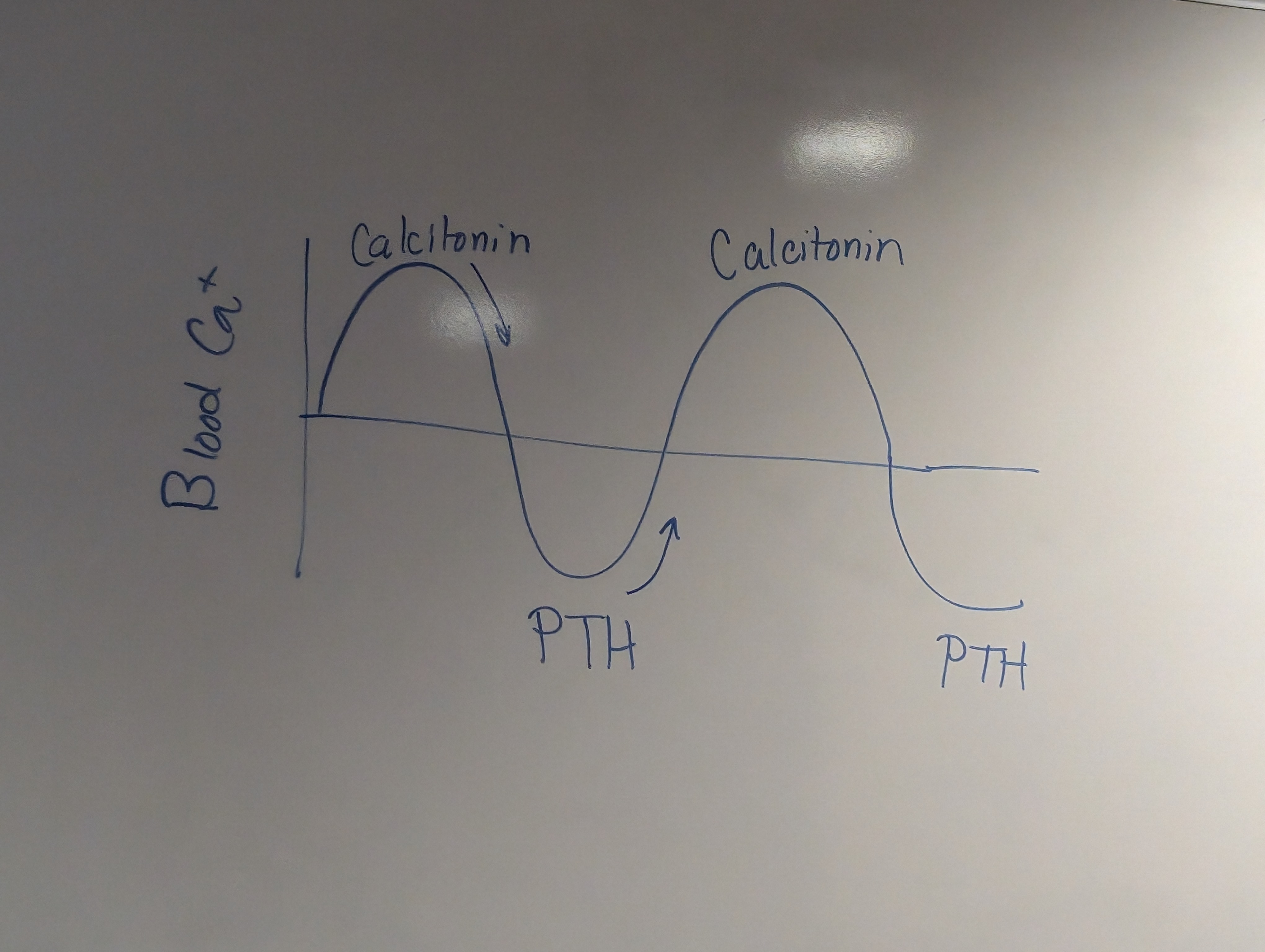
decreases blood Ca2+, shuts the osteoclasts down which activates the osteoblasts (bone building cells). The osteoblasts grab/remove all the calcium in the bloodstream (decreases calcium levels).
Parathyroid glands
closely associated with the thyroid glands (may even be within it), number of them is highly variable (humans and most verts have 2, reptiles have 1, birds have 4), in birds and mammals it does removal of gland rapidly decreases blood calcium levels. Produces PTH in all verts except fish. Antagonist to thyroid gland to maintain calcium homeostasis, negative feedback
PTH targets
osteoclasts
Parathyroid Hormone (PTH) action
Increases blood calcium levels (opposite of calcitonin). Promotes osteoclast activity, inhibits osteoblasts, osteoclasts release calcium into the bloodstream.
Adrenal gland
paired glands that are composed of unrelated tissue types (cortex and inner medulla) in mammals, sits right on top of the kidneys, produces cortisol, aldosterone, androgens, epinephrine and norepinephrine.
Cortisol target
global
Cortisol (glucocorticoid) in the adrenal cortex action
Regulates food metabolism (glucocorticoid mobilizes glucose), reduces inflammation, helps body store fat (promotes fat storage). Primarily mammalian and bird hormone.
Aldosterone target
kidneys
Aldosterone (mineralocorticoid) in the adrenal cortex action
Regulates water balance/urinary output by regulating sodium levels. (mineralocorticoids metabolizes minerals, sodium in this case). Promotes the reabsorption of sodium and plays a role in urination because water diffuses with the increase of sodium concentration.
Androgen target
hair follicles
Androgens (in the adrenal cortex) action
stimulates hair growth, associated with sexual maturation
Epinephrine and norepinephrine target
global
Epinephrine and norepinephrine (in the adrenal medulla) action
activates flight or fight response
Pancreas
endocrine and exocrine gland, contains endocrine cells (islets of Langerhans), little hubs of hormones production, have different cells within them. Produces insulin and glucagon
Insulin target
liver, skeletal muscle, adipose tissue
Insulin action
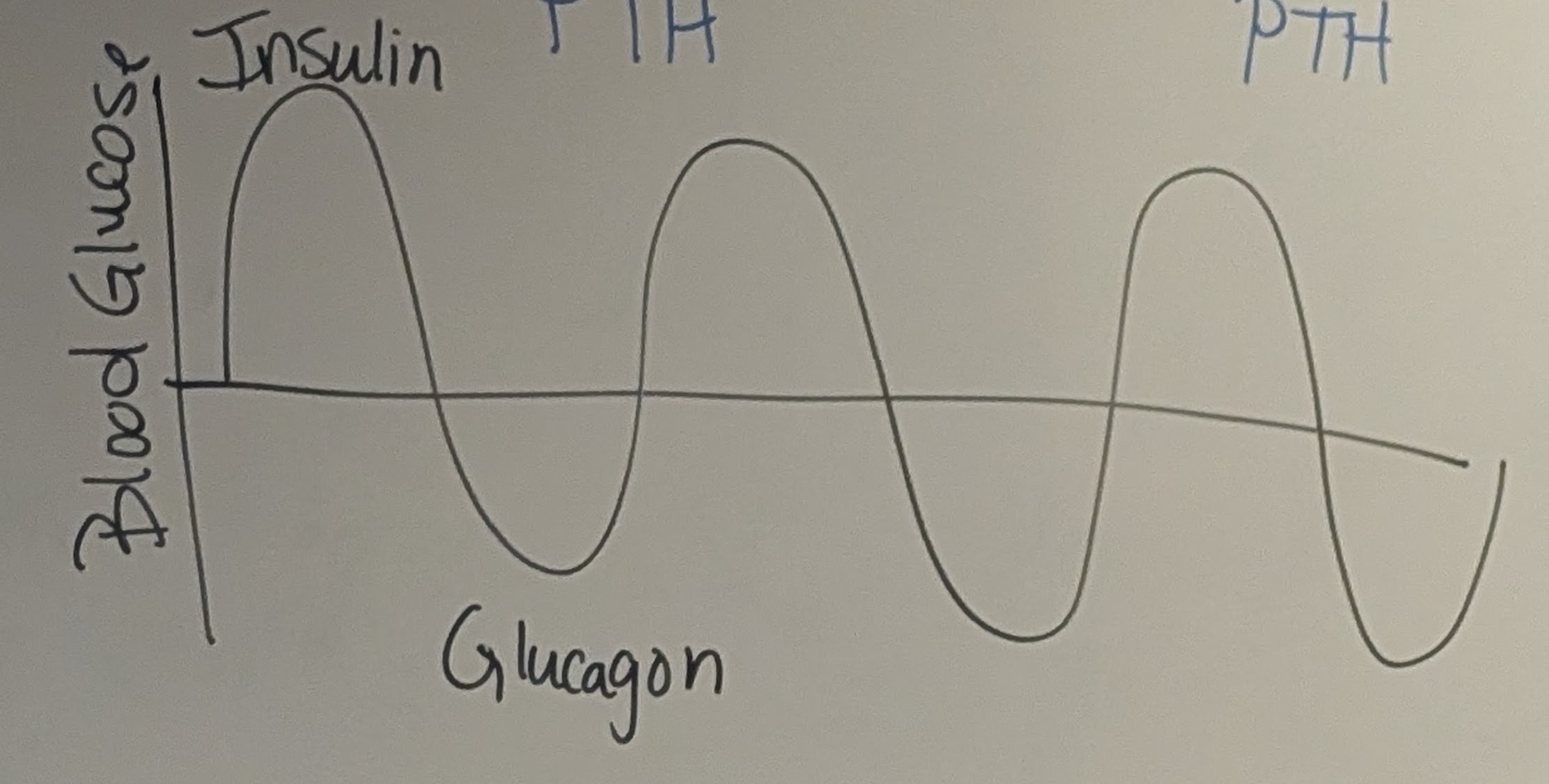
Stimulates cells to take in glucose (by glycogen) and store it, works to reduce blood glucose levels
Glucagon target
liver, adipose (NEVER skeletal muscle)
Glucagon action
Stimulates cells to breakdown glycogen and release glucose into the blood. Antagonistic to insulin
Estrous Cycle
Seasonal or cyclic reproductive cycle in females. Females are only sexually receptive during brief periods of “heat” (estrus). Endometrium (inner epithelial layer of the uterus) is not shed, instead it reverts to original state (in nonoriginal state it swells and fills with blood so that it can support an implanted zygote).
Menstrual Cycle
Reproductive cycle characteristic of anthropoids (primarily) and elephant shrews and some bats. Females are sexually receptive throughout cycle. Ends with the breakdown and discharge of the endometrium
Menopause
permanent cessation of ovulation, due to a decline in estrogen and progesterone. Only occurs in a few groups of mammals usually because it caps lifetime fitness. Possible explanation for its evolution is the grandmother hypothesis. Ex) orcas, Japanese macaques, humans, etc.
Grandmother hypothesis
grandmothers help raise grandchildren, helping daughters raise grandchildren indirectly helps fitness, kin selection.
Fight or Flight Response/general adaptation syndrome
Activated when exposed to extreme or long term stress, preparing the body to deal with a stressor 9fighting or getting away) and allows the body to work outside of homeostasis for a short period.
Stage 1 of fight or flight response
Alarm reaction: something horrifying just happened. Initiated by hypothalamus when stress is perceived. Sympathetic NS is activated. Adrenal medulla releases epinephrine (causes increase in blood glucose) and in the pancreas glucagon increases and insulin decreases to increase blood glucose. Heart contractions increase, vasodilation in coronary and skeletal muscles, vasoconstriction in the kidneys. All non-essential organ system functions are inhibited by vasoconstriction (kidneys and digestive system). Increases resources (oxygen and glucose) to the brain, heart, and muscles.
Stage 2 of fight or flight response
Resistance reaction. Extended releases of epinephrine causes release of cortisol (only happens when stimulus is sustained). Stimulates glucose metabolism to continue powering the flight and use additional resources. Pain receptors suppressed. Inflammation reduced (to allow animal to continue fighting by preventing stressors that would prevent the animal from doing the task).
Stage 3 of fight or flight response
Exhaustion. Resistance reaction cannot be maintained any longer (resources have be depleted), prolonged exposure to cortisol causes wasting of muscles, suppression of immune system, and storage of fat (adipose cells) why weight gain is a common response to stress.
Posterior Pituitary Gland
Stores hormones produced by the hypothalamus.
Growth Factor
Substances that promote cell growth, division, and survival.
Thymosin
Hormone involved in the development of T-cells in the immune system.
Gonadotropin-Releasing Hormone (GnRH)
Hormone released by the hypothalamus that stimulates FSH and LH.
Somatostatin
Hormone that inhibits the release of growth hormone.
Corticotropin-Releasing Hormone (CRH)
Hormone that stimulates the release of ACTH.
Thyroid Hormone Feedback
Negative feedback mechanism regulating thyroid hormone levels.
Hypothalamic-Pituitary Axis
The regulatory system connecting the hypothalamus, pituitary gland, and various endocrine glands.
Insulin-like Growth Factor (IGF)
Stimulates growth and development in response to growth hormone.
Gonads
Reproductive organs that produce gametes and hormones.
Hormonal Homeostasis
The balance of hormone levels in the body.