Cognitive Processes Exam 2 NCSU (PSY 420)
 Call Kai
 Learn
Learn Practice Test
 Spaced Repetition
 Match
Match Flashcards
 Knowt Play
1/52

There's no tags or description
Looks like no tags are added yet.
Name | Mastery | Learn | Test | Matching | Spaced | Call with Kai |
|---|
No analytics yet
Send a link to your students to track their progress
53 Terms
Selective Attention
Refers to the skill through which one focuses on one input or one task while ignoring other stimuli
Shadowing
repeating an audio track
Dichotic Listening
different messages to each ear
Attended Channel
listen to this one
Unattended channel
ignore this one
cocktail party effect
-ability to attend to only one voice among many
-Unattended channel can be noticed if you hear your own name or words of high personal significance
inattentional blindness
-failing to see visible objects when our attention is directed elsewhere
-there can be no perception without attention
Change Blindness
inability to detect changes in scenes
Spatial Attention
sometimes thought of as a "searchlight" = we can move this searchlight in space, as well as adjust the size of the "beam"
unilateral neglect
A syndrome in which people ignore objects located toward their left and the left sides of objects located anywhere; most often caused by damage to the right parietal lobe
Divided Attention
performing multiple tasks simultaneously
mode code attention resources
Mode: Visual - Auditory
Code: Spatial Verbal
Visual - Spatial task
driving on a curvy road
Visual - verbal task
glancing at text on a gps
Auditory - spatial task
listening for the positions of cars near you
Auditory - verbal task
listening to a science podcast
Attentional resources can be divided into:
-Spatial resources
-Verbal Resources
-Visual Resources
-Auditory Resources
Response Selector
"traffic cop"/ coordinates and times activities - both physical and mental
Central Executive
Coordinates the allocation of other resources - sets goals and priorities/chooses strategies
Executive control strongly connected to
Working memory
Anti-saccade task
moving towards a cue is easy but moving eyes away from a cue is hard
Goal Neglect
relying on habitual responses that are contrary to the goals of a particular task
Perservation
the tendency to produce the same response over and over when the task requires a change in response
Types of Attentional Systems
-System 1: Automatic
-System 2: Controlled
System 1: Automatic
Operates:
-Quickly
-With little or no effort
-no sense of voluntary control
System 2: Controlled
Operates:
-by allocation resources to effortful mental activities
-Often associated with feelings of: agency, choice, and concentration
One way to frame learning and memory
acquisition, storage, retrieval
2 reasons computer analogy is problematic
1. New learning is grounded in previously learned (stored) knowledge
2.Effective learning depends on how the information will be later retrieved
The Modal Model
the three-stage memory model that divides memory into 3 areas--sensory, short term, and long term
Short term memory (STM)
holds the information currently in use
Long-term memory
all of the information one can remember
The Modal Model information processing (pic)
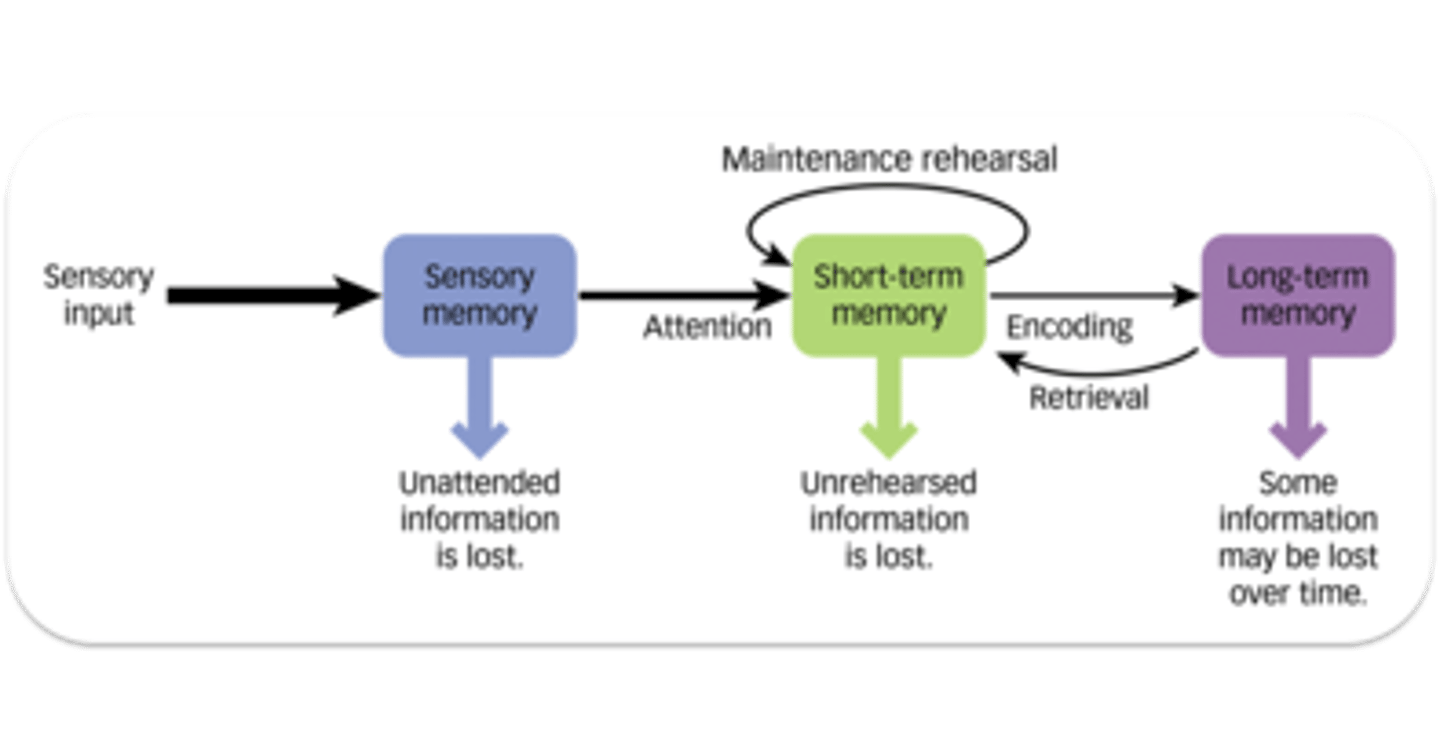
Working memory
a dynamic form of short-term memory
Primacy effect
better memory for first few iteams
Memory rehearsal
allows transfer from WM to LTM
Recency Effect
Better memory for the last few items based on working memory
Reading span test
-A measure that captures the active nature of working memory
-The number of words remembered is the reading span
Operation Span test
-Another measure of working memory
-Is this equation true or false?
-Remember a word
Chunking
-Condense information
-Requires effort
-Reduces load
-Does not increase WM
Working memory metaphor
Loading dock - mechanically transfers input to and from long term memory
Better working memory metaphor
Librarian - actively categorizes, catalogs and cross references new material
Two types of rehearsal
1. Maintenance rehearsal
2. Relational or Elaborative Rehearsal
Maintenance Rehersal
Reciting
Relational or Elaborative rehearsal
linking
Repeated exposure
does not guarantee memory
Shallow processing
superficial
Deep processing
meaningful
Incidental learning
unintentional
Intentional learning
intentional
Retrieval Paths
-paths that guide one's thoughts toward the content to be remembered
-More elaborative encoding creates more retrieval paths
Mnemonics
improve memory through organization
Peg-word systems
items are "hung" on a system of already well known "pegs" (first-letter mnemonics)
Context-dependent learning
is dependent on the state one is in during acquisition

