AQA GCSE Biology - Autumn Term Assessment 1 2022 - Photosynthesis, Organisation and the Heart
0.0(0)
 Studied by 1 person
 Call Kai
 Learn
Learn Practice Test
 Spaced Repetition
 Match
Match Flashcards
 Knowt Play
Card Sorting
1/101

Last updated 8:46 AM on 11/10/22
Name | Mastery | Learn | Test | Matching | Spaced | Call with Kai |
|---|
No analytics yet
Send a link to your students to track their progress
102 Terms
1
New cards
What organisms perform photosynthesis?
Plants, algae, and some bacteria
2
New cards
Where does photosynthesis occur?
chloroplasts (plant cells) in the leaves
3
New cards
What molecules are required for photosynthesis?
carbon dioxide and water
4
New cards
What are the products of photosynthesis?
glucose and oxygen
5
New cards
Photosynthesis is
Conversion of light energy from the sun into chemical energy.
6
New cards
Photosynthesis formula...
6CO2 + 6H2O (+ sunlight) ---> C6 H12 O6 + 6O2
7
New cards
What mineral ions are needed for photosynthesis?
phosphorus, potassium, magnesium, nitrogen
8
New cards
Uses of glucose produced in photosynthesis
Fats and lipids (stored in seeds), proteins, starch stored in plants, to make cellulose, used for energy in respiration
9
New cards
Photosynthesis: endo or exothermic reaction?
Endothermic, because it takes in energy from the environment, and does not release it
10
New cards
Guard cells are....
- Bean shaped cells surrounding the stomatal pore in pairs that regulate the opening and closing of the stomata
- They have a thin outer wall, thick inner wall, nucleus, chloroplasts and a central vacuole
- They have a thin outer wall, thick inner wall, nucleus, chloroplasts and a central vacuole
11
New cards
Describe the opening and closing of the stomata
When there is surplus water:
- Water moves into the guard cells by osmosis (from low to high concentration down the concentration gradient)
- Guard cells become turgid
- Stomata opens
When water is scarce:
- Water moves out of the guard cells by osmosis (from low to high concentration down the concentration gradient)
- Guard cells become flaccid
- Stomata closes
- Water moves into the guard cells by osmosis (from low to high concentration down the concentration gradient)
- Guard cells become turgid
- Stomata opens
When water is scarce:
- Water moves out of the guard cells by osmosis (from low to high concentration down the concentration gradient)
- Guard cells become flaccid
- Stomata closes
12
New cards
Gas Movement in the leaf
- Carbon Dioxide diffuses down the concentration gradient from a region of high concentration (outside the leaf) to a region of low concentration (inside the leaf)
- Oxygen produced in photosynthesis diffuses down the concentration gradient from an area of high concentration (inside the leaf) to a low concentration (outside the leaf)
- Oxygen produced in photosynthesis diffuses down the concentration gradient from an area of high concentration (inside the leaf) to a low concentration (outside the leaf)
13
New cards
Factors affecting the rate of photosynthesis:
light intensity, temperature, carbon dioxide concentration and the number of chloroplasts
14
New cards
How does temperature affect the rate of photosynthesis?
- The higher the temperature, the higher the rate of photosynthesis as the particles have more kinetic energy
- Increases the rate of successful collisions between the enzymes and the substrates and the rate of diffusion of gases
- Results in the formation of products
- If the temperature is over around 45 degrees Celsius, the enzymes may become denatured and that reduces the overall rate until it stops completely
- Increases the rate of successful collisions between the enzymes and the substrates and the rate of diffusion of gases
- Results in the formation of products
- If the temperature is over around 45 degrees Celsius, the enzymes may become denatured and that reduces the overall rate until it stops completely
15
New cards
How does light intensity affect the rate of photosynthesis?
- The higher the light intensity, the higher the rate of photosynthesis
- The rate will carry on increasing until another factor becomes the limiting factor, the graph levels off and the rate becomes constant
- The rate will carry on increasing until another factor becomes the limiting factor, the graph levels off and the rate becomes constant
16
New cards
Calculating light intensity
Light intensity = 1/distance^2
17
New cards
Limiting Factor
- Can be defined as something present in the environment in such a short supply that it restricts life processes
- Doesn't end the reaction: it just stops the reaction rate from getting any faster
- Doesn't end the reaction: it just stops the reaction rate from getting any faster
18
New cards
How does CO2 concentration affect the rate of photosynthesis?
- The higher the concentration of CO2, the higher the rate of photosynthesis
- The rate will carry on increasing until another factor becomes the limiting factor, the graph levels off and the rate becomes constant
- The rate will carry on increasing until another factor becomes the limiting factor, the graph levels off and the rate becomes constant
19
New cards
How does the number of chloroplasts affect the rate of photosynthesis?
- The more chloroplasts the plant has, the faster the rate of photosynthesis
- This is because they contain the green pigment chlorophyll which absorbs light energy for photosynthesis
- This is because they contain the green pigment chlorophyll which absorbs light energy for photosynthesis
20
New cards
How is the leaf adapted for photosynthesis? (6 marks)
- Waxy cuticle coats the leaf and prevents water loss as it is waterproof and gas-proof, and transparent which means it can absorb sunlight faster
- Upper epidermis which protects inner tissues and reduces water loss because it is a thin transparent layer that allows light for photosynthesis and isn't reflected away and does not have any air spaces or pores so no gas/water is lost
- Palisade mesophyll, it's the main site of photosynthesis as glucose is made here, and this is possible as it has many chloroplasts that are filled with chlorophyll and are located near the top of the leaf so it has more access to sunlight and they are tightly packed long and thin cells, and so have more surface area
- Spongy mesophyll, which is responsible for gas exchange, allows gas to pass through the large air spaces between and has a large surface area to enable rapid diffusion of gases
- Lower epidermis, which protects the inner tissues and allows light for photosynthesis as it is a thin and transparent layer and has pores called stomata
- Stomata, located mainly in the lower epidermis to prevent water loss, are where the gases go in and out of the leaf, and are controlled by guard cells to allow for CO2 to diffuse in and O2 and water vapour to diffuse out of the leaf, and prevents water loss by closing
- Upper epidermis which protects inner tissues and reduces water loss because it is a thin transparent layer that allows light for photosynthesis and isn't reflected away and does not have any air spaces or pores so no gas/water is lost
- Palisade mesophyll, it's the main site of photosynthesis as glucose is made here, and this is possible as it has many chloroplasts that are filled with chlorophyll and are located near the top of the leaf so it has more access to sunlight and they are tightly packed long and thin cells, and so have more surface area
- Spongy mesophyll, which is responsible for gas exchange, allows gas to pass through the large air spaces between and has a large surface area to enable rapid diffusion of gases
- Lower epidermis, which protects the inner tissues and allows light for photosynthesis as it is a thin and transparent layer and has pores called stomata
- Stomata, located mainly in the lower epidermis to prevent water loss, are where the gases go in and out of the leaf, and are controlled by guard cells to allow for CO2 to diffuse in and O2 and water vapour to diffuse out of the leaf, and prevents water loss by closing
21
New cards
Xylem
Dead cells in the vascular tissue/bundle that carries water upward from the roots to every part of a plant (transpiration). water only moves upward
22
New cards
Phloem
Living cells that transport sugar and other molecules made by the plant in the leaf to the rest of the plant (translocation). sugar moves in both directions
23
New cards
Properties of xylem
Form long, dead hollow vessels, have no end walls so stream of water is continuous, strengthened by lignin which is also waterproof as it causes cells to die, have no internal organelles so allows for a larger capacity of water to be carried
24
New cards
Properties of phloem
Have sieve plates that distribute amino acids evenly throughout the plant, have no nuclei, have perforated end plates so that their cytoplasm connects one cell to the next, have companion cells which have nuclei, cytoplasm and many mitochondria which provide energy
25
New cards
Route of water from soil to roots
Water is absorbed by the roots from the soil: it moves from a lower to a higher concentration by osmosis into the root hair cell
26
New cards
Route of mineral ions from soil to roots
Mineral ions like magnesium enter the plant through the roots, and as they move from an area of lower concentration in the soil to higher concentration in the plant, they move against the concentration gradient via active transport
27
New cards
Adaptations of root hair cells
- Have extensions which give them a larger surface area so the rate of water moving into the plant by osmosis is higher
- Have many mitochondria which provide energy for active transport for the absorption of mineral ions in the soil
- They don't have chloroplasts as they are underground and don't need to photosynthesise, which means they have more space for a large vacuole which maintains the concentration gradient for water to move into the plant
- Have many mitochondria which provide energy for active transport for the absorption of mineral ions in the soil
- They don't have chloroplasts as they are underground and don't need to photosynthesise, which means they have more space for a large vacuole which maintains the concentration gradient for water to move into the plant
28
New cards
Turgid
swollen as from a fluid (often water in a plant)
29
New cards
Flaccid
not plump and swollen but floppy or loose (often due to lack of water in a plant)
30
New cards
Stomatal Density
number of stomata per unit area
31
New cards
Uses of water in a plant
Reactant for photosynthesis, movement of mineral ions and for support and frigidity
32
New cards
Movement of water from roots to rest of plant
- Water moves from the soil into the roots by osmosis
- The water moves from the roots into the stem, and this replaces the water that is constantly moving up the stem
- Water moves up the stem into the leaf to replace water lost by transpiration
- Water is lost from the leaves through open pores (stomata) by transpiration
- The water moves from the roots into the stem, and this replaces the water that is constantly moving up the stem
- Water moves up the stem into the leaf to replace water lost by transpiration
- Water is lost from the leaves through open pores (stomata) by transpiration
33
New cards
Transpiration
Loss of water vapour by evaporation from the leaves of a plant through the stomata
34
New cards
Transpiration stream
the movement of water through a plant from the roots to leaves as a result of loss of water by evaporation from the surface of the leaves
35
New cards
Adaptations to limit water loss in a plant
- Waterproof waxy cuticle
- stomata closing at night
- more stomata on the underlayer (most plants)
- wilting
- guard cells
- stomata closing at night
- more stomata on the underlayer (most plants)
- wilting
- guard cells
36
New cards
Adaptations to limit water loss in aquatic plants
- Stomata on upper layer to allow CO2 uptake from the atmosphere
- No need for roots and xylem (no need for lignin) as leaf is supported by water
- Very thin cuticle, since water conservation is not a problem
- No need for roots and xylem (no need for lignin) as leaf is supported by water
- Very thin cuticle, since water conservation is not a problem
37
New cards
Adaptations to limit water loss in desert plants
- Leaves reduced to spines to reduce surface area for water loss (and deter grazing animals)
- Sunken stomata (in grooves) to avoid drying winds and trap water vapour
- Very thick waxy cuticle which is waterproof
- Shallow roots to absorb water from lightest rainfall
- Very deep roots penetrate to the very low water table
- Often have hairs to prevent water loss by trapping moist air
- Sunken stomata (in grooves) to avoid drying winds and trap water vapour
- Very thick waxy cuticle which is waterproof
- Shallow roots to absorb water from lightest rainfall
- Very deep roots penetrate to the very low water table
- Often have hairs to prevent water loss by trapping moist air
38
New cards
Potometer
a device used for measuring the rate of water uptake of a plant due to photosynthesis and transpiration
39
New cards
Rate of transpiration
Rate of loss of water through the stomata on leaves
40
New cards
Calculating the rate of transpiration using a bubble potometer
- Measure distance the air bubble travels
- Time how long it takes to travel that distance
- Rate = Distance/ Time
- Time how long it takes to travel that distance
- Rate = Distance/ Time
41
New cards
Factors affecting the rate of transpiration
- Temperature
- Ventilation/ air movement
- Humidity
- Light
- Ventilation/ air movement
- Humidity
- Light
42
New cards
How does temperature affect the rate of transpiration?
- The higher the temperature, the higher the rate of transpiration
- Particles have more kinetic energy and so more stomata open and diffusion occurs more rapidly
- Particles have more kinetic energy and so more stomata open and diffusion occurs more rapidly
43
New cards
How does ventilation/ air movement affect the rate of transpiration?
- The higher the wind velocity, the higher the rate of transpiration
- This is because it helps to remove the boundary layer of water molecules surrounding the leaf
- Increases the water concentration gradient, so osmosis occurs more rapidly
- This is because it helps to remove the boundary layer of water molecules surrounding the leaf
- Increases the water concentration gradient, so osmosis occurs more rapidly
44
New cards
How does humidity affect the rate of transpiration?
- The higher the humidity, the lower the rate of transpiration
- It increases the number of water molecules surrounding the leaf and decreases the water concentration gradient of water between the inside and outside of the plant so osmosis occurs less rapidly
- It increases the number of water molecules surrounding the leaf and decreases the water concentration gradient of water between the inside and outside of the plant so osmosis occurs less rapidly
45
New cards
How does light intensity affect the rate of transpiration?
- The higher the light intensity, the higher the rate of transpiration
- This is because the plant is essentially photosynthesizing more, so more stomata open and more water is lost
- This is because the plant is essentially photosynthesizing more, so more stomata open and more water is lost
46
New cards
Atria
the two upper chambers of the heart
47
New cards
Ventricles
the two lower chambers of the heart
48
New cards
Aorta
Largest artery in the body that takes oxygenated blood from the heart to the rest of the body
49
New cards
Vena cava
largest vein in the body that takes deoxygenated blood from the body to the heart
50
New cards
Pulmonary artery
artery carrying deoxygenated blood from the heart to the lungs
51
New cards
Pulmonary vein
vein carrying oxygenated blood from the lungs to the heart
52
New cards
Describe the movement of gases in the lungs during gas exchange
- There is more CO2 in the blood than in the alveolus so CO2 diffuses into the alveolus and is breathed out
- There is more oxygen in the alveolus than in the blood so oxygen diffuses into the blood and is transported to the body cells
- There is more oxygen in the alveolus than in the blood so oxygen diffuses into the blood and is transported to the body cells
53
New cards
Features of the lungs for efficient gas exchange
- Constant ventilation (movement of air being breathed in and out)
- Many alveoli which are small and packed into the lungs so they have a large total surface area
- Good blood supply (blood vessels)
- Thin walls for gas exchange (1 cell thick)
- Many alveoli which are small and packed into the lungs so they have a large total surface area
- Good blood supply (blood vessels)
- Thin walls for gas exchange (1 cell thick)
54
New cards
Properties of a single circulatory system
- Blood flows once through the heart in 1 cycle through 1 circuit called the systemic circuit
- Occurs in fish and reptiles
- Heart has only 2 chambers
- Only deoxygenated blood passes through the heart
- Less efficient as the gill capillaries slow down blood flow, the body receives blood at low pressure which decreases the rate of oxygen supply to the cells
- Occurs in fish and reptiles
- Heart has only 2 chambers
- Only deoxygenated blood passes through the heart
- Less efficient as the gill capillaries slow down blood flow, the body receives blood at low pressure which decreases the rate of oxygen supply to the cells
55
New cards
Properties of a double circulatory system
- Blood flows twice through the heart in 1 cycle through 2 circuits called the pulmonary and systemic circuits
- Occurs in all other vertebrates
- Heart has 4 chambers
Both deoxygenated and oxygenated blood passes through the heart and are kept separate which is more efficient
- More efficient as blood is at a higher pressure (especially in humans and mammals which increases the rate of supply of glucose and oxygen to the cell and also rapid removal of wastes from them
- Occurs in all other vertebrates
- Heart has 4 chambers
Both deoxygenated and oxygenated blood passes through the heart and are kept separate which is more efficient
- More efficient as blood is at a higher pressure (especially in humans and mammals which increases the rate of supply of glucose and oxygen to the cell and also rapid removal of wastes from them
56
New cards
The Pulmonary Circuit
Consists of
- The pulmonary artery which takes deoxygenated blood from the right ventricle of the heart to the lungs to be oxygenated
- The pulmonary vein which takes oxygenated blood from the lungs to the left atrium of the heart to be pumped around the body
- The pulmonary artery which takes deoxygenated blood from the right ventricle of the heart to the lungs to be oxygenated
- The pulmonary vein which takes oxygenated blood from the lungs to the left atrium of the heart to be pumped around the body
57
New cards
The Systemic Circuit
Consists of
- The aorta (the largest artery) which takes oxygenated blood from the left ventricle of the heart to be pumped around the body, and splits into the hepatic artery (blood to liver), the mesenteric artery (blood to guts), and the renal artery (blood to kidneys)
- The vena cava (the largest vein) which takes deoxygenated blood from the body to the right atrium of the heart to be pumped to the lungs and consists of the hepatic portal vein (blood from gut to liver), the renal vein (blood from kidneys to heart), and the hepatic vein (blood from liver to heart)
- The aorta (the largest artery) which takes oxygenated blood from the left ventricle of the heart to be pumped around the body, and splits into the hepatic artery (blood to liver), the mesenteric artery (blood to guts), and the renal artery (blood to kidneys)
- The vena cava (the largest vein) which takes deoxygenated blood from the body to the right atrium of the heart to be pumped to the lungs and consists of the hepatic portal vein (blood from gut to liver), the renal vein (blood from kidneys to heart), and the hepatic vein (blood from liver to heart)
58
New cards
Describe the blood flow through the heart
- Deoxygenated blood enters the heart from the vena cava into the right atrium
- Blood flows into right ventricle through the right AV valve
- Blood leaves the heart via the pulmonary artery to the lungs to be oxygenated
- Blood flows through the capillaries around the lungs and oxygen diffuses into the blood and CO2 diffuses out
- The oxygenated blood enters the left atrium via the pulmonary vein
- Blood flows into the left ventricle through the left AV valve
- Blood leaves the heart via the aorta and flows around the body
- Blood flows into right ventricle through the right AV valve
- Blood leaves the heart via the pulmonary artery to the lungs to be oxygenated
- Blood flows through the capillaries around the lungs and oxygen diffuses into the blood and CO2 diffuses out
- The oxygenated blood enters the left atrium via the pulmonary vein
- Blood flows into the left ventricle through the left AV valve
- Blood leaves the heart via the aorta and flows around the body
59
New cards
Arteries
Blood vessels that carry blood away from the heart
60
New cards
Veins
Blood vessels that carry blood back to the heart (visit the heart)
61
New cards
Capillaries
Connect veins and arteries
62
New cards
Movement of blood through blood vessels
- Heart pumps blood around the body
- Arteries carry the blood from the heart to the capillaries
- Arteries split up to make capillaries
- The capillaries go to every cell in the body
- The capillaries join to make veins
- Veins have valves to keep blood flowing in the right direction
- The veins carry blood from the capillaries back to the heart
- Arteries carry the blood from the heart to the capillaries
- Arteries split up to make capillaries
- The capillaries go to every cell in the body
- The capillaries join to make veins
- Veins have valves to keep blood flowing in the right direction
- The veins carry blood from the capillaries back to the heart
63
New cards
Properties of Arteries and Arterioles
- Carry oxygenated blood at high pressure as the lumen is narrow
- Blood is carried away from the heart to the body (except the pulmonary artery)
- Small lumen keeps the pressure high
- Thick layer of muscle and elastic tissue allows the arteries to stretch as blood flows through
- Structure from inside to out is lumen, tunica interna, tunical media and tunica externa
- tend to be
- Blood is carried away from the heart to the body (except the pulmonary artery)
- Small lumen keeps the pressure high
- Thick layer of muscle and elastic tissue allows the arteries to stretch as blood flows through
- Structure from inside to out is lumen, tunica interna, tunical media and tunica externa
- tend to be
64
New cards
Lumen
Gap in the middle of any tube
65
New cards
Properties of Veins and Venules
- Carry deoxygenated blood at lower pressure from the body to the heart (apart from the pulmonary vein)
- The blood in the vein is a darker red colour as it is deoxygenated, not blue!
- Have wide and long lumen which allows for large volumes of blood to flow easily
- Have valves which remove the backflow of blood
- Veins have less elastic and muscle tissue than arteries
- Structure from inside to out is lumen, tunica interna, tunical media and tunica externa
- Tend to be
- The blood in the vein is a darker red colour as it is deoxygenated, not blue!
- Have wide and long lumen which allows for large volumes of blood to flow easily
- Have valves which remove the backflow of blood
- Veins have less elastic and muscle tissue than arteries
- Structure from inside to out is lumen, tunica interna, tunical media and tunica externa
- Tend to be
66
New cards
Properties of capillaries
- They are small blood vessels which link arteries and veins
- Large networks of them surround organs which give them a large surface area and blood travels through them very slowly, allowing substances to diffuse in and out of the blood
- Walls are only one cell thick so there is a shorter distance for the gases to travel and no cell in your body is ever more than 0.05mm away from a capillary
- Have small lumen (slows the flow of blood for successful gas exchange)
- Most famous are the ones in the lungs around the alveoli
- Large networks of them surround organs which give them a large surface area and blood travels through them very slowly, allowing substances to diffuse in and out of the blood
- Walls are only one cell thick so there is a shorter distance for the gases to travel and no cell in your body is ever more than 0.05mm away from a capillary
- Have small lumen (slows the flow of blood for successful gas exchange)
- Most famous are the ones in the lungs around the alveoli
67
New cards
Erythrocytes
another name for red blood cells
68
New cards
Leukocytes
white blood cells
69
New cards
Properties of blood plasma
- A yellowish colored liquid component of blood that forms about 55% of your blood
- Bathes the cells and transports many substances
- Carries CO2 produced in body cells back to lungs
- Carries urea from the liver to the kidneys for excretion
- Carries solubles products of digestion absorbed by the villi in the small intestines to body cells (such as amino acids)
- Carries lactic acid from muscles when exercising to the liver to be oxidised
- Carries antibodies from white blood cells to the site of infection
- Carries hormones from glands to the target organs (such as thyroid glands located in the front of your neck)
- Bathes the cells and transports many substances
- Carries CO2 produced in body cells back to lungs
- Carries urea from the liver to the kidneys for excretion
- Carries solubles products of digestion absorbed by the villi in the small intestines to body cells (such as amino acids)
- Carries lactic acid from muscles when exercising to the liver to be oxidised
- Carries antibodies from white blood cells to the site of infection
- Carries hormones from glands to the target organs (such as thyroid glands located in the front of your neck)
70
New cards
Properties of platelets
- Fragments of cells that can release fibres
- When you cut your skin, they gather at the site and release fibre-like proteins which form a mesh
- As the blood flows by, the red blood cells get caught in it and dry out to form a scab/ blood clot
- They are good for the body as it is not an open wound and protects us from too much bleeding until the skin can be reformed and heal
- When you cut your skin, they gather at the site and release fibre-like proteins which form a mesh
- As the blood flows by, the red blood cells get caught in it and dry out to form a scab/ blood clot
- They are good for the body as it is not an open wound and protects us from too much bleeding until the skin can be reformed and heal
71
New cards
Properties of white blood cells
- Produce antibodies (the lymphocytes do this) and antitoxins to neutralise antitoxins
- Phagocytes engulf microbes and digest them (mucus)
- Distinct due to their shape and oddly shaped nuclei (often a lot bigger than other nuclei)
- Phagocytes engulf microbes and digest them (mucus)
- Distinct due to their shape and oddly shaped nuclei (often a lot bigger than other nuclei)
72
New cards
Properties of red blood cells
- Transport oxygen from lungs to all somatic cells so that respiration can take place
- No nuclei so there is more space to carry haemoglobin + oxygen that binds to it
- Biconcave disc shape provides a larger SA:V ratio for diffusion of oxygen
- As haemoglobin is red (pigments are always proteins), blood is also red
- No nuclei so there is more space to carry haemoglobin + oxygen that binds to it
- Biconcave disc shape provides a larger SA:V ratio for diffusion of oxygen
- As haemoglobin is red (pigments are always proteins), blood is also red
73
New cards
Properties of haemoglobin
- Large protein molecule folded around 4 iron
- When the concentration of the oxygen is lower, in the body organs, the oxyhaemoglobin splits to release oxygen to the tissues
- If your body lacks Fe (iron), your body can't make enough red blood cells and you can suffer from anaemia which can make you feel tired, fatigued and dizzy
- When the concentration of the oxygen is lower, in the body organs, the oxyhaemoglobin splits to release oxygen to the tissues
- If your body lacks Fe (iron), your body can't make enough red blood cells and you can suffer from anaemia which can make you feel tired, fatigued and dizzy
74
New cards
Systole
Contraction of the heart muscle (constricted space)
75
New cards
Diastole
Relaxation of the heart muscle (dilated space)
76
New cards
The stages of the cardiac cycle
atrial systole, ventricular systole, diastole
77
New cards
stage 1: atrial systole
- Heart is full of blood, the muscles are contracting in both atria and the space is constricted
- AV valves open because the pressure in the atria is increased and so the valves are forced open
- Blood flows into both ventricles, and there is no backflow from the heart as veins have valves
- AV valves open because the pressure in the atria is increased and so the valves are forced open
- Blood flows into both ventricles, and there is no backflow from the heart as veins have valves
78
New cards
Stage 2: Ventricular systole, atrial diastole
- Atria relax and space is dilated in the atria
- Ventricles contract (0.1 sec after atria), space in there is constricted, and due to pressure, AV valves close
- Increase in pressure causes semilunar valves to open, and the blood flows from the ventricles to the arteries and lasts around 0.3 secs
- Ventricles contract (0.1 sec after atria), space in there is constricted, and due to pressure, AV valves close
- Increase in pressure causes semilunar valves to open, and the blood flows from the ventricles to the arteries and lasts around 0.3 secs
79
New cards
stage 3: ventricular diastole
- Ventricles relax, space is dilated
- Because of low pressure in the heart, blood flows from veins into atria again
- Blood flows from atria to ventricles and the whole process starts again...
- Because of low pressure in the heart, blood flows from veins into atria again
- Blood flows from atria to ventricles and the whole process starts again...
80
New cards
Pressure graph for one cycle
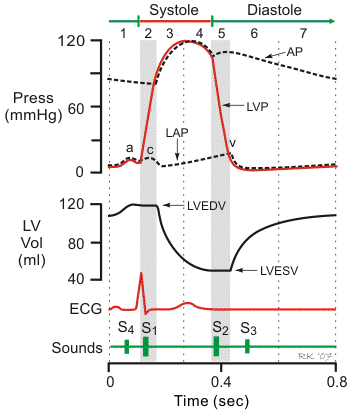
81
New cards
Coronary
pertaining to the heart
82
New cards
Cholesterol
LDL and HDL
83
New cards
Plaque
A deposit of fatty material on the inner lining of an arterial wall
84
New cards
CVD (cardiovascular disease)
a disease that affects the heart and blood vessels
85
New cards
Angina
Restricted flow of blood to the heart - lack of oxygen leads to anaerobic respiration and pain in the chest
86
New cards
heart attack (myocardial infarction)
Heart muscle totally starved of oxygen so it dies
87
New cards
Stroke
Blood supply to the brain is restricted, so it starves the brain cells of oxygen
88
New cards
Aneurysm
A balloon-like blood-filled structure that forms at a weak point in the artery wall. They frequently burst leading to blood loss
89
New cards
heart failure
A condition where the heart can't pump enough blood to meet the body's needs
90
New cards
Irregular heartbeat
A problem with the pacemaker cells (found in the muscle walls of the right atrium) if the heart is not contracting efficiently
91
New cards
Leaky/faulty valves
Valves can become leaky/faulty so the blood does not pass efficiently through the heart and can back flow
92
New cards
Coronary artery
Supplies the heart muscle cells with oxygen and nutrients so that it can beat continuously and keep respiring without getting tired
93
New cards
Coronary Heart Disease
- Occurs when fatty material builds up in the coronary arteries, narrowing them and restricting blood flow to the heart
- Can happen to any artery, but is particularly dangerous here as it is quite small
- Can happen to any artery, but is particularly dangerous here as it is quite small
94
New cards
Atheroma
A fatty deposit which forms within the wall of an artery (plaque)
95
New cards
Atherosclerosis
The narrowing and hardening of the arteries and the narrowing of the lumen
96
New cards
CHD development in the vessels
- Stage 1: lumen is wide , plenty of blood flow
- Stage 2: Cluded lumen as the fat buildup restricts the blood flow to the heart, but still provides some blood to the heart (could cause angina)
- Stage 3: Platelets will get trapped and form a mesh, trap red blood cells and forma blood clot, which starved the heart of oxygen and therefore causes a heart attack
- Stage 2: Cluded lumen as the fat buildup restricts the blood flow to the heart, but still provides some blood to the heart (could cause angina)
- Stage 3: Platelets will get trapped and form a mesh, trap red blood cells and forma blood clot, which starved the heart of oxygen and therefore causes a heart attack
97
New cards
LDL cholesterol (low density lipoprotein)
- Also known as monounsaturated fats or saturated lipids, and are generally animal based
- When turned into a lipoprotein and carried by the blood, they form LDLs which are linked to increased risk of heart disease, and so are known as bad cholesterol
- When turned into a lipoprotein and carried by the blood, they form LDLs which are linked to increased risk of heart disease, and so are known as bad cholesterol
98
New cards
HDL cholesterol (high density lipoprotein)
- Also known as polyunsaturated fats or unsaturated lipids, and are generally plant-based
- When turned into a lipoprotein and carried by the blood, they form HDLs which regulate/clear LDLs and promote the excretion of them, and are linked to reduced risk of heart disease and so are known as good cholesterol
- When turned into a lipoprotein and carried by the blood, they form HDLs which regulate/clear LDLs and promote the excretion of them, and are linked to reduced risk of heart disease and so are known as good cholesterol
99
New cards
Functions of Cholesterol
- It is a waxy, fat-like substance
- Making bile (needed for digestion)
- Repair and maintenance of cell membranes
- Synthesis of steroid hormones, like testosterone and cortisone
- However it is insoluble in blood and must be carried by lipoproteins
- Making bile (needed for digestion)
- Repair and maintenance of cell membranes
- Synthesis of steroid hormones, like testosterone and cortisone
- However it is insoluble in blood and must be carried by lipoproteins
100
New cards
Controlling cholesterol
The total amount of cholesterol in people's bodies is different for everyone, and mainly depends on their diet and gene
 Note
Note  Flashcards (64)