Evolution yr2 sem1
 Studied by 1 person
 Call Kai
 Learn
Learn Practice Test
 Spaced Repetition
 Match
Match Flashcards
 Knowt Play
1/234

There's no tags or description
Looks like no tags are added yet.
Name | Mastery | Learn | Test | Matching | Spaced | Call with Kai |
|---|
No analytics yet
Send a link to your students to track their progress
235 Terms
what are analogies
traits that have evolved independently in different species but look the same - for example birds and bats have both evolved wings
convergent evolution
the type of evolution that produces analogies - two species evolving separately to have the same/similar trait
what are homologies
traits that are similar by evolutionary descent - they can look very different
i.e. humans, cats and whales have the same body plan for arms but they all look completely different
what is adaptive radiation
when an ancestral species rapidly diversifies into new species - occupying different ecological niches
how can we tell which traits are homologies and which are analogies
the comparative method
checks their phylogenetic history and ecological pressures
what is a vestigial trait
traits that have lost their function through evolution
used to be useful and adaptive, not aren’t useful i.e. tail bones
what are behavioural vestigial characteristics
behaviours that used to be adaptive but are less so now
i.e. phobias - we have fears of snakes eventhough we have likely never come across a poisonous one before
explain ‘just so stories’ - Kipling
not plausible origin stories
stories made for children explaining where they got their traits from
i.e. elephants got their trunks because crocodiles pulled their noses
exaptations
traits that evolved to solve one problem, but then play a new adaptive role i.e. feathers evolving for warmth but now being adaptive for flight
explain how traits can be a developmental byproduct
traits can arise as a byproduct of another trait being selected for
i.e. men have nipples because women have nipples and there is no pressure/reason for them to get rid of theirs
explain how traits can be maladaptive
they used to be adaptive, but are now harmful
i.e. our preference for sugary and fatty foods used to be adaptive when it was scarce, but now it is abundant it is making us obese
explain what phylogenetic inertia is
limits on what can evolve due to previous adaptations
i.e. flying pigs
not all traits can evolve because of physical constraints and our evolutionary history
what is Orgel’s second rule
Evolution is more clever than us as it can come up with unusual solutions to problems
i.e. platypus’ having a beak that can detect electrical signals in the water to locate prey
what does it mean for evolution to be ‘for the good of the species’
natural selection doesn’t favour species who kill themselves ‘for the good of the group’
it takes a gene’s eye view - killing yourself to relieve pressure for the rest of the group you don’t pass on your genes
explain the is-ought fallacy aka Hume’s Law
just because something did evolve, doesn’t mean we ought to act that way i.e. just because men evolved to be more aggressive than women doesn’t mean they ought to be
explain the naturalistic fallacy
just because something feels good doesn’t mean it is
‘goodness (morality) cannot be reduced to natural properties’
explain biological determinism
there is no biological determinism - our genes and evolution do not determine our fate
i.e. just because men are evolved to be more aggressive doesn’t mean they WILL be
explain the nature vs nurture debate
genes vs environment
they both influence traits so the argument is a false dichotomy and too reductionist
what is social spencerism
discusses societal evolution
economies and societies follow the same principles of natural selection - like survival of the fittest
name one way darwin’s idea has been misused
eugenics i.e. nazis
what is the EEA
Environment of evolutionary adaptedness
the EEA is the environment we have evolved in - specifically the african savanna (as we did 99% of our evolution here)
who coined the term EEA
Bowlby
What is adaptive lag
when adaptions can’t keep up with the changing environment - leading to traits that used to be adaptive, but now aren’t i.e. phobias
what are 4 core principles of evolution by natural selection
heritability
variability
surplus offspring
nonrandom survival and reproduction
give examples of evolution not due to natural selection
mutations
genetic drift
founder effect
mutual selection
criticisms of evolutionary psychology:
not very different from sociobiology
out of date understanding of evolution
give some key features of the behavioural ecology approach
ecology - how the immediate environment impacts us
optimality - the best possible solution given the environment
not interested in cognition
what is the goal of the behavioural ecology approach
to determine how differences between individuals can be explained due to optimality and fitness explanations
who studies the !Kung
DeVore
!kung is a tribe in tanzania who DeVore studied to see how ecology impacted their behaviour
how does the behavioural ecology approach use historical data
looks at birth records and birth rates
links with environmental information i.e. wars at the time to see how these impacted population levels
define adaptability
the degree to which a species can survive and reproduce in different environments
define niche
a niche is the environment and way of life of a species
greater overlap in niches leads to greater competition
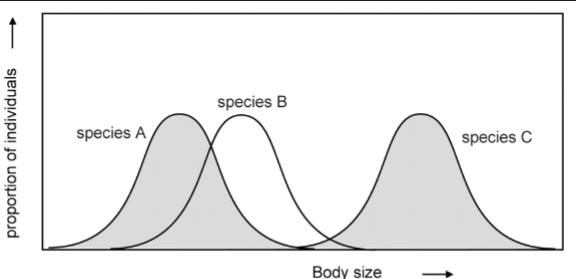
what is optimal foraging theory
links to niches - considers the best strategy to survive i.e. if there are lots of animals in overlapping niches, maybe it is better to evolve to occupy a different niche.
examples of humans adapting to niches
sickle cell anaemia - developed as a resistance to malaria
the carpentered niche - humans living in a world of corners has lead us to develop an illusion where different lines represent inwards or outwards facing corners
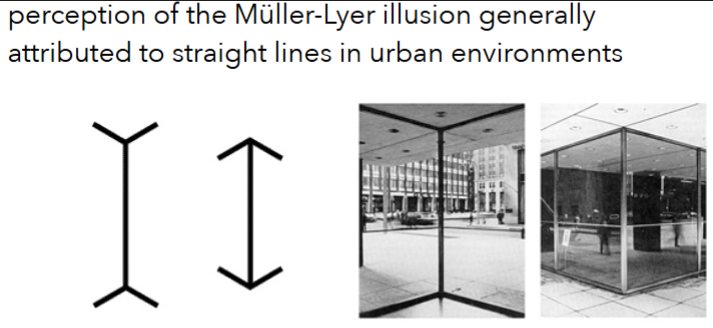
explain what ultimate causation and proximate causation are
ultimate causation = evolutionary levels of explanation - explaining why a phenomenon exists
proximate causation = explains how a phenomenon works using immediate circumstances i.e. our genes or environment
what are Tinbergen’s 4 questions regarding how traits arise
ultimate (why questions)
function?
evolution?
proximate (how questions)
development?
causation?
function
what the purpose of the trait is
evolution question
phylogeny (the study of our evolution to see connections amongst ancestors)
looking at the evolutionary history of a trait
development question
looking at the ontogeny (development) of a species to see where traits vary throughout development
causation question
looking at the immediate circumstances that tigger a behaviour
i.e. stimuli that elicit a response
what kind of traits can convergent evolution produce
analogous traits
what traits does adaptive radiation produce
homologous traits
what is the founder effect
it is when a new smaller population (coming from a larger one) has heightened levels of certain traits due to it’s lack of genetic diversity
what causes traits to appear blended
pleiotropy
codominance
incomplete dominance
what is pleiotropic vs polygenetic
pleiotropic = one gene influences multiple traits
polygenetic = multiple genes influence one trait
why should we study non-human primates
we share 98% of our dna with chimps and bonobos
and since we are both in the primate order, we can look back at their traits to see which of our traits could be homologies
why should we not compare humans with non-human primates
huxley vs wilberforce:
debate in victorian england - people were concerned with the idea that we could be related to another species
scopes monkey trial:
teacher on trial for teaching evolution when it was illegal to do so
when did dinos go extinct and primates formed
65 mill years ago
when did homo sapiens develop
300 k years ago
what is adaptive radiation and what did it produce
when a species branches off and starts rapidly differentiating
it caused the development of loads of new animals including primates!
name the main epochs (geological periods of time) relating to primate development
eocene
oligocene
miocene - 23-5 million yrs ago - monkeys and apes flourished
pleiocene - 5 million yrs ago - monkeys have now overtaken apes in numbers
what is taxonomy
defining and organising organisms in hierarchal structures
what are some defining characteristics of a primate
opposable thumbs and big toes
flat nails - no claws
locomotion is hind limb dominant
dry nose
forward facing eyes
binocular vision
what are some flaws in the primate taxonomy
aye-ayes have claws but are primates
pandas have opposable thumbs but are not primates
not all primates have dry noses
cats have forward facing eyes
what are the key features of binomial nomenclatures (Carl Von Linne) plus name for humans and chimps
genus (family) is uppercase and comes first
species (smaller category) is lowercase and last
italicised if typed
underlined if written
i.e. Homo sapiens, Pan troglodyte
name the class, order, family, genus then species of humans and chimps
class - mammals
order - primate
family - hominids
genus - human = homo, chimp = pan
species - human = sapien, chimp = troglodyte
name the primate order
hominoidea - superfamily, lesser and great apes
hominidae - family, great apes
homininae - subfamily, homo, pan, gorilla
hominini - tribe, homo, pan
hominina - subtribe
name all 5 great apes
humans
chimpanzees
gorillas
orangutans
bonobos
what does arboreal mean
living in trees - most primates are arboreal
give reasons why primates could be considered ‘slower’ than other animals
they have smaller litters (of 1)
longer pregnancies
longer childhoods
longer lifespans
name and define 4 different social structures primates live in
solitary - orangutan. males live alone, females live alone with infants
monogamy - one male and one female
polygyny - gorillas. one male, many females and infants
polyandry - bonobos. everyone mates with everyone
name and explain the two types of competition
contest competition
caused by clumped resources
more dominant = more resources
scramble competition
caused by dispersed resources
primates run around to find resources
draw a diagram of how socioecology can influence social systems
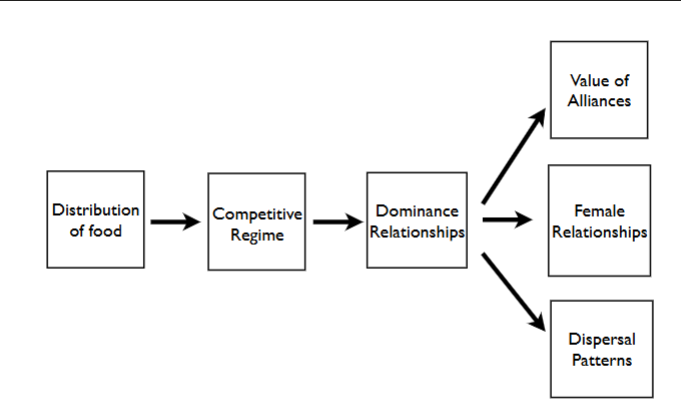
describe how chimps and bonobos differ in behaviour
chimps:
resolve conflict through aggression
won’t share food
bonobos:
resolve conflict through sex
happily share food
describe how chimps and human children differ
chimps and humans (2-3 yrs) have the same physical learning skills i.e. tool use
chimps have worse social learning skills - i.e. won’t take cues from others
there is some evidence to suggest they do have some kind of implicit theory of mind - experiment where gorilla hides and they look to where the gorilla used to be
name 4 key characteristics of humans
bipedal locomotion
larger brain:body ratio
slower development - longer childhoods
language and culture
when and why did bipedal locomotion evolve (give 4 reasons)
evolved 6-7 million years ago in the australopithecines
made ground movement easier - more efficient
good for long distance
helps keep us cool (wind exposure, less solar radiation, further from hot ground)
keeps hands free for carrying and foraging
state when australopithecines were around
developed in the pliocene epoch 4.2 million years ago, around during the pleistocene epoch (2.6 mya - 12 ka)
what are key features of australopithecines + lucy
bipedal
sexually dimorphic
smaller brains (400 cubic cm)
used oldowan stone tools (mode 1)
lucy is the most famous australopithecine fossil, proof of her bipedal nature is found in footprints in volcanic ash
name the epochs
eocene
oligocene
miocene
pliocene
pleistocene
anthropocene
when was the genus homo around
2.8 mya
homo erectus
early form of homo
pleistocene had a variable environment, which favoured larger brains (800 cubic cm)
brain size doubled from australopithecines
body grew from 5ft - 6ft
shorter childhoods (more similar to apes)
tools become more complex - acheulean (mode 2) i.e. hand axes
homo heidelbergensis
around 1.3 mya - 600 ka
bigger brains - 1200 cc
more complex tools - levellois technique (mode 3)
detail brain sizes of all homo
homo floresiensis - 370 cc
australopithecines - 400 cc
homo erectus - 800 cc
homo heidelbergensis - 1200 cc
homo sapiens - 1450 cc
homo neanderthalensis - 1520 cc
homo neanderthalensis
600-33 ka
adapted to colder climates (europe)
shorter and stockier than modern humans
even bigger brains than us - 1520 cc
developmental patterns similar to us (length of childhood)
language - fox b2 gene and hyoid bone present, both linked to flexible vocals and language
complex tools to hunt large prey
care for sick
bury dead
homo sapiens
physically developing in africa at the same time as homo neanderthalensis (300 ka)
mentally human around 40-50 ka with art and jewellery appearing (some jewellery evidence from 130 ka)
mode 4 tools used
shelters built
dogs domesticated
ritual burials
arts and crafts
neanderthals and homo sapiens interbred - what are neanderthal genes associated with
schizophrenia, more belly fat, risk of sunburn,
homo floresiensis
found on island flores in indonesia 18-14ka
brain is 370 cubic cm
3 ft tall
more 4 tools used
denisovians
found from one pinky bone discovered in a cave
not neanderthal nor homo sapien so must be another ?
dated to 41 ka
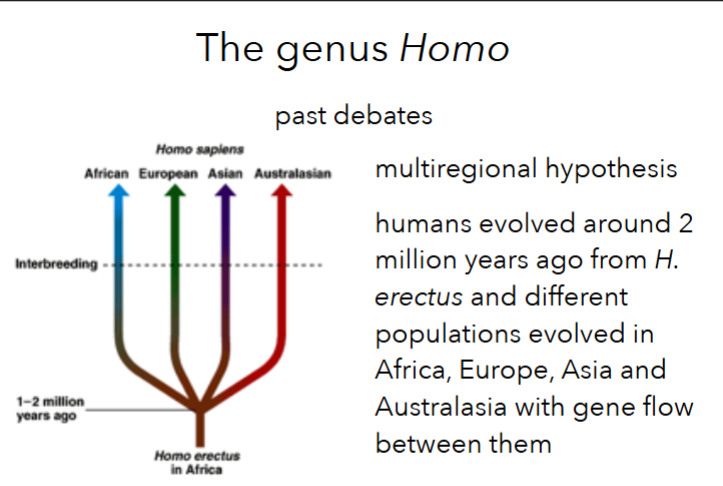
draw and explain the multiregional hypothesis
humans evolved from homo erectus in one location 2 million years ago
they moved to different parts of the world forming different groups (europeans, asians, africans, australasians)
suggests our groups are more distinct
draw and explain the out of africa hypothesis
modern humans evolved around 200 ka
multiple waves of migration with lots of mixing genes
suggests different ethnicities are more similar because the evolutionary branch isn’t as long ago
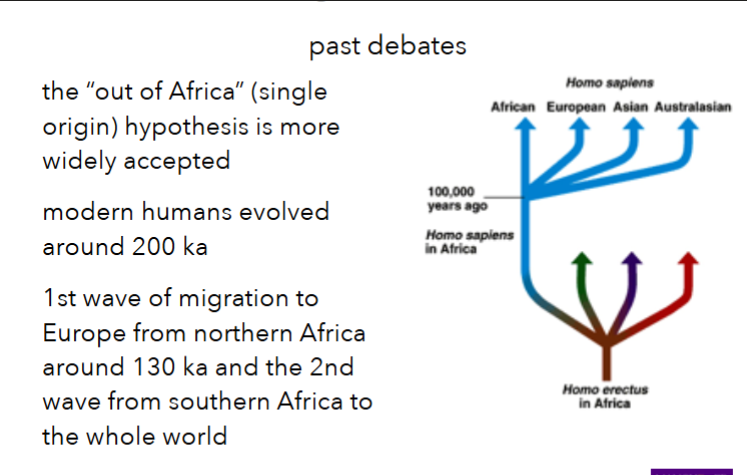
explain how differing levels of genetic diversity relates to the out of africa/african origins hypothesis
great apes all have more genetic variation than we do, and there is more genetic variation within africa - supporting the african origins hypothesis (because as we migrate from one place we go through population bottlenecks - reducing variation)
name 3 ways of gaining food
collected food - i.e. fruit picking
extracted food - i.e. termites from ground
hunted foods
why do humans hunt more than chimps
hunting is more cognitively challenging than collecting
expensive tissue hypothesis - meat requires a smaller gut to digest, meaning we have more space in our bodies for brain matter.
brains are also expensive tissue - they require lots of energy, meat gives us this energy easily
how does age relate to hunting
men reach peak hunting efficiency at 50
however they reach peak strength at 30
suggests knowledge plays a key role i.e. being able to detect tracks
why do we hunt in groups
hunters have a far higher chance of success if they hunt in groups, so less chance of starving
we often hunt prey larger than we can eat alone before it would go bad
so we hunt in groups and share to allow us to eat meat
what has complexity of foraging tasks favoured
larger brains and slower development (so we have time to learn the skills)
what has food sharing and division of labour favoured
reduced sexual dimorphism
give evidence for sex differences in toys
female monkeys preferred to play with dolls
male monkeys preferred to play with trucks
state differences in male and female chimp behaviours
males:
better at mental rotation tasks (turning an object around to see it from another angle)
engage in more rough and tumble play
females:
more attentive social learners
carry sticks around like dolls
issues with having sex
meiosis has a cost - only half your genes get passed on
courtship has a cost - you have to find and court a mate before you can mate
explain fisher’s principle on keeping the ratio 1:1
a sexual population should produce an equal number of male and female offspring
this means the rarer sex is at an advantage - ensuring the ratio is kept at 1:1
explain the red queen hypothesis on why we have sex
parasites can evolve quickly, so we need to adapt just as fast to keep up resistance to them
sexually reproducing populations are better at overcoming bacteria and parasites because it changes the host and keeps high host variation
increases our genetic variability
explain muller’s ratchet
we have sex because asexual populations are at risk of developing harmful mutations
explain sexual selection
the differences in individuals in mating success
runs against natural selection because sexually selective d
features aren’t always cost effective for SURVIVAL i.e. male peacocks having huge flamboyant tails
what is sexual asymmetry
the differences between males and females in reproduction
females have large gametes, that are expensive. so they are choosier since their investments are higher
males have smaller and multiple sperm, so they are cheap
what is anisogamy
the differences between male and female gametes
sperm vs egg
intrasexual selection
competition within a sex
males competing with other males for access to females
intersexual selection
mate choice
females choosing a mate based on desirable traits
runaway selection
mothers choose a mate based on desirable traits
daughters are more likely to choose these traits too
sons are more likely to display these traits so they get chosen
 Note
Note  Flashcards (43)