Marketing test 1
 Call Kai
 Learn
Learn Practice Test
 Spaced Repetition
 Match
Match Flashcards
 Knowt Play
1/145

Earn XP
Description and Tags
Jay Barfield marketing test one ch 1,2,3,4,5
Name | Mastery | Learn | Test | Matching | Spaced | Call with Kai |
|---|
No analytics yet
Send a link to your students to track their progress
146 Terms
Marketing
The activity, set of instructions, and processes for creating, communicating, delivering, and exchanging offerings that have value for customers clients, partners, and society at large
Two facets of marketing
Philosophy ( customer satisfaction orientation)
Organizational function (process that implements it)
exchange
When someone gives up something to receive something else, they would rather have
5 conditions for exchange to exist
must be at least 2 parties
each party has something that might be of value to the other party
each party is capable of communication and delivery
each party is free to accept or reject the exchange offer
Each party believes it is appropriate or desirable to deal with the other party
4 philosophies of marketing management
Product orientation
sales orientation
market orientation
societal marketing orientation
Product orientation
A philosophy that focuses on the firms internal capabilities rather than on the desires and needs of the marketplace firm's
what can we do best
sales orientation
The belief that people will buy more goods and services if aggressive sales techniques are used, and that high sales result in high profits
Market orientation (Marketing concept)
The idea that the social and economic justification for an organizations existence is the satisfaction of customers wants and needs while meeting organizational objectives.
societal marketing orientation
the idea that an organization exists not only to satisfy customer wants and needs and to meet organizational objectives but also to preserve or enhance individuals and society’s long term best interests
Customer value
the relationship between benefits and the sacrifice necessary to obtain those benefits
(benefits - the goods you provide, sacrifice - the things the customer gives)
Customer satisfaction
customers evaluation of a good or service in terms of whether it has met their needs and expectations
Relationship marketing
A strategy that focuses on keeping and improving relationships with current customers
Empowerement
delegation of authority to solve customers problems quickly, usually by the first person the customer notifies regarding a problem
Teamwork
collaborative efforts of people to accomplish common objectives
customer relationship management (CRM)
a company wide business strategy designed to optimize profitability, revenue, and customer satisfaction by focusing on highly defined and precise customer groups
Big data
the discovery, interpretation and communication of meaningful patterns in data
on demand marketing
delivering relevant experiences, integrates across both physical and virtual environments, through the consumers decisions and buying process.
Sales firms
Focus on internal needs
deliver Products
target everyone
focus on volume
emphasize promotion
Marketing-oriented firms
focus on customer needs
seek to satisfy customers
target segments of the market
focus on relationships
emphasize coordinated strategy
Reasons to study marketing (4)
Impacts economy and standard of living
helps understand business
career opportunities
makes you an informed customer
strategic planning
managerial process of creating and maintaining a fit between objectives/ resources and evolving opportunities
Goals of strategic planning:
long run profits
Growth
Two questions to answer when planning strategically
What is the organizations main activity
how will it achieve its goals
the 2 questions strategic marketing answers
What is the organizations main activity at any particular time
How will it reach its goals
Strategic Business Unit (SBU)
A subgroup of a single business or collection of related businesses within the larger organization
(body armor is a SBU of coca- cola)
SBU characteristics
When properly created and SBU has:
A distinct mission and a specific target market
Control over its resources
its own competitors
A single business or a collection of closely related businesses
plans independent of the other SBU’s in the total organization
3 most used tools for strategic planning
Ansoff’s strategic opportunity matrix
the Boston consulting group model
the general electric model
The choice depends on whether the firm expects profits now vs after market share growth
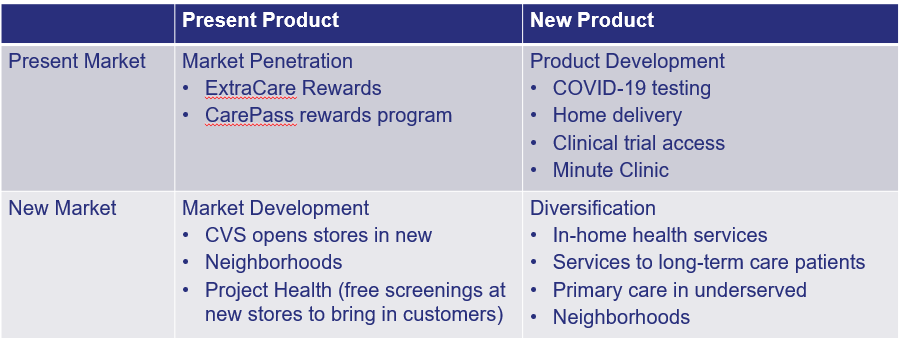
Ansoff’s Strategic opportunity matrix (4 growth strategies)
Market Penetration - Increase market share among existing customers
ex: CVS extra care card
Market development - attract new customers to existing products
ex: CVS opening stores in new areas
product development - the creation of new products for present markets
ex: CVS minute clinic or its new delivery service
Diversification - introducing new products into the market
ex: CVS bough Signify health (in home clinician visits)
Boston consulting group/ Portfolio matrix
Portfolio matrix = a tool for allocating resources among products or SBUs on the basis of relative market share and market growth rate
relative market share is the ratio of a company's share to the share of the largest competitor; there is an assumption that market share and profitability are linlked
BCG Model (4 categories)
star- fast-growing market leader
profitable but need cash, protect buy reincesting in it (product improvement, distribution, promotion, efficiency)
Cash Cow - generates more cash than needed to maintain share
low growth, dominant share; just maintain dominance, resist over extending line unless demand rises dramatically; move excess cash to growth areas
Problem Child (question mark) -rapid growth but poor profit margins
needs lots of cash; becomes a dog without. Invest heavily/ acquire/reposition or drop
Dog - Low growth potential + small market share
Often exit market, tough competition + low Growth + low market share
After BCG classification 4 strategies
Build - Feed it; often for problem child you think can become a star
Hold - Protect cash cow market share
Harvest - Maximize short term cash, usually not done to stars.
Divest- dump low-share/low-growth; problem children/dogs
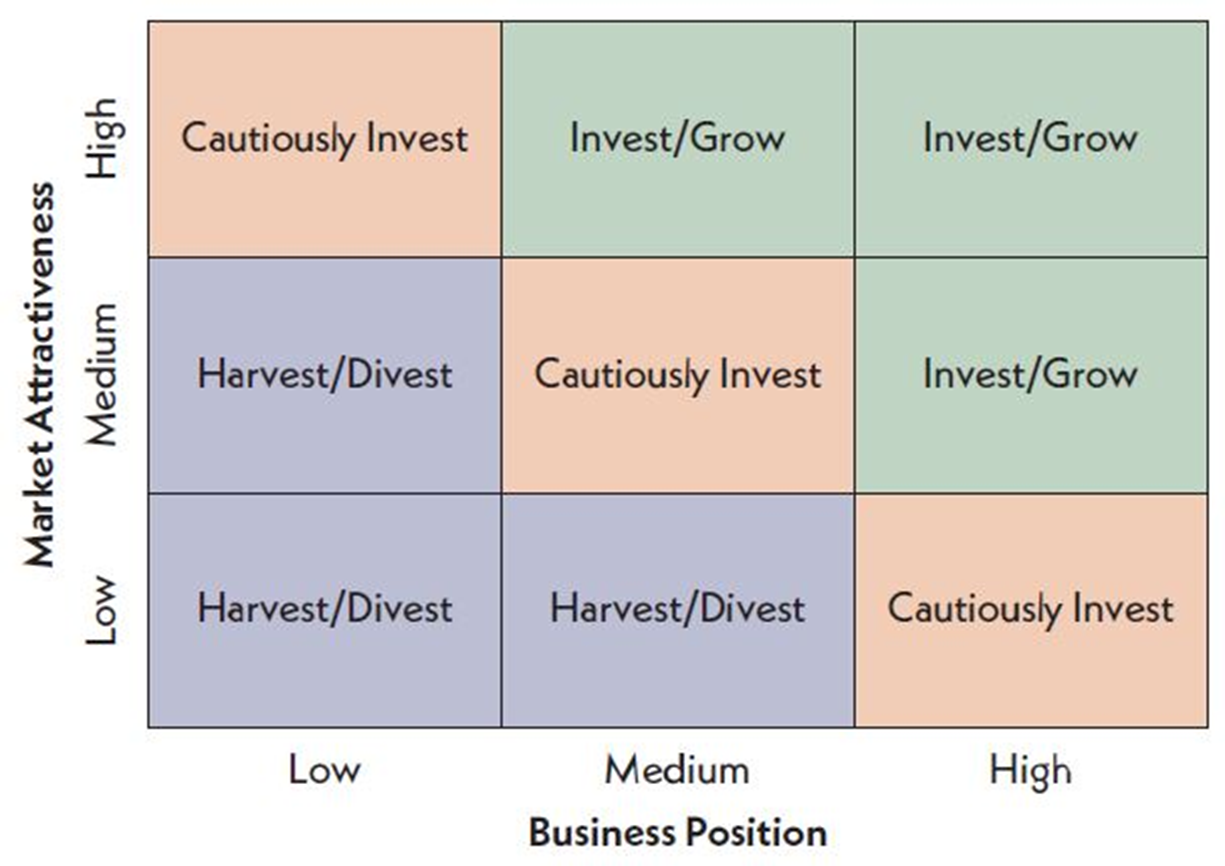
GE model (GE / McKinney)
Dimensions: Market attractiveness + company strength. These are richer and more complex, but harder to quantify
Low attractiveness: Avoid/harvest/Divest
Medium attractiveness: Maintain, withdraw if it slips
High - high attractiveness - (Thriving market + strong position) - Invest
The marketing plan overview
separated into:
Planning
Marketing planning
marketing plan
Planning
The process of anticipating future events and determining strategies to achieve organizational objectives in the future
Marketing planning
designing activities relating to marketing objectives and the changing marketing environment
Marketing Plan
A written document that acts as a guidebook for marketing activities for the marketing manager
Why write a marketing plan
A marketing plan forces you to examine the environmental + internal business reality
clarifies activities and aligns employees toward shared goals
becomes a reference point for future success
helps you enter,arlet aware of problems and opportunities
Oral plans alone are not enough because plans are complex. Plans can include budgets, timetables, needed research, and advanced planning elements
Mission statement
A statement of the firm’s business based on a careful analysis of benefits sought by present and potential customers and an analysis of existing and anticipated environmental conditions
mission statement answers - “what business are we in“ and shapes resource allocation/profitability/ survival. should focus on markets served, not just the product offered (avoids tech making you obsolete), resource
Market myopia
myopia = too narrow, term literally means market too narrow
defining a business in terms of goods and services rather than in terms of the benefits customers seek
Mission can be to narrow (myopia) or too broad (meaningless)
Situation analysis (SWOT)
SWOT analysis = identifying internal Strengths (S) and weaknesses (W). While also examining external Opportunities (O) and Threats (T)
Environmental scanning
collection and interpretation of information about forces, events, and relationships in the external environment that may affect the future of the organization or the implementation of the marketing plan
Competitive advantage (3 types)
a set of unique features of a company and its products that are perceived by the target market as significant and superior to those of the competition.
Cost
product/service differentiation
Niche
Cost competitive advantage
Being the low-cost competitor in an industry while maintaining satisfactory profit margins
HOW to reduce cost: Experience curves, efficient labor, govt subsidies, etc
Experience Curves
curves that show costs declining at a predictable rate as experience with a product increases
these curves include manufacturing/marketing/admin costs, reflect learning by doing, tech advances, and economies of scale
Product/ Service differentiation competitive advantage
The provision of something that is unique and valuable to buyers, beyond simply offering a lower price than that of the competition
tends to last longer than cost advantages; Ex: Brand name recognition, dealer network, reliability, company image, service
Niche competitive advantage
The advantage achieved when a firm seeks to target and effectively serve a small segment of the market
niche can be the only viable advantage for small firms; pick segments with growth potential, but not crucial to giant competitors
Sustainable competitive advantage
An advantage that cannot be copied by the competition
This advantage is almost never perpetual, its usually limited in time so you must keep innovating to stay in the game.
source of this adv might be: Assets (patents, copyrights, locations, equipment) + skills(customer service, promotion)
Marketing objectives
A statement of what is to be accomplished through marketing activities
Marketing objectives should be
time specific
realistic
measurable
compared to a benchmark
Marketing Strategy
The activities of selecting and describing one or more target markets and developing and maintaining a marketing mix that will produce mutually satisfying exchanges with target markets
Target market
group the organization designs/implements/maintains a marketing mix for
Marketing Opportunity analysis (MOA)
The description and estimation of the size and sales potential of market segments of interest, and the assessment of key competitors
Three target selection strategies:
Appeal to the entire market with one marketing mix (Shotgun approach)
Concentrating on one segment of the market (Rifle)
By appealing to multiple market segments using multiple marketing mixes
THE MARKETING MIX (FOUR P’s)
A unique blend of Product, Place, Promotion, and Pricing Strategies designed to produce mutually satisfying exchanges with a target market
Product is usually the starting point; the product includes package/warranty/service/brand/image/value. Any mix is only as good as its weakest component
MUST KNOW 4 P’s for like all of marketing
PRODUCT
PLACE
PROMOTION
PRICING
Implementation
turning plan into action assignments
Requires: delegating authority, timeline resources organizational acceptance
evaluation
Gauging the extent to which the marketing objectives have been achieved during the specified time period
4 reasons objectives fail
unrealistic marketing objectives
inappropriate marketing strategies in the plan
poor implementation
changes in the environment after the objective was specified and he strategy was implemented
Control
mechanisms to evaluate results and correct actions within budget
marketing audit
A thorough systematic, periodic evaluation of the objectives, strategies structure, and performance of the marketing organization
4 characteristics
Independent
comprehensive
periodic
systematic
Post audit tasks: Verify accuracy, assign accountability, prioritize recommendations
Social control
Any means used to maintain behavioral norms and regulate conflict
Behavioral norms
standards of Propper or acceptable behavior. Several models of social control are important to marketing
Modes of social control important to marketing
ETHICS, Laws, formal and informal groups, self-regulation, the media, and an active civil society
Note: Laws often codify ethical rules, but laws usually reflect the lowest form of acceptable behavior. Legal DOES NOT mean ethical
Ethics
The MORAL PRINCIPLES OR VALUES that generally govern the conduct of an individual or a group
Unwritten rules governing interactions
Ex: cutting in a line is not illegal but people see it as unfair in turn unethical.
Deontological theory
Duty/ Obligation-based theory. Follow duties and promises, follow the law
Utilitarian ethical theory
Consequences based theory. Greatest benefit to most people, that choice is the ethically correct one
casuist ethical theory
Compare to similar cases and outcomes. Use past extremes to form compromise
moral relativism
Time and place ethics; No absolute rules. Choose the “lesser of evils” Depending on context
virtue
Character trait that is valued as good; Aristotle/Plato taught: Virtue “training” helps you solve dilemmas
Morals
The rules people develop as a result of cultural values and norms
Morals are foundation of ethical behavior.
business ethics is a subset of life values learned via family, education, religion.
Code of Ethics
A guideline to help marketing managers and other employees make better decisions
Identifies acceptable practices , Internal control > external regulation (Laws), Reduces confusion in determining if decision is ethical, encourages discussion about right and wrong.
ethical training is common and reduces misconduct rates
Ethics across countries (FCPA)
Federal Corrupt Practices Act (FCPA) - Prohibits U.S. corporations from making illegal payments to foreign public officials to obtain/ enhance business dealings
ethics varies culture to culture; Bribery may be more accepted in some places than others
Corporate social responsibility (CSR)
A businesses concern for societies welfare.
Stakeholder Theory
Social responsibility means paying attention to the interests of every affected stakeholder in every aspect of operations
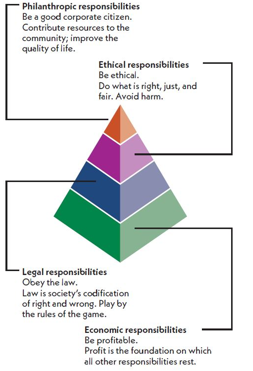
pyramid of corporate social responsibility
CSR includes economic, legal, ethical, philanthropic responsibilities. Economic performance is the base of the pyramid that supports the structure
Sustainability
Socially responsible companies outperform peers by focusing or world problems as profit opportunities and “help the world simultaneously”
Green Marketing
Develop/market products minimizing negative environmental effects or improving environment
Greenwashing
Add minimal green attributes to market as green
Cause related marketing
The cooperative efforts between a for-profit firm and a non-profit organization.
Differs from philanthropy (tax-deductible donation).
Cause marketing is an ongoing relationship, not a straight donation
External marketing environment + marketing mix
marketing manegers key decisions relate to creation of the marketing mix. The marketing mis is within forms control but the external environment Forces your to adapt
Environmental Scanning
The continual collection and evaluation of environmental information to identify market opportunities and threats
firms scan population shifts, age/income distribution, industry trends, current/ potential customers, and competitors and their actions
Sucessful Firms realize that creating Value for customers is the key to large profits and market share
80/20 rule
Often 20% of the customers produce 80% of the revenue. Firms must understand loyalty drivers and protect them
Ex: Airline loyalty points
Social Factors in marketing
Social change is the hardest to forecast/influence. Social factors include attitudes, values, lifestyles.
Values formed via family/friends/ influencers. values affect what people buy, prices paid, promotion effectiveness and where/when they shop
Demography/ Demographics
The study of peoples vital statistics such as, age, race, gender, and location
Demographics are the basis for any market of people
How social media has changes behaviors
social media made online review increasingly important. social media changed the way we communicate, browse for products, make purchases, keep track of others.
Social dilemma - the more you are online the more your privacy is stripped away and there is possibility for manipulation through fyps and other things
pop culture
The products and forms of expression and identity that are frequently encountered or widely accepted, commonly liked, or approved, and characteristic of a particular society at a given time
Pop culture marketing increases emotional connection, attention, loyalty. Brands can develop a “Personality“ and feel approachable.and
Purchasing power
a comparison of income versus the relative cost of a standard set of goods and services in different geographic areas
Basically income - cost of living. High purchasing power means more discretionary income (spending on what you want vs what you need)
inflation
A measure of the decrease in the value of money, expressed as the percentage reduction in value since the previous year
firms respond to inflation with private brands, limiting services, discount retailing
Recession
A period of economic activity characterized by negative growth, which reduces demand for goods and services
When GDP falls for two consecutive quarters, it is defined a recession`
Basic research
Pure research that aims to confirm an existing theory or to learn more about a concept or phenomenon
confirm theory/ learn about phenomenon
Applied research
Research that attempts to develop new or improved products
actually develop the product
Sherman Antitrust act (1890)
makes monopolies/restraint of trade illegal
Clayton act (1914)
Prohibits practices that lessen competition
Price discrimination, exclusive dealing, tying agreements
Federal Trade Commission Act (1914)
Creates the FTC.
Prohibits unfair methods of competition
Robinson Patman Act (1936)
Prohibits price discrimination between different purchasers
Consumer credit protection act (1968)
requires that lenders fully disclose the true interest rates and all other charges to credit customers for loans and installment purchases
public health cigarette smoking act (1971)
Prohibits tobacco ads on radio and tv
Consumer product safety act (1972)
Created the consumer product safety comission, which has authority to specify safety standards for most products
Child protection Act (1990)
Regulates the number of minutes of advertising on children’s tv.
Childrens online privacy protection act (1998)
Empowers the FTC to set rules regarding how and when marketers must obtain parental permission before asking children marketing research questions
Do not call law (2003)
protects consumers against unwanted telemarketing calls
CAN-SPAM Act (2003)
Protects consumers against unwanted email, or spam
Restoring American financial stability act (2010)
Created the Consumer Financial protection Bureau to protect consumers against unfair, abusive, and deceptive financial practices
Patient protection and affordable care act (2010)
Overhauled the U.S. Health system. Mandated and subsidized health ins for individuals (questionable success)
Consumer product safety commission (CPSC )
federal agency established to protect health and safety of consumers in and around homes
Food and Drug administration
Enforces regulations against adulterated / Misbranded / Hazardous food and drug products

