Nerve impulses + synaptic transmission
 Call Kai
 Learn
Learn Practice Test
 Spaced Repetition
 Match
Match Flashcards
 Knowt Play
1/31

There's no tags or description
Looks like no tags are added yet.
Name | Mastery | Learn | Test | Matching | Spaced | Call with Kai |
|---|
No analytics yet
Send a link to your students to track their progress
32 Terms
Define stimulus
A change in environment
What is resting potential in a neurone?
-70mV
How is resting potential maintained?
The Na+/K+ pump actively transports 3Na+ ions out of the axon and 2K+ ions into the axon
The membrane is more permeable to K+ ions (as there are more K+ ion channels compared to Na+ ion channels) this means K+ ions diffuse out of the axon faster than Na+ ions diffuse back in. (Membrane is less permeable to Na+ ions)
There are negatively charged proteins (and Cl- ions) in the axon.
What happens when the axon is depolarised?
Na+ ions enter the axon due to a stimulus
Due to the influx of Na+ ions diffusing along the axon membrane the potential difference across the axon becomes more positive
If enough Na+ ions enter, the axons potential difference will reach threshold (-55mV) and exceed it
At -55mV Na+ voltage-gated channels will change tertiary structure and open
And so more Na+ ions move into the axon by facilitated diffusion (down their electrochemical gradient) until action potential is reached (+40mV)
What happens if threshold is not reached or exceeded?
Na+ ions will be pumped back out by the Na+/K+ pump and axon returns back to threshold
Define action potential
The momentary positive potential difference across the surface membrane of an neurone following its depolarisation (+40mV)
What happens when action potential is reached and axon returns to resting potential?
After it reaches action potential (+40mV), tertiary structure of the voltage-gated Na+ ion channels changes and they close.
And the voltage-gated K+ ion channels open
And so too many K+ ions move out of the axon so the axon becomes more negative than resting potential (hyperpolarisation)
(Na+/K+ still actively transports 3Na+ions out of axon and pumps in 2K+ ion into the axon)
The K+ voltage gated channels close
Axon returns to resting potential
Explain hyperpolarisation
Occurs when axon hyperpolarises to approx -80mV which is more negative than resting potential (-70mV)
Due to too many K+ ions leaving via the K+ voltage-gated channels
So the the voltage-gated K+ ions channels close and the potential difference slightly increases back to -70mV
Describe how an action potential is propagated in a myelinated axon
The Na+ ions enter the axon at the first Node of Raniver causing the axon to become more positive inside
The influx of positive Na+ ions repel the positive ions already present in the axon so they move towards the next Node of Ranvier
This causes threshold to be reached at the next Node of Ranvier, so the Na+ voltage gated channels open and move Na+ move in by facilitated diffusion
This process repeats itself at each node of Ranvier, down the axon
This is known as salutatory conduction, because action potential jumps from one node of Ranvier to the next (allowing conduction of nerve impulse to be faster)
What is meant by the all or nothing principle?
A threshold value must be reached in order for an action potential to occur
All action potentials are the same size/magnitude (+40mV)
How does the strength of a stimulus affect the frequency of action potentials?
The stronger the stimulus the higher the frequency of action potentials transmitted along a neuron.
However, above a certain strength of stimulus the frequency of action potentials cannot get any higher
(Frequency of action potentials is dependent on intensity of stimulus)
What is the refectory period?
The period of time during which a new action potential cannot be generated
What two factors contribute to the refractory period?
The Na+ ion voltage gated channels become inactive immediately after they were opened. This means that for a short period of time they cannot open again
The neurone is hyperpolarised so it is ‘further away’ from threshold level required to generate an action potential
How does the refectory period ensure impulses are kept discrete?
It prevents a new action potential being generated immediately after the previous one because the Na+ voltage-gated channels will not open (they are inactive)
How does the refractory period limit the frequency of impulses transmission
when and why does this matter?
It prevents a new action potential being generated immediately after the previous one because
This is relevant because if a stimulus strength increases, the frequency of impulses increases.
But because the frequency of impulses cannot exceed a certain level, it is not possible to differentiate between stimuli above a certain strength
How are nerve impulses an example of postive feedback ?
Because when Na+ ions enter the axon, it becomes slightly depolarised
Then the Na+ ion voltage-gated channels open axon becomes even more depolarised and so moves further away from resting potential
Describe and explain how myelination and saltatory conduction affect the speed of conductance
Speed of conduction is higher in myelinated neurones
This is because myelinated provides electrical insulation
So the depolarisation can jump from one node of Ranvier to other next, (salutatory conduction)
As ions only diffuse in and out of the axon at the Nodes of Ranvier
Whereas in non-myelinated axons, depolarisation concurs along the whole length of the axon.
Describe and explain how the axon diameter affects the speed of conductance
The bigger the diameter, the higher the speed of conductance
This is becaue a bigger diameter means there is less resistance to the movement of the action potential down the axon
There is also proportionally less leakage of K+ ions
Describe and explain how temperature affects speed of conductance
The higher the temperature, the higher the speed of conductance
This is because the ions have more kinetic energy so the rate of diffusion of ions into and out of the axon increases
Synaptic transmission
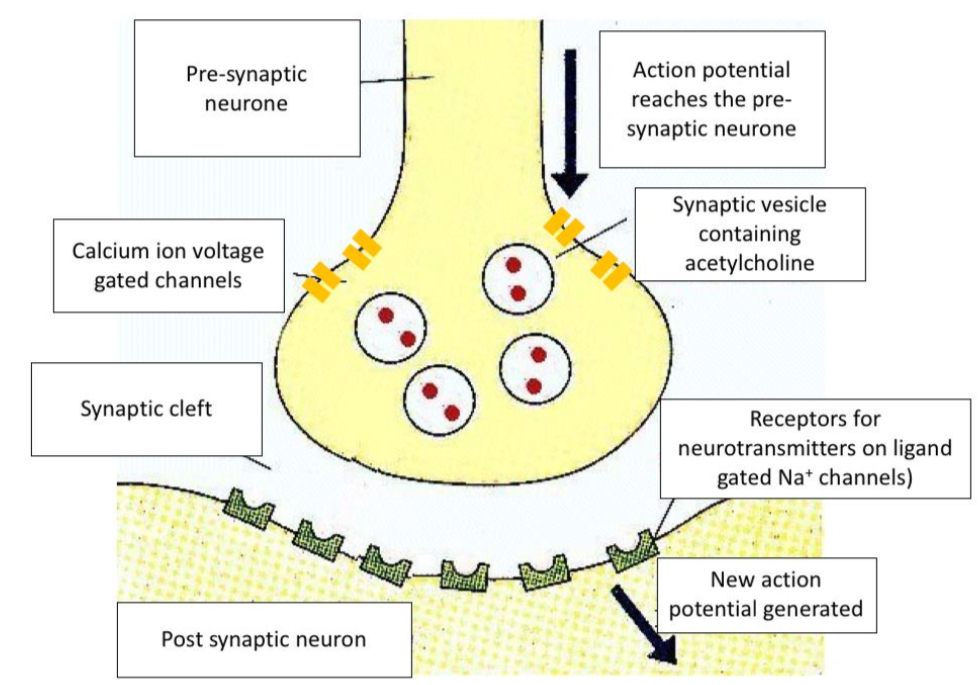
Describe what happens at a cholinergic synapse
The action potential reaches the end of the pre-synaptic neurone and is depolarised due to influx of Na+ ions
Voltage-gated Ca2+ ions channels open so Ca2+ ions move in by facilitated diffusion
The Ca2+ cause the synaptic vesicles containing neurotransmitters move towards the pre-synaptic membrane and fuses with it
The neurotransmitter (acetylcholine) is released via exocytosis
Acetylcholine diffuses across the synaptic cleft
Acetylcholine binds to specific, complementary receptors (on the ligand-gated Na+ ion channels) on the post-synaptic membrane
The ligand-gated Na+ ion channels open and Na+ ions move onto the post-synaptic neurone by facilitated diffusion, down their electrochemical gradient, causing it to depolarise
If threshold is exceeded, Na+ voltage-gated channels open, so more Na+ ions move in by facilitated diffusion and a new action potential is generated in the post-synaptic neurone
Acetylcholinesterase hydrolyses the acetylcholine to form ethanoic acid and choline
The ethanoic acid and choline are reabsorbed into the pre-synaptic neurone
ATP is used to regenerate acetylcholine using the ethanoic acid and choline
What is meant by ‘unidirectionality’
That the impulses only travel in one direction along axons and across synapses
Describe how a synapse ensures unidirectionality of impulses
Only the pre-synaptic neurone contains synaptic vesicles with neurotransmitter
Only the post-synaptic neurone has specific receptors which the neurotransmitters can bind to
What is an excitatory synapse
When Na+ ions move into the post synaptic neurone so it becomes more positive inside,
making it more likely that an action potential is generated in the post-synaptic neurone
What is an inhibitory synapse?
• When the post synaptic neurone becomes more negative
• Due to either K + ions moving out or Cl- ions moving in
• This means that more Na+ ions would be required in order for an action potential to be reached
• So it is less likely that an action potential is generated in the post-synaptic neurone
Summation?
The rapid build up of neurotransmitters in the synapse to help generate an action potential
Spatial summation?
When there is more than one pre-synaptic neurone synapsed to the same post-synaptic neurone
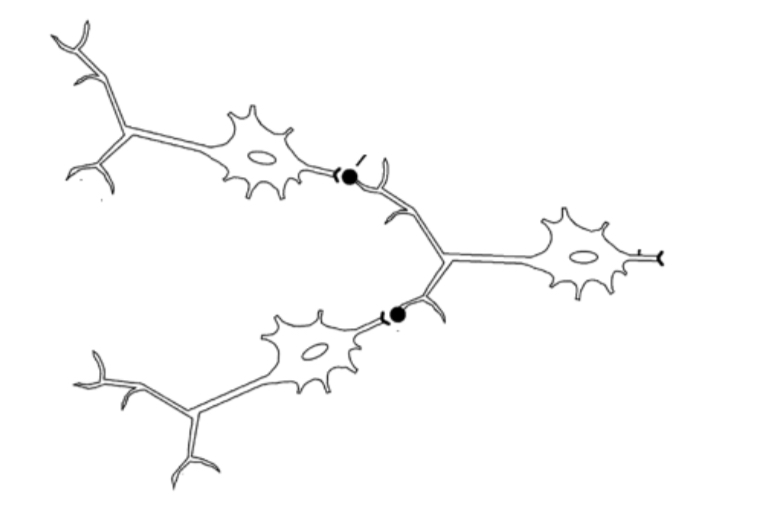
Describe how spatial summation makes it more possible for an action potential to occur in the post-synaptic neurone?
Neurotransmitter from both presynaptic neurones bind to the receptors (on the ligand-gated channels) on the post-synaptic neurone.
So sufficient Na+ ion ligand-gated channels open
So sufficient Na+ ions move into the post-synaptic neurone by facilitated diffusion
So threshold is exceeded and an action potential will be generated
Temporal summation?
When the pre-synaptic neurone has a high frequency of action potentials
Describe how temporal summation makes it more possible for an potential to occur in the post-synaptic neurone?
A large amount of neurotransmitter is released by the pre-synaptic neurone in a short space of time
So sufficient Na+ ion ligand-gated channels open
So sufficient Na+ ions move into the post-synaptic neurone by facilitated diffusion
So threshold is exceeded and an action potential will be generated
What is meant by agonist drugs? And how do they work?
An agonist drug has a similar shape to the neurotransmitter and will bind to the same receptor that the neurotransmitter binds to
An agonist causes the receptors to respond in the same way as if the neurotransmitter itself was bound
E.g. the neurotransmitter usually binds to a ligand-gated channel and causes the channel to open, agonist would bind to the channel and cause the channel to open, even in the absence of the neurotransmitter
What is meant by antagonist drugs and how do they work?
An antagonist drug has a similar shape to the neurotransmitter and will bind to the same receptor that the neurotransmitter binds to
An antagonist cause the receptor to respond in a different way to what would happen if the neurotransmitter itself was bound
E.g. neurotransmitter usually binds to a ligand-gated channel and cause the channel to open, the antagonist would bind to the channel (so the neurotransmitter cannot bind) and prevent the channel from opening.

