Year 8 Geography: Weather
 View linked note
 Call Kai
 Learn
Learn Practice Test
 Spaced Repetition
 Match
Match Flashcards
 Knowt Play
1/61

Earn XP
Description and Tags
Name | Mastery | Learn | Test | Matching | Spaced | Call with Kai | Chat |
|---|
No analytics yet
Send a link to your students to track their progress
62 Terms
What is weather?
The Day to Day atmosphere of a certain place
What is Climate
The long term atmosphere commonly over 30 years
What is Temperature measured with?
A themometer
What units is temperature in?
Degrees Celsius
What is Rainfall measured in?
Millimeters
What is Rainfall measured with?
A Rain Gauge
What is Air pressure measured in?
Milibars
What is Air pressure measured with?
A Barometer
What do you measure wind speed with?
An Anemometer
What do you measure wind speed in?
Mph
What do you measure wind Direction with?
A weather Vane
What do you measure Cloud Cover with?
Your eyes
What do you measure Cloud Cover in?
Oktas
What do you measure Wind Direction in?
Compass points
Evaporation
The process of water turning into Gas
Condensation
Water vapour turning into a liquid
Precipitation
Water falling from the sky
Surface Runoff
Water being moved by Gravity to larger water accomodations
Groundwater
Water stored in the ground/ flowing in the ground
Transpiration
The process of a plant absorbing water and releasing water vapour through it’s leaves.
Interception
when precipitation does not reach the floor and is instead interrupted by leaves, branches, the forest floor, etc.
What does water vapour accumulate and condensed onto to make cloud drops?
Nuclei
Explain the process of Clouds forming
Firstly, the sun heats up the ground. This causes the air at ground level to rise and the air vapour within to cool down (since the further away from the ground the colder it gets)
When cooled, The water vapour collides and sticks to particles found in the air known as condensation Nuclei that contain aerosols such as salt and dust.
As the Water Vapour rises and cools, more Water Vapour accumulates and condenses on the surface of the Nuclei.
When enough water vapour condenses around the Nuclei a cloud droplet is formed.
Individual cloud droplets are lightweight, tiny and spread out so they stay afloat as the form of a cloud.
At times, the cloud droplets combine to become larger droplets or crystals. As this occurs, they grow in size and weight and gradually fall from the sky as rain.
Explain Relief rainfall
occurs when warm moist air from the Atlantic Ocean rises up over mountains. When the warm air rises, it cools and condenses to form clouds, which bring rain. Once the air has passed over the mountains, it descends and warms.
Explain Frontal rainfall
occurs when a warm front meets a cold front. The heavier cold air sinks to the ground and the warm air rises above it. When the warm air rises, it cools. The cooler air condenses and form clouds. The clouds bring heavy rain.
Explain convectional rainfall
Convectional rainfall occurs when the heated air from the earth's surface rises upwards along with the water vapour and gets condensed when it reaches a higher altitude. Here the clouds carrying the water vapour are not carried away by the wind and hence, it rains in the same place.
Stratus Cloud
Flat or smooth
Cumulus/cúmulo Cloud
Heaped up/puffy
Cirrus/Cirro cloud
High up/ wispy
Alto cloud
Medium level
Nimbus/Nimbo
Rain bearing cloud
What are Biomes?
Global Scale ecosystems
5 factors that affect a Biomes Climate
Altitude
Contrary to popular belief, Getting closer to the sun will not make you any warmer. This is because the sun does not hit us directly but instead comes into contact with the ground and heats it up instead. From there, the ground warms up the air which supplies
us with warmth in the process.
The higher up we go, the further we are from the ground supplying us with warm and therefore it gets colder. This is also why we see snow at the top of mountains.
Rain shadow
Many deserts are found on the leeward sides of mountains while precipitation falls on the other side.
Distance to the Sea
In winter, the seas are warmer than the land and therefore warms up places closest to the sea. In summer, the sea is cooler so it instead decreases the temperature of the land.
Ocean Currents
The world's oceans move constantly in patterns that are called currents.
This can spread heat from the equator to places further north and south
Gulf stream
Warm water from the equator travels north from the Gulf of Mexico into the Atlantic Ocean. This part of the Gulf Stream is called the North Atlantic Drift.
What is Extreme Weather?
Any weather even which is significantly different from the average or usual weather for a place at that time.
What is an Airmass?
A large body of air that travels from one place to another
Martime + Polar Airmass
Wet and cold Weather
Maritime airmass
Wet weather
Polar airmass
Cold weather
Continental Airmass
Dry weather
Tropical Airmass
Warm weather
What is a jet stream?
A strong air current
When the polar jet stream moves North over the UK, we get ____ weather.
Hot
When the polar jet stream moves south over the UK, we get ___ weather.
Cold
The ___________ scale rates hurricanes on a scale of 1-5 according to their wind speed with 5 being the strongest.
Saffir-Simpson
What is the most dangerous main hazard of a hurricane?
Storm surges
Hurricane Katrina was a major tropical storm which hit the city of ______ (among other places) in A_____ 2___.
New Orleans, August 2005
Name 3 impacts of Hurricane Katrina?
1800 deaths
300,000 homes destroyed
Shops were looted
Fuel prices rose
Tourism decreased, meaning loss of income for businesses.
3 million people with no electricity
Cotton and sugar crops destroyed
Damage to coastal habitats
80% of New Orleans was flooded
$300 billion of damage ($81 in New Orleans)
Coastal habitats were flooded
What is the eyewall of the Hurricane?
the edge of the eye where there are strong winds over 120mph , rain, thunderstorms.
Name the Aspects of the structure of tropical storms?
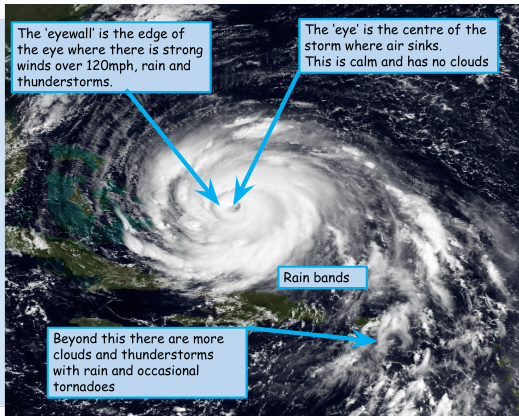
What causes the Monsoon?
It is caused when the winds change direction and blow moist air from the ocean over the continent. The himalayas are a physical barrier to these winds, forcing the air to rise and create relief rainfall. The winds change direction as the Land becomes warmer than the sea. In october, winds change direction again and the weather changes back to the dry season.
What heats up quicker? the land or the Ocean?
Land
The monsoon is a wet season from what months?
June to october
what percent of the population lives in areas affected by monsoons?
60%
Monsoons Account for __% of the rainfall in India
80%
__% of the indian population rely on the rain for agriculture
70% of the indian population rely on the rain for agriculture
How old is the earth?
4.55 Billion years old
Glacial period is…
Cold periods of time when there is an ice age and the ice extends down across Europe and North america
inter glacial is…
Warmer periods of time when lots of the ice melts.
List the Long term evidence for Climate change
Ice cores
Tree Rings
Artwork
List the short term evidence for Climate change
Tempreature increase
Sea levels rising
Melting ice sheets
list the natural causes of climate change…
Sunspots
Volcanic eruptions
Earths orbit
What is the Enhanced green house effect?
When theres too much carbon emmisions.