Nervous - Final: A Comprehensive Overview (AKA S*** You Should Already Know)
 Call Kai
 Learn
Learn Practice Test
 Spaced Repetition
 Match
Match Flashcards
 Knowt Play
1/141

There's no tags or description
Looks like no tags are added yet.
Name | Mastery | Learn | Test | Matching | Spaced | Call with Kai |
|---|
No analytics yet
Send a link to your students to track their progress
142 Terms
T/F: Neurons have high energy needs and thus high glucose reserves
False, low glucose reserves, rely on blood
In what order are cells sensitive to hypoxia?
Neurons > Oligos > Astros > Microglia > Endo
(NOAME)
An example of a genetic defect affecting cell metabolism is what?
Cerebellar abiotrophy
An example of a genetic defect affecting cell migration/maturation is what?
Lissencephaly

An example of a genetic defect affecting elimination of by-products is what?
Lysosomal storage disease
An example of a deficiency affecting cell metabolism is what?
Thiamine deficiency/Sulfur excess,
Hypoglycemia
(Lack of energy)
An example of an excess nutrient competing for normal nutrient binding sites is what?
Selenium excess in pigs
T/F: Salt poisoning is often direct in ruminants and indirect in pigs
True
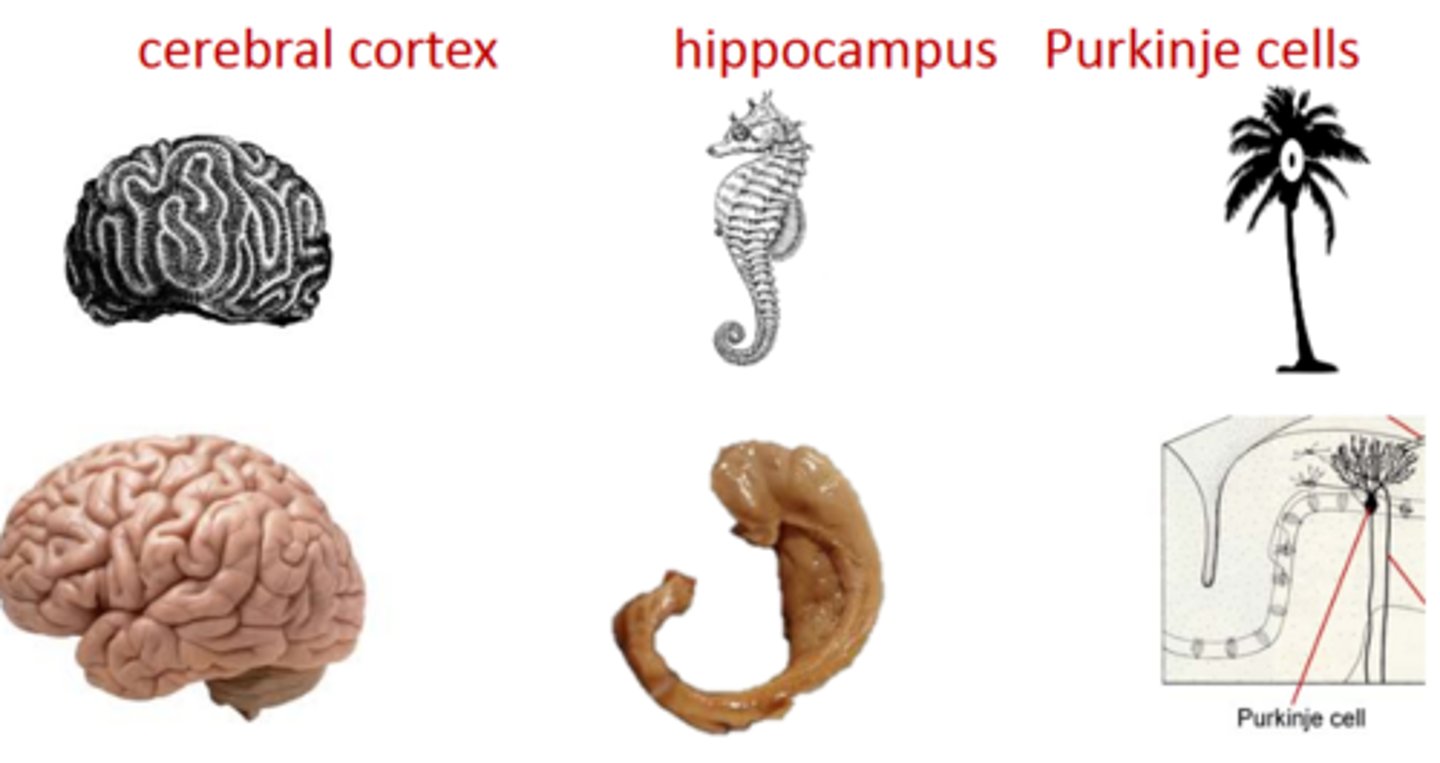
What areas are most sensitive to hypoxia?
Cerebral cortex,
Hippocampus, and
Purkinje cells
Which type of trauma is most severe when a stationary head is hit by a moving object (a bat)?
Coup
Which type of trauma is most severe when a moving head bounces against a stationary object?
Contrecoup
What poison causes laminar cortical necrosis by substituting for calcium ions?
Lead
What poison causes regional necrosis produced by yellow start thistle?
Nigropallidal encephalomalacia
What poison causes spongiosis due to hepatic dysfunction?
Ammonia
What fungal organism has a tropism for blood vessels?
Aspergillus encephalitis
What is an example of a pathogen entering via direct extension, common in cats?
Cuterebriasis
What is an example that has local replication in the muscle then travels through the nerves?
Rabies
What autoimmune disease is due to an influx of inflammatory cells forming perivascular cuffs?
Granulomatous meningoencephalitis (GME)
T/F: The dorsal arch of C2 should overlap C1
True
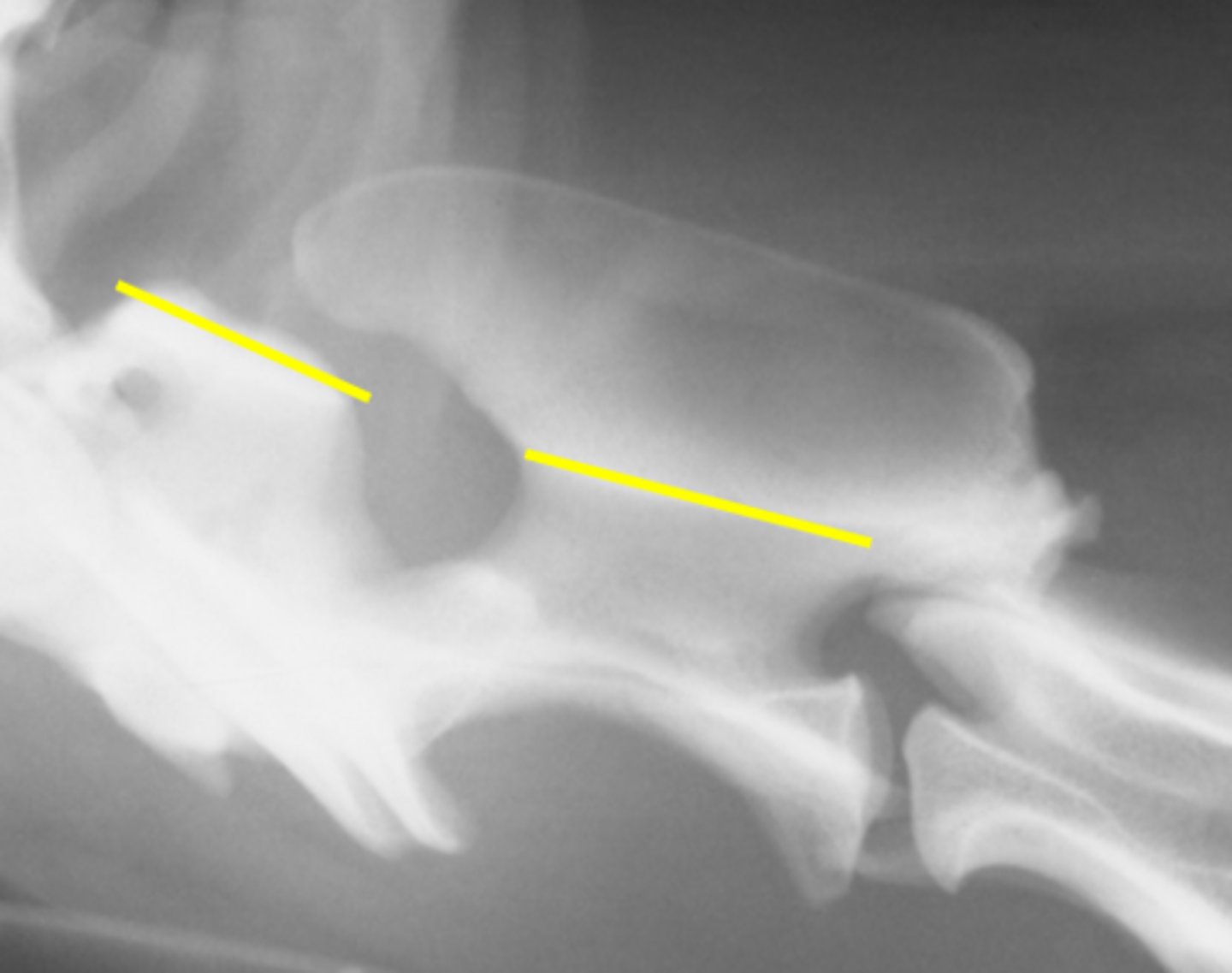
Which vertebra has a large, ventrally oriented transverse process?
C6
What is the anticlinal vertebrae?
T10/11
T/F: The disc space between T10/11 is often wider
False, narrower
Which vertebrae are often shorter to the adjacent ones?
C7 and L7
Which vertebrae have indistinct ventral borders due to the diaphragm?
L3 and L4
Which intervertebral foramina look like a horse head?
Lumbar
Which disc space is often wider compared to others?
L7 - S1
What is the first vertebrae will have dorsal spinous processes that superimpose over the intervertebral space?
T1 (C7 is more central)
Small, wedge shaped vertebrae leading to curvature of the spine are called what?
Hemivertebrae
A malformation at the junction of a spinal segment where the vertebrae assume characteristics of both segments is called what?
Transitional vertebrae
Failure of segmentation of vertebrae is called what?
Block vertebrae
What is the gold standard for imaging of most neurologic conditions?
MRI
T/F: You know how an MRI works
If you said "it is imaging of the a single proton (the hydrogen nucleus) which lines of the magnetic field for the protons, subsequently disturbs said fields, and monitors the release of energy as they return to their original orientation, allowing us to visualize brain matter in detail," then true
T/F: T2 weighted images are good for anatomy
False, T2 good for pathology, T1 for anatomy
Which MRI weight suppresses CSF signal?
FLAIR
Which MRI weight visualizes hemorrhage?
T2 star
Which MRI weight suppresses signal from fat?
STIR
Which MRI weight identifies areas of restricted fluid diffusion, like strokes?
DWI/ADC
Neurolocalize:
Seizures
Forebrain
Neurolocalize:
Dull mentation
Forebrain or brainstem
Neurolocalize:
Circling right
Right forebrain or right vestibular (circle toward lesion)
Neurolocalize:
Right postural reaction deficits
Left forebrain (contralateral), or
Right brainstem/spinal cord (ipsilateral)
T/F: The menace response utilizes pathways to the brain, while the PLR does not
True, need brain to blink
Neurolocalize:
Head tilt (right)
Listing (right)
Horizontal nystagmus, (fp left)
Right vestibular
(lean toward lesion, but look away)
Neurolocalize:
Decreased facial sensation (right)
Right trigeminal or brainstem
Neurolocalize:
Head tilt (left)
Mentally dull
Left central vestibular
Neurolocalize:
Postural reaction deficits (right)
Head tilt (left)
Horizontal nystagmus (fp right)
PR deficits indicate right brainstem.*
Rest indicate left vestibular.
LISTEN TO BRAIN
Right paradoxical (central) vestibular
*Also right cord or left brain, but this does not make sense with other signs
Neurolocalize:
Decreased gag reflex
Brainstem
Neurolocalize:
Tetraparesis and ataxia (x4)
Brainstem or cord
Neurolocalize:
Postural reaction deficits (x4)
Forebrain, brainstem, cord
Neurolocalize:
Head pressign
Forebrain
Neurolocalize:
UMN (x4)
C1 - C5
Neurolocalize:
UMN (PL)
T3 - L3
Neurolocalize:
LMN (TL)
UMN (PL)
C6 - T2
Neurolocalize:
LMN (PL)
L4 - S3
Neurolocalize:
Flaccid bladder, fecal incontinence (unless horse)
L4 - S1
Neurolocalize:
Patellar reflex absent only
L4 - L6 (femoral nerve)
Neurolocalize:
Pelvic limb withdrawal absent only
L6 - S1 (sciatic nerve)
Neurolocalize:
Perineal reflex absent only
S1 - S3 (pudendal nerve)
Neurolocalize:
Thoracic limb withdrawal absent only
C6 - T2 (radial/median/ulnar nerve)
Neurolocalize:
Cutaneous trunci absent at T13 bilaterally
T12
Neurolocalize:
Decreased tone and reflexes
Profound muscle atrophy
Peripheral nerve
Neurolocalize:
Atrophy of muscle with no reflex deficits
Decreased tone
Muscle
Neurolocalize:
Fatiguability with no atrophy and variable reflexes
NMJ
Neurolocalize:
Left thoracic limb monoparesis
L brachial plexus or peripheral nerve
Neurolocalize:
Collapse in pelvic limb with exercise
Normal gait when rested
NMJ
Neurolocalize:
Dull mentation
Vertical nystagums
Decreased pelvic withdrawal
Fecal incontinence
Central vestibular AND L4 - S3
Name that disease!
Degeneration of cerebellum without known cause
Affects younger animals
Diagnose with biopsy
Cerebellar abiotrophy
Name that disease!
Signs of sleeping during the day and restless at night
Diagnosed by visualizing small interthalamic adhesion
Treated with selegiline
Cognitive dysfunction
Name that disease!
Accumulation of CSF in cranium
Best diagnosed with MRI
Can be treated with a shunt to peritoneum
Hydrocephalus
Name that disease!
Caudal fossa is too small, leading to crowding
Often in Cavalier King Charles
Signs include phantom scratching and C1 - T2 myelopathy
Chiari-like Malformation
Name that disease!
More common in cats with panleukopenia
Symmetrical, non-progressive ataxia
Cerebellar hypoplasia
Name that disease!
Hyperexcitability due to lower neuronal threshold
Signs include facial rubbing and muscle tremors
Hypocalcemia
Name that disease!
Causes swelling of the brain cells
Treating aggressively can lead to dehydration and demyelination
Hyponatremia
Name that disease!
Caused by a deficiency of a certain hormone
Signs include vestibular dysfunction in older, large dogs
Hypothyroidism
Name that disease!
Due to a vascular bypass from the liver
Signs include abnormal behavior and pacing
Diagnosed on CBC with low BUN and elevated ammonia
Hepatic Encephalopathy
Name that disease!
Leads to decreased ATP production in the brain
Good prognosis if treated early
Thiamine deficiency
Name that disease!
Most common brain tumor in small animals
Histopath is the only definitive diagnosis
Meningioma
Name that disease!
Affects middle aged dogs, especially brachycephalics
Very poor prognosis
Glioma
Name that disease!
Causes unilateral masticatory muscle atrophy
Trigeminal nerve sheath tumor
What are the two mainstays of treatment for the conservative management of brain tumors?
Steroids at anti-inflammatory doses, and
Anticonvulsants
What is the dose range for physiologic, anti-inflammatory, and immunosuppressive doses of prednisone?
Physiologic: 0.1 - 0.2 mg/kg/day
Anti-inflammatory: 0.5 - 1.0 mg/kg/day
Immunosuppressive: 2 - 4 mg/kg/day
Name that disease!
Noninfectious inflammatory disease of toy breeds
Three forms: ocular, focal, and multifocal
Treated with immunosuppressive doses of prednisone
GME
Name that disease!
Noninfectious inflammatory necrotizing brain disease
Histopath is only definitive diagnosis
NME/NLE
Name that disease!
Infectious inflammatory disease of the respiratory tract
Signs include hyperkeratotic foot pads and nasal planum
Diagnosed with conjunctival scraping
Canine Distemper Virus
Name that disease!
Infectious inflammatory diseas that leads to obstructive hydrocephalus
Signs include central vestibular and forebrain signs
Diagnosed by high globulins
FIP
What form of FIP causes neurologic signs?
Dry
Name that disease!
Infectious inflammatory disease transmitted by saliva
Makes cats more susceptible to lymphoma
FeLV
Name that disease!
Virus locally replicates in muscle after bite
Should be considered in any acute, rapid neurologic condition
IFA detection in the brain is the gold standard of diagnosis
Rabies
Name that disease!
Most common mycotic encephalopathy of small animals
Cryptococcus neoformans
Name that disease!
Infectious inflammatory disease from ingestion of sporulated oocysts
Typically seen more in cats
Toxoplams gondii
Name that disease!
Infectious inflammatory disease similar to T. gondii
Neospora caninum
Name that disease!
Infectious inflammatory disease associated with Dermacentor ticks
Rocky Mountain Spotted Fever (Rickettsia rickettsii)
Name that disease!
Toxin that causes polioencephalomalacia
Treated with Succimer and calcium
Lead
Name that disease!
Toxin that is an acetylcholinesterase inhibitor, leading to too much ACh
Causes muscarinic and nicotinic signs (salivation, tremors, bradycardia)
Treated with 2-PAM to disrupt binding
Organophosphate
Name that disease!
Toxin that blocks GABA channels and facilitates sodium channels
Causes tremors and ataxia, mostly in cats
Is absorbed through the skin
Pyrethrin and Permethrin
Name that disease!
Toxin that blocks electron transport chain
Causes seizures and excitation
Bromethalin
Name that disease!
Snail poison
Causes seizures
DIagnose by frozen stomach contents
Metaldehyde
What is the formula for cerebral perfustion pressure?
Mean arterial pressure minus intracranial pressure
When cerebral perfusion pressure drops, it leads to ischemia in the brain, which is corrected by catecholamines that cause hypertension, which is compensated for with bradycardia. This is an example of what?
Cushing's Reflex
Ranking motor activity, brainstem reflexes, and level of consiousness are all part of what?
The Modified Glasgow Coma Scale

