Anatomy week 4: hearing, smell, and taste

0.0(0)
studied byStudied by 0 people
0.0(0)
call with kaiCall with Kai
learnLearn
examPractice Test
spaced repetitionSpaced Repetition
heart puzzleMatch
flashcardsFlashcards
GameKnowt Play
Card Sorting

1/37

encourage image

There's no tags or description

Looks like no tags are added yet.

Last updated 7:53 PM on 1/27/26
Name
Mastery
Learn
Test
Matching
Spaced
Call with Kai

No analytics yet

Send a link to your students to track their progress

38 Terms

1
New cards

what are the 3 sections of the ear, and what is their general function

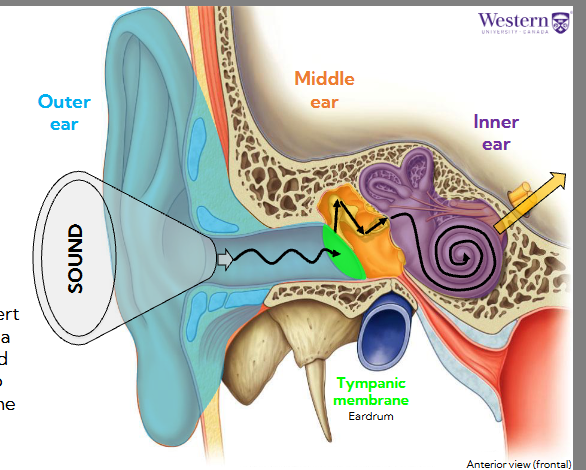
  • The ear is comprised of three sections, the outer, middle, and inner ear.

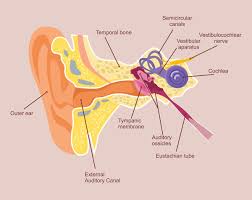
  • Their primary function is to funnel sound waves into the external auditory canal, convert those waves into vibrations via the tympanic membrane, and convert those vibrations into nervous impulses to send to the brain for hearing
<ul><li><p><span style="background-color: transparent;"><span>The ear is comprised of three sections, the outer, middle, and inner ear.</span></span></p></li><li><p><span style="background-color: transparent;"><span>Their primary function is to funnel sound waves into the external auditory canal, convert those waves into vibrations via the tympanic membrane, and convert those vibrations into nervous impulses to send to the brain for hearing</span></span></p></li></ul><p></p>
2
New cards

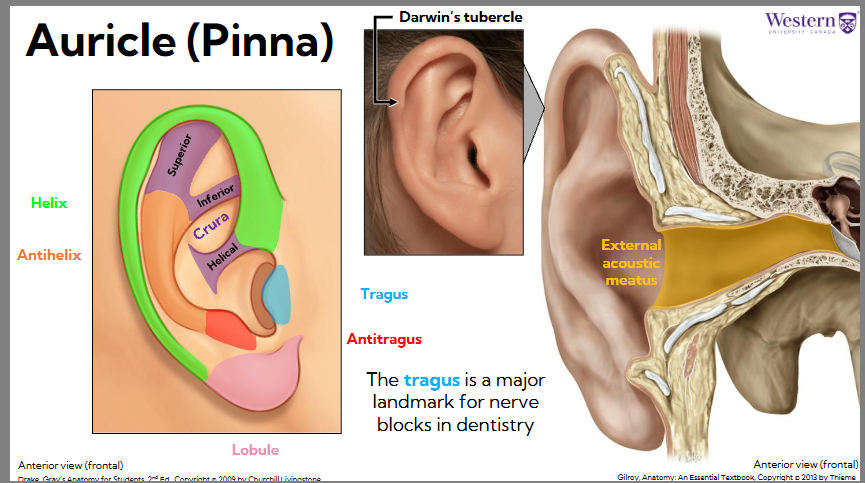
outer ear: auricle (pinna)

  • Auricle = actual ear on side of head

  • Some people have darwins tubercle, bump on top of helix, collects more sound

  • Auricle of auricle is to filter/funnel sound to external acoustic meatus

3
New cards

outer ear: arches of the auricle/pinna

  • Has main arches

    • Helix - outer most ridge

      • Has helical crura projection

    • Antihelix - smaller one inside

      • Has superior and inferior crura projections

    • The tragus is a major landmark for nerve blocks in dentistry: find TMJ and mandibular nerve

    • Antitragus: across the opening of the ear from the tragus

    • Lobule - skin dangling

<ul><li><p><span style="background-color: transparent;"><span>Has main arches</span></span></p><ul><li><p><span style="background-color: transparent;"><span>Helix - outer most ridge</span></span></p><ul><li><p><span style="background-color: transparent;"><span>Has helical crura projection</span></span></p></li></ul></li><li><p><span style="background-color: transparent;"><span>Antihelix - smaller one inside</span></span></p><ul><li><p><span style="background-color: transparent;"><span>Has superior and inferior crura projections</span></span></p></li></ul></li><li><p><span style="background-color: transparent;"><span>The tragus is a major landmark for nerve blocks in dentistry: find TMJ and mandibular nerve</span></span></p></li><li><p><span style="background-color: transparent;"><span>Antitragus: across the opening of the ear from the tragus</span></span></p></li><li><p><span style="background-color: transparent;"><span>Lobule - skin dangling</span></span></p></li></ul></li></ul><p></p>
4
New cards

outer ear: external acoustic meatus and ceruminous glands

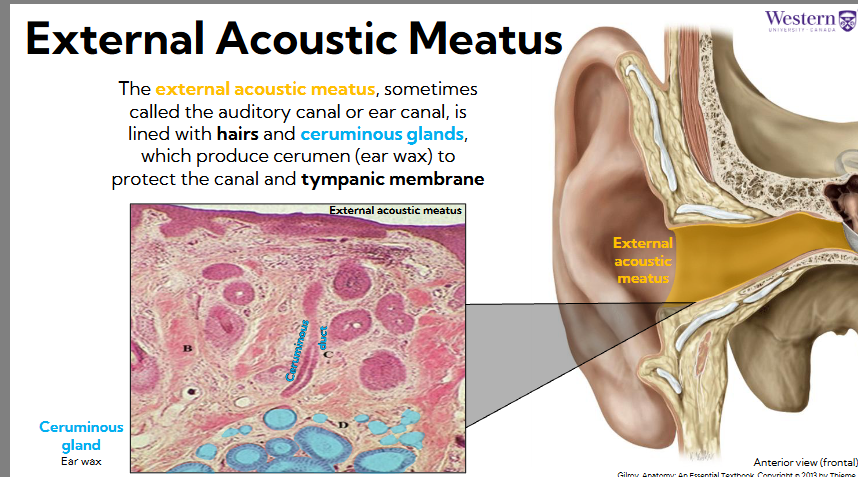
  • The external acoustic meatus, sometimes called the auditory canal or ear canal, is lined with hairs and ceruminous glands, which produce cerumen (ear wax) to protect the canal and tympanic membrane

  • Cerumen is funneled through ceruminous ducts to external acoustic meatus

  • Hairs also trap dust and debris, provides support structure for cerumen
<ul><li><p><span style="background-color: transparent;"><span>The external acoustic meatus, sometimes called the auditory canal or ear canal, is lined with hairs and ceruminous glands, which produce cerumen (ear wax) to protect the canal and tympanic membrane</span></span></p></li><li><p><span style="background-color: transparent;"><span>Cerumen is funneled through ceruminous ducts to external acoustic meatus</span></span></p></li><li><p><span style="background-color: transparent;"><span>Hairs also trap dust and debris, provides support structure for cerumen</span></span></p></li></ul><p></p>
5
New cards

tympanic membrane

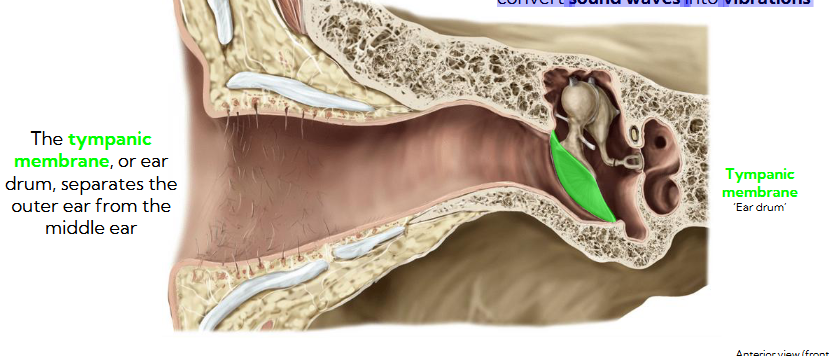
  • The tympanic membrane, or ear drum, separates the outer ear from the middle ear

  • It prevents debris from entering the middle ear, but its main job is to convert sound waves into vibrations
<ul><li><p><span style="background-color: transparent;"><span>The tympanic membrane, or ear drum, separates the outer ear from the middle ear</span></span></p></li><li><p><span style="background-color: transparent;"><span>It prevents debris from entering the middle ear, but its main job is to convert sound waves into vibrations</span></span></p></li></ul><p></p>
6
New cards

middle ear: tympanic membrane and ossicles

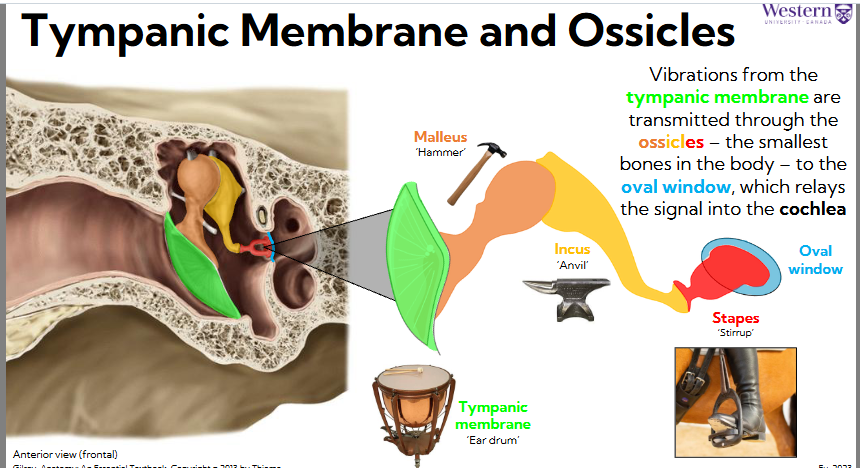
  • Vibrations from the tympanic membrane are transmitted through the ossicles – the smallest bones in the body – to the oval window, which relays the signal into the cochlea

  • Base of malleus connects to tympanic membrane, head of hammer is ball shaped head. It takes force from membrane and transmits it to incus (anvil)

  • Incus transmits force to stapes (stirrup), transmits force onto oval window membrane which goes to inner ear
<ul><li><p><span style="background-color: transparent;"><span>Vibrations from the tympanic membrane are transmitted through the ossicles – the smallest bones in the body – to the oval window, which relays the signal into the cochlea</span></span></p></li><li><p><span style="background-color: transparent;"><span>Base of malleus connects to tympanic membrane, head of hammer is ball shaped head. It takes force from membrane and transmits it to incus (anvil)</span></span></p></li><li><p><span style="background-color: transparent;"><span>Incus transmits force to stapes (stirrup), transmits force onto oval window membrane which goes to inner ear</span></span></p></li></ul><p></p>
7
New cards

middle ear muscles

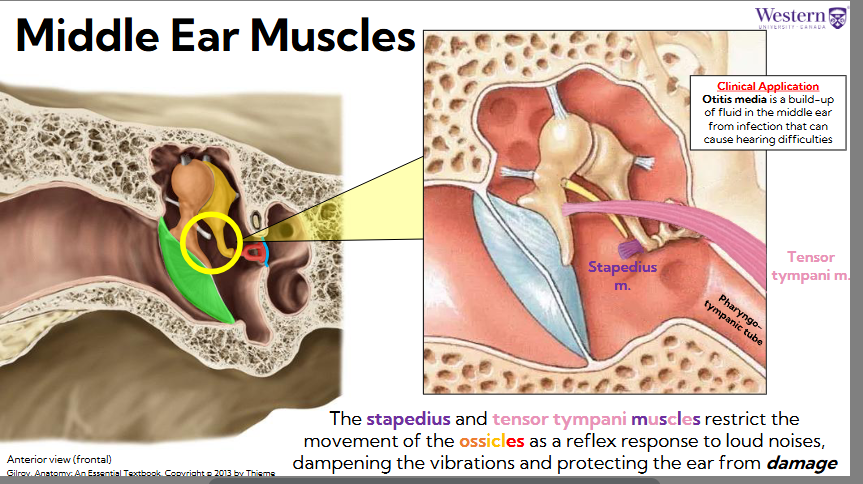
  • The stapedius and tensor tympani muscles restrict the movement of the ossicles as a reflex response to loud noises, dampening the vibrations and protecting the ear from damage

  • Tensor tympani pulls on base of the malleus to tighten tympanic membrane and prevents some of force from being transmitted onto incus

    • Malleus pivots away and force is reduced

  • These muscles respond to intense loud noises, prevents sound from damaging system
<ul><li><p><span style="background-color: transparent;"><span>The stapedius and tensor tympani muscles restrict the movement of the ossicles as a reflex response to loud noises, dampening the vibrations and protecting the ear from damage</span></span></p></li><li><p><span style="background-color: transparent;"><span>Tensor tympani pulls on base of the malleus to tighten tympanic membrane and prevents some of force from being transmitted onto incus</span></span></p><ul><li><p><span style="background-color: transparent;"><span>Malleus pivots away and force is reduced</span></span></p></li></ul></li><li><p><span style="background-color: transparent;"><span>These muscles respond to intense loud noises, prevents sound from damaging system</span></span></p></li></ul><p></p>
8
New cards

pharyngo tympanic tube (eustachian tube)

  • connects the middle ear to the nasopharynx

  • pathway for fluid, used to pop our ears

    • Diffuse (lower pressure) air creates a vacuum effect on ear drum and pulls it one way, air enters through pharynx to equilibrate outside air in pharynx and middle ear to match outside air, so tympanic membrane stays in neutral
9
New cards

otitis media

  • When sick, infected mucus can get into middle ear, causes ear infection

  • Otitis media, build up of fluid in the middle ear from infection that can impede these structures and cause hearing difficulties

10
New cards

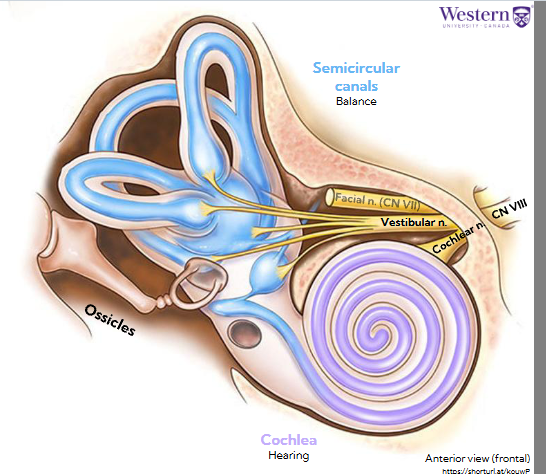
inner ear: fluid filled spaces

  • The inner ear is made up of two fluid-filled spaces – the semicircular canals, which are involved in balance, and the cochlea, which is the primary organ of hearing

  • Send signals back through vestibular cochlear nerve

    • Vestibular branch comes from semicircular canals

    • Cochlear branch comes from cochlea

    • They join to form CN VIII

<ul><li><p><span style="background-color: transparent;"><span>The inner ear is made up of two fluid-filled spaces – the semicircular canals, which are involved in balance, and the cochlea, which is the primary organ of hearing</span></span></p></li><li><p><span style="background-color: transparent;"><span>Send signals back through vestibular cochlear nerve</span></span></p><ul><li><p><span style="background-color: transparent;"><span>Vestibular branch comes from semicircular canals</span></span></p></li><li><p><span style="background-color: transparent;"><span>Cochlear branch comes from cochlea</span></span></p></li><li><p><span style="background-color: transparent;"><span>They join to form CN VIII</span></span></p></li></ul></li></ul><p></p>
11
New cards

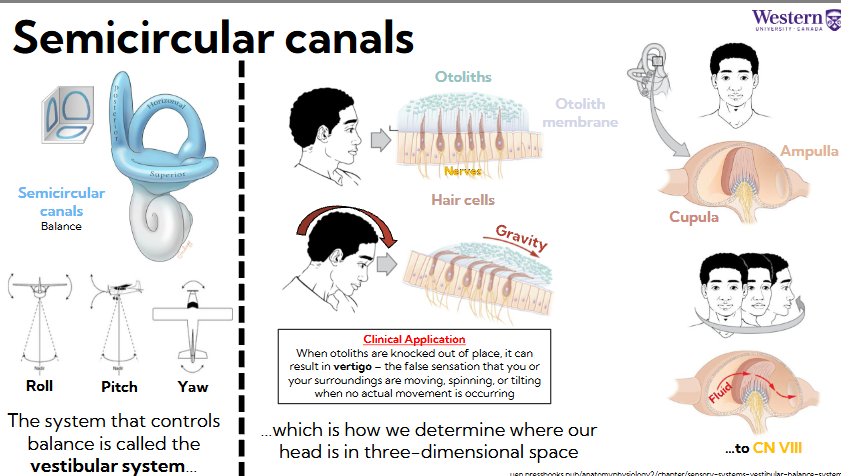
inner ear: what are the semicircular canals

  • The system that controls balance is called the vestibular system which is how we determine where our head is in three-dimensional space

  • One in each plane

  • They sense:

    • Roll: coronal 

    • Pitch: up or down, sagittal

    • Yaw: transverse movement 

<ul><li><p><span style="background-color: transparent;"><span>The system that controls balance is called the vestibular system which is how we determine where our head is in three-dimensional space</span></span></p></li><li><p><span style="background-color: transparent;"><span>One in each plane</span></span></p></li><li><p><span style="background-color: transparent;"><span>They sense:</span></span></p><ul><li><p><span style="background-color: transparent;"><span>Roll: coronal&nbsp;</span></span></p></li><li><p><span style="background-color: transparent;"><span>Pitch: up or down, sagittal</span></span></p></li><li><p><span style="background-color: transparent;"><span>Yaw: transverse movement&nbsp;</span></span></p></li></ul></li></ul><p></p>
12
New cards

how do semicircular canals work (otolith membrane)

  • When head is neutral: hair cells project into otolith membrane (jellylike fluid), on top of jelly, have otolith crystals, add weight

    • When bend our head, causes top of membrane to sage one way or another, moving jelly and hair cells

    • Bending interpreted as nervous signal

  • Sense movement: ampulla (big open space) at end of semicircular canals, filled with fluid, they contain cupula projections,

    • As we move, fluid moves, pushes cupula, triggers nerve impulse
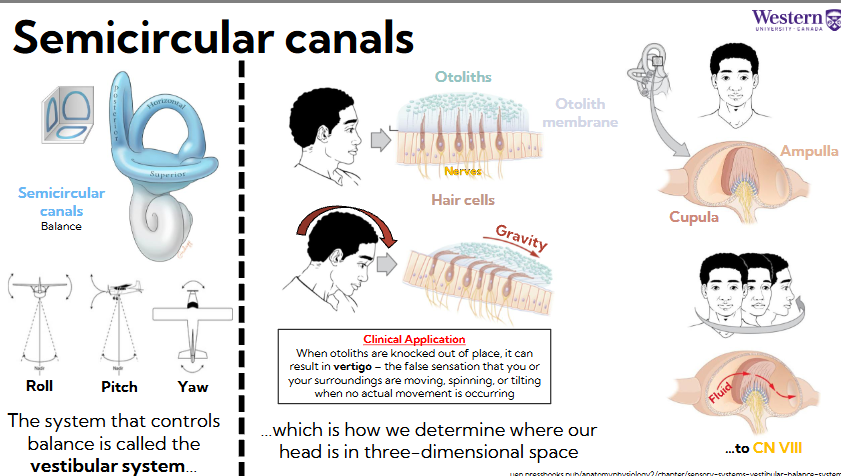
<ul><li><p><span style="background-color: transparent;"><span>When head is neutral: hair cells project into otolith membrane (jellylike fluid), on top of jelly, have otolith crystals, add weight</span></span></p><ul><li><p><span style="background-color: transparent;"><span>When bend our head, causes top of membrane to sage one way or another, moving jelly and hair cells</span></span></p></li><li><p><span style="background-color: transparent;"><span>Bending interpreted as nervous signal</span></span></p></li></ul></li><li><p><span style="background-color: transparent;"><span>Sense movement: ampulla (big open space) at end of semicircular canals, filled with fluid, they contain cupula projections,</span></span></p><ul><li><p><span style="background-color: transparent;"><span>As we move, fluid moves, pushes cupula, triggers nerve impulse</span></span></p></li></ul></li></ul><p></p>
13
New cards

how does vertigo work

  • When otoliths are knocked out of place, it can result in vertigo – the false sensation that you or your surroundings are moving, spinning, or tilting when no actual movement is occurring

14
New cards

the cochlea

  • The cochlea contains sensory receptors that transmit signals to the cochlear n. – a branch of the vestibulocochlear n. (CN VIII) – for hearing

  • Signal goes through tympanic membrane, then ossicles, and then oval window (entrance to inner ear) which pusses on perilymph fluid

    • Moves through cochlea, all the way around and back out
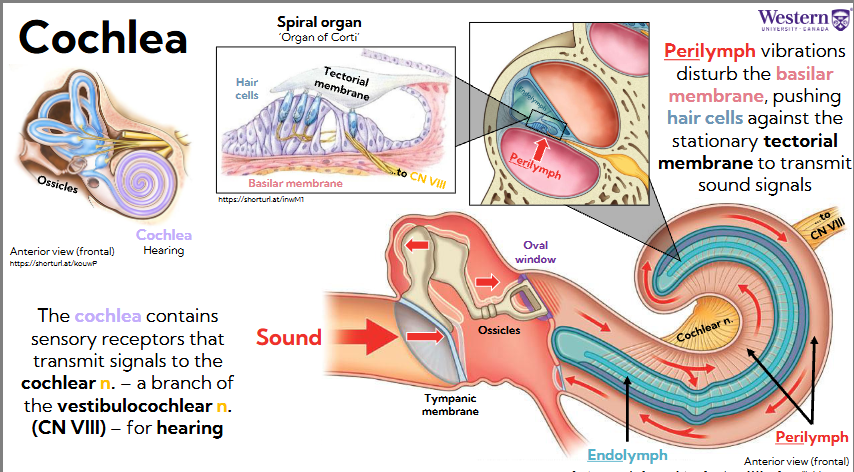
<ul><li><p><span style="background-color: transparent;"><span>The cochlea contains sensory receptors that transmit signals to the cochlear n. – a branch of the vestibulocochlear n. (CN VIII) – for hearing</span></span></p></li><li><p><span style="background-color: transparent;"><span>Signal goes through tympanic membrane, then ossicles, and then oval window (entrance to inner ear) which pusses on perilymph fluid</span></span></p><ul><li><p><span style="background-color: transparent;"><span>Moves through cochlea, all the way around and back out</span></span></p></li></ul></li></ul><p></p>
15
New cards

how are frequencies detected in the cochlea (endolymph and perilymph)

  • Endolymph trapped within perilymph, moves

    • Different frequencies push and move endolymph on different areas

    • Perilymph pushes on spiral organ or organ of corti (within endolymph), force pushes onto basilar membrane, bends cilia (hair cells) against the tectorial membrane (rigid does not move), depending how they bend, sends signal through cochlear branch

  • Perilymph vibrations disturb the basilar membrane, pushing hair cells against the stationary tectorial membrane to transmit sound signals
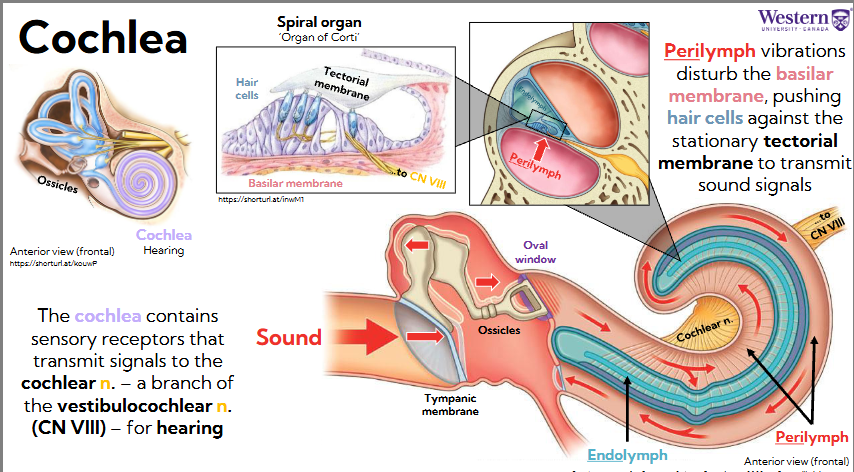
<ul><li><p><span style="background-color: transparent;"><span>Endolymph trapped within perilymph, moves</span></span></p><ul><li><p><span style="background-color: transparent;"><span>Different frequencies push and move endolymph on different areas</span></span></p></li><li><p><span style="background-color: transparent;"><span>Perilymph pushes on spiral organ or organ of corti (within endolymph), force pushes onto basilar membrane, bends cilia (hair cells) against the tectorial membrane (rigid does not move), depending how they bend, sends signal through cochlear branch</span></span></p></li></ul></li><li><p><span style="background-color: transparent;"><span>Perilymph vibrations disturb the basilar membrane, pushing hair cells against the stationary tectorial membrane to transmit sound signals</span></span></p></li></ul><p></p>
16
New cards

mechanism of hearing different frequencies

  • The cochlea has a tonotopic organization, meaning different frequencies reach different parts of sections along its length

  • Lower frequencies travel deeper into the cochlea than higher ones do

  • Higher frequencies hit endolymph earlier (have shorter sound waves)
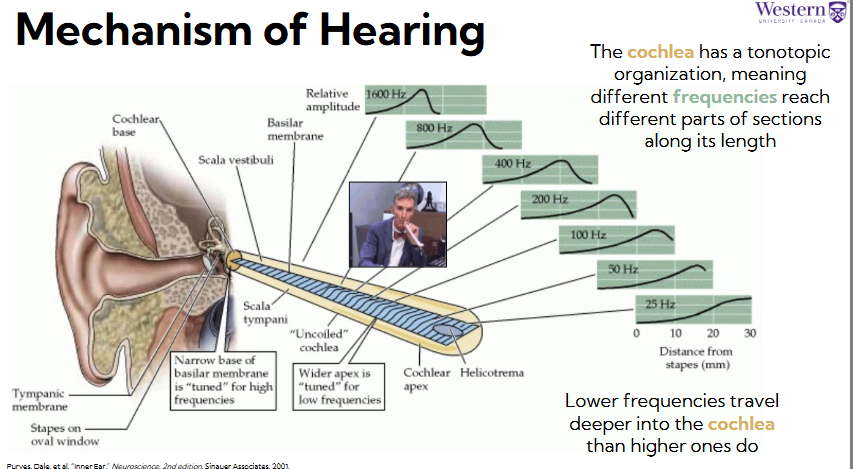
<ul><li><p><span style="background-color: transparent;"><span>The cochlea has a tonotopic organization, meaning different frequencies reach different parts of sections along its length</span></span></p></li><li><p><span style="background-color: transparent;"><span>Lower frequencies travel deeper into the cochlea than higher ones do</span></span></p></li><li><p><span style="background-color: transparent;"><span>Higher frequencies hit endolymph earlier (have shorter sound waves)</span></span></p></li></ul><p></p>
17
New cards

the auditory pathway

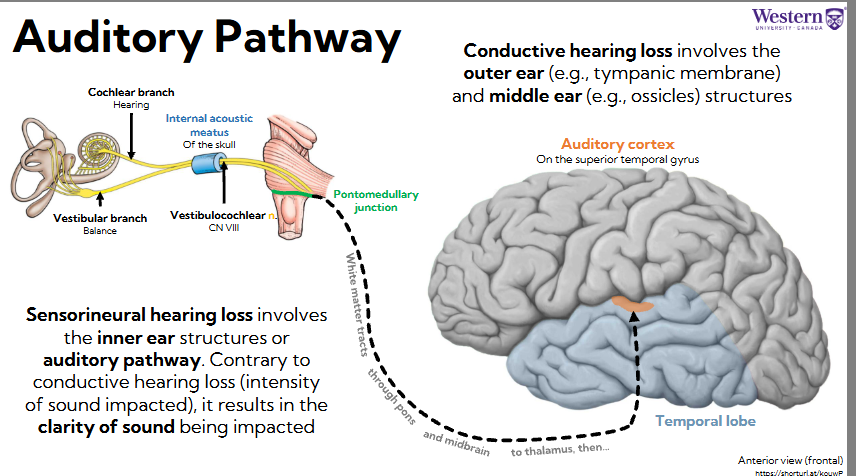
  • Vestibular and cochlear branch get bundled together and travel through internal acoustic meatus of the skull, becomes vestibulocochlear n and returns to pontomedullary junction. White matter tracts reach up to the thalamus, shoots those signals to the auditory cortex (on superior temporal gyrus)
<ul><li><p><span style="background-color: transparent;"><span>Vestibular and cochlear branch get bundled together and travel through internal acoustic meatus of the skull, becomes vestibulocochlear n and returns to pontomedullary junction. White matter tracts reach up to the thalamus, shoots those signals to the auditory cortex (on superior temporal gyrus)</span></span></p></li></ul><p></p>
18
New cards

sensorineural hearing loss vs. conductive hearing loss

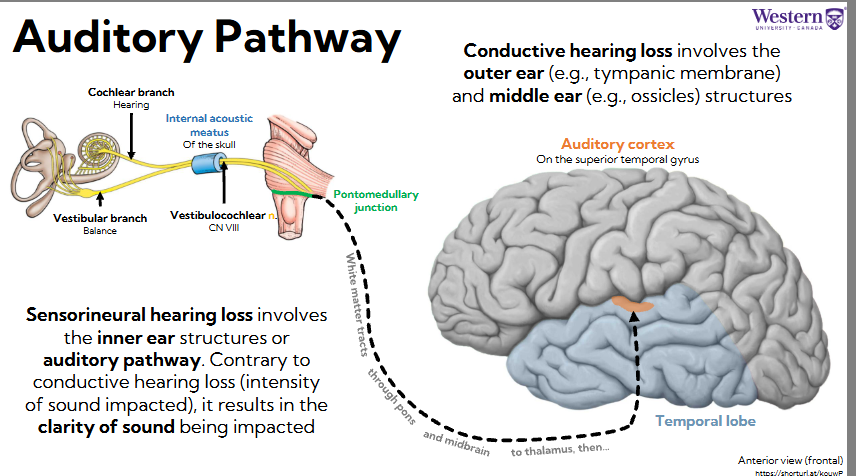
  • Sensorineural hearing loss involves the inner ear structures or auditory pathway. Contrary to conductive hearing loss (intensity of sound impacted), it results in the clarity of sound being impacted

  • Conductive hearing loss involves the outer ear (e.g., tympanic membrane) and middle ear (e.g., ossicles) structures

    • Otitis media

    • Or permanent damage dampens amount of vibrations which effects amount of vibration
<ul><li><p><span style="background-color: transparent;"><span>Sensorineural hearing loss involves the inner ear structures or auditory pathway. Contrary to conductive hearing loss (intensity of sound impacted), it results in the clarity of sound being impacted</span></span></p></li><li><p><span style="background-color: transparent;"><span>Conductive hearing loss involves the outer ear (e.g., tympanic membrane) and middle ear (e.g., ossicles) structures</span></span></p><ul><li><p><span style="background-color: transparent;"><span>Otitis media</span></span></p></li><li><p><span style="background-color: transparent;"><span>Or permanent damage dampens amount of vibrations which effects amount of vibration</span></span></p></li></ul></li></ul><p></p>
19
New cards

why are olfaction and gustation connected

  • Both use chemoreceptors

    • The olfactory (smell) and gustatory (taste) systems use chemoreceptors – specialized sensory cells that detect external chemical stimuli

20
New cards

nasal cavity bones

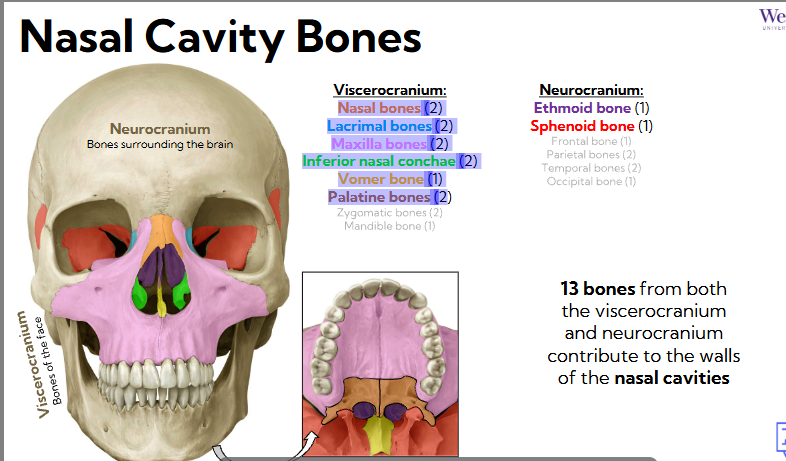
  • 13 bones from both the viscerocranium and neurocranium contribute to the walls of the nasal cavities

21
New cards

viscerocranium nasal cavity bones

  • Viscerocranium: face bones

    • Nasal bones (2) - bridge of nose

    • Lacrimal bones (2) - near tear ducts

    • Maxilla bones (2) - upper jaw, walls and floor of nasal cavity

    • Inferior nasal conchae (2) - project into nasal cavities from lateral walls

    • Vomer bone (1) - wall of nasal septum

    • Palatine bones (2 - floor of nasal cavity)

    • zygomatic and mandible not included in nasal cavity
<ul><li><p><span style="background-color: transparent;"><span>Viscerocranium: face bones</span></span></p><ul><li><p><span style="background-color: transparent;"><span>Nasal bones (2) - bridge of nose</span></span></p></li><li><p><span style="background-color: transparent;"><span>Lacrimal bones (2) - near tear ducts</span></span></p></li><li><p><span style="background-color: transparent;"><span>Maxilla bones (2) - upper jaw, walls and floor of nasal cavity</span></span></p></li><li><p><span style="background-color: transparent;"><span>Inferior nasal conchae (2) - project into nasal cavities from lateral walls</span></span></p></li><li><p><span style="background-color: transparent;"><span>Vomer bone (1) - wall of nasal septum</span></span></p></li><li><p><span style="background-color: transparent;"><span>Palatine bones (2 - floor of nasal cavity)</span></span></p></li><li><p><span style="background-color: transparent;"><span>zygomatic and mandible not included in nasal cavity</span></span></p></li></ul></li></ul><p></p>
22
New cards

neurocranium bones of nasal cavity

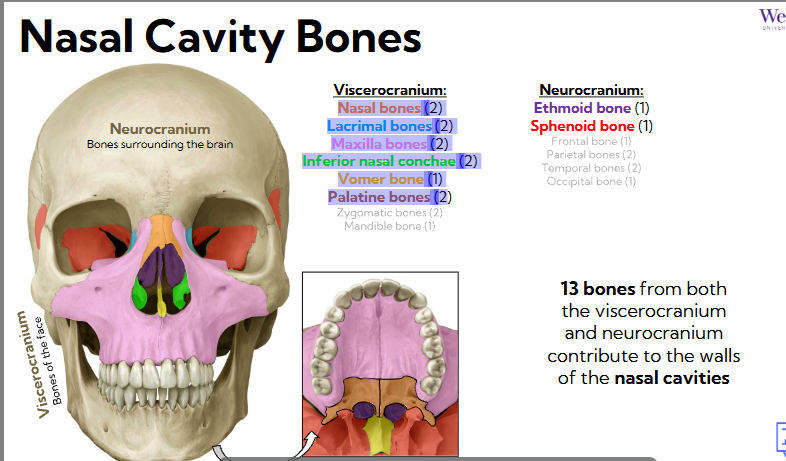
  • Neurocranium: bones surrounding brain 

    • Ethmoid bone

    • Sphenoid bone- houses brain, posterior aspect of nasal cavity
<ul><li><p><span style="background-color: transparent;"><span>Neurocranium: bones surrounding brain&nbsp;</span></span></p><ul><li><p><span style="background-color: transparent;"><span>Ethmoid bone</span></span></p></li><li><p><span style="background-color: transparent;"><span>Sphenoid bone- houses brain, posterior aspect of nasal cavity</span></span></p></li></ul></li></ul><p></p>
23
New cards

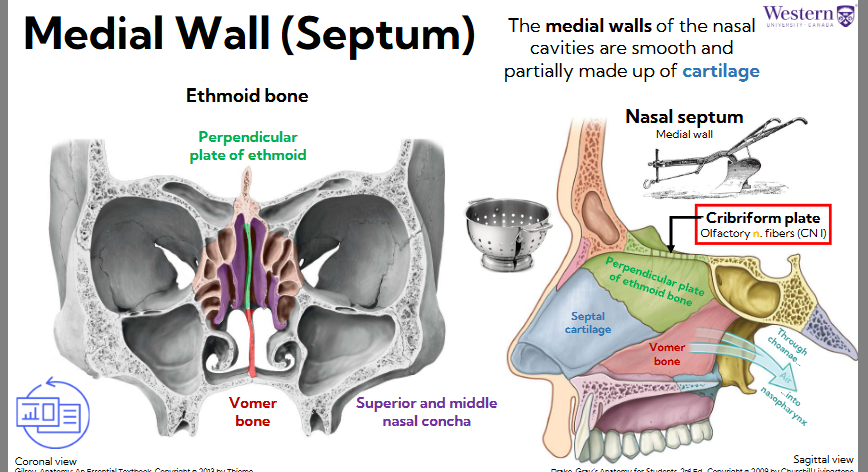
medial wall of nasal cavity (septum)

  • Huge portion made of ethmoid bone -medial wall (perpendicular plate of ethmoid)

  • Meets with vomer bone at bottom

  • Septal cartilage is huge chunk of medial wall

  • Air passes through choanae into nasopharynx

    • Moves past cribriform plate, top of ethmoid bone, with holes that run through it, where olfactory nerve fibers run, embedded in mucosa to sense

  • The medial walls of the nasal cavities are smooth and partially made up of cartilage
<ul><li><p><span style="background-color: transparent;"><span>Huge portion made of ethmoid bone -medial wall (perpendicular plate of ethmoid)</span></span></p></li><li><p><span style="background-color: transparent;"><span>Meets with vomer bone at bottom</span></span></p></li><li><p><span style="background-color: transparent;"><span>Septal cartilage is huge chunk of medial wall</span></span></p></li><li><p><span style="background-color: transparent;"><span>Air passes through choanae into nasopharynx</span></span></p><ul><li><p><span style="background-color: transparent;"><span>Moves past cribriform plate, top of ethmoid bone, with holes that run through it, where olfactory nerve fibers run, embedded in mucosa to sense</span></span></p></li></ul></li><li><p><span style="background-color: transparent;"><span>The medial walls of the nasal cavities are smooth and partially made up of cartilage</span></span></p></li></ul><p></p>
24
New cards

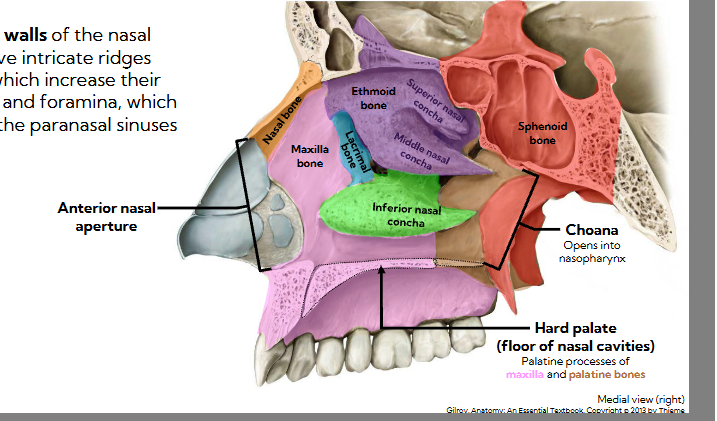
lateral walls of nasal cavity

  • The lateral walls of the nasal cavities have intricate ridges (conchae), which increase their surface areas, and foramina, which connect with the paranasal sinuses

    • Anterior nasal aperture -openings

    • Maxilla bone makes huge chunk of lateral bone

    • Nasal bone makes bridge

    • Lacrimal bone

    • Inferior nasal concha

    • Ethmoid bone: superior nasal concha and middle nasal concha

    • Hard palate: palatine processes of palatine bones and maxilla 

    • Spehnoid bone has choana - opening into nasopharynx
<ul><li><p><span style="background-color: transparent;"><span>The lateral walls of the nasal cavities have intricate ridges (conchae), which increase their surface areas, and foramina, which connect with the paranasal sinuses</span></span></p><ul><li><p><span style="background-color: transparent;"><span>Anterior nasal aperture -openings</span></span></p></li><li><p><span style="background-color: transparent;"><span>Maxilla bone makes huge chunk of lateral bone</span></span></p></li><li><p><span style="background-color: transparent;"><span>Nasal bone makes bridge</span></span></p></li><li><p><span style="background-color: transparent;"><span>Lacrimal bone</span></span></p></li><li><p><span style="background-color: transparent;"><span>Inferior nasal concha</span></span></p></li><li><p><span style="background-color: transparent;"><span>Ethmoid bone: superior nasal concha and middle nasal concha</span></span></p></li><li><p><span style="background-color: transparent;"><span>Hard palate: palatine processes of palatine bones and maxilla&nbsp;</span></span></p></li><li><p><span style="background-color: transparent;"><span>Spehnoid bone has choana - opening into nasopharynx</span></span></p></li></ul></li></ul><p></p>
25
New cards

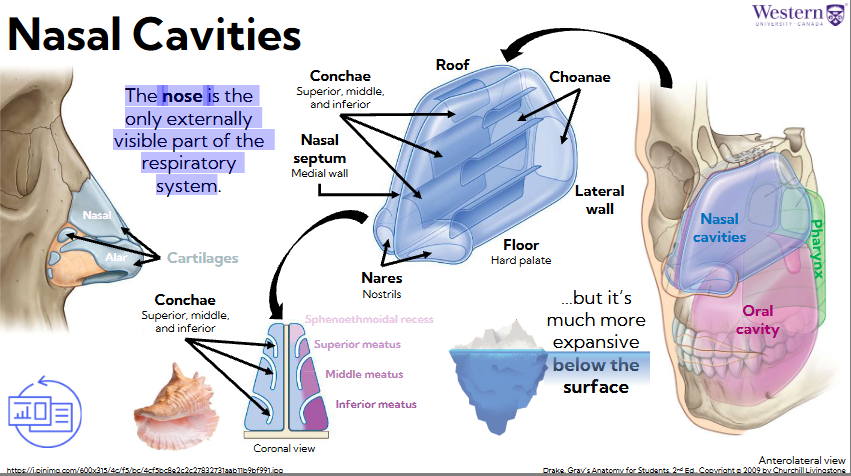
chonae projections in nasal cavity

  • The nose is the only externally visible part of the respiratory system - mostly cartilage

  • But its much more expansive below the face

  • Choanae create projections into nasal cavity, create pockets (inferior, middle, inferior meatus) creates turbulence in nasal cavity to help with olfaction

  • Olfaction happens in sphenoethmoid recess (roof of nasal cavity)
<ul><li><p><span style="background-color: transparent;"><span>The nose is the only externally visible part of the respiratory system - mostly cartilage</span></span></p></li><li><p><span style="background-color: transparent;"><span>But its much more expansive below the face</span></span></p></li><li><p><span style="background-color: transparent;"><span>Choanae create projections into nasal cavity, create pockets (inferior, middle, inferior meatus) creates turbulence in nasal cavity to help with olfaction</span></span></p></li><li><p><span style="background-color: transparent;"><span>Olfaction happens in sphenoethmoid recess (roof of nasal cavity)</span></span></p></li></ul><p></p>
26
New cards

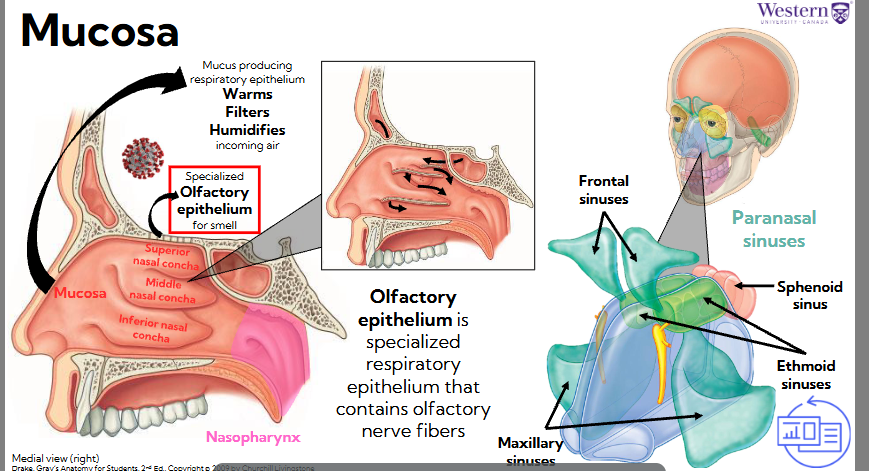
mucosa (smell)

  • Olfactory epithelium is specialized respiratory epithelium that contains olfactory nerve fibers

  • Mucosa producing respiratory epithelium:

    • Warms, filters, and humidifies incoming air

  • Paranasal sinuses (chambers within bones), lots of SA to perform these functions

  • Air passed by specialized olfactory epithelium for smell

    • Covid virus targets olfactory epithelium, can't smell
<ul><li><p><span style="background-color: transparent;"><span>Olfactory epithelium is specialized respiratory epithelium that contains olfactory nerve fibers</span></span></p></li><li><p><span style="background-color: transparent;"><span>Mucosa producing respiratory epithelium:</span></span></p><ul><li><p><span style="background-color: transparent;"><span>Warms, filters, and humidifies incoming air</span></span></p></li></ul></li><li><p><span style="background-color: transparent;"><span>Paranasal sinuses (chambers within bones), lots of SA to perform these functions</span></span></p></li><li><p><span style="background-color: transparent;"><span>Air passed by specialized olfactory epithelium for smell</span></span></p><ul><li><p><span style="background-color: transparent;"><span>Covid virus targets olfactory epithelium, can't smell</span></span></p></li></ul></li></ul><p></p>
27
New cards

olfactory n (CN I)

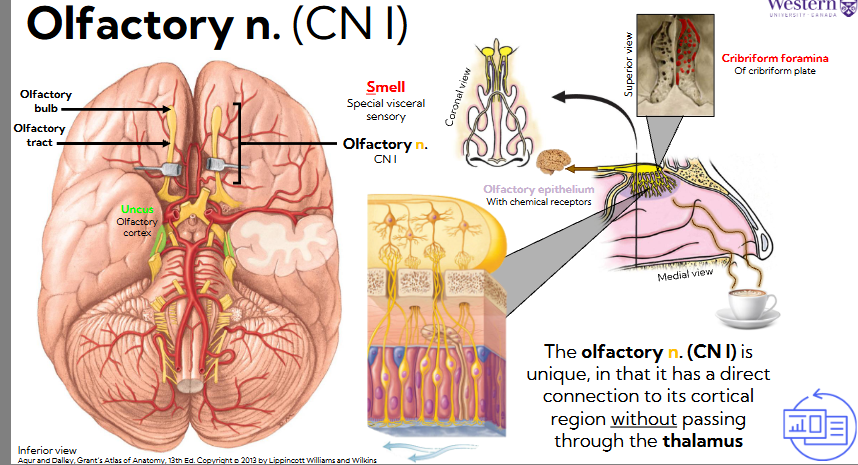
  • The olfactory n. (CN I) is unique, in that it has a direct connection to its cortical region without passing through the thalamus

  • Has CNS neurons: olfactory n., bulb, and tract (located in uncus)

  • Olfactory bulb sits on inside of skull on the cribriform plate of ethmoid

    • Has little holes, cribriform foramina, where nerve fibers project through and embed in olfactory epithelium

    • Aromas pass odor molecules, mucosa dissolves those chemicals, and olfactory nerve transmits to nervous signals

  • Only sensory nerve that does not relay to thalamus, goes directly to cortex
<ul><li><p><span style="background-color: transparent;"><span>The olfactory n. (CN I) is unique, in that it has a direct connection to its cortical region without passing through the thalamus</span></span></p></li><li><p><span style="background-color: transparent;"><span>Has CNS neurons: olfactory n., bulb, and tract (located in uncus)</span></span></p></li><li><p><span style="background-color: transparent;"><span>Olfactory bulb sits on inside of skull on the cribriform plate of ethmoid</span></span></p><ul><li><p><span style="background-color: transparent;"><span>Has little holes, cribriform foramina, where nerve fibers project through and embed in olfactory epithelium</span></span></p></li><li><p><span style="background-color: transparent;"><span>Aromas pass odor molecules, mucosa dissolves those chemicals, and olfactory nerve transmits to nervous signals</span></span></p></li></ul></li><li><p><span style="background-color: transparent;"><span>Only sensory nerve that does not relay to thalamus, goes directly to cortex</span></span></p></li></ul><p></p>
28
New cards

olfactory pathway

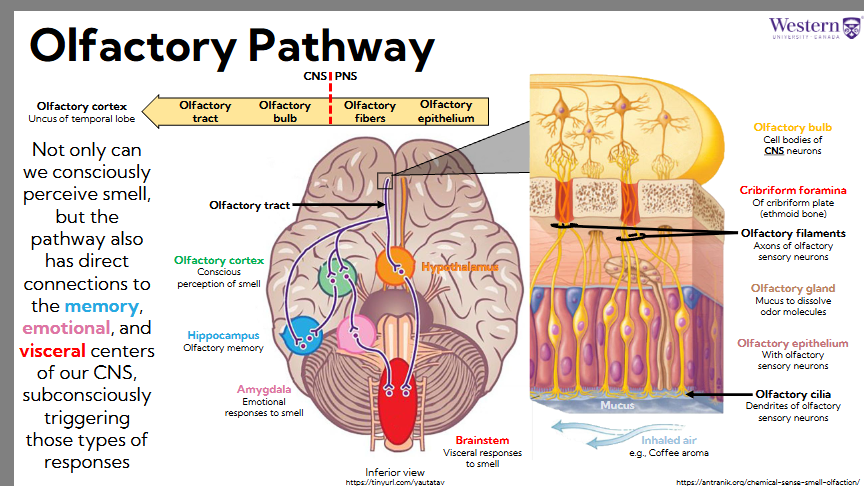
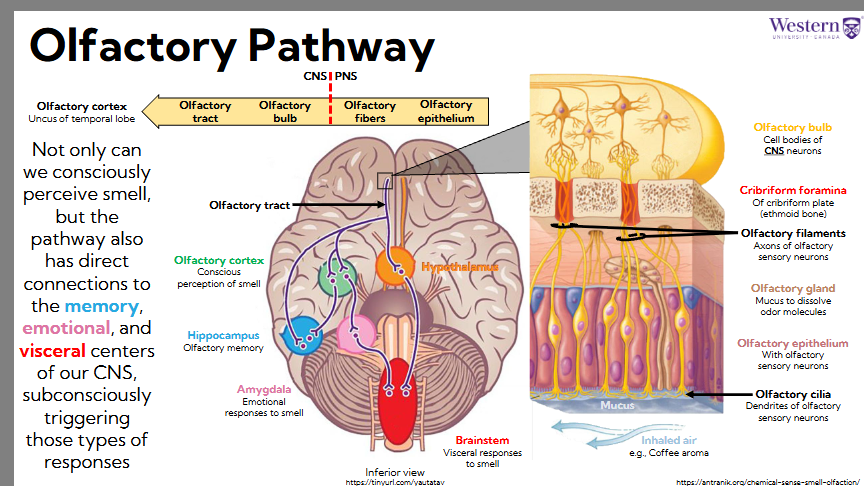
  • Not only can we consciously perceive smell, but the pathway also has direct connections to the memory, emotional, and visceral centers of our CNS, subconsciously triggering those types of responses

29
New cards

olfactory pathway in nasal cavities:

  • Nose: in order top down

    • Olfactory epithelium: with olfactory sensory neurons

    • Olfactory gland: mucus to dissolve odor molecules

    • Olfactory cilia: dendrites of olfactory sensory neurons

    • Olfactory filaments: axons of olfactory sensory neurones- toward brain (true olfactory nerves)

    • Cribriform foramina: of cribriform plate (ethmoid bone) - separates PNS from CNS

    • Olfactory bulb: synapse with cell bodies of CNS neurons
<ul><li><p><span style="background-color: transparent;"><span>Nose: in order top down</span></span></p><ul><li><p><span style="background-color: transparent;"><span>Olfactory epithelium: with olfactory sensory neurons</span></span></p></li><li><p><span style="background-color: transparent;"><span>Olfactory gland: mucus to dissolve odor molecules</span></span></p></li><li><p><span style="background-color: transparent;"><span>Olfactory cilia: dendrites of olfactory sensory neurons</span></span></p></li><li><p><span style="background-color: transparent;"><span>Olfactory filaments: axons of olfactory sensory neurones- toward brain (true olfactory nerves)</span></span></p></li><li><p><span style="background-color: transparent;"><span>Cribriform foramina: of cribriform plate (ethmoid bone) - separates PNS from CNS</span></span></p></li><li><p><span style="background-color: transparent;"><span>Olfactory bulb: synapse with cell bodies of CNS neurons</span></span></p></li></ul></li></ul><p></p>
30
New cards

olfactory pathway in brain

  • Brain: 

    • Olfactory cortex: conscious perception of smell- first place we send smell

    • Hippocampus: olfactory memory- directly connects to olfactory cortex, also connects to olfactory cortex (indirect connection)

    • Amygdala: emotional responses to smell

    • Brainstem: visceral responses to smell - reflexes like disgust
<ul><li><p><span style="background-color: transparent;"><span>Brain:&nbsp;</span></span></p><ul><li><p><span style="background-color: transparent;"><span>Olfactory cortex: conscious perception of smell- first place we send smell</span></span></p></li><li><p><span style="background-color: transparent;"><span>Hippocampus: olfactory memory- directly connects to olfactory cortex, also connects to olfactory cortex (indirect connection)</span></span></p></li><li><p><span style="background-color: transparent;"><span>Amygdala: emotional responses to smell</span></span></p></li><li><p><span style="background-color: transparent;"><span>Brainstem: visceral responses to smell - reflexes like disgust</span></span></p></li></ul></li></ul><p></p>
31
New cards

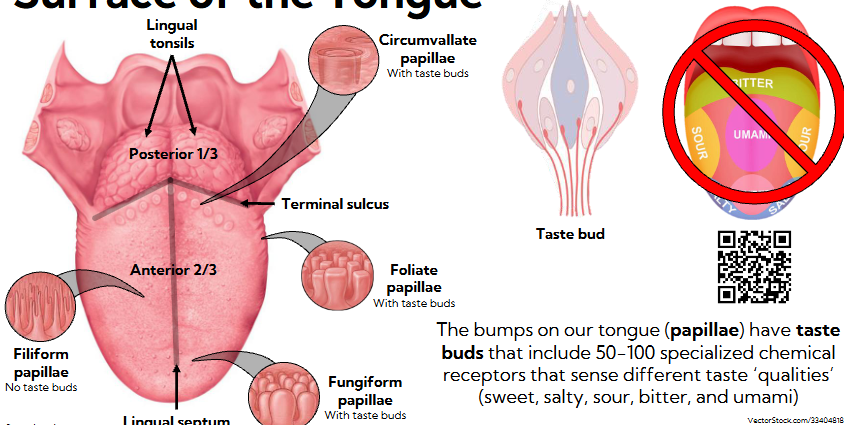
surface of the tongue

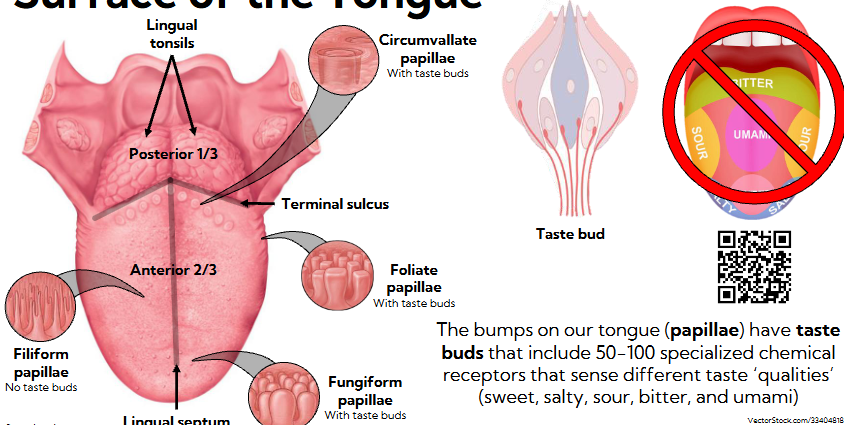
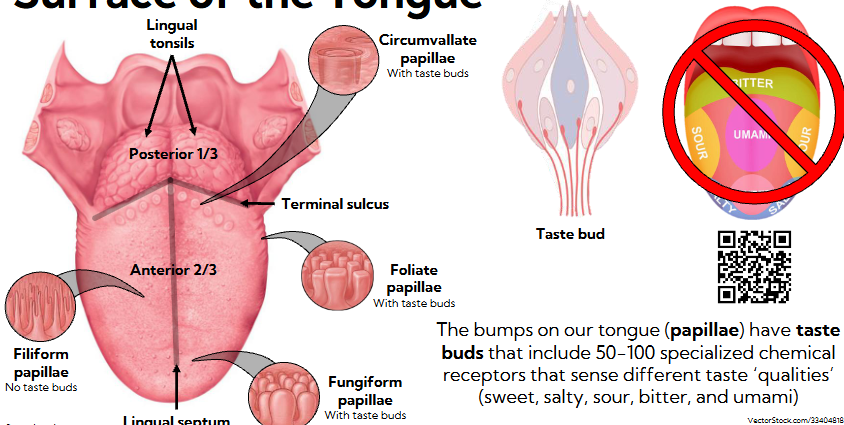
  • The bumps on our tongue (papillae) have taste buds that include 50-100 specialized chemical receptors that sense different taste ‘qualities’ (sweet, salty, sour, bitter, and umami)

  • Lingual septum divides tongue into 2 sides

  • Terminal sulcus, v shaped group, separates anterior ⅔ of tongue from posterior ⅓ 

  • Lingual tonsils - immune response

  • Filiform papillae - no taste buds, purpose to give us control over food, friction additive so we can move food
<ul><li><p><span style="background-color: transparent;"><span>The bumps on our tongue (papillae) have taste buds that include 50-100 specialized chemical receptors that sense different taste ‘qualities’ (sweet, salty, sour, bitter, and umami)</span></span></p></li><li><p><span style="background-color: transparent;"><span>Lingual septum divides tongue into 2 sides</span></span></p></li><li><p><span style="background-color: transparent;"><span>Terminal sulcus, v shaped group, separates anterior ⅔ of tongue from posterior ⅓&nbsp;</span></span></p></li><li><p><span style="background-color: transparent;"><span>Lingual tonsils - immune response</span></span></p></li><li><p><span style="background-color: transparent;"><span>Filiform papillae - no taste buds, purpose to give us control over food, friction additive so we can move food</span></span></p></li></ul><p></p>
32
New cards

papillae with taste buds:

  • Fungiform: bulbous, little mushrooms

  • Foliate: squared off

  • circumvallate : circular suction cups, help bring food back as we swallow
<ul><li><p><span style="background-color: transparent;"><span>Fungiform: bulbous, little mushrooms</span></span></p></li><li><p><span style="background-color: transparent;"><span>Foliate: squared off</span></span></p></li><li><p><span style="background-color: transparent;"><span>circumvallate : circular suction cups, help bring food back as we swallow</span></span></p></li></ul><p></p>
33
New cards

taste bud

  • 50-100 sensors that detect diff types of taste

  • Scattered throughout the tongue

<ul><li><p><span style="background-color: transparent;"><span>50-100 sensors that detect diff types of taste</span></span></p></li><li><p><span style="background-color: transparent;"><span>Scattered throughout the tongue</span></span></p></li></ul><p></p>
34
New cards

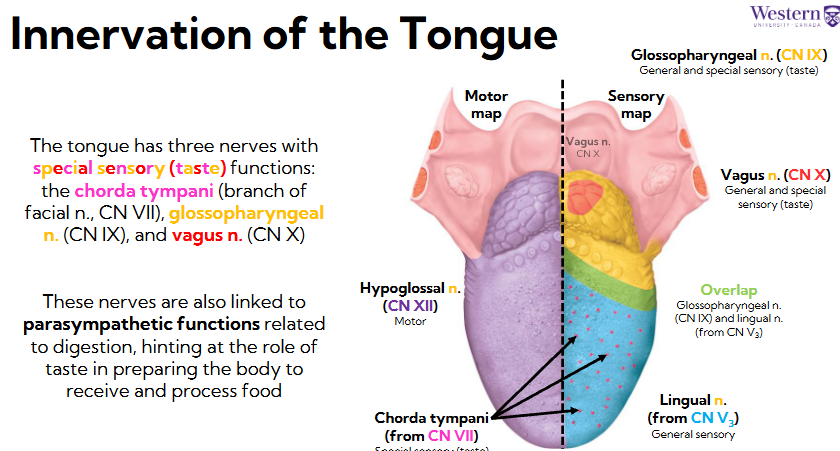
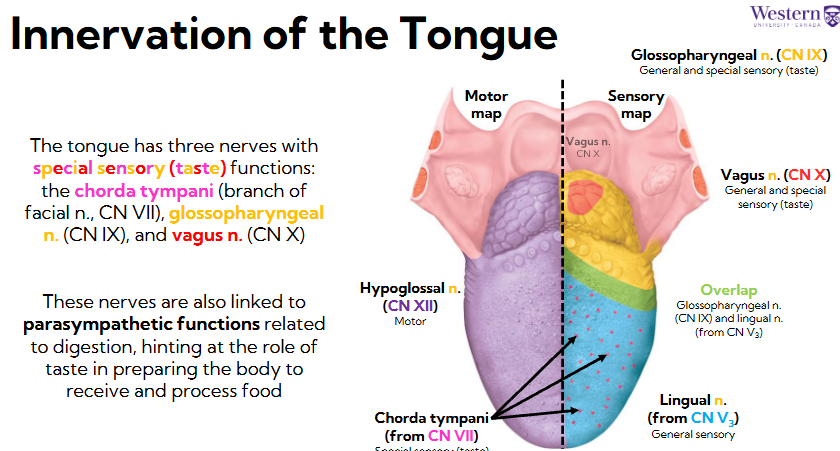
innervation of the tongue

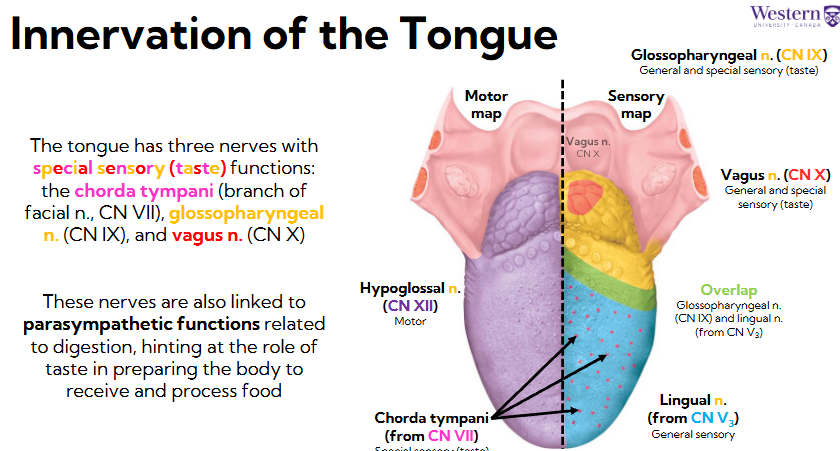
  • The tongue has three nerves with special sensory (taste) functions: 

  • the chorda tympani (branch of facial n., CN VII), glossopharyngeal n. (CN IX), and vagus n. (CN X)

  • These nerves are also linked to parasympathetic functions related to digestion, hinting at the role of taste in preparing the body to receive and process food

  • Sensory includes general and special

<ul><li><p><span style="background-color: transparent;"><span>The tongue has three nerves with special sensory (taste) functions:&nbsp;</span></span></p></li><li><p><span style="background-color: transparent;"><span>the chorda tympani (branch of facial n., CN VII), glossopharyngeal n. (CN IX), and vagus n. (CN X)</span></span></p></li><li><p><span style="background-color: transparent;"><span>These nerves are also linked to parasympathetic functions related to digestion, hinting at the role of taste in preparing the body to receive and process food</span></span></p></li><li><p><span style="background-color: transparent;"><span>Sensory includes general and special</span></span></p></li></ul><p></p>
35
New cards

motor innervation of tongue

  • (CN XII) innervates

<ul><li><p><span style="background-color: transparent;"><span>(CN XII) innervates</span></span></p></li></ul><p></p>
36
New cards

sensory innervation of tongue

  • Lingual n (from CN V#), innervates general sensory anterior ⅔ 

  • Chorda tympani from CN VII brings back special sensory for taste

  • Glossopharyngeal n (CN IX) does general and special sensory taste, in posterior ⅓ 

  • Vagus n (CN X) general and special sensory in posterior spot of tongue
<ul><li><p><span style="background-color: transparent;"><span>Lingual n (from CN V#), innervates general sensory anterior ⅔&nbsp;</span></span></p></li><li><p><span style="background-color: transparent;"><span>Chorda tympani from CN VII brings back special sensory for taste</span></span></p></li><li><p><span style="background-color: transparent;"><span>Glossopharyngeal n (CN IX) does general and special sensory taste, in posterior ⅓&nbsp;</span></span></p></li><li><p><span style="background-color: transparent;"><span>Vagus n (CN X) general and special sensory in posterior spot of tongue</span></span></p></li></ul><p></p>
37
New cards

gustatory pathway

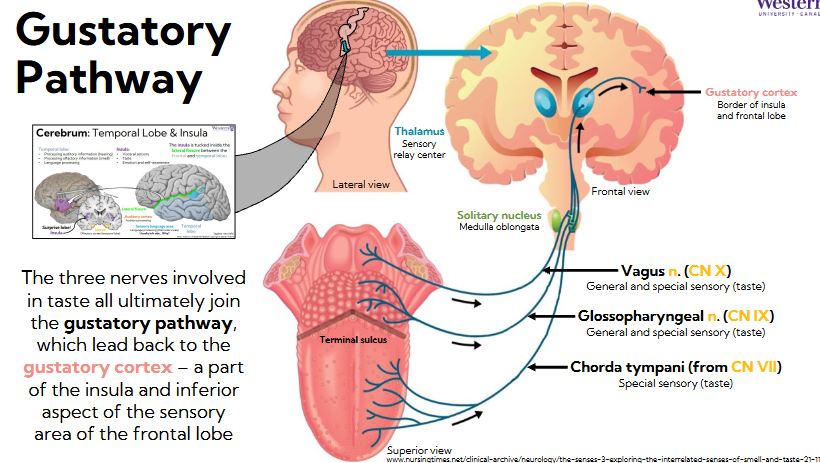
  • The three nerves involved in taste all ultimately join the gustatory pathway, which lead back to the gustatory cortex – a part of the insula and inferior aspect of the sensory area of the frontal lobe

    • Vagus n: general and special sensory (taste)

    • Glossopharyngeal n: general and special sensory (taste)

    • Chorda tympani (from CN VII): special sensory (taste)

  • Feed back to solitary nucleus in the medulla oblongata, those neurons feed back to thalamus (sensory relay center)

  • Thalamus sends signal to gustatory cortex, border of insula and inferior lateral aspects of frontal lobe

  • All of these nerves have parasympathetic functions: 

    • Chorda tympani CN VII and glossopharyngeal CN IX create mucus

    • Vagus innervates digestive system

  • Means taste sensing nerves have direct line to parasympathetic response, explains when we taste we salivate
<ul><li><p><span style="background-color: transparent;"><span>The three nerves involved in taste all ultimately join the gustatory pathway, which lead back to the gustatory cortex – a part of the insula and inferior aspect of the sensory area of the frontal lobe</span></span></p><ul><li><p><span style="background-color: transparent;"><span>Vagus n: general and special sensory (taste)</span></span></p></li><li><p><span style="background-color: transparent;"><span>Glossopharyngeal n: general and special sensory (taste)</span></span></p></li><li><p><span style="background-color: transparent;"><span>Chorda tympani (from CN VII): special sensory (taste)</span></span></p></li></ul></li><li><p><span style="background-color: transparent;"><span>Feed back to solitary nucleus in the medulla oblongata, those neurons feed back to thalamus (sensory relay center)</span></span></p></li><li><p><span style="background-color: transparent;"><span>Thalamus sends signal to gustatory cortex, border of insula and inferior lateral aspects of frontal lobe</span></span></p></li><li><p><span style="background-color: transparent;"><span>All of these nerves have parasympathetic functions:&nbsp;</span></span></p><ul><li><p><span style="background-color: transparent;"><span>Chorda tympani CN VII and glossopharyngeal CN IX create mucus</span></span></p></li><li><p><span style="background-color: transparent;"><span>Vagus innervates digestive system</span></span></p></li></ul></li><li><p><span style="background-color: transparent;"><span>Means taste sensing nerves have direct line to parasympathetic response, explains when we taste we salivate</span></span></p></li></ul><p></p>
38
New cards

anosmia and ageusia

  • Ageusia = Loss of the sense of taste, inability to detect different flavours

    • These overlap and work together

  • Combined effect of taste and smell in perception

  • Anosmia and ageusia can be associated with the natural aging process, which is why our tastes evolve over time

    • Acquired tastes

    • Always evolving