Bio 241 final exam
0.0(0)
 Studied by 3 people
 Call Kai
 Learn
Learn Practice Test
 Spaced Repetition
 Match
Match Flashcards
 Knowt Play
Card Sorting
1/207

Earn XP
Description and Tags
Last updated 9:25 PM on 12/13/22
Name | Mastery | Learn | Test | Matching | Spaced | Call with Kai |
|---|
No analytics yet
Send a link to your students to track their progress
208 Terms
1
New cards
energy demand
energy is needed in organisms for maintenance, growth, and reproduction
2
New cards
what does energy demand depend on?
body size, activities, environment (temperature)
3
New cards
ectotherm
cold blooded animal, whose body temperature varies with the temperature of its surroundings
4
New cards
endotherm
warm blooded animal, whose body controls and regulates its temperature by controlling the internal heat it produces
5
New cards
the study of anatomy/physiology is called?
scalling
6
New cards
surface area proportional to
length^2 (squared)
7
New cards
volume is proportional to
length^3 (cubed)
8
New cards
length is proportional to
surface area ^1/2 or volume ^1/3
9
New cards
what supports mass in an organism?
need to obtain resources and excrete waste
10
New cards
how is small SA:V ratios a disadvantage to large things?
- nutrient exchange- highly branched circulatory/respiratory/digestive systems that increase SA
11
New cards
how is small SA:V ratios an advantage for large things?
- heat protection- heat produced by V and lost by SA
12
New cards
scaling relationships (power and log transformed functions)
Y=aX^b / log Y = b(log X) = log a
13
New cards
why should we log transform scaling relationships?
data normalization/used to make power function linear
14
New cards
isometry
both dimensions remain proportional b=1(.98~1.02)ex-\> slope of heart growth (b=0.98)
15
New cards
positive allometry (hyperallometry)
as one dimension increases the other increases to a greater proportionb=1+ex-\> crab (b=1.57)
16
New cards
negative allometry (hypoallometry)
as one dimension increases the other decreases to a lesser proportionb=-1ex-\> slope of brain as we grow (b=0.73)
17
New cards
energyIN=
energyASSIMILATION+energyPRODUCTION
energyRMR+energyACTIVITY+energyPRODUCTION+energyEXCRETION
energyRMR+energyACTIVITY+energyPRODUCTION+energyEXCRETION
18
New cards
energyASSIMILATION=
energyRMR+energyACTIVITY+energyPRODUCTION+energyEXCRETION
energyIN-energyEXCRETION
energyIN-energyEXCRETION
19
New cards
larger organisms
- need more food- greater eIN per unit time- eat more food at a given time- eat less often-take in more air per breath- pump more volume blood per heartbeat- lower breathing/heart rate- smaller SA:V
20
New cards
measure of evolutionary fitness
total amount and rate at which things obtain energy from food
21
New cards
retention time
time it takes for food to pass through digestive tract, phenotypic trait on environment
22
New cards
is food that remains in the stomach longer more or less nutritious ?
less
23
New cards
how is food excreted?
food broken down by chewing (-energy)
nutrients absorbed (+energy)
energy absorbed = digestion rate decreases
all possible energy extracted leaving dregs
dregs excreted
nutrients absorbed (+energy)
energy absorbed = digestion rate decreases
all possible energy extracted leaving dregs
dregs excreted
24
New cards
why are digestive tracts long?
increase SA:V
25
New cards
RMR
resting metabolic rate, energy consumption, heat, calories
26
New cards
most accurate way to take energyRMR
heat loss/gain measured in calories or joules
27
New cards
BMR
basal metabolic rate- least possible rate, at complete rest
28
New cards
SMR
standard metabolic rate - ectotherms rate at specified temperature
29
New cards
FMR
field metabolic rate - measured in wild animals
30
New cards
direct calorimetry
measures rate heat leaves body,
31
New cards
indirect calorimetry
o2 consumed/co2 produced, measures rspirometry
32
New cards
kleibers law
metabolic rate is proportional to m=aW^3/4
m=total metabolic rate
log m = log a + blog w
m=total metabolic rate
log m = log a + blog w
33
New cards
energy ACTIVITY
movement above resting rate, activity increases heat, covers costs for resting
34
New cards
energy PRODUCTION
represents growth and reproduction,
35
New cards
if energy budget is balanced what will energyPRODUCTION be?
0
36
New cards
if more energy is consumed, what energyPRODUCTION?
positive, +mass
37
New cards
if not enough energy consumed, what energyPRODUCTION?
negative, -mass
38
New cards
homeostasis
regulation of an internal environment in response to the external environment
39
New cards
what different kinds of parameters do organisms need to control in order to maintain homeostasis ?
ph, water, blood pressure, osmoregulation, solutes, temp, o2/co2, heart rate
40
New cards
negative feedback mechanisms
change in variable under homeostatic control that triggers a response that opposes the change
41
New cards
three parts to a negative feedback chain
sensor, integrator and effector
42
New cards
what does the sensor do in a negative feedback chain?
detects environmental conditions
43
New cards
what does the integrator do in a negative feedback chain?
analyses signal from sensor and compares conditions to set point, then activates appropriate effector
44
New cards
what does the effector do in a negative feedback chain?
causes physiological change that opposes deviation from set point
45
New cards
positive feedback mechanisms
change in variable under homeostatic conditions that control triggers to response that amplifies change
46
New cards
example of positive feedback chain ?
birth
47
New cards
what is the integrator whilst giving birth?
pituitary gland that releases oxytocin
48
New cards
what is the effector whilst giving birth?
oxytocin causing uterus to contract, puts pressure on the uterus
49
New cards
thermoregualtion
regulating body temperature
50
New cards
ambient temperature (Ta)
the temperature of the surrounding environment.
51
New cards
body temperature (Tb)
the amount of heat in the body that is a balance between the amount of heat produced and the amount lost by the body
52
New cards
body heat is generated by
metabolism
53
New cards
body heat can be regulated by
changing conductance
54
New cards
conductance
rate of heat exchange
55
New cards
homeotherm
maintains constant body temperature
56
New cards
heterotherm
variable body temperature, Tb fluctuates with Ta
57
New cards
regional heterothermy
parts of body vary in temperature
58
New cards
adaptation of regional heterothermy
countercurrent heat-exchange system
59
New cards
hypothermy
decreasing body temperature, causes you to shiver (below TNZ)
60
New cards
hyperthermy
increasing body temperature, causes you to pant (above TNZ)
61
New cards
low conductance is a adaptation for
heat retention
62
New cards
high conductance is an adaptation for
heat loss
63
New cards
behavioral regulation of conductance
moving to optimize heat exchange with environment to attain ideal body temp
64
New cards
exposure in relation to conductance
movement in or out of sun, surface area-\> lizard basking in sun
65
New cards
grouping in relation to conductance
huddling together to share radiation-\> penguins
66
New cards
dormancy
daily torpor, reducing your RMR to preserve heat and reduce E requirementshibernation, massive reduction in RMR
67
New cards
do bears hibernate?
no
68
New cards
migration
complete avoidance of poor environmental conditions
69
New cards
physiological regulation of conductance
making physiological adjustments to optimize heat exchange with environment to attain ideal body temp
70
New cards
membrane acclimation
physiological changes that occur in response to seasonal temperature changed, change cellular conditions to work optimally in cold/warm environments
helping membranes not be too fluid or viscous
helping membranes not be too fluid or viscous
71
New cards
blood flow
vasodilation/vasoconstriction
72
New cards
vasodilation
increase in conductance with environment,
endotherms- when hot to release heatectotherms- when cold to increase heat gained from environments
endotherms- when hot to release heatectotherms- when cold to increase heat gained from environments
73
New cards
vasoconstriction
decrease in conductance with environment,
endotherms- when cold to retain heatectotherms- when got to retain heat
endotherms- when cold to retain heatectotherms- when got to retain heat
74
New cards
insulation
internally(fat/blubber), externally(fur/feathers), piloerection (fluffing /increasing thickness of layer)
75
New cards
fur/feather thickness/length
better insulator, change thickness seasonally,
76
New cards
fur colouration
-dark fur absorbs light and generates heat-white fur allows light to reach skin + generates heat-black skin + white fur best for heat retention-hollow hairs allow radiation to transmit down hair shaft
77
New cards
sweating and panting
heat loss due to evaporation
78
New cards
cryoprotectants
molecules produced to lower freezing point, allow ice to form not internally-\> frog, hamsters
79
New cards
antifreeze proteins
ice nucleating agents, prevents ice formation
80
New cards
shivering thermogenesis
action of antagonistic muscles generates heat without causing movement
81
New cards
non-shivering thermogenesis
special (brown) fat tissue that is loaded with special mitochondria, used to generate heat instead of e- released in transit for ATP it is sent through UCP! which releases more of the energy as heat
82
New cards
MRmax
max metabolic rate
83
New cards
MRsus
sustained metabolic rate
84
New cards
what would be used first in quick physical movements ?
pools of ATP in cells
85
New cards
what would be used second in quick physical movements ?
phosphocreatine (PCr) used to replenish ATP
86
New cards
what will be used third and help maintain physical movements?
glycolysis
87
New cards
what will be used lastly to help maintain physical movements?
oxidative phosphorylation
88
New cards
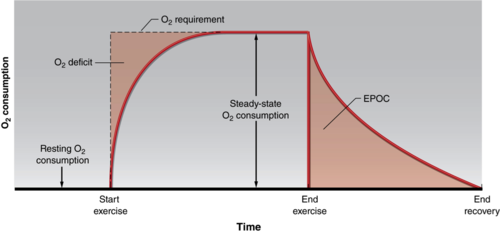
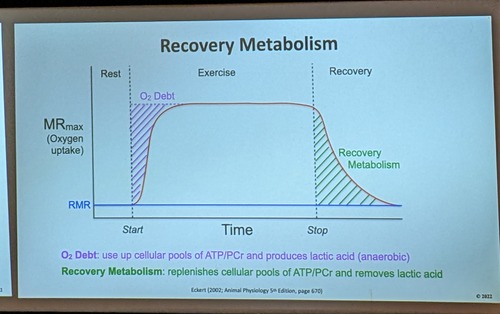
o2 debt
use up cellular pools of ATP/PCr and produces lactic acid
89
New cards
recovery metabolism
replenishes ATP/Pcr and removes lactic acid
90
New cards
mass relationship to active MRmax
smaller mass = lower MRmax, larger max = higher MRmax
91
New cards
mass relationship to mass specific MRmax
smaller mass = high MR, larger mass = low MR
92
New cards
metabolic scope
capacity for activity,MRmax/RMR or MRsus/RMR
93
New cards
scope will be simmillar between ...
ecto/endotherms of simmillar mass
94
New cards
mass specific metabolic rate
way of measuring locomotion, energy (o2 volume) required to move one unit of mass of organisms, as velocity increases
95
New cards
cost of transport
way of measuring locomotion, energy required to move one unit of an organism one distance, as velocity increases
96
New cards
what effects Eactivity
inertial forces, momentum forces, drag forces,
97
New cards
inertia
tendency of mass to resist motion
98
New cards
momentum
tendency of moving mass to sustain velocity
99
New cards
drag
force generated by opposite direction of things movement
100
New cards
do large or small things overcome drag better?
large,-\>mosquito vs elephant
 Note
Note  Flashcards (76)