Parasitology Virology basics
 Call Kai
 Learn
Learn Practice Test
 Spaced Repetition
 Match
Match Flashcards
 Knowt Play
1/60

There's no tags or description
Looks like no tags are added yet.
Name | Mastery | Learn | Test | Matching | Spaced | Call with Kai |
|---|
No analytics yet
Send a link to your students to track their progress
61 Terms
Pandemic
Epidemic over a wide geographic area, or even worldwide.
Antigenic Shift
Major changes that result in novel viral antigens
Antigenic Drift
Minor changes that occur continuously over time as the virus replicates
Epidemiology
The study of the occurrence and distribution of disease and factors that control presence or absence of disease.
Viremia
Presence of viruses in the bloodstream.
Herd Immunity
Immunity to an infectious agent in a high percentage of a given population of people that helps prevents spread of disease.
Diagnosis
What cannot be made based on clinical presentation due to the number of viruses?
Rhinitis
The viruses that causes this are adenovirus, rhinovirus, coronavirus, rubella virus, influenza virus, and herpes simplex virus.
Pharyngitis
The viruses that cause this are adenoviruses, cornaviruses, coxsackie viruses, epstein-barr virus, herpes simplex virus
Vesicles/Blister-like lesions
The viruses that cause this are herpes simplex virus, varicella-zoster virus, smallpox virus, and coxsackie viruses
Exanthem/Rash
The viruses that cause this are rubella, rubeola, coxsackie, and echoviruses
Adenovirus
The symptoms caused by this virus are pharyngitis, conjunctivitis, laryngitis, pneumonia, diarrhea, cystitis, and systemic infection.
antivrial drugs
Small number of these for treatment due to the volatility of viruses.
Vidarabine
Antiviral drug used for herpes viral encephalitis that cna reduce mortality from 80% to <30%
Therapeutic Ig
This is used in cases of HBV exposure
C-section
This is done to prevent an HSV infection of a newborn
Epidemic
More localized spread of an “old” organism.
Virions
Virus particles that gain entry to the body via mucous membranes
Obligate intracellular organism
The type of parasite a virus is, meaning it cannot live on its own.
Attachment (adsorption)
Penetration (Entry)
Uncoating (removal of capsid)
Synthesis (Production of nucleic acid)
Assembly (structural proteins are put together into viruses)
Release (Cell lysis and release new viruses)
Steps of the infectious cycle
Acute viral stage
Happens very quickly
Latent viral stage
No symptoms but the virus is still inside, potentially waiting to emerge later
Chronic viral stage
Persistent symptoms that can last for very long times
Nasopharyngeal swabs or washings
The type of specimen collection for RSV, influenza, and COVID
Feces
The type of specimen collection for Norovirus, rotavirus, and enterovirus
Vesicular fluid or swabs
The type of specimen collection for skin lesions for HSV, VZV, coxsackie
CSF
The type of specimen collection for enteroviruses (polio and arboviruses
Urine
The type of specimen collection for mumps, CMV, rubella
Blood
Can be collected only during the acute phase of the infection due to viruses remaining only for a short duration, from the portal of entry to the site of the target organ.
Commercial swabs
Consists of Virocult, viral culturettes, and culturettes
Transport media
The liquid that swabs should be placed in to move viruses. Also consists of antibiotics and protein to remove bacteria.
4C
The temperature for viruses to be stored in due to enveloped viruses being weak to freezing temperatures and room temperature.
Cytopathology
The examination of stained tissue or cells by light microscopy for the presence and location of cytologic changes such as inclusions, necrosis, “giant” cells, cytoplasmic modifications, vacuolization.
Electron microscopy
The method to identify viruses for those that cannot be cultured, such as HBV and rotaviruses.
Direct Fluorescent antibody (DFA)
Detects viral antigens
Indirect Fluorescent Antibody (IFA)
More sensitive in detecting viral antigens
Direct IF steps
Flood slide with labeled antibody reagent
antibody specific to viral antigen will bind if virus is present in specimen
Perform a rinse/wash procedure to remove unbound antibody
Examine for fluorescence using fluorescent microscope
(lecture 1 cut off)
(lecture 1 cut off)
Virus cell culture supplies
Viruses require suitable host cells, a cell culture media, and an incubator
1-4 weeks
The incubation period needed to incubate viruses.
Living Cells
The type of specimen needed for viruses to multiply, because they are strict, intracellular parasites.
Cytopathic Effect (CPE)
The effects of a virus on a cell, causing things like cell death (pyknosis/necrosis), multinucleated cells, and abnormal rounding or swelling of cells
Cytopathic effect rate
The HSV is rapid, why VZV and CMV are slow.
RMK, MRC-5, Hep-2, A-549
The types of cells used for culture of viruses
Shell Vial Cell Culture
The rapid modification of traditional viral cell culture, where it is stained with virus-specific fluorescent antibodies.
Speed
The advantage of Shell Vial Cell Culture
Separate vial must be set up for each virus
The disadvantage of Shell Vial Cell Culture
MALDI-TOF MS
Matrix-Assisted Laser Desorption Ionization - Time of Flight - Mass Spectrometry
Mass of DNA/RNA
The principal of MALDI-TOF MS where it measures this to determine the base sequence.
NAAT or Culture
These are used in conjunction with MALDI-TOF MS
MALDI-TOF
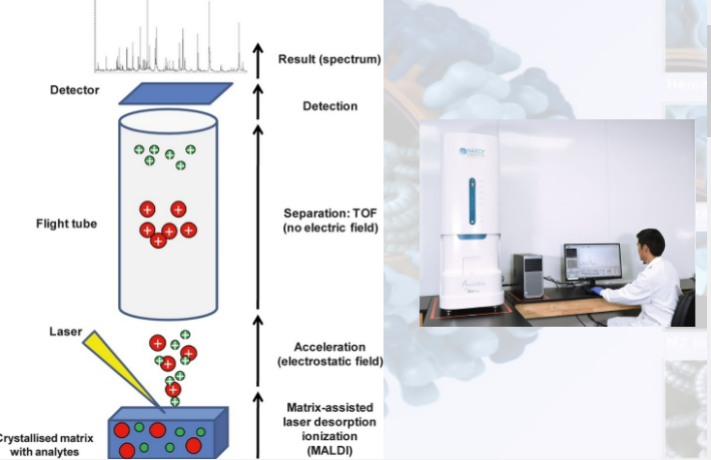
NAAT
Nucleic Acid Amplification Techniques/Testing
PCR
Polymerase Chain Reaction
RT-PCR
Reverse transcriptase PCR (for amplification of RNA)
NAAT Terminology
Probe, amplicon, hybridize, complementary, quantitative, qualitative, multiplex
Acute specimens
Type of specimen obtained at the onset of symptoms.
IgM, lasts a few weeks
The type of immunoglobulin found in an acute specimen, and how long it lasts for.
Convalescent specimen
Type of specimen obtained 2-4 weeks later
IgG, lasts months to years
The type of immunoglobulin found in convalescent specimens, and how long it lasts for
Serological diagnosis
Performed when a demonstration of a 4-fold rise in titer between acute and convalescent specimens.
Single detectable titer
This may be indicative of lingering antibodies from a past infection, or a successful vaccination

