Exam 1
 Call Kai
 Learn
Learn Practice Test
 Spaced Repetition
 Match
Match Flashcards
 Knowt Play
1/232

Earn XP
Description and Tags
lecture content and in-class questions https://quizlet.com/185020207/neuro-3000-exam-1-flash-cards/
Name | Mastery | Learn | Test | Matching | Spaced | Call with Kai |
|---|
No analytics yet
Send a link to your students to track their progress
233 Terms
Are nerves bidirectional?
No, there are two separate nerve systems
what did Jean Pierre Flourens’ experimental ablation show about the cerebellum?
the cerebellum mainly plays a role in coordination of movement. additionally, sensation and perception
Belief of Egyptians
heart = key to soul and memory storage
discarded brain and preserved everything else in body
knew about brain damage though
What treatments did Egyptians use for brain damage?
drilling holes & immobilization for head and spine injuries
Hippocrates (Ancient Views)
"father of medicine”
Hippocratic Oath
4 humors: 4 elements linked with 4 bodily fluids
Hippocrates believed that the brain is the center of
sensation and intelligence
T/F: Hippocrates distinguished that injuries on one side of the head may result in convulsions on the opposite side of the body
T
Herophilus (Ancient Views)
“father of anatomy”
dissections allowed observations of nerves and arteries
analyzed connections of specific body parts to specific nerves
What was Herophilus able to describe in detail due to his dissections of animals and humans?
a. arteries
b. veins
c. lobes
d. brain ventricles
d. brain ventricles
Which model was Galen (17th and 18th) responsible for?
ventricular fluid-mechanical model
brain ventricles
fluid-filled cavities in the brain
Galen’s ventricular fluid-mechanical model
early version of the ventricular fluid-mechanical model of the nervous system based on the flow of vital and animal “spirits” through ventricles
Andreas Vesalius (17th and 18th)
produced detailed drawings of the brain based on his anatomical findings
brain = controlling organ for consciousness and thought
had a mechanical approach to Galen’s ventricular theory
named pons and hippocampus
Rene Descartes (1596-1650) summary
devised hydraulic model
distinguished mind (non-physical) from brain (physical) — mind-brain dualism
adopted an empirical “scientific method”
What did Descartes believe that nerves carried as hollow tubes?
“animal spirits”
What is the link between the mind and brain?
the pineal gland
What did the Descartes hydraulic model shows hollow nerves from the eyes projecting to?
ventricles
By 1800, which of the following ideas were known?
a. white matter carries nerve fibers that communicate with gray matter
b. peripheral and central divisions
c. action potential
d. every brain has the same general pattern of bumps and grooves
a, b, and d
Luigi Galvani (1737-1798)
electrical stimulation of the muscles produced contractions
Bois-Reymond & Bernstein (19th century) discovered
nerve action potential but did not fully understand the mechanism
Hermann von Helmholtz (1821-1894)
nerve impulse is much slower than electrical conduction in a wire
*holtz = volts = wire
after the 19th century, were animal spirits considered to be responsible for movement?
no, movement in nerves were thought to be operated by electrical properties
What did Flourens show that the brainstem was important for?
vital functions such as breathing
how is the approach of ablation (either physical of genetic tools) widely used in the modern age?
to inactivivate or over-activate regions in the brain or specific cell types hypothesized to be important for a specific process
what is phrenology?
a pseduo-science that the subtle differences in the lobes, lobules, and sulk of the brain correlate w specific traits of an individual. devised and promoted by German anatomist Franz Josef Gall
Paul Broca discovered
Broca’s area
What does localization support?
that the physical brain controls behavior of all mammals not dualist view that mind and brain are separaate
Are behaviors localized?
yes and no. Despite complex behaviors being distributed and localized. The distributed parts incorporate key local elements that mainly affect changes in behavior
*understand complexity of this
Fritsch & Hitzig
contraction of specific muscles on the opposite side of the body
through electrical stimulation in certain areas of the anesthetized dog brain
Penfield and Rasmussen (1950)
motor cortex of awake humans = motor map
motor “homunculus”
Hodgkin and Huxley
action potential mechanism is due to inward flow of sodium and outward flow of potassium
studied squid giant axon
Sir John Eccles
axonal and synaptic transmission is chemical, not electrical
studied stretch reflex
Eric Kandel
cAMP is a key signal molecule that controls behavioral adaptation of the gill withdrawal reflex
What is Aplysia?
a snail that is a simple invertebrate animal model
Paul greengard (20th century and Beyond)
studied “slow transmission” by dopamine, involving binding to the dopamine receptor followed by increased cAMP and protein phosphorylation by protein kinase A (PKA)
Arvid Carlsson (20th cent.)
role of dopamine in control of movement
For their discoveries Kandel, Greengard and Carlsson were awarded the Nobel Prize in 2000 for their combined work on …
“signal transduction in the nervous system”
What are two key overlaps from genetic and neuroscience timelines?
1880: histochemical methods (Golgi, Nissl)
1950-2000: molecular biology methods revolution
Why did Sydney Brenner develop c. elegans as a model system?
bc it was simple
only has 959 somatic cell, and 302 neurons (lineage of all cells known!)
When did Brenner complete the map of all connections of all 302 neurons of C.Elegans?
1986
For c. elegans, if you ablate a neuron in the head using a laser, what affect will you see?
Motor reversal will be affected in response to gentle head touch
Specific behavioral circuitry of c. elegant was mapped by…
using the connector map to see who a specific neuron interacts with and then use ablation studies to define the perfect circuitry
Brenner, Horvitz, and Sulston were awarded Nobel Prize in 2002 for…
“their discoveries concerning genetic regulation of organ development and programmed cell death”
which mammal was used for early studies of the visual system?
monkeys (they are visually similar to human)
which species are excellent to study olfaction and the first to be studied for the somatosensory system?
rats and mice
the 3 Rs of research
replacement, reduction, and refinement
replacement
methods that avoid of replace the use of animals in areas where they would have been used otherwise
reduction
methods that minimize the number of animals used per experiment or test, either by enabling researchers to obtain comparable levels of info (of a given art and precision) from fewer animals, or to obtain more inform the same number of animals (thereby avoiding further animal use)
refinement
methods that minimize any pain, suffering, distress or lasting harm that may be experience by the animals, and improve animal welfare
Chapter 2 content begins
…
Overview of the central and peripheral nervous system
sensory input (PNS) —> sensory info procession, cognition (CNS) —> motor output (PNS)
neuron
main chemical-electrical circuit components that drive brain function
how many neurons are in the human brain?
around 85 billion
glia
physical “support” cells to neurons
maintain CNS environment
provide immune functioning
types of glial cells
astrocytes, oligodendrocytes, microglia, ependymal cells
astrocytes
most abundant glial cell
controls chemical content of neuron synapse
oligodendrocytes
makes myelin sheath that increases the speed of neuronal transmission
myelin sheath
wraps around neuronal axons that speed up neuron transmission
microglia
brain inflammatory cell
used for stress responses and synaptic pruning
synaptic pruning
the process in which the brain removes neurons and synapses that it does not need
ependymal cells
line brain ventricles
maintain CSF homeostasis
miscellaneous cells in the brain
endothelial and pericytes
endothelial
brain blood vessel cells, arteries, veins and capillaries
pericytes
regulate capillary function (read more about this)
contribute to blood brain barrier by interacting with endothelial cells
Blood brain barrier
The barrier between the layers of the brain ensuring that substances that don’t need to be in the brain such as blood don’t get in. The barrier is controlled by endothelial cells, pericytes, and tight junctions.
basic parts of a neuron
cell body (soma), a dendrite, and an axon
What creates distinct neuronal subtypes (why do neurons look different)?
a different combination of the parts of an axon
*some neurons have a bigger cell body than others or longer axon
which neuron has the largest cell body?
purkinje cell (50-80 um)
what are neuronal dimensions typically measured in?
microns
What is the peripheral nervous system equivalent of oligodendrocytes?
Schwann cells
studying neurons timeline
1590: microscope
1897: “fix the brain” with formaldehyde
section the brain
Golgi 1873; Nissl 1894: brain stains
What does a Golgi stain show?
clear view of the structure of a neuron; shows what kind of neuron is present
What does a Nissl stain show?
stain the cell body; used to look at neuron density
add up till ribosomes in lecture 2 slides
ribosome
machine that attaches to the mRNA and makes a protein
translation
ribosome reads genetic code of mRNA sequence by pairing the codon with a specific tRNA anticodon
mrna sequence —> protein
genetic code
each codon (3 nucleotides) stands for a different
smooth ER
synthesizes cholesterol and lipids needed for making new cell membrane
rough ER
ribosomes in RER used for making membrane proteins
what is the rough ER peppered with?
ribosomes attached to mRNAs that exited the nucleus
Which membrane is the RER continuous with?
outer nucleur membrane
Where do RER and Golgi App extend into?
the process of reading and copying the DNA sequence of the gene to make the mRNA is called ________.
transcription
The portions of a gene whose DNA sequence codes for a protein is typically broken up into smaller subregions called _______ interspersed with other subregions called _______ that do not code for proteins
exons…… introns
Does mature mRNA contain both exons and introns?
No, only contains exons (protein coding sequences).
Why do neurons have higher rates of protein synthesis?
bc neurons have unusually high rates of protein synthesis and a greater need for membrane proteins
Golgi apparatus
post-transitional modifications to proteins (adding carbs and lipid groups) and moving membrane proteins to different parts of the cell including axons and dendrites
What is the soma and dendrite often called to distinguish it from the axon?
somatodendritic domain
Where is SER found?
soma, dendrite and axon
Lecture 3 content begins
…
how many axons does a neuron contain?
1
axon
single long extension from the cell body that transmits the action potential, and provides input to other neurons
axon hillock
portion of axon adj to the cell body that generates the action potential
serves as a “filter” to select materials to traffic from the soma to the axon
axon collaterals
axon branches that split or bifurcate off of the main axon
axon varicosities (boutons en passant)
swellings that release NT along the length of the axon
axon terminal (terminal button/bouton)
small enlargements at the end of the axon that store and release neurochemicals; the presynaptic element
different kinds of axons in the cerebellum
parallel fibers and climbing fiber
______ emanates as a single axon from ______ cells, which bifurcates into ___ branches that form many ____ ________ contacts with Purkinje cell dendrites
a parallel fiber; granule; two; en passant
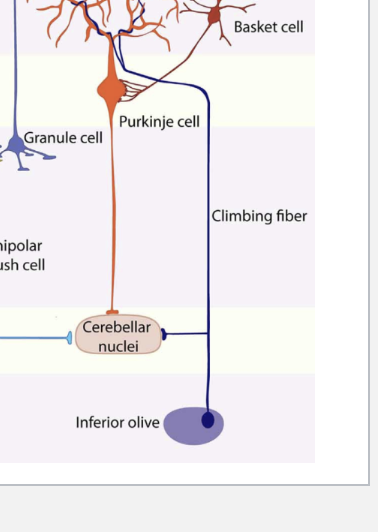
climbing fiber
axon from inferior olive neurons (in brain stem)
makes two contacts in the cerebellum
axon collateral contacts the deep cerebellar nuclei neurons using a single terminal bouton, but the main Xon climbs like a vine on the Purk. cell making numerous en passant contacts on P cell dendrites
Since there is no rough ER or Golgi app in the axon, how are molecules moved down the axon from the soma?
cytoskeleton?

