Chapter 5 - Product Life cycle and Pricing Strategies
 Studied by 0 people
 Call Kai
 Learn
Learn Practice Test
 Spaced Repetition
 Match
Match Flashcards
 Knowt Play
1/24

There's no tags or description
Looks like no tags are added yet.
Name | Mastery | Learn | Test | Matching | Spaced | Call with Kai |
|---|
No analytics yet
Send a link to your students to track their progress
25 Terms
Product life cycle
Different strategies are appropriate to different stages, each stage below;
Development
Introduction
Growth
Maturity
Decline
Introduction
Price skimming
Growth
Market Penetration
Maturity
Consolidation strategy
Decline
Niche, Harvest or Divest
limitations of product life cycle
The length of each stage varies enormously and stages can be affected by decisions made.
Stages can be skipped.
Ways to Maximising Profit
Reducing time to market
Considering costs during design phase
Extend the length of the cycle itself
How costs change as products go through their life cycle
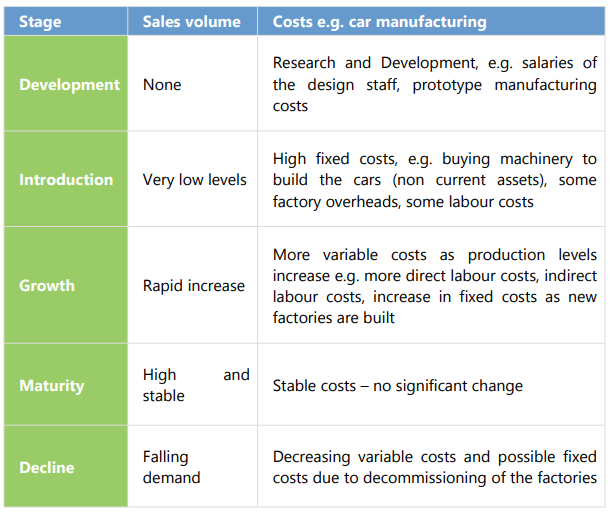
Customer life cycle
Could effectively be increase by continually ensuring customer needs are met, as “new customers are 20x more expensive than old” as an old saying goes
Pricing strategies
Premium Pricing
Market skimming
Penetration pricing
Economy pricing
Cost plus pricing
Psychological pricing
Product line pricing
Optional product pricing
Captive product pricing
Product bundle pricing
Promotional pricing
Dual pricing
Predatory pricing
Loss leader
Product differentiation
Premium Pricing
High price where the product is unique and a substantial competitive advantage exists
Market skimming
Often occurs when a product is new and very innovative, therefor appealing to the early adopter market who will buy it regardless of the price you charge.
Penetration pricing
A low price is set in order to gain market share. Once this is achieved the price increased
Economy pricing
Charging a low price for a no frills service
Cost Plus pricing
Price at the cost plus a percentage mark-up
Psychological pricing
Taking into account the way a customer thinks as they purchase.
Product line pricing
A range of products or services where the price reflects the benefits gained
Optional product pricing
Extras sold alongside the main product
Captive product pricing
having a product that requires resources to use - pricing depending on that i.e low product but high refillable item (Printer, Video games console)
Product bundle pricing
Combining a number of products in the same package
Promotional pricing
Pricing to promote a product
Dual pricing
Different pricing in different countries - or peak and off peak tickets
Predatory pricing
Pricing out competitors that you know can’t match as they would suffer a loss.
Loss leader
Sold at a loss - Used to establish a market share which can then be leveraged against other products
Product differentiation
Varieties of the same product so that it can be sold to a much larger market.
 Note
Note  Flashcards (260)