General Anesthetics
 Call Kai
 Learn
Learn Practice Test
 Spaced Repetition
 Match
Match Flashcards
 Knowt Play
1/25

There's no tags or description
Looks like no tags are added yet.
Name | Mastery | Learn | Test | Matching | Spaced | Call with Kai | Chat |
|---|
No analytics yet
Send a link to your students to track their progress
26 Terms
What effects are used to achieve Balanced Anesthesis?
List the drugs used for these effects
Balanced anesthesis
Hypnosis/amnesia + analgesia + immobility + autonomic control
Hypnosis/amnesia
Propofol or volatile anesthetics
Analgesia
opioids (fentanyl) ± adjuncts (ketamine)
Immobility
Neuromuscular blockers (e.g., rocuronium)
NOTE: paralysis; not unconsciousness
Autonomic control
Blunt stress response
(volatile + opioid ± dexmedetomidine/β-blocker)
Describe MAC
What is it?
Relationship to potency? Examples?
Clinical Use
Interpretation
What shifts MAC?
MAC
What is it?
Minimum [] inhaled anesthetic -> prevents skeletal muscle movement in response to surgical incision in 50%
Relationship to Potency:
Inversely proportional
Nitrous oxide
Large MAC → low potency
Isoflurane
Small MAC → high potency
Clinical Use:
Set vaporizer %
Compare volatile anesthetics
Interpretation:
MAC reflects immobility (spinal cord) more than amnesia/analgesia
MAC SHIFTERS
MAC ↓ (need less gas)
Elderly,
hypothermia,
pregnancy,
opioids/sedatives
MAC ↑ (need more gas)
Hyperthermia,
chronic EtOH (classic)
Describe the Blood:gas partition
What is it?
What are the effects of High vs Low blood:gas partition
Blood:gas partition
What is it?
How much dissolves in blood
High vs Low blood:gas partition
High:
More soluble
Slower rise in alveolar [] → delayed induction/Wake-up
Low:
Less soluble
Faster equilibration → rapid on/off (alveoli rise/fall quickly)
NOTE:
Stuck in blood = slow; stays in gas = fast
List the UPTAKE DETERMINANTS and their relationships to induction. Why?
UPTAKE DETERMINANTS
Ventilation ↑
Faster induction
(alveolar partial pressure rises faster)
Cardiac output ↑
Slower induction
(blood “soaks up” more anesthetic)
Solubility ↑
o Slower induction
(more dissolved → less left in alveoli)
Describe the [] effect
What is it?
Ex?
Concentration effect:
What is it?
higher inspired % → FA (alveolar fraction)/FI (inspired fraction) rises faster
***The more you increase the concentration of a drug, the faster the alveolar [] matches the [] and the faster the drug sets in***
Ex:
N₂O ( often delivered at high %)
strong analgesic adjunct, weak anesthetic (needs partners)
“fills fast” → quicker alveolar rise → faster onset
Note:
High FI → fast FA
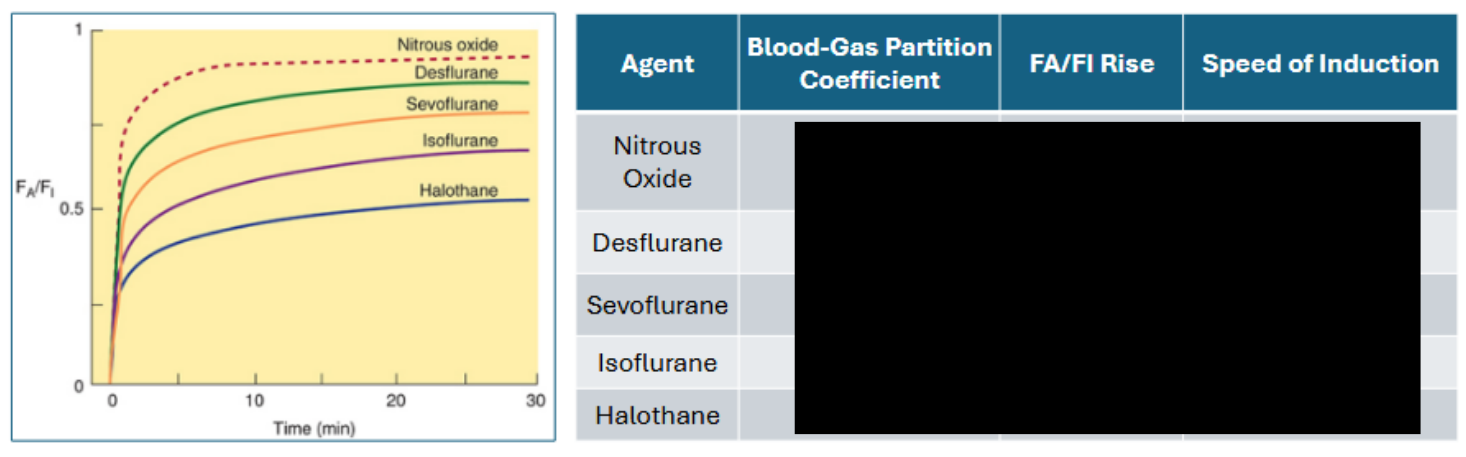
MEM TIP: Suck “HIS D, NO” (Highest → lowest Blood:Gas)

Describe the VOLATILE AGENTS
Sevoflurane
Clinical Use? why
Desflurane
Benefits? AE?
Isoflurane
Clinical Use? Why?
N2O
Uses? AE?
Describe the shared organ effects of volatiles:
CV
Resp
CNS
VOLATILE AGENTS
Sevoflurane
Smooth, non-pungent → best for mask induction (kids)
Desflurane
Fastest on/off,
airway irritant → coughing/laryngospasm risk
Isoflurane
Pungent, “middle speed” → good for maintenance
not mask induction
N₂O
Adjunct analgesic, weak anesthetic
expands closed gas spaces + B₁₂ (methionine synthase) inhibition risk
SHARED ORGAN EFFECTS
CV:
vasodilation → ↓SVR → ↓BP
(dose dep).
Resp:
↓ ventilatory drive
Many: Bronchodilation
Pungent agents: cough/laryngospasm
CNS:
↓ CMRO₂
(cerebral metabolic rate of oxygen)
↑CBF/↑ICP at higher doses
(dose dep.)
Describe SEVOFLURANE
Therapeutic use
Pros
AE
SEVOFLURANE
Therapeutic Use
Inhalational (mask) induction
maintenance (esp. pediatrics)
Pros
Non-pungent → minimal airway irritation
Relatively fast on/off
AE:
Dose-dependent hypotension
respiratory depression
Describe DESFLURANE
Pros
AE
Avoid
DESFLURANE
Pros
Very rapid on/off → great for quick emergence
Fastest wake-up gas
AE
Pungent
Airway irritant
cough, bronchospasm, laryngospasm
sympathetic surge
tachy/HTN
Esp w/ rapid increases
Avoid:
Asthma/COPD or other reactive airway patients
Mask Induction
MEM TIP: HIS D, Stinky; Panic when inserted;
Describe ISOFLURANE
Pros
AE
What is Coronary Steal Syndrome?
ISOFLURANE
Pros
Stable, predictable maintenance anesthesia
AE
Dose-dependent ↓SVR → hypotension
Pungent → not great for mask induction
Coronary steal syndrome
Vasodilation -> redistribute flow away from ischemic regions
MEM TIP: I Steal
Describe Nitrous Oxide
Clinical Use
AE
N₂O (NITROUS OXIDE)
Clinical Use:
Fast adjunct analgesic
Not a stand alone anesthetic
AE:
Air-space rule
Diffuses into closed spaces faster than N₂ leaves -> expands bubbles
Avoid when air can’t escape
Pneumothorax, bowel obstruction, middle ear surgery
Chronic Exposure:
B₁₂ inactivation (↓ methionine synthase)
neuropathy + megaloblastic anemia.
Describe IV Induction:
Clinical Usage
Pros
Ideal induction drug Characteristics
IV INDUCTION
Clinical usage:
Fastest way to “turn off consciousness”
Maintain w/ volatile anesthetic or TIVA (infusion)
Pros:
Quick, predictable onset for airway control + smooth transition to maintenance
Ideal induction drug Characteristics
Rapid onset, short duration, hemodynamically tolerable
Describe PROPOFOL
Clinical Usage
MOA
Pros
AE
PROPOFOL
Clinical Usage:
IV induction “workhorse”
MOA
Potentiates GABAA → hypnosis/amnesia.
Pros
Rapid on/off + antiemetic (smooth wake-up)
Adverse Effects
↓ BP (vasodilation/↓inotropy),
resp depression/apnea,
Injection pain
Propofol infusion syndrome (w/ prolonged/high-dose)
metabolic acidosis + rhabdo + cardiac failure
“ARC”
Describe ETOMIDATE
Clinical Usage
MOA
AE
ETOMIDATE
Clinical Usage:
Induction choice when BP = fragile
Best for Hemodynamic instability
(minimal BP drop vs propofol)
MOA
Potentiates GABAA → hypnosis
AE:
Adrenal suppression
(↓ 11β-hydroxylase → ↓cortisol/aldosterone)
Myoclonus
PON/V (postoperative nausea & vomiting)
MEM TIP:MI DATE, Fragile (BP) Men (low adrenal)
Describe Katamine:
Clinical Usage
MOA
AE
KETAMINE
Clinical Usage:
anesthesia + analgesia (strong)
Asthma/bronchospasm, trauma, hypotension
MOA
NMDA antagonist
AE:
↑ sympathetic tone (↑HR/↑BP)
Bronchodilation
Emergence reactions
(vivid dreams/hallucinations) + ↑secretions → cough/laryngospasm risk
MEM TIP: AE very similar to DESflurane
Describe Midazolam
Class
Clinical usage
AE
Reversal
Midazolam
Class:
BENZODIAZEPINES
Clinical Usage:
Rapid anxiolysis + anterograde amnesia
(adjunct, not analgesic)
MEM TIP: AAAA, NA; (anxiolysis, anteriograde amnesia, adjunct, not analgesic)
AE:
Sedation
Seizures
respiratory depression
Withdrawal in benzo-dependent pts
Reversal
Flumazenil
(competitive antagonist)
MEM TIP: the FLU Stopped ME DAZO (dazzling)
Describe Barbiturates
Class
Members
MOA
AE
Classic CI
Barbiturates
Class:
Induction drugs
Members:
Thiopental
methohexital
MOA:
GABAA → ↑ duration of Cl⁻ channel opening
***vs benzos ↑ frequency***
AE:
↓CMRO₂ → ↓CBF/↓ICP
Hypotension + respiratory depression
Classic CI:
Acute intermittent porphyria (trigger/worsen attacks)
Describe CONTEXT-SENSITIVE HALF-LIFE
What is it?
Clinical Usage
Classic comparison
CONTEXT-SENSITIVE HALF-LIFE
What is it?
Time for plasma level to drop 50% after stopping an infusion
***Context = how long is the injusion***
***longer infusion = longer half life
tissue redistribution → drug leaks back ***
***NOTE, CONTEXT IS NOT LINEAR***
Clinical Usage:
Predicts wake-up time better than elimination t½ after prolonged drips
Classic Comparison:
Remifentanil & propofol stays short
Fentanyl & midazolam get longer as infusion time increases
Describe Opioids
Clinical Usage
AE
Monitor Closely
OPIOIDS
Clinical Usage:
analgesia + “stress response blocker”
blunt sympathetic surges (↓HR/↓BP)
laryngoscopy/intubation
incisions
AE:
respiratory depression
Dose dependent
Sedatives synergy
Fentanyl
chest wall rigidity → difficult ventilation
Monitor Closely:
Pain off + RR down
What are the clinical usages of Neuromuscular blockers
NEUROMUSCULAR BLOCKERS
Clinical Usage:
Paralysis only
must still sedate + treat pain
Intubation & surgical relaxation
NOTE:
Always confirm adequate sedation before/while paralyzed
Describe Succinylcholine
Class
Clinical Usage
MOA
AE
Succinylcholine
Class:
DEPOLARIZER
Clinical Usage:
Fastest paralytic (rapid onset, short duration)
MOA:
Persistent end-plate depolarization → paralysis
AE
HyperK⁺, bradycardia, ↑IOP
Malignant hyperthermia
w/ volatile agents
Describe the NONDEPOLARIZERS
Clinical Usage
Members
Reversal Strats
NONDEPOLARIZERS
Clinical Usage:
Paralysis only (no sleep/pain relief)
Members:
Cisatracurium
Rocuronium
Vecuronium
Reversal:
Neostigmine (↑ACh) + glycopyrrolate (blocks muscarinic AEs)
Sugammadex
rocuronium & vecuronium
Describe Dexmedetomidine (Precedex)
MOA
Clinical Usage
Pros
AE
Dexmedetomidine (Precedex)
MOA:
α₂-agonist → “cooperative” sedation + sympatholysis + opioid- sparing.
Clinical Usage:
smooths induction/emergence;
Blunts tachy/HTN;
lowers volatile + opioid needs.
Pros:
minimal respiratory depression
(unlike opioids/benzos).
AE:
bradycardia + hypotension
(watch preload/AV block).
Describe MALIGNANT HYPERTHERMIA
Trigger
Signs
Labs
Tx
Describe Dantrolene
MOA
Clinical Usage
MALIGNANT HYPERTHERMIA
Trigger
Volatile anesthetics + succinylcholine
Sign:
Rapid rise in end-tidal CO₂ (↑ ETCO₂) (despite ventilation) →
muscle rigidity + tachycardia → fever
Labs
Acidosis
HyperK
Rhabdomyolysis/↑CK
Tx
Stop triggers
Volatile agents + succinylcholine OFF
100% O₂ + hyperventilate (flush anesthetic, blow off CO₂)
Dantrolene
Dantrolene:
MOA:
blocks RyR1 → ↓ SR Ca²⁺ release → ↓ rigidity + ↓heat/CO₂ production
Clinical Usage:
Active cooling
Treat hyperK + acidosis
Manage rhabdo/arrhythmias
Describe Awareness
What is it?
High risk Settings
Prevention?
Awareness
What is it?
explicit recall during anesthesia
(rare, high-stakes)
High-risk settings:
trauma + OB + hemodynamic instability
(dose often “light”)
TIVA (Total Intravenous Anesthesia )
no end-tidal agent → dosing/IV failure can be missed
Prevention:
end-tidal anesthetic concentration monitoring
(when using volatiles)
depth monitoring when appropriate/high risk
(e.g., BIS)
Describe PONV & EMERGENCE DELIRIUM
PON/V risk Factor
Prophylaxis
How to reduce triggers?
What causes Emergence delirium
Management
PONV & EMERGENCE DELIRIUM
PON/V risk factor:
Female + nonsmoker + opioids + motion sickness
Prophylaxis
Ondansetron ± dexamethasone
Reduce triggers:
Minimize volatiles + opioid-sparing analgesia
Emergence delirium
Due to sevoflurane/desflurane in some settings
Management
Reassure, reorient, treat pain/hypoxia
Stay calm