Neuro Lecture 10: Basal Ganglia + Cerebellum
 Call Kai
 Learn
Learn Practice Test
 Spaced Repetition
 Match
Match Flashcards
 Knowt Play
1/41

There's no tags or description
Looks like no tags are added yet.
Name | Mastery | Learn | Test | Matching | Spaced | Call with Kai | Chat |
|---|
No analytics yet
Send a link to your students to track their progress
42 Terms
Do the basal ganglia and cerebellum initiate movement?
No, they MODULATE movement (it is initiated by the primary motor cortex)
This structure controls starting, stopping, timing of slow ramp movements by facilitating or inhibiting other movement structures
Basal ganglia
This structure modulates postural reflexes, coordinating fast movements
Cerebellum
What are the 3 components of the basal ganglia?
Input, output, instrinsic?
Putamen (input)
Caudate nucleus (input)
Globus pallidus (instrinsic= external + subthalamus; output=internal)
The caudate and putamen are called what?
Striatum
The putamen and globus pallidus make up what?
Lenticular nuclei
This is part of the substantia nigra and a major input of the basal ganglia as well as a source of dopamine
Pars compacta
What are the inputs of the basal ganglia (2)?
Most of cortex (motor + somatosensory)
Substantia nigra
What are the outputs of the basal ganglia?
Motor cortices and brainstem
What are the functions of the basal ganglia (2)?
Monitors motor and somatosensory info
Procedural memory
What are the regulatory loops between basal ganglia structures (4)?
S.O.P.L
Skeletomotor
Oculomotor
Pre-frontal
Limbic
This loop controls degree and force of movement
Skeletomotor
This loop controls spatial perception with eye movements
Oculomotor
This loop controls executive function with motor planning
Pre-frontal
This loop controls motivation and emotional responses with movement
Limbic
Lack of spontaneous movements slowing of voluntary movements
Hypokinesia
Involuntary, spontaneous movements
Hyperkinesia
Uncontrollable movements (often jerky)
The individual movements ‘make sense’, appear purposive, but are completely involuntary
Progressive, appearance in mid 40’s, fatal
Pathology:
Wasting of caudate and putamen (no regulation of GP)
Dementia is a component in 50% of cases
Huntington’s chorea/disease - ex. of hyperkinesia
Rigidity
Bradykinesia - poverty and slowness of movement
Ex. Parkinson’s
Hypokinetic dyskinesias
Bradykinesia, tremors & rigidity
Pathology: Loss of pigmented cells within the Substantia nigra affecting dopamine transmission
Parkinson’s Disease
These are examples of what?
Chorea (brief, irregular, involuntary)
Athetosis (continuous, slow, flowing, writhing)
Dystonia (chorea/athetosis which occurs after sustained muscle contractions)
Ballismus (‘flinging’)
Tic
Hyperkinetic dyskinesias
Twice as many neurons as cerebral cortex
Input from cortex and feedback to cortex.
Input from many brainstem systems
And from ascending somatosensory and descending motor tracts.
Cerebellum
The older system of the cerebellum modulates what reflexes?
What 3 main tracts? No what tract?
Postural reflexes
Spinocerebellar, vestibulospinal, and reticulospinal
No cerebellar-spinal tract
The newer system of the cerebellum modifies what movements?
Rapid + ballistic movements
The gyri of the cerebellum
Increases the size and space of cerebellum
Folia
Separating the hemispheres at the midline portion of the cerebellum
Information regarding gross coordination, posture, and locomotion
Vermis
Small anterior portion of the cerebellum
Information regarding balance, oculomotor control, and posture
Flocculonodulus
Separates anterior and posterior lobes
On superior portion of the cerebellum
Primary fissure
Separates posterior lobe into superior and inferior portions
Along the transverse midline of the cerebellum
Horizontal fissure
Separates the flocculonodulus from the cerebellar hemispheres
Along the posterior aspect of the flocculonodulus
Posterolateral fissure
Information regarding motor planning, fine coordination, manipulation and muscle tone
Cerebellar hemispheres
Receiving afferent information and projecting efferent cerebellar information
Within the white matter (on either side of the vermis) of the cerebellum
Beneath the folia
Deep nuclei
These enter and exit the cerebellum via the cerebellar peduncles
Cerebellar axonal fibers
Controls efferents from cerebellum to thalamus, red nucleus
Superior cerebellar peduncle
Controls afferents to cerebellum from contralateral pons
Middle cerebellar peduncle
Controls afferents to cerebellum from spinocerebellar tracts and vestibular system and others
Inferior cerebellar peduncle
The cerebellum influences what side of the body?
The cortex?
Cerebellum - ipsilateral
Cortex - contralateral
What are the 6 major cerebellar pathways, what do they control?
Call Vibes And Post Cool Reels
Cerebrocerebellar (motor cortex)
Vestibulocerebellar (balance)
Anterior Spinocerebellar (lower body)
Posterior Spinocerebellar (lower body)
Cuneocerebellar (upper body)
Rostral spinocerebellar (upper body)
What is the order of the cerebrocerebellar afferent pathway (afferent info from cortex to cerebellum)?
Cortex
Internal capsule
Cerebral peduncles
Pons nuclei
Cross at pons fasciculus?
Middle cerebellar peduncle
Deep nuclei
Cerebellar hemispheres
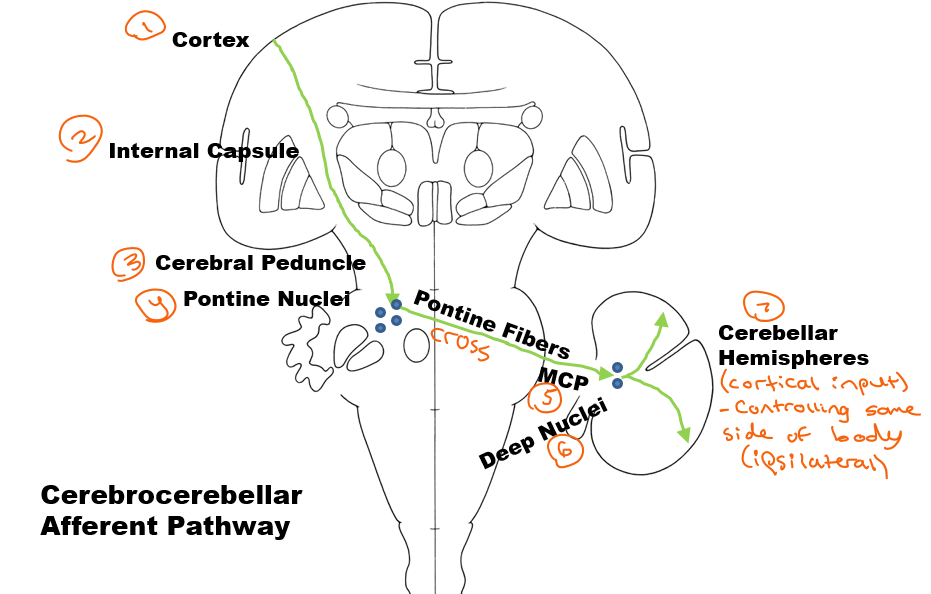
The cerebellar hemispheres control what 3 things?
Motor planning
Fine coordination + manipulation
Muscle tone
What is the order of the cerebrocerebellar efferent pathway (efferent info from cerebellum to cortex)?
Cerebellar hemisphere
Deep nuclei
Superior cerebellar peduncle
Cross to the contralateral red nucleus (midbrain)
Thalamus (VL)
Cortex
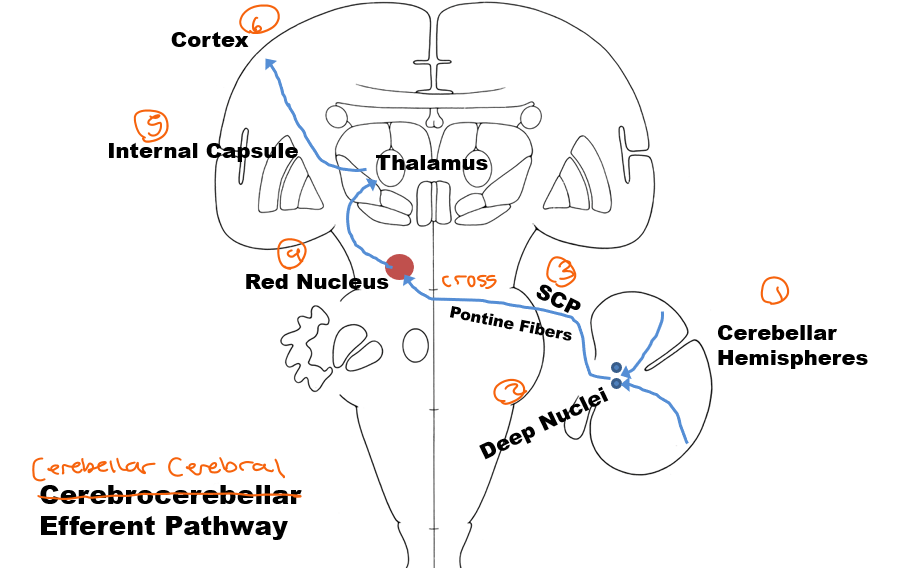
Cerebrocerebellar dysfunction includes what 5 things?
D. D. A. I. H
Dysmetria (under or overshoot in coordination)
Dysdiadochokinesia (problem with rapid alternating movements)
Ataxia (generalized problems with coordination)
Intention tremors (during deliberate movements)
Hypotonia (decrease in tone)