Biology chapter 3

0.0(0)
Studied by 0 people
call kaiCall Kai
Locked
learnLearn
examPractice Test
spaced repetitionSpaced Repetition
heart puzzleMatch
flashcardsFlashcards
GameKnowt Play
Card Sorting

1/9

encourage image

There's no tags or description

Looks like no tags are added yet.

Last updated 4:32 AM on 9/19/26
Name
Mastery
Learn
Test
Matching
Spaced
Call with Kai
Chat

No analytics yet

Send a link to your students to track their progress

10 Terms

1
New cards

Four major groups of biological molecules

1. Carbohydrates: sugars and sugar polymers; energy and structure

2. Lipids: mostly nonpolar molecules; energy storage, membranes, signaling

3. Proteins: amino acid polymers; enzymes, transport, movement, regulation

4. Nucleic acids: nucleotide polymers; information storage and transfer

2
New cards

Carbon Chemistry

Carbon has four valence electrons and can form four covalent bonds.

Carbon can bond to itself, forming chains, branches, and rings.

Carbon skeletons can be modified by functional groups.

This flexibility creates enormous molecular diversity.

3
New cards

Hydrocarbon skeletons

Hydrocarbons contain only carbon and hydrogen.

Carbon skeletons may be linear, branched, or ring-shaped.

Single and double bonds change molecular shape and

flexibility.

Many biological molecules are modified hydrocarbon skeletons

4
New cards

Functional groups

Functional groups are small reactive groups of atoms that give larger molecules specific chemical properties.

Common groups include :

OH: Hydroxyl

C=O: Carbonyl,

OH-C=O: Carboxyl

NH3: Amino

PO34-: phosphate

SH: Sulfhydryl

Functional groups help determine how molecules interact with water and with each other.

<p><span data-name="black_small_square" data-type="emoji">▪</span> Functional groups are small reactive groups of atoms that give larger molecules specific chemical properties.</p><p><span data-name="black_small_square" data-type="emoji">▪</span> Common groups include :</p><p><span data-name="black_small_square" data-type="emoji">▪</span> OH: Hydroxyl</p><p><span data-name="black_small_square" data-type="emoji">▪</span> C=O: Carbonyl,</p><p><span data-name="black_small_square" data-type="emoji">▪</span> OH-C=O: Carboxyl</p><p><span data-name="black_small_square" data-type="emoji">▪</span> NH3: Amino</p><p><span data-name="black_small_square" data-type="emoji">▪</span> PO34-: phosphate</p><p><span data-name="black_small_square" data-type="emoji">▪</span> SH: Sulfhydryl</p><p><span data-name="black_small_square" data-type="emoji">▪</span> Functional groups help determine how molecules interact with water and with each other.</p>
5
New cards

Structural isomers

Glucose and fructose both have the formula C₆H₁₂O₆.

Glucose has an aldehyde group at the end of the carbon chain.

Fructose has a ketone group inside the carbon chain.

Same formula does not mean same function.

<p><span data-name="black_small_square" data-type="emoji">▪</span> Glucose and fructose both have the formula C₆H₁₂O₆.</p><p><span data-name="black_small_square" data-type="emoji">▪</span> Glucose has an aldehyde group at the end of the carbon chain.</p><p><span data-name="black_small_square" data-type="emoji">▪</span> Fructose has a ketone group inside the carbon chain.</p><p><span data-name="black_small_square" data-type="emoji">▪</span> Same formula does not mean same function.</p>
6
New cards

Stereoisomers

Stereoisomers are mirror-image forms of a molecule.

The same atoms are connected in the same order, but

arranged differently in space.

Biological enzymes often recognize only one form.

This is why molecular shape matters


Example: D-Glucose and L-Glucose

Chiral centers have 4 different

substituents

Enantiomers: arranged in a mirror

image

Diastereomers: not mirror images

Why is this important?

D-glucose is recognized by our

enzymes and is metabolized to give us

energy (calories)

L-glucose is not and thus hase zero

calories (artificial sugar)
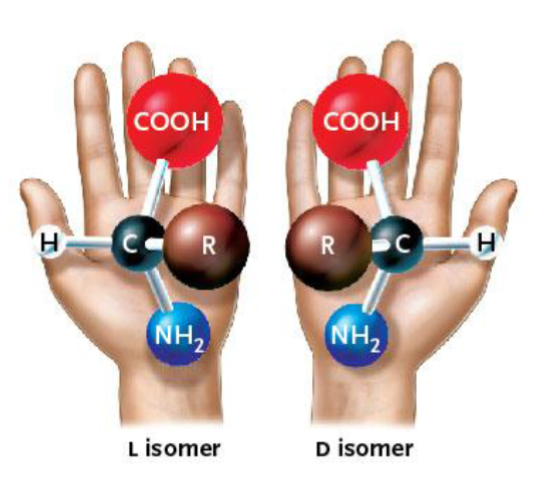
<p><span data-name="black_small_square" data-type="emoji">▪</span> Stereoisomers are mirror-image forms of a molecule.</p><p><span data-name="black_small_square" data-type="emoji">▪</span> The same atoms are connected in the same order, but</p><p>arranged differently in space.</p><p><span data-name="black_small_square" data-type="emoji">▪</span> Biological enzymes often recognize only one form.</p><p><span data-name="black_small_square" data-type="emoji">▪</span> This is why molecular shape matters</p><p></p><p>Example: D-Glucose and L-Glucose</p><p><span data-name="black_small_square" data-type="emoji">▪</span> Chiral centers have 4 different</p><p>substituents</p><p><span data-name="black_small_square" data-type="emoji">▪</span> Enantiomers: arranged in a mirror</p><p>image</p><p><span data-name="black_small_square" data-type="emoji">▪</span> Diastereomers: not mirror images</p><p><span data-name="black_small_square" data-type="emoji">▪</span> Why is this important?</p><p><span data-name="black_small_square" data-type="emoji">▪</span> D-glucose is recognized by our</p><p>enzymes and is metabolized to give us</p><p>energy (calories)</p><p><span data-name="black_small_square" data-type="emoji">▪</span> L-glucose is not and thus hase zero</p><p>calories (artificial sugar)</p>
7
New cards

Monomers vs polymers

A monomer is a small molecular subunit.

A polymer is a larger molecule built from repeating monomers.

Carbohydrates, proteins, and nucleic acids are built by linking monomers.

Lipids are a major biomolecule class, but most are not true polymers

8
New cards

Dehydration synthesis

Synthesis via dehydration reaction to remove water.

A covalent bond forms between monomers.

This reaction builds larger molecules from smaller

subunits.

Examples: glycosidic bonds and peptide bonds.

<p><span data-name="black_small_square" data-type="emoji">▪</span> Synthesis via dehydration reaction to remove water.</p><p><span data-name="black_small_square" data-type="emoji">▪</span> A covalent bond forms between monomers.</p><p><span data-name="black_small_square" data-type="emoji">▪</span> This reaction builds larger molecules from smaller</p><p>subunits.</p><p><span data-name="black_small_square" data-type="emoji">▪</span> Examples: glycosidic bonds and peptide bonds.</p>
9
New cards

Hydrolysis

Hydrolysis adds water to break a covalent

bond

Digestion relies heavily on hydrolysis.

Hydrolysis releases monomers that cells can

absorb and reuse.

<p><span data-name="black_small_square" data-type="emoji">▪</span> Hydrolysis adds water to break a covalent</p><p>bond</p><p><span data-name="black_small_square" data-type="emoji">▪</span> Digestion relies heavily on hydrolysis.</p><p><span data-name="black_small_square" data-type="emoji">▪</span> Hydrolysis releases monomers that cells can</p><p>absorb and reuse.</p>
10
New cards



