Limits
 Call Kai
 Learn
Learn Practice Test
 Spaced Repetition
 Match
Match Flashcards
 Knowt Play
1/10

There's no tags or description
Looks like no tags are added yet.
Name | Mastery | Learn | Test | Matching | Spaced | Call with Kai | Chat |
|---|
No analytics yet
Send a link to your students to track their progress
11 Terms
What is a Limit?

2. What does it mean for a limit not to exist (DNE)?
Verbal: A two-sided limit does not exist if the left-hand limit and right-hand limit approach two different values, if the outputs oscillate wildly without settling on a number, or if the outputs grow without bound.

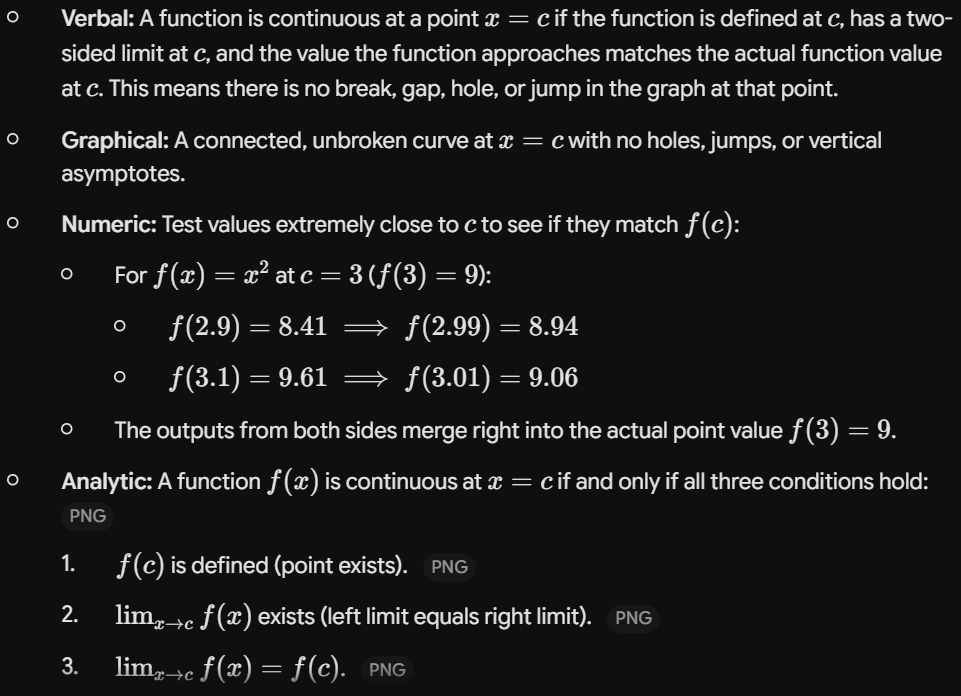
3. What does it mean for a function to be continuous at a point?
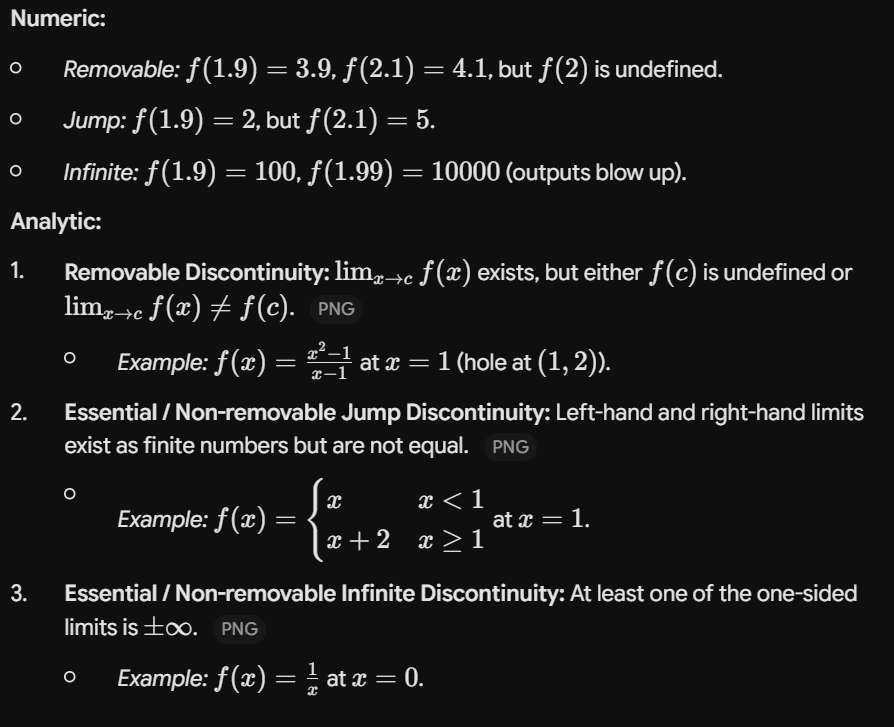
4. What are the different types of discontinuities?
Verbal: Discontinuities are places where a function fails to be continuous. They occur whenever any of the 3 continuity conditions fail—meaning the point is undefined, the limit doesn't exist, or the point doesn't match the limit.
Graphical:
Removable Discontinuity (Hole): The curve has a missing point or a single point offset above/below the path.
Jump Discontinuity: The graph breaks vertically into two separate heights.
Infinite Discontinuity: The graph shoots up or down along a vertical asymptote.
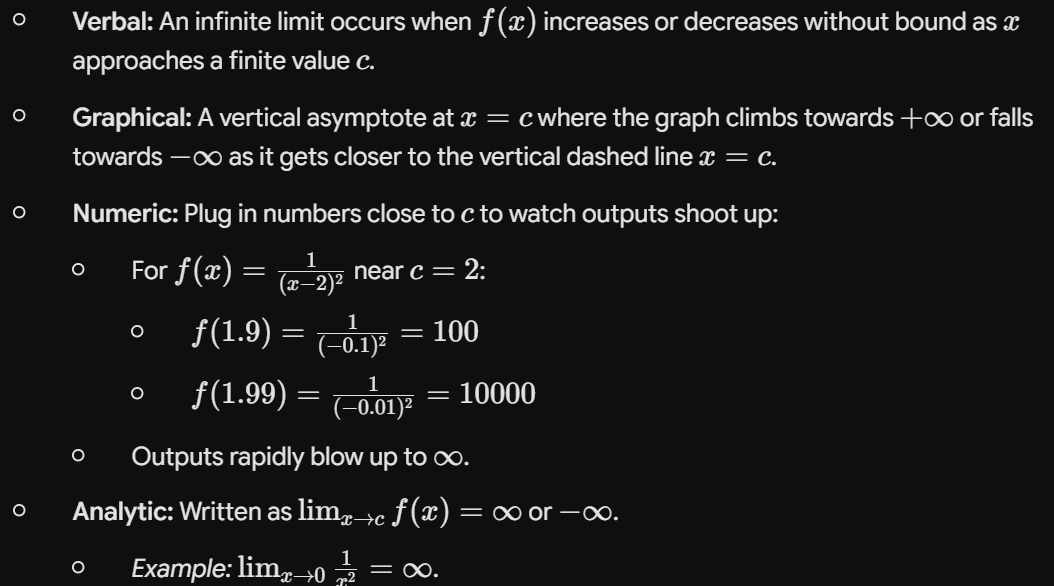
5. What is an infinite limit?
6. What are limits at infinity (and negative infinity)?

7. What is a derivative?

*8. When is a function differentiable? (or not differentiable?)
Verbal: A function is differentiable at x = a if it has a defined, finite derivative (slope) at that point. Differentiability requires the function to be continuous AND smooth at that point.

9. Why are tangent lines important and how do you find them?

1. Squeeze Theorem

2. Intermediate Value Theorem (IVT)
