Stability and Retention
 Call Kai
 Learn
Learn Practice Test
 Spaced Repetition
 Match
Match Flashcards
 Knowt Play
1/38

There's no tags or description
Looks like no tags are added yet.
Name | Mastery | Learn | Test | Matching | Spaced | Call with Kai | Chat |
|---|
No analytics yet
Send a link to your students to track their progress
39 Terms
What is the definition of stability and relapse?
how are they different?
Relapse or stability is the tendency for change in the tooth position (intra-arch) and arch relationship (inter-arch) from the final positions in which they were placed at the end of tx
When ortho tx is completed you want teeth to remain in their final position
Stability: moving from positon a to b but teeth want to now move to position c d e
Relapse: moving teeth from position a to b but tooth moves back to a
What are some divisions of relapse? (3)
Physiological relapse - return to the original malocclusion
(influence of the dentoalveolar and periodontal complex that causes movement of teeth in a direction returning to original malocclusion
True relapse - due to poor treatment)
(the nature of mechanics used and type of movement carried out results in a lack of stability and relapse potential)
Unfavourable growth
(changes in facial growth particularly if unfavourable can result in relapse and lack of stability of final results)
adequate retention regimes and good mechanics but nature of future growth is more unpredictable and difficult to control
Why should a distinction be made between relapse of ortho treatment (physiological and true relapse) and changes due to facial growth/occlusal maturation?
Physiological and True relapse can be anticipated and avoided thorugh
adequate retention regimes and good mechanics but the nature of future growth is more unpredictable and difficult to control
Stability is controlled by what factors? (5)
Soft tissue factors
Occlusal factors
Facial growth/occlusal maturation
Supporting tissues (pdl complex)
Habits
How can soft tissues affect stability?
A malocclusion before ortho tx is in a position of balance
(and therefore stability) partly determined by soft tissues e.g lips and tongue - teeth line in a zone of equilibrium with surrounding soft tissues
Unless a new position of stability is found, the result will not be stable
So must be considered during diagnosis and tx planning - a new position of stability needs to be found with the surrounding soft tissues

How are soft tissue factors important in class 2 div 1 corrections?
The stability of the corrected overjet is dependent on the upper labial segment being under the control of the lower lip
underdevelopment of the jaw - the lip can act as a lip trap (secondary)
tx should ensure the the lower lip is labial to the upper incisors


case
retropositioning of the lower jaw causes the lower lip to be positioned palatal to the upper incisors causing a lip trap which is exacerbating the class 2 div 1 malocclusion
class 2 div 1 and skeletal 2
there is favourable soft tissues
vertical dimension isnt significantly increased which allows for competent lip seal at the end of tx which helps control the upper incisors very well


Case
unfavourable soft tissues with incompetent lips
increased vertical dimension

case
Incompetent lips, increased vertical dimension
retention regime after tx would be needed

case
as well as increased vertical dimension, a short upper lip length can also make it difficult for the lower lip to cover the upper incisors
avg 20-22 mm in females 22-24 mm in males
this will have implications on the prolonged retention regime in reduced upper lip and cause of limited lip seal
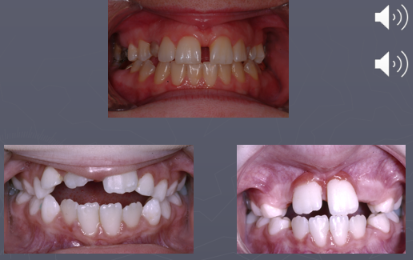
What is another soft tissue feature factor that strongly indluences relapse after correction?
Low frenal attachment or fleshy upper labial frenum
what does a fleshy/low frenal attachment cause and how is it tx?
Aetiology for midline diastema
surgical excision of the fibrous tissue may be undertaken, as if it is retained then there is a stronger tendency for relapse and opening up of midline diastema following tx
removal aids stability
Factors affecting stability: Occlusal factors
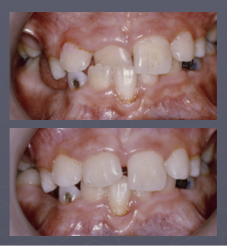
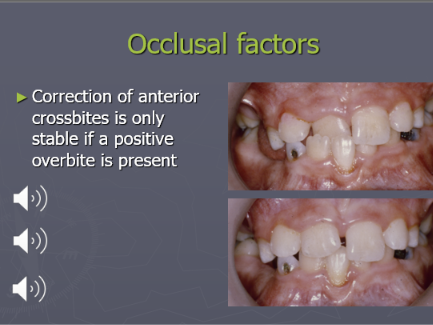
Correction of an anterioir crossbite is only stable if what is present?
A positive overbite is present
mixed dentition, class 1 mal, ant cross bite ur1
labial migration of lr1 and gingival attachment loss and retention of labial surface of lr1 - warranting correction
URA is used to procline the ur1 over the 1 to correct the cross bite
because a good overbite is achieved after tx, the corrected malocclusion will be retained and remain stable as the overlap can prevent relapse
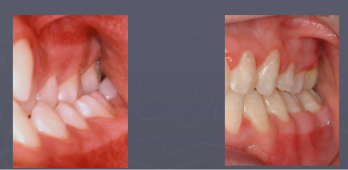
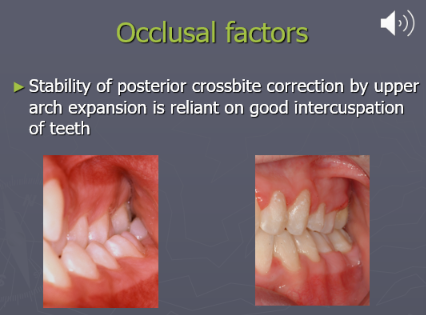
Stability of posterior crossbite correction b y upper arch expansion is reliant on what?
Good intercuspation of the teeth
Affecting left buccal quadrant - correction with expansion - there is good buccal overbite and intercuspation which helps prevent relapse

Overall which is important about the occlusion for retention of results at the end of ortho tx?
when ortho tx is complete, a well socked in occlusion/good intercuspation/the teeth are locked in together
it is less likely that teeth will relapse
good digitations helps with retaining results

Factors affecting stability: facial growth/occlusal maturation
Facial growth continues long after what?
Why would occlusal change occur with facial growth?
Example of unfavourable growth
Forwards and upwards and downwards/backwards growth can cause what?
Long after ortho tx has finished (facial growth continues from childhood well into adult hood)
Dentoalveolar adaptation tends to maintain occlusal relationship even when skeletal relationships change with growth - but if intercuspation of teeth is poor, or dentoalveolar compensation is at its limit - occlusal changes can occur
e.g Skeletal 3 malocclusion completion during teenage years and facial growth continues with growth of the mandible, this will re-establish the class 3 malocclusion as a consequence of unfavourable facial growth
growth rotations
forwards and upwards and downwards/backwards caries lower labial segment into the lip creating force tipping distally - increasing crowding

Occlusal maturation occurs when?
what are the changes that occur? (4)
Why can this be an important factor in stability?
Lip maturation?
Throughout life
decrease in arch lenght, decrease in intercanine width. increase in overbite, increase in lower incisor crowding - occur slowly throughout life but can have an impact
since a lot of ortho tx is carried out during teenage years, the implications of long term changes due to occlusal maturation must be considered in planning for ortho retention to avoid changes
Lip maturation and tone overtime can lead to uprighting of labial segments therefore up righting (retroclines upper and lower incisors)

Factors affecting stability: supporting tissues
What is included in the SUPPORTING TISSUES? (3)
Supporting bone, PDL and supracrestal periodontal fibres
How is the supporting tissues affecting stability?
therefore, why is it important to retain tooth movements until what?
How long does it take for the supporting bone and principal fibres of the PDL take to adapt?
Why are the supracrestal fibres important? and how long do they take to adapt?
When teeth are moved by ortho appliances, the recently deposited bone is particularly susceptible to resorption (can therefore lead to movement/relapse of corrected teeth)
(movement of teeth includes deposition of bone during ortho as they’re moved)
To allow for full adaptation and remodelling of the supporting tissues
6 months
They take longer - up to a year and is an important factor in partial relapse of rotated teeth
Factors affecting stability: habits
What is a habit assocted with ant open bites?
prolonged digit sucking habit leads to anterioir open bite
if corrections are made, pre-existing habits need to cease prior to ortho tx as continuation of habits after completion of ortho tx will cause relapse of teeth and development of the anterioir open bite

What is retention in orthodontics?
The holding of teeth following orthodontic tx in the treated position for the period necessary for the maintenance of the result
number of factors that contribute to changes to occlusion throughout life, as these changes occur throughout life, retention can be thought of as a lifelong process if you wish to avoid significant movement of teeth

Why is retention carried out? (4)
To allow periodontal and gingival reorganisation (reorganise and readapt to new tooth positions)
To minimise changes from facial growth
To permit neuromuscular adaptation to the corrected tooth positions
To maintain unstable tooth positions - if positions required are a compromise or for aesthetics where aesthetics takes precedence

Is retention planned after ortho tx?
Retention must be planned at the same time as active tx
What should retention take into account? (3)
Which teeth/aspects of the malocclusion are prone to relapse
Type of retainer
Duration of the retention

What features make teeth prone to relapse?
present pre-treatment? (9) factors created during tx? (4)
Pre-treatment:
Rotations/slipped contact
median diastema
spacing
palatal canines (significantly displaced teeth)
class 2 div 2 (presence of rotated upper lateral and increased overbite)
Grossly incompetent lips
forwards tongue posture
anterioir open bite
periodontal disease
created during tx:
expansion (intercanine and buccal segment expansion)
Incisor advancement
Incisor retraction (encroaches on the tongue space)
Extractions

Type of retainer: retention can be provided by two things?
the treated malocclusion (itself provides retention)
retention appliance - fixed (lingual or palatal attachment) and removable

In this anterior open bite correction what form of retention would be applied?
remember than an ant open bite is prone to relapse
retention can be provided by positive overbite
malocclusion following correction can prevent relapse of the ur1 back into crossbite


In this class 2 div 1 with mandibular retrognathia and lip trap
retention choice?
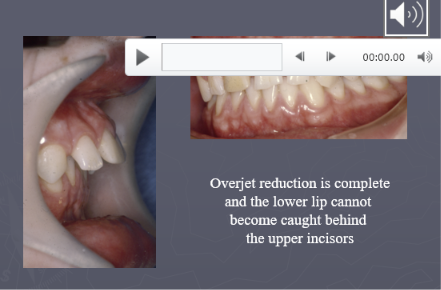
upper incisors are retained by the lower lip
in the image the lower lip is controlling the upper incisors as a lip seal has been achieved and will aid in stability and prevent relapse
one of the main aims is to get lower lip control of upper incisors

What is the name of this retainer?
HAWLEY
acrylic base plate
retained using adams cribs/clasp usually placed on first perm molars
upper and lower labial segment retention thorugh labial bow to fit on labial surfaces of upper and lower incisors
occlusion is free to settle as no part of the retainer interfereswith the occlusal surfaces of the teeth
rigid particularly in the palatal area, it is good at retainiend expansion cases in the upper arch - expansion is a feature prone to relapse
pts instructed to wear these 6 months full time and 6months night time wear
then one to two nights prolonged wear for a long period of time
duration and regime is customised to each patietn to help retain the specific features


What is this retainer?
Vacuum formed retainer
Essix retainer
thickness varies
Accepted by patients - more aesthetic
doesn’t sit on roof of the mouth so more comfortable and accepted
from the design it overlays occlusal surfaces of teeth and may not be ideal retainer were settling occlusion is required
where expansion is carried out this type of retainer is not ideal due flexibility and inability to retain the corrected expansion so Hawley is more suitable
downsides of removable - can be removed and inserted by pts - this means that the success of retention with removable is reliant on pt compliance and ability to be able to wear the removable ortho retainer for the prescribed and desired regime proposed
Why would you use a fixed over removable retainer?
If particularly prone to relapse a removable retainer may not be sufficient so fixed are used to provide indefinite retention
e.g midline diastema

What is another case that is particularly prone to relapse and would benefit from use of permanent retention via fixed appliance (2)
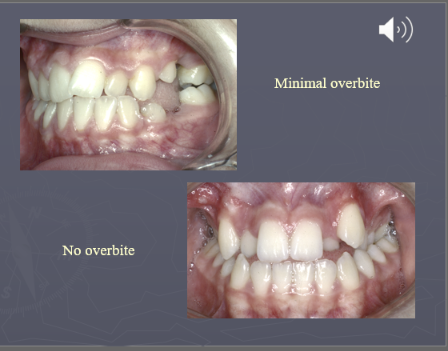
Reduced overbite (increased vertical dimension), so correction of cross bite of the lateral incisors but relapse of crossbite because of the increased vertical dimension (combination of fixed and removable can be used)
No overbite

What type of retainer is this?
Bonded retainer
retain alignment of upper and lower labial segments
extend from canine on one side to contralateral canine on other side in lower arch
upper arch - one lateral to other lateral incisor
mechanically retained using composite
usually placed for prolonged period of time - so must be fabricated really well and neatly adapted onto the surfaces of teeth to help maintain hygienic environment that can easily be kept clean by the patient
maintenance regime is agreed upon to ensure maintenance of fixed retainer and dental health in the long term
failure - deterioration in dental and periodontal health around fixed retainer
Duration of ortho retention
Commonly - retention regimes are 6 months full time then 6 months part time
for removable largely based on periodontal reorganisation
but many factors, so widely recognised that in order to maintain ortho correction and minimise degree of relapse retention should be prolonged and though of as life long
frequently:
fixed in labial segments particularly with lower in conjunction with
removable - 6 months fulltime, 6 part time, 1-2 nights indefinitely