Personal Finance & Economic Indicators: Key Concepts and Processes
 Call Kai
 Learn
Learn Practice Test
 Spaced Repetition
 Match
Match Flashcards
 Knowt Play
1/64

There's no tags or description
Looks like no tags are added yet.
Name | Mastery | Learn | Test | Matching | Spaced | Call with Kai | Chat |
|---|
No analytics yet
Send a link to your students to track their progress
65 Terms
Personal Finance
the Study of Personal & family resources considered important in achieving financial Success
Financial Literacy
Knowledge of facts, concepts, Principals, & tools of Money Management
Financial capability
ability to handle day-to-day financial Matters
Financial Well-being
the degree to which we can fully Meet current & ongoing financial obligations and feel secure in our financial future & be able to make Choices that allow us to enjoy life
Financially responsible
accountable for your future financial Well-being & Strive to make good decisions in Personal finance
5 steps in the financial planning process:
1. Evaluate our financial health relative to current lifestyle and career choice.
2. Define our financial goals.
3. Develop a plan of action to achieve our goals.
4. Implement spending and saving plans to monitor and control progress toward goals.
5. Review our financial progress and make changes as appropriate.
Financial success
achievement of financial aspirations that are desired, planned, or attempted
Financial security
comfortable feeling that our financial resources will be adequate to fulfill any needs we have as well as most of our wants
Financial happiness
experience we have when we are satisfied with our money matters
Current consumption
Spending on goods & Services
Savings
Income not spent on current consumption
Investments
assets Purchased with the goal of Providing additional future income from the asset itself
Standard of living
Where we'd like to be
Level of living
where we actually are in the Moment
Economy
system of Managing the productive resources of a country, State or community
Capitalism
A country's trade & industry are controlled by private owners who seek profit
Economic growth
Condition of increasing production (business activity) and consumption in the economy
Consumer spending accounts for
about 70% of the total U.S. economy
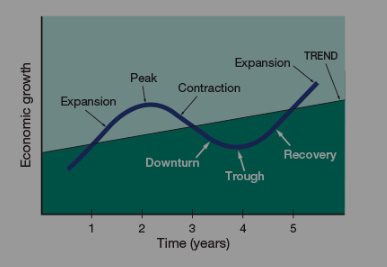
Business cycle
Process by which the economy grows and contracts over time
Deleveraging
a time period when credit use shrinks in an economy instead of expanding as during normal economic times
Recessions
recurring period of decline in total output, income, employment, and trade
Economic indicator
any economic statistic (unemployment rate, GDP, inflation rate) that suggests how well the economy is doing or how well the economy might do in the future
Procyclical economic indicator
moves in the same direction as the economy
Procyclical economic indicator examples
retail sales, industrial production, new orders for durable goods (housing starts), # of employers on nonagricultural payrolls, & the GDP.
Gross Domestic Product (GDP)
the market value of all the goods & services produced in the country. Best example of procyclical indicator
GDP <2%
Very low growth (not enough to create jobs for job market college graduates)
GDP =3%
growth occurring at a Safe Speed that doesn't induce excessive inflation
GDP >4%
fears of rising Prices or inflation
Counter cyclical economic indicator
Moves in the opposite direction from the economy
Counter cyclical economic indicator examples
Unemployment rate (GDP = 2.5% to prevent Unemployment rate rising)
Leading economic indicators
indicators that Change before the economy changes
Leading economic indicators examples
Stock Market, # of new building Permits, existing home sales, home Prices, jobless claims, & the CCI
Consumer Confidence index
gauges how consumers feel about the economy & their personal finances
The Conference Board Leading Economic Index (LEI)
Composite index reported Monthly that suggests the future direction of the US economy
Inflation
rise in the general level of Prices
Stagflation
Stagnant economic growth & high unemployment accompanied by rising Prices
Consumer Price Index (CPI)
broad measure of Changes in the Prices of all goods & Services Purchased for consumption by urban households.
Real Income
income Measured in constant Prices relative to some base time Period
Nominal Income
income that hasn't been adjusted for inflation & decreasing Purchasing power
Purchasing Power
the amount of good's & services that one's income Will buy
Rule of 70
A formula to determine how long it will take for the Value of a dollar to decline by one-half
Deflation
broad, sustained decline in Prices of goods & Services
Interest
Price of borrowing money, Most often reported as an Annual Percentage of the amount borrowed
Fed (Federal Reserve Board)
an agency representing the central banking system of the United States.
Federal Funds Rate
Short-term rate at which banks lend funds to other banks overnight
Opportunity cost
the value of the next best alternative that must be forgone
Trade-offs
giving up one thing for another
Utility
the ability of a good or service to satisfy a human want
Marginal Utility
extra satisfaction derived from having one more incremental unit of a product or service
Marginal Cost
the additional cost of one more incremental unit of Some item
Marginal tax rate
the tax rate at which our last dollar earned is taxed
Tax-exempt income
income from an investment whose earnings are free or exempt from taxation
Tax-exempt income examples
interest on Municipal bonds issued by agencies of state & local governments
Tax deferred income
When a Person does not make a current Payment on income taxes now & instead Pays the tax at a future point in time
Tax deferred income examples
401(k) retirement Plan
Time Value of Money (TVM)
Method by Which one can compare cash flows across time
Simple Interest
i = p x r x t where
p = is the Principal,
r = is the rate of interest,
t = is the time in years
Compound Interest
return earned when previous investment earnings are reinvested into the same investment
Future Value
the value of an asset projected to the end of a particular time period.
FV Equation
(Present Value of Sum money )(1.0+i)^n
Rule of 72
formula for figuring the # of years it takes to double the Principal using compound interest.
Rule of 72 Formula
72 / interest rate = time
Annuity
a stream of payments to be over time at fixed intervals, typically annually
Present Value
the current value of an asset that will be received in the future.
PV Formula
PV = (Future Value of Sum of Money) / (1.0 + i)^n