Module 3: Structure of Viruses
 Call Kai
 Learn
Learn Practice Test
 Spaced Repetition
 Match
Match Flashcards
 Knowt Play
1/24

Earn XP
Description and Tags
Virology
Name | Mastery | Learn | Test | Matching | Spaced | Call with Kai | Chat |
|---|
No analytics yet
Send a link to your students to track their progress
25 Terms
range in size
20 to 400 nm in diameter
capsid
protien coat covering nucleic acid genome
spikes
protien or glycoprotien structures on the surface of virus particles invloved in receptor binding on host cells
subunit
single folded polypeptide chain
structural unit
unit from which capsids or nucleocapsids are built
envelope
host cell derived lipid bilayer
Function of virons
protection of genome
delivery of genome
package critical viral enzymes into target cells
interactions with cell components to ensure infectious cycle
genome packaging challenges
extreme electrostatic repulsion
high internal pressure
steric confinement
ordered condensation
virus particles are _______
metastable
metastable
flip between a stable and unstable state
stable - must protect the genome
unstable - must come apart on infection to uncoat
how to achieve metastability?
spring loaded energy
reversible bonds
kinetic trapping
environmental cues
tools used for viral structural biology
electron microscopy
x-ray crystallography
cryo-election microscopy (cryoEM) & cryoelectron tomography
parameters for helical symmetry
identical inter-subunit contacts
pitch of helix (P) - P= μ x p (μ is subunits per turn and p is axial rise per subunit)
open-ended architectyre
RNA co-assembly
Identical inter-subunit contacts
coat protein molecules engage in identical interactions with one another
Pitch of helix (P)
defined as P = μ × p, where μ is subunits per turn and p is axial rise per subunit
Open-ended architecture
unlike icosahedral capsids, they can adapt length to accommodate variable genome sizes
RNA co-assembly
single-stranded viral RNA winds inside a helical groove, stabilizing the tube
Genome packaging challenges
extreme electrostatic repulsion
high internal pressure
steric confinment
ordered condensation
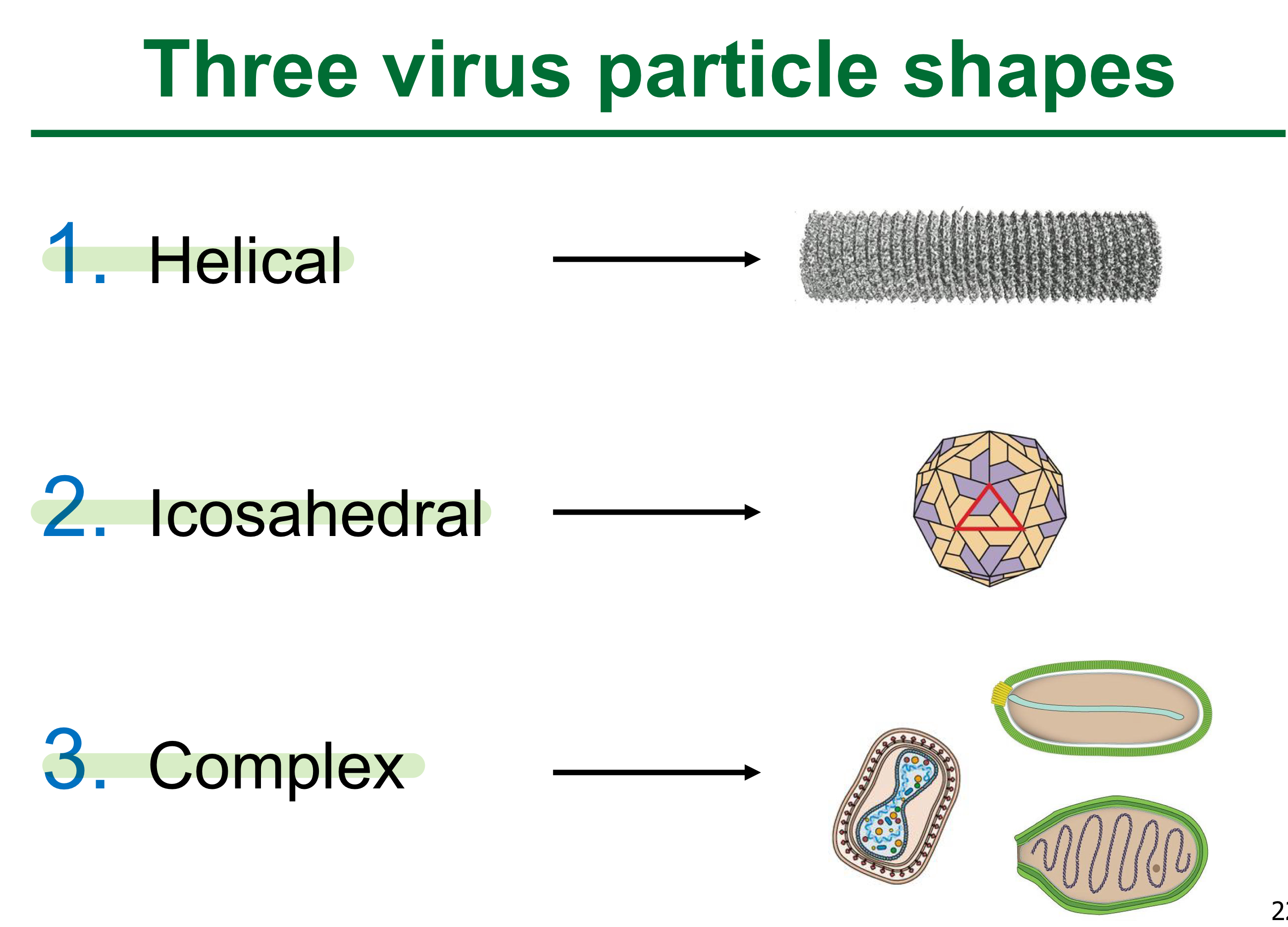
Three virus particle shapes
helical
icosahedral
complex
Genetic Economy Principle
viral genomes dont have coding capacity for large single protien coats
mutimeric repeat strategy - multiple copies of identical small protien subunits
maximized volume - repeat identical unite —> large internal volumetric storage & minimal coding DNA
error reduction
symmetry requirement
Symmetry rules
Rule 1 - each subunit has identical bonding contacts with this neighbors
Rule 2 - these bonding contacts are usually non-covalent (reversible & error free)
Why are animal viruses with helical symmetry always enveloped?
It is for survival. Non-enveloped helical capsids would be too unstable to survuve the physical and chemical attachs in an animal host cells
The envelope acts as a protective flexible cushion that stabilizes the long helical capsid.
How can you make a round capsid from protiens with irregular shapes?
Clue 1 - all round capsids have a precise number of protiens - multiples of 60 are common (60, 180, 240, 960)
Clue 2 - Spherical viruses come in many sizes, but capsie protiens are 20 - 60 kDa average.
W&C called these icosahedral symmetry
Icosahedral symmetry parameters
closed spherical shell - optimal geometric design for forming a closed shell from subunit repeats
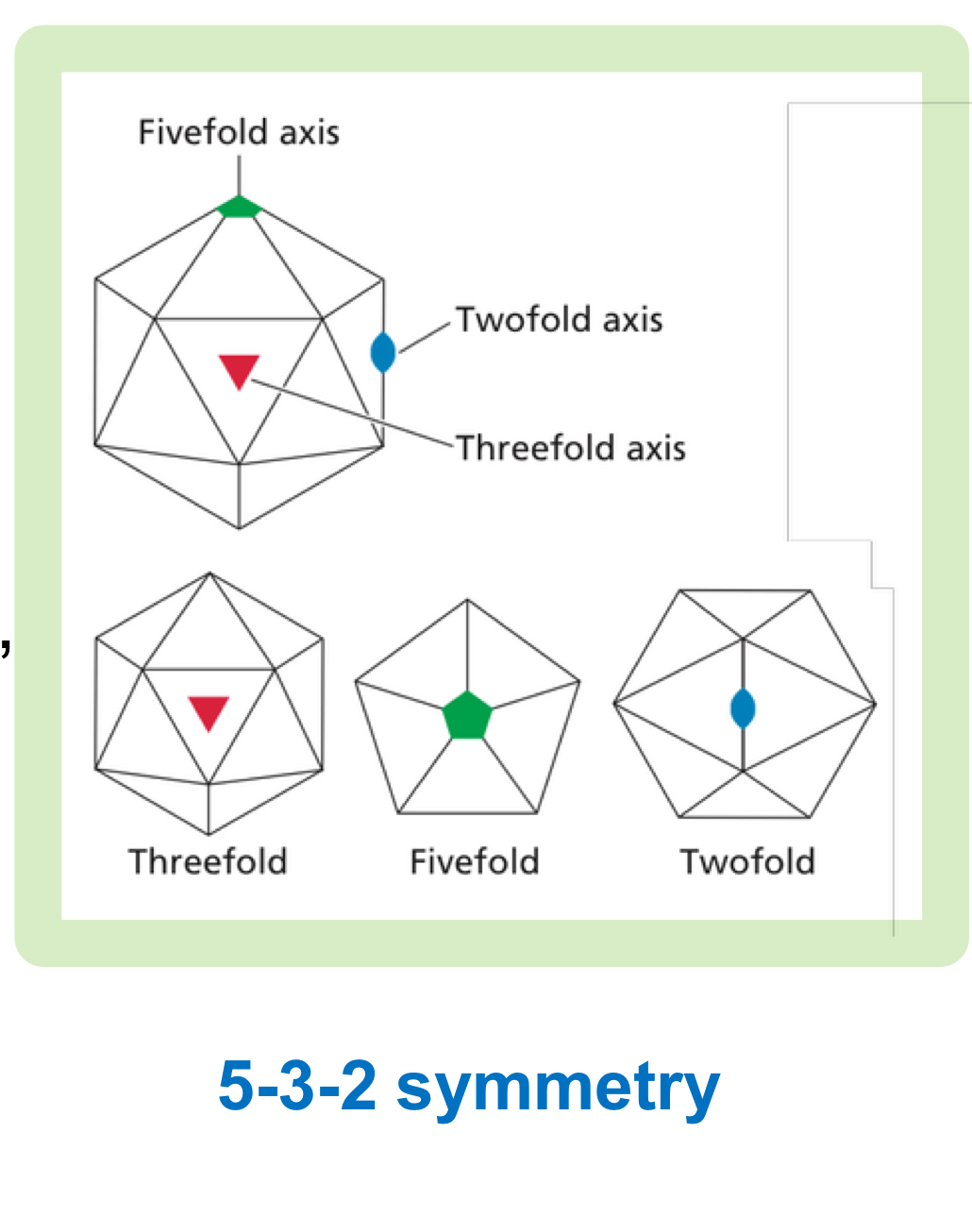
faces - 20 equilateral triangular faces and 12 vertices
three rotational axes - 5 fold (vertices), 3 fold (face centers), and 2 fold (edge centers) axes of symmetry
subunit minimum - n=60 identical subunits required for a closed icosahedron
maximized internal volume
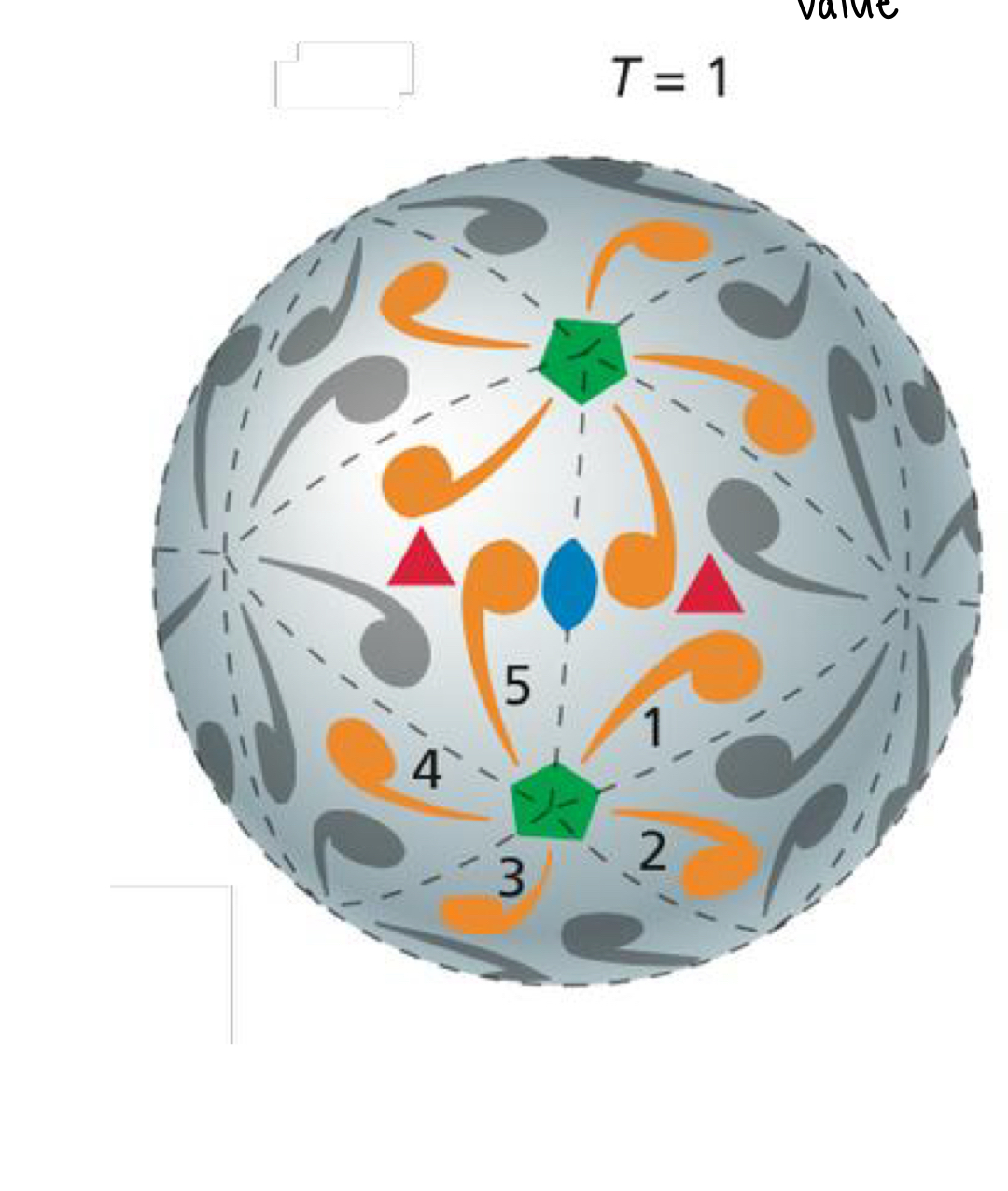
simple icosahedral capsids (T=1)
made of 60 identical protien subunits arranged as 12 pentamers (n=5 subunits)
interactions of all molecules are identical (head to head, tail to tail)