CHEM001C_Chemical Reactions
 Call Kai
 Learn
Learn Practice Test
 Spaced Repetition
 Match
Match Flashcards
 Knowt Play
1/11

There's no tags or description
Looks like no tags are added yet.
Name | Mastery | Learn | Test | Matching | Spaced | Call with Kai | Chat |
|---|
No analytics yet
Send a link to your students to track their progress
12 Terms
Chemical Reactions
A process in which one or more substances are converted into new substances with different physical and chemical properties.
exothermic, endothermic
Evidences of Chemical Reactions
It produces gas.
It produces a solid (a precipitate).
It changes color.
It gives off heat (________) or it absorbs heat (________)
Reactants
Substances that enter into a chemical reaction.
Products
Substances that are produced by a chemical reactions.
Law of Conservation of Mass
States that matter is neither created nor destroyed in a chemical reaction.

Combination or Synthesis Reaction
[TYPES OF CHEMICAL REACTIONS] Two or more reactants combine to form a single product.
![<p><strong>[TYPES OF CHEMICAL REACTIONS] </strong>Two or more reactants combine to form a single product.</p>](https://assets.knowt.com/user-attachments/5c2aa8a0-ee16-432a-9d4c-db767b540b9a.png)
Decomposition Reaction
A reaction in which a single reactant is broken down into two or more smaller compound or elements.

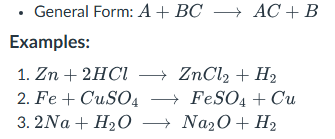
Single Displacement Reaction
A reaction in which an uncombined element displaces an element that is part of the compound.
The reactants are always one element (or diatomic molecule) and one compound.
Double Displacement Reaction
A reaction that involves the exchange of parts between the two compounds.
Atoms or ions from two different compounds replace each other.
There are two compounds as reactants and two compounds as products.

Neutralization Reaction
A specific type of double displacement reaction.
The reaction between an acid and a base forming salt and water.

Combustion Reaction
A reaction in which a substance reacts with oxygen, usually with the release of heat and light to produce flame.
Substances react with O2 to produce CO2 and H2O.
A rapid exothermic reaction.

Ok
