Histology of the Small and Large Intestines
 Call Kai
 Learn
Learn Practice Test
 Spaced Repetition
 Match
Match Flashcards
 Knowt Play
1/66

There's no tags or description
Looks like no tags are added yet.
Name | Mastery | Learn | Test | Matching | Spaced | Call with Kai | Chat |
|---|
No analytics yet
Send a link to your students to track their progress
67 Terms
What is the function of the small intestine?
the principal site for the digestion of food and absorption of amino acids, carbohydrates and lipids
How does bile and pancreatic enzymes enter the duodenum?
the common bile duct and the major duodenal papilla
What are 3 mucosal specializations that increase the surface area of the small intestines?
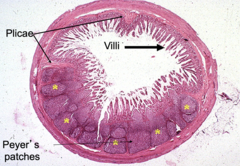
1. plicae
2. villi
3. microvilli
What are the plicae circulares?
permanent folds of mucosa and submucosa that help mix and slow down chyme.

What two regions of the small intestine have prominent plicae circulares?
1. (distal) duodenum
2. jejunum
What region of the small intestine has reduced # and size of plicae circulares?
ileum
The plicae circulares are supported by (loose/dense) connective tissue.
dense
Why are the plicae circulares in the small intestine supported by dense connective tissue, not loose connective tissue?
the plicae do not expand or move

T/F: The plicae circulares contain numerous immune cells, blood capillaries and lymphatic capillaries (lacteals).
False
What are the intestinal villi?
evaginations (fingerlike projections) of the mucosa that completely cover the surface of the small intestine

T/F: The intestinal villi contain numerous immune cells, blood capillaries and lymphatic capillaries (lacteals).
True
What type of epithelium lines the intestinal villi?
simple columnar epithelium

What is the function of the lacteals in the intestinal villi?
absorbing food materials and draining into the venous system.

What are the lymphoid nodules in the intestinal submucosa?
organized aggregations of lymphoid tissue that are part of the GALT system

What are the lymphoid nodules in the ileum?
Peyer's patches
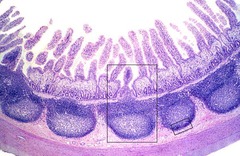
T/F: The intestinal villi also contain smooth muscle.
True
What is the function of the smooth muscle in the intestinal villi?
it contracts and helps with the movement of chyme through the small intestine.
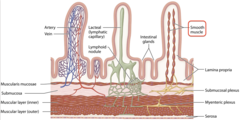
What are the crypts of Lieberkuhn?
intestinal glands in the mucosa, small openings between villi. the epithelium is continuous with that of the adjacent villi
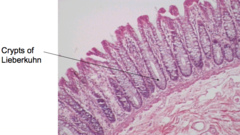
What are 5 types of cells that are found differentiating in the intestinal glands (crypts of Lieberkuhn)?
1. absorptive cells
2. goblet cells
3. Paneth cells
4. enteroendocrine cells
5. stem cells
The plicae and what other surface specialization diminish in size as you go through the intestinal tract?
villi
T/F: As the villi decrease in size and # in the ileum, the crypts of Lieberkuhn also decrease in size and number.
False
What are the microvilli of the enterocytes of the small intestine?
tiny projections of plasma membranes that amplify the luminal surface
What protein is present in microvilli to stabilize their structure and causes them to slightly contract/move?
actin
Why do we want microvilli to have the ability to slightly move/contract?
By moving around, the microvilli are increasing the amount of surface area available to absorb nutrients from chyme. this maximizes the absorption possible in the small intestine.
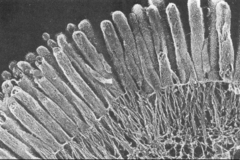
What are the 6 types of cells in the intestinal mucosa?
1. Enterocytes
2. Goblet cells
3. Paneth cells
4. Enteroendocrine cells
5. M cells
6. Stem cells

What are the 3 key functions of enterocytes?
1. transport of substances from the lumen to circulation
2. secrete digestive enzymes
3. creates a barrier between the lumen and intracellular regions, preventing lumen contents from leaking out

The striated border formed by the microvilli of enterocytes is also known as what?
the brush border

How do enterocytes interact to prevent the contents of the lumen from "leaking out"?
they are bound together by tight junctions.

What organelle is more prominent in enterocytes to allow for lipid absorption and processing?
SER

After being absorbed and processed by enterocytes in the small intestine, lipids are transported through (capillaries/veins/lacteals).
lacteals
Why are lipids transported by lacteals away from enterocytes, instead of by blood capillaries?
the processed lipids are too large to enter the blood capillaries

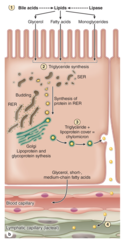
How are lipids processed by enterocytes in the small intestine? (5 steps)
1. Bile acids and Lipase break down lipids into fatty acids, glycerol, and monoglycerides.
2. These lipid products are absorbed by the microvilli
3. Once in the enterocyte, the fatty acids undergo triglyceride synthesis in the SER
4. the triglycerides are packaged with proteins (which were made in the RER) in the golgi
5. these triglycerides+proteins are known as chylomicrons, which are then secreted into the lymphatic system.
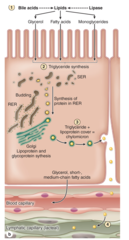
What is a chylomicron?
type of lipoprotein formed in enterocytes to transport lipids away from the GI tract
What are goblet cells?
unicellular glands along the GI tract

Goblet cells (decrease/increase) in number from the duodenum to the ileum.
increase
Why does the number of goblet cells increase as you travel through the small intestine?
as chyme goes through the intestines, it loses water and fluid. goblet cells keep the intestines lubricates as water is absorbed out of chyme.
What type of granules are accumulated at the apex of goblet cells?
mucinogen granules

What are paneth cells?
Base of crypts, they secrete antibacterials to help regulate the normal bacterial flora

What 3 types of antibacterials are secreted by paneth cells?
1. lysozyme
2. defensins
3. glycoproteins
How do defensins exert an antimicrobial effect?
by increasing the membrane permeability of target organisms (parasites or bacteria) by the formation of ion channels.
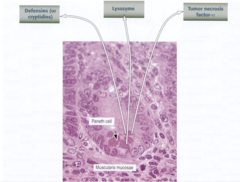
How do lysozymes exert an antimicrobial effect?
increase the permeability of certain bacteria by degradation of their peptidoglycan coat
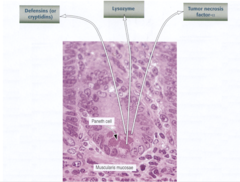
What factor secreted by paneth cells is produced in response to diverse infectious agents and tissue injury?
Tumor necrosis factor-alpha

When would someone have an increase in the number of paneth cells in their small intestine?
infections
What cell type in the small intestine is part of the diffuse neuroendocrine system (DNES), is located in the crypts, and secretes peptides with both endocrine and paracrine effects?
enteroendocrine cells
What are 6 hormones that are secreted by enteroendocrine cells in the GI tract?
1. Gastrin
2. CCK
3. Secretin
4. GIP
5. VIP
6. Motilin
The duodenum receives what 3 substances from other parts of the GI tract?
1. Chyme from the stomach
2. Bile from the gallbladder
3. Pancreatic juice from the pancreas
What structure separates the duodenum from the stomach?
the pyloric sphincter
What submucosal glands are present only in the duodenum?
Brunner's glands

Brunner's glands include what two types of cells?
1. zymogen-secreting
2. mucus-secreting
What is the function of Brunner's glands in the duodenum?
protect and neutralize the acidic chyme entering the small intestine by secreting substances with a pH of 8.1-9.3
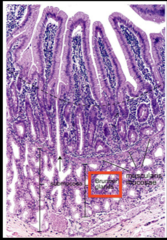
Which region of the small intestine is the most compact/most simple?
Jejunum
What is a key feature of the ileum that can help us identify it histologically?
Peyer's patches
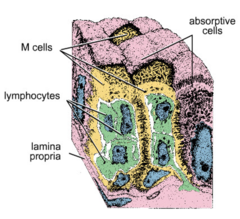
What are M cells in the small intestine?
(aka microfold cells)
specialized epithelial cells overlaying Peyer's patches and lymphatic nodules

What is the function of M cells in the small intestine?
they sample the remaining chyme via endocytosis and activate the immune response (if needed) via stimulating the release of IgA in the lumen
What are 3 distinct structures seen throughout the colon?
1. teniae coli
2. hautra
3. omental appendices
T/F: The colon mucosal surface contains crypts but no plicae or villi.
True
The number of goblet cells (decreases/increases) as you move down the colon.
increases
What are the 3 functions of the colon?
1. absorb electrolytes and water (active transport)
2. move the waste material along its way (peristalsis)
3. store waste material until it is time for it to be evacuated
As you reach the rectum, the number of goblet cells and _____________ (cells) are almost equal.
absorptive
What are the 4 types of cells found in the crypts of the large intestine?
1. absorptive
2. goblet
3. regenerative
4. enteroendocrine (APUD)

What is a key histological feature of the appendix?
Germinal centers of lymphatic nodules

The presence of what type of cell in the appendix indicates its role in the immune response?
paneth
The appendix has a large number of lymphatic nodules that extend into what layer of the GI tract wall?
submucosa
In the anal canal, the epithelium transitions from simple columnar to what?
stratified squamous
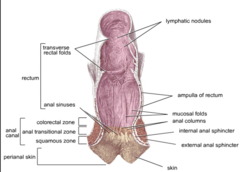
The transition from simple columnar to stratified squamous epithelium in the anal canal is (sudden/gradual).
gradual
The epithelium of the anal canal becomes keratinized at what point?
near the anal opening
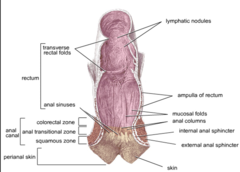
Anal glands are present in what layer of the GI tract wall?
submucosa