13. Basics of Molecular Spectroscopy
 Call Kai
 Learn
Learn Practice Test
 Spaced Repetition
 Match
Match Flashcards
 Knowt Play
1/9

There's no tags or description
Looks like no tags are added yet.
Name | Mastery | Learn | Test | Matching | Spaced | Call with Kai | Chat |
|---|
No analytics yet
Send a link to your students to track their progress
10 Terms
(1.2a) Explain how each of the following can adversely affect the linearity of a UV-Vis quantitative determination:
a) unaccounted acid-base equilibria or molecular interactions
The concentration of a target species, and that of other species in solution, can affect the molecular form of a target. As a calibration is built under these conditions, the different molecular forms change the absorption characteristics of the system, often leading to non-linearity at high concentrations. Making measurements at a pH near a pKa of target can have this effect. Also, analytes prone to self-association will associate more and change absorption profiles at higher concentrations.
(1.2b) Explain how each of the following can adversely affect the linearity of a UV-Vis quantitative determination:
b) Measuring absorption off-peak-maximum
This is a problem when you use a broad band light source. Off-peak-maximum , the absorption signature has a significant slope, and the magnitude of this slope (between the edges of the bandpass) will change as concentration of the analyte changes. This does not occur when measuring on-peak-maximum.
(1.3b) T/F? For the absorption of infrared light to occur, the rotational excitation must involve a change in the dipole moment of the molecule.
False; vibrational
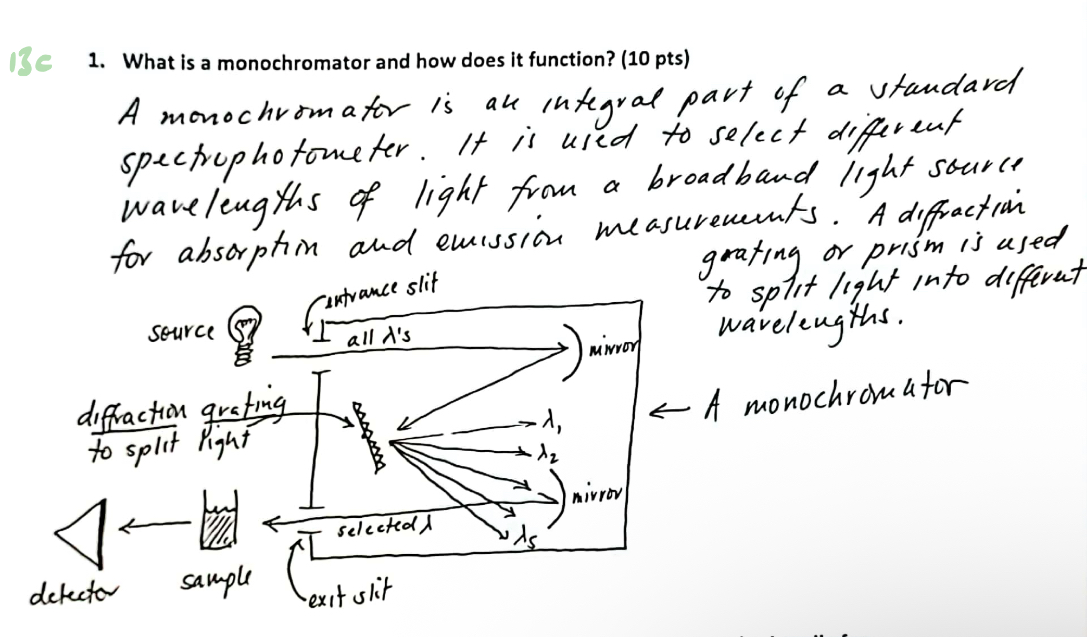
(2.1) What is a monochromator and how does it function?
(3.3b) T/F? The absorption of infrared radiation by a molecule causes vibrational excitation.
True
(3.5e) What effect can unaccounted acid-base equilibria or molecular interactions have on quantitative UV/Vis measurements?
Because many equilibria such as those mentioned are concentration dependent, the relative degrees of reactants and products in these systems will change over the calibration range used. This will ultimately limit the linearity of the calibration curve at higher concentrations.
(4.2) What is a deleterious effect that will likely occur in UV-Vis absorption measurements if you measure absorption off-peak-maximum or if your analyte is subject to processes like metal chelation or dimerization.
Loss in linearity/linear range at high concentration during calibration.
(4.3) What is a primary advantage of a diode array detector compared to a standard photomultiplier tube?
A diode array detector can detect the absorption of a wide range of wavelengths by a sample, simultaneously. A PMT requires the use of wavelength scanning and a monochromator because only one wavelength (or a narrow band) can be measured at a time.
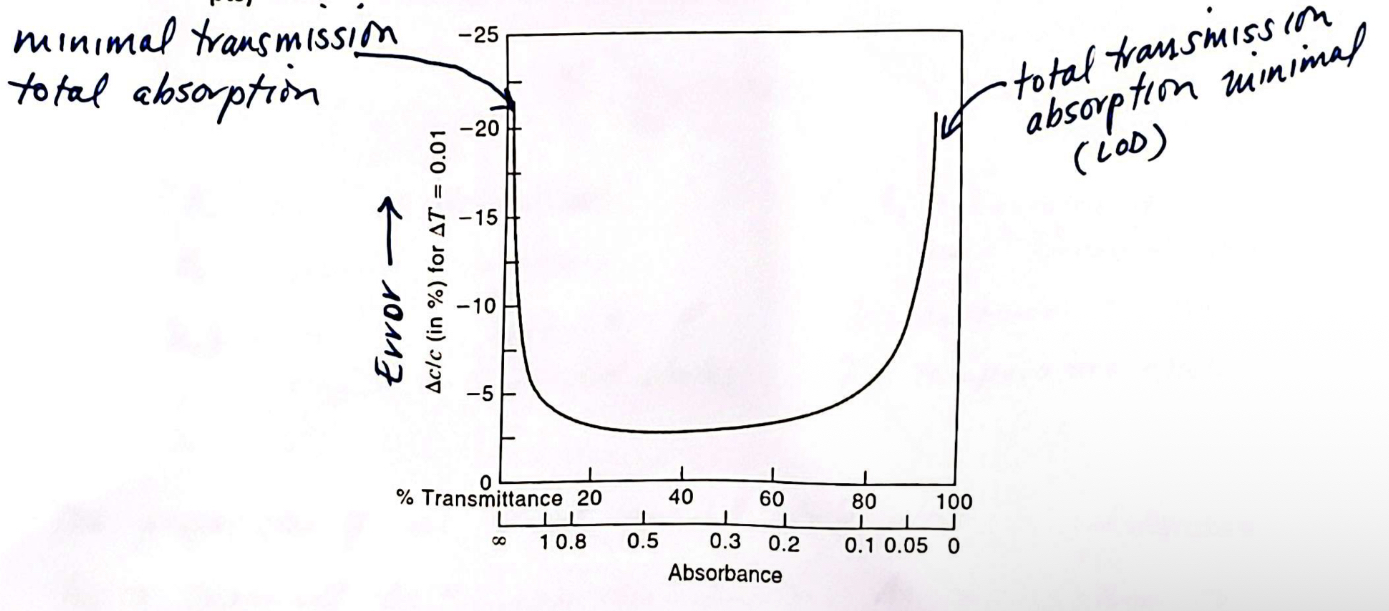
(4.4a) What does this plot tell you about making UV-Vis measurements.
This plot demonstrates that the amount of error increases exponentially as you approach the limits of total absorption and total transmission. The most precise measurements will be made between 0.1 and 1 AU.
(4.4b) Why do each of these steep upslopes in the curve occur at low and high percent transmittance?
Under conditions of total absorption, very little light is reaching the detector; electronic noise competes with limited signal.
Under conditions of minimal absorption, this is close to the detection limits. A very small decrease in incident light is trying to be made in the presence of a strong background light source.