Islamic Art History - Umayyads of Spain (750-1009)
 Call Kai
 Learn
Learn Practice Test
 Spaced Repetition
 Match
Match Flashcards
 Knowt Play
1/11

There's no tags or description
Looks like no tags are added yet.
Name | Mastery | Learn | Test | Matching | Spaced | Call with Kai | Chat |
|---|
No analytics yet
Send a link to your students to track their progress
12 Terms

Great Mosque of Cordoba, Southwest Facade, Spain
Period & Dates: 784-987, Umayyad
Place: Cordoba, Spain
Patron: Abd al-Rahman I
One of the earliest monuments of the Umayyad Spanish dynasty, built/expanded in 4 different stages.
Likely built on site of a Christian church, continues to share the space to this day
Massive hypostyle hall made of Roman spolia columns

Great Mosque of Cordoba, Plan, Spain
Period & Dates: 784-987, Umayyad
Place: Cordoba, Spain
Patron: Abd al-Rahman I
One of the earliest monuments of the Umayyad Spanish dynasty, built/expanded in 4 different stages.
3rd expansion added larger Mihrab space & exclusive area for Caliph to worship
4th expansion expanded to the right and made the shape wider/more typical of a mosque

Great Mosque of Cordoba, Interior View, Spain
Period & Dates: 784-987, Umayyad
Place: Cordoba, Spain
Patron: Abd al-Rahman I
Spolia columns, different heights so two tiered arch systems provides the desired large lofty ceiling
Rectangular pier on top of column acts as support for the second arch.
Two-toned painted arches to differentiate between brick and stone blocks
Two-tone is reminiscent of the Dome of the Rock
Horseshoe arch becomes associated with the Islamic art world from sites such as this, Spanish Umayyad art adopts this from seeing Visigoth arches in Spain

Great Mosque of Cordoba, Polylobed Arches around the Maqsura, Spain
Period & Dates: 784-987, Umayyad
Place: Cordoba, Spain
Patron: Abd al-Rahman I
Directly in front of the Mihrab
5 lobed arch, very ornate to beautify this significant area of the mosque
Two-tone idea continues, but is not just plainly painted, the colored in area is decorated to contrast the plain white zones
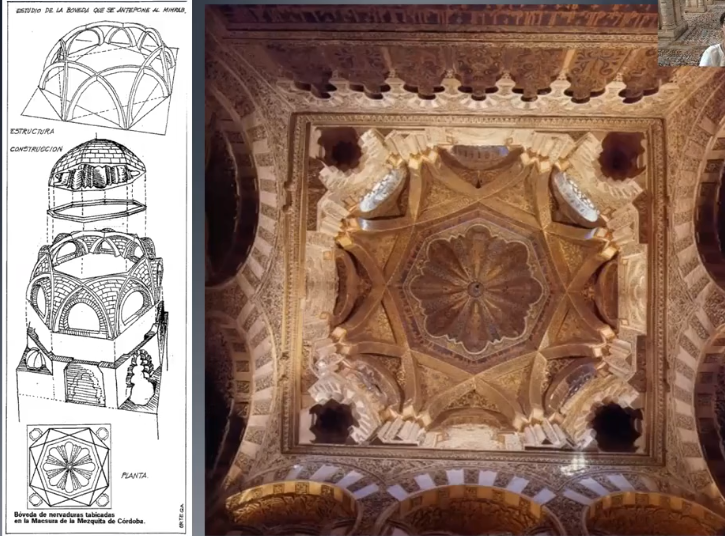
Great Mosque of Cordoba, Dome in front of the Mihrab/, Spain
Period & Dates: 784-987, Umayyad
Place: Cordoba, Spain
Patron: Abd al-Rahman I
Uses squinches to support dome, creates octagonal shape
Creates extreme geometric details through the architecture
Mosaic, calligraphy, stucco, are all features around the dome to add to the all-over decoration. Everything is ornamental

Great Mosque of Cordoba, Al-Hakam’s Maksura, Spain
Period & Dates: 961-976, Umayyad
Place: Cordoba, Spain
Patron: Al- Hakam
Maqsura —> exclusive space in front of the Mihrab for the caliph
Large surfaces covered with stucco, which is an Abbasid invention
Elaborately decorated to show the maximum amount of importance of this space

Great Mosque of Cordoba, Mihrab with Koranic Inscriptions of the Proclamation of Divine Glory, Spain
Period & Dates: 784-987, Umayyad
Place: Cordoba, Spain
Patron: Abd al-Rahman I
Not exactly a niche but a small room, represents opening into the divine world
Glows with divine light from unseen source
Keyhole arch directly influenced from Visigoth churches
Most sacred space in the mosque, Koranic inscription (blue dye with gold letters & vice versa) mimics manuscripts
Text praises the divine and the ruler’s rights
Byzantine (Not Muslim & did not know Arabic) mosaic artists worked on these mosaics

Madinat al-Zahra, horseshoe arches in the audience hall
Period & Dates: 784-987, Umayyad
Place: Madinat al-Zahra, Spain
Patron: Abd al-Rahman III
Just outside of Cordoba, influence shows
Combines Samarran stucco style decor with horseshoe arches, color palette, and extremely elaborate Mihrab niche of G.M. Cordoba
Functioned as a secular palace with a mosque
Spanish Umayyad REALLY valued luxury and luxury arts and artists

Ivory Pyxis made for Princess Subh
Period & Dates: 784-987, Umayyad
Place: Spain
Patron: Princess Subh
Material: IVORY
Pyxis: cylindrical shape with a lid, often follow lobed design, calligraphy around lid, and all over decoration
Iconography was almost always royalty, such as lions or depictions of royal families

Al-Mughira Pyxis
Period & Dates: 784-987, Umayyad
Place: Spain
Patron: Al-Mughira
Likely a coming of age present for Al-Mughira’s 18th year due to the inscription around the lid stating the date
Lions attacking bulls —> Lions represent royal family and military conquest
Four medallions around the pyxis represent people and animals in a symmetrical fashion, shows rich, princely luxuries as well as a love for all over decor & symmetry
IVORY
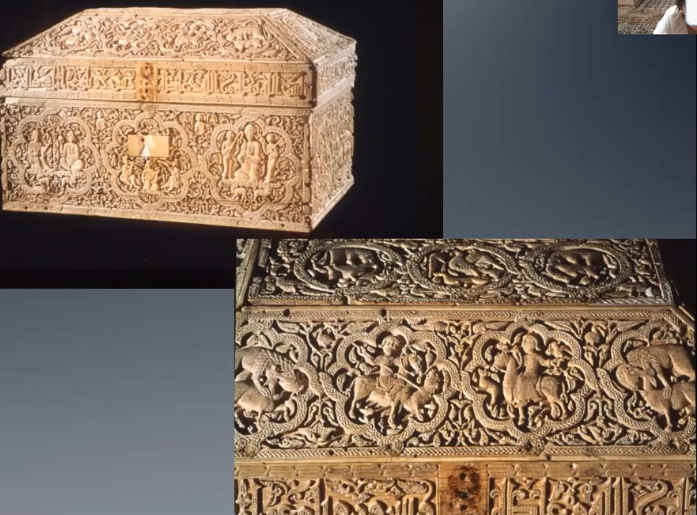
Casket of Abd al-Malik
Period & Dates: 1004, Umayyad
Place: Spain
Patron: Abd al-Malik
Commissioned to celebrate military victory, granted title “Sword of the State”
IVORY
21 Medallions are plated by one infinite connected lobed loop
Continues common representational themes such as lions, luxury, military conquest, court life, hunting, festivities

Pyxis of Sayf al-Dawla
Period & Dates: 1004, Umayyad
Place: Spain
Patron: Abd al-Malik
Scenes contained within horseshoe shaped arches, not medallions. Potentially recalling the architecture & gardens of Madinat al-Zahra, or even Paradise as Islam describes it
Palm tree —> associated with paradise & creation myths
Tree of life, as well as other fruit trees