bio 2.0 chp 14
 Call Kai
 Learn
Learn Practice Test
 Spaced Repetition
 Match
Match Flashcards
 Knowt Play
1/55

There's no tags or description
Looks like no tags are added yet.
Name | Mastery | Learn | Test | Matching | Spaced | Call with Kai | Chat |
|---|
No analytics yet
Send a link to your students to track their progress
56 Terms
true/false:
sexual reproduction mostly results in genetically different offspring but with the same chromosome number as each parent
true
meiosis is a cell division process required for forming ____ in sexually reproducing organisms
egg cells or sperm cells
the precursor cells that complete interphase and then enter Meiosis I are ____
diploid
if the precursor cell that enters into meiosis has total chromosomes denoted as 2n=2, what would be the chromosome status in daughter cells at the end of Meiosis I (chromosome number; diploid/haploid)
one chromosome with sister chromatids attached; haploid
if the precursor cells that enter into meiosis has total chromosomes of 2n=2, what would be the chromosome status in daughter cells at the end of Meiosis II?
one chromosome only; haploid
the daughter gamete cells formed at the end of Meiosis II are:
are not genetically identical to parent cells
Genetic diversity or genetic variation during Meiosis results in gametes with a unique set of genes. Match the process that results in genetic diversity with the meiotic phase in which it occurs (two answers).
crossing over at Prophase I
independent assortment at Metaphase I
two members of gene (alleles) separate equally into gametes. This separation of alleles into gametes is defined as:
principle of segregation
alleles of gene pairs assort independently of other gene pairs. this statement can be categorized as:
principle of independent assortment
the segregation of alleles of a single gene observed by Mendel corresponds to chromosome segregation during Meiosis at ___
anaphase I
The principle of independent assortment corresponds to which part of Meiosis I?
Metaphase I
true/false:
the boxes of Punnett square correspond to possible genotypes of offspring
true
Mendel Monohybrid cross involving crossing Pea Plants that
differed in one contrasting trait produced F2 offsprings with following
genotype ratio___ and phenotype ratio__
1:2:1; 3:1
Pea plants, parental generations (P) with yellow and round seeds
(AARR) were crossed with green and wrinkled seeds (aarr) to
produce F1 offsprings, and later, F1 offsprings were used as parents in
a self-fertilization cross to generate the F2 population. What would be
the probability of obtaining offspring with green and wrinkled
seeds? (Hint: Punnett square can be drawn for individual traits, and
subsequently, probability multiplication rule could be used to find
the outcomes of events that occur simultaneously).
1/16
In certain plants, the yellow color seed trait is dominant to the
green color seed trait. If a heterozygous plant for the seed color trait
is crossed with a homozygous yellow seed color plant, what is the
probability that the offspring will be the ones with green color seed
trait?
0
Note: First-division nondisjunction occurs when homologous pairs
fail to separate during anaphase I. Second-division nondisjunction
occurs when sister chromatids fail to separate during anaphase II.
Say for a diploid human cells (2n=46), if nondisjunction occurs IN MEIOSIS II, what would be the chromosome number in each of the
four sperm gamete cells?
23, 23, 24, 22
Note: First-division nondisjunction occurs when homologous pairs
fail to separate during anaphase I. Second-division nondisjunction
occurs when sister chromatids fail to separate during anaphase II.
Say for a diploid human cells (2n=46), if nondisjunction occurs in meiosis I, what would be the chromosome number in each of the
four sperm gamete cells?
24, 24, 22, 22
In humans, the ability to taste bitter compounds (T) is dominant
to being unable to taste it (t), and having freckles (F) is dominant to
having no freckles (f). If a man with the genotype TtFf is married to
a woman who cannot taste bitter compounds and has no freckles.
What is the probability that they would have a child who can taste
bitter compounds and has no freckles?
1/4
true/false:
the dominant trait inheritance in the Pedigree chart can skip generations for the affected individuals
false
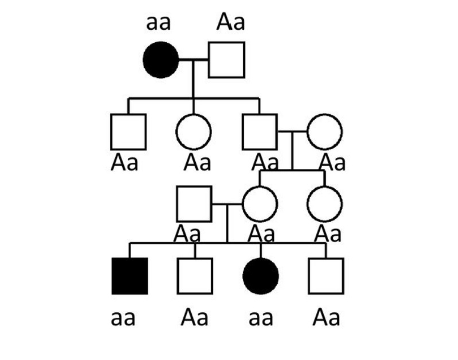
If the trait represented by the filled symbols is a rare inherited
trait with complete penetrance due to a single gene with
alleles A and a, what mode of inheritance does the pedigree suggest
for the below picture?
recessive
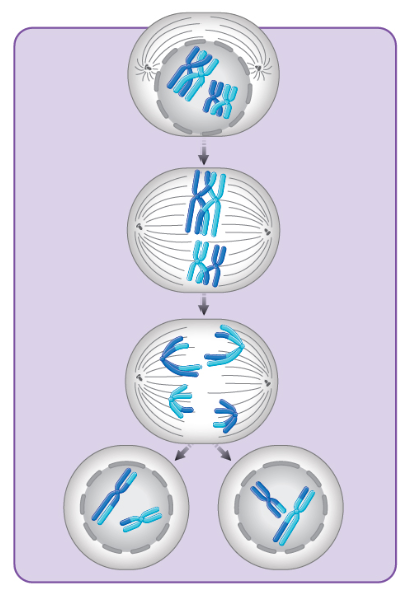
does this depict mitosis, meiosis I, or meiosis II?
meiosis I
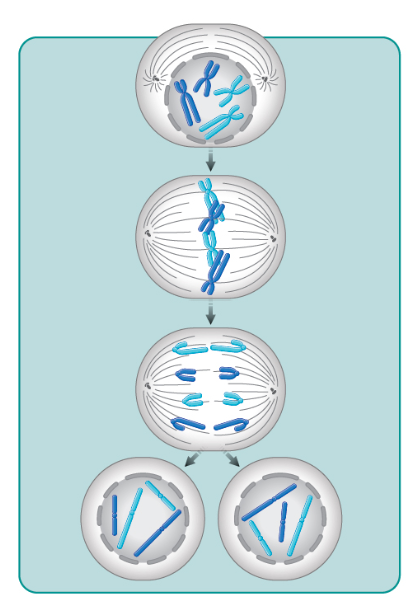
does this depict mitosis, meiosis I, or meiosis II?
mitosis
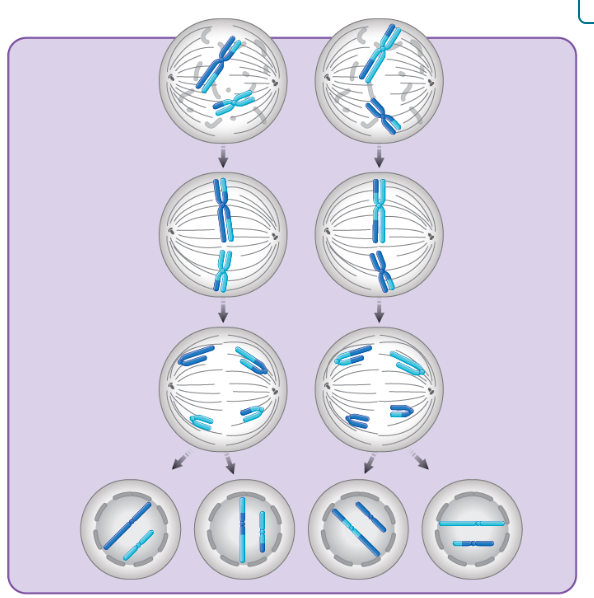
does this depict mitosis, meiosis I, or meiosis II?
meiosis II
Sexual reproduction results:
in a new generation that is not genetically identical to its parents
all are correct
in a new generation with the same number of chromosomes as each parent.
in offspring that are not genetically identical.
from combining genetic material from two gametes.
all are correct
The principle of independent assortment holds that:
the pattern of inheritance of one trait does not influence the pattern of inheritance of another trait.
For an individual who is heterozygous for two genes, Aa and Bb, what does independent assortment predict?
Offspring inheriting the dominant (A) allele of the first gene are equally likely to inherit either the dominant (B) or the recessive (b) allele of the second gene
In a cross between two individuals who are heterozygous for two traits determined by dominant and recessive alleles (Aa Bb), what is the expected ratio of offspring for the trait determined by the first gene (Aa)?
3:1
In a cross between two individuals who are heterozygous for two traits determined by dominant and recessive alleles (Aa Bb), what is the expected ratio of phenotypes for the traits determined by both genes?
9:3:3:1
When a 9:3:3:1 ratio of phenotypes is produced by a cross between two individuals, which phenotypes are present in the rarest class that is represented by only 1 of the 16 possible genotypes of offspring?
These offspring have the recessive phenotype of both traits
In his cross, what did Mendel do?
he studied traits controlled by a single gene
in Mendel’s crosses:
the plants he started with had two alleles of each gene
how did Mendel make crosses with his plants?
he grew plants from seeds and fertilized the ovules of one plant with the pollen from another
When Mendel crossed yellow peas with green peas, the next generation was all yellow. How is this explained?
The parental plants pass one of their two alleles on to the offspring which is heterozygous, and the A allele is dominant to the a allele
When the F1 plants are allowed to self fertilize, they produced both yellow and green peas in the next generation. How is this explained?
In the F1 heterozygotes, the alleles segregate from each other when gametes form and then combine to make homozygotes and heterozygotes offspring
true/false:
Errors in chromosome segregation can occur in either the first or second meiotic division
true
In normal meiosis, when do homologous chromosomes separate from each other?
in the first meiotic division/meiosis I
what is nondisjunction?
failure of chromosomal separation
If nondisjunction occurs in the first meiotic division, how many of the four possible gametes produced from meiosis will have a different number of chromosomes than expected?
four
In which type of nondisjunction could the two copies of a chromosome in a gamete be heterozygous?
nondisjunction in the first meiotic division
Prophase of meiosis I has some important differences from prophase of mitosis. In meiosis, homologous chromosomes ____________, and __________ occurs.
form pairs; crossing over
During meiosis crossing over takes place between:
non-sister chromatids
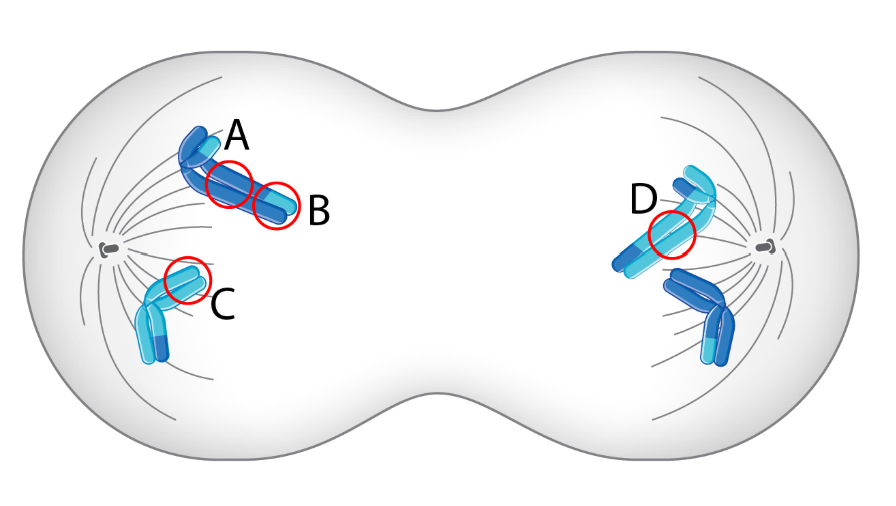
Which circle is likely to contain both paternal and maternal gene variants (alleles)?
circle B
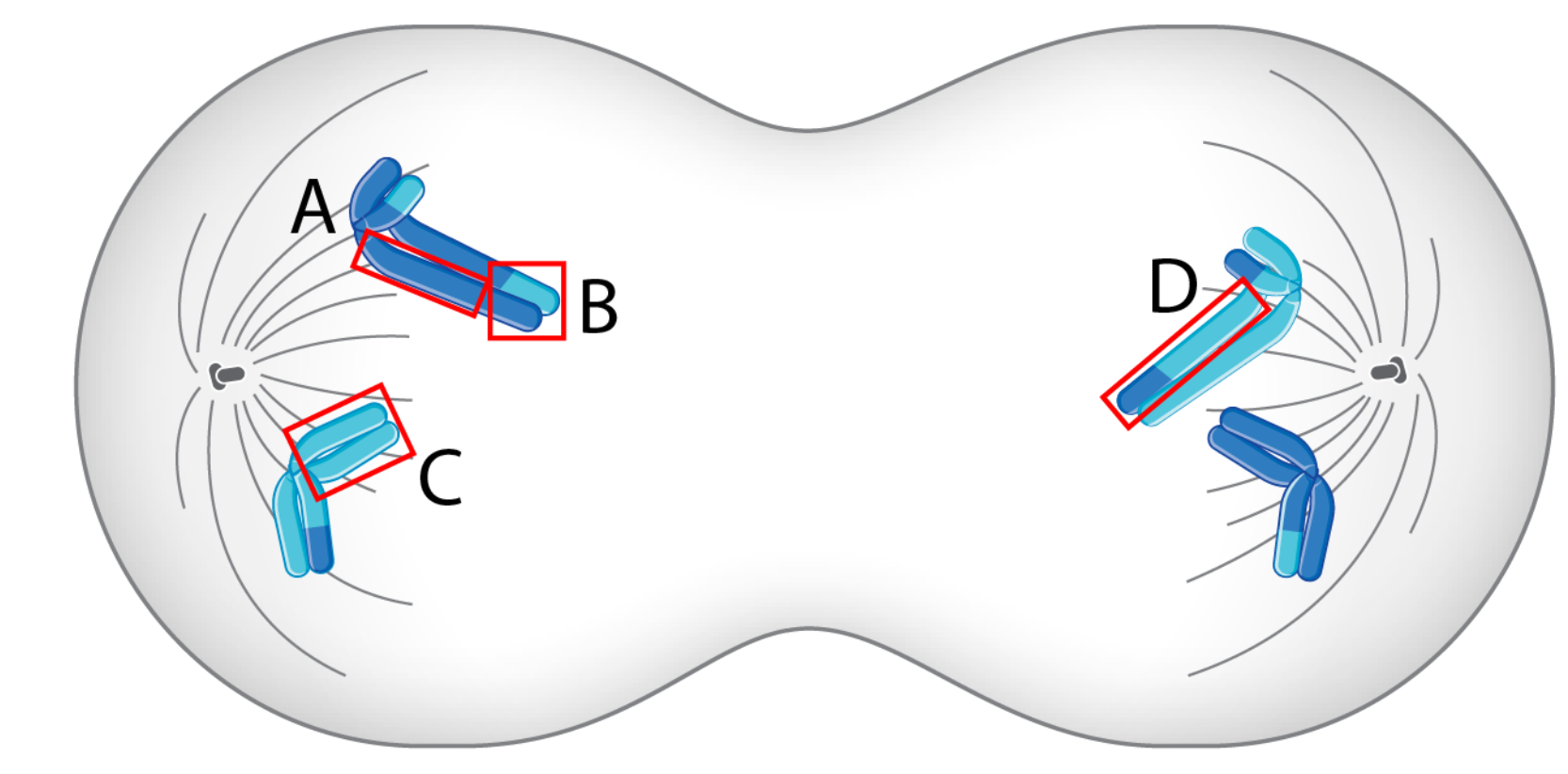
In the figure, which box encloses two copies of the same gene variants (alleles) from only one of the parents?
box C
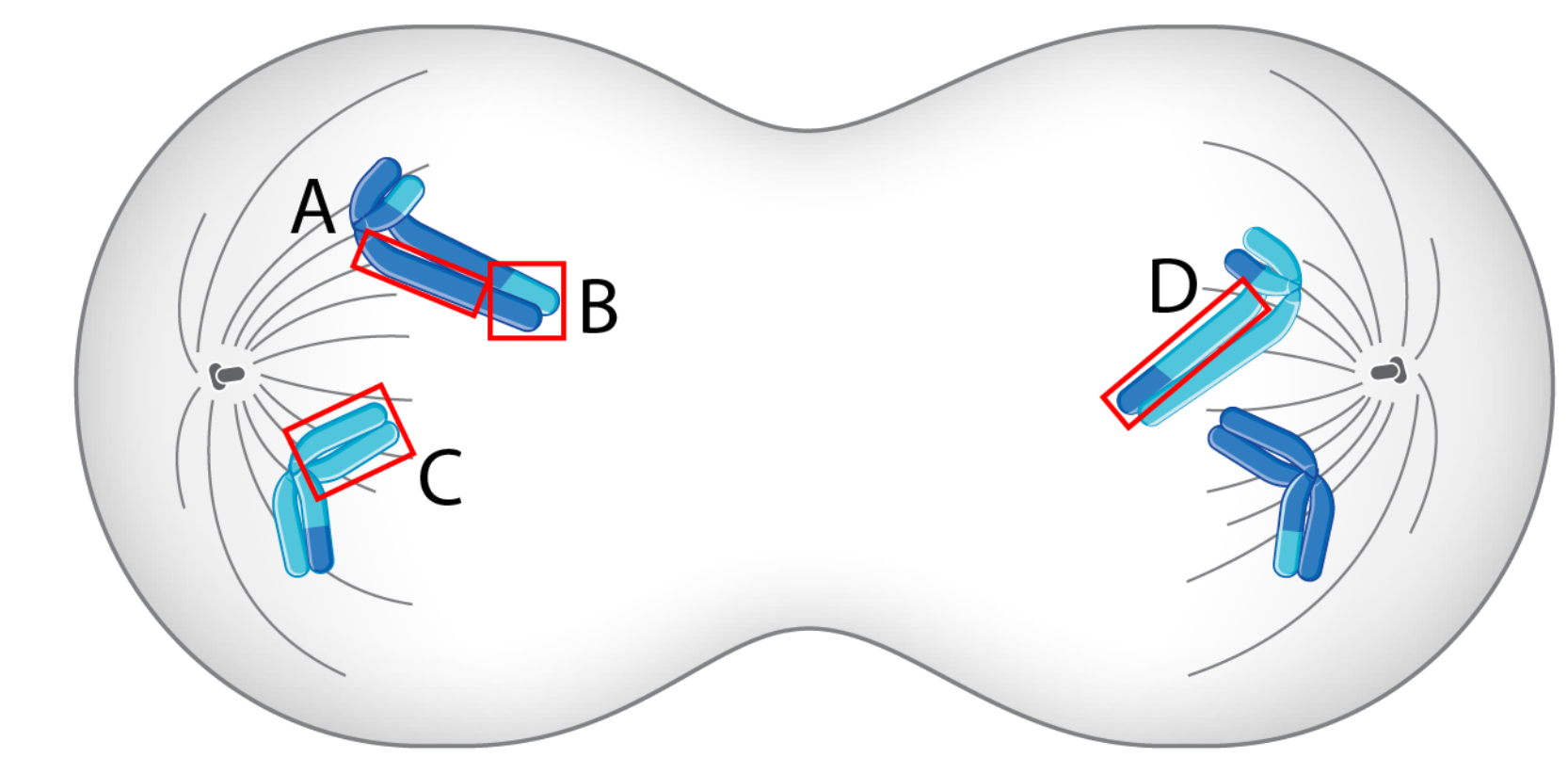
In the figure, which box encloses gene variants (alleles) of the same genes from both parents?
box B
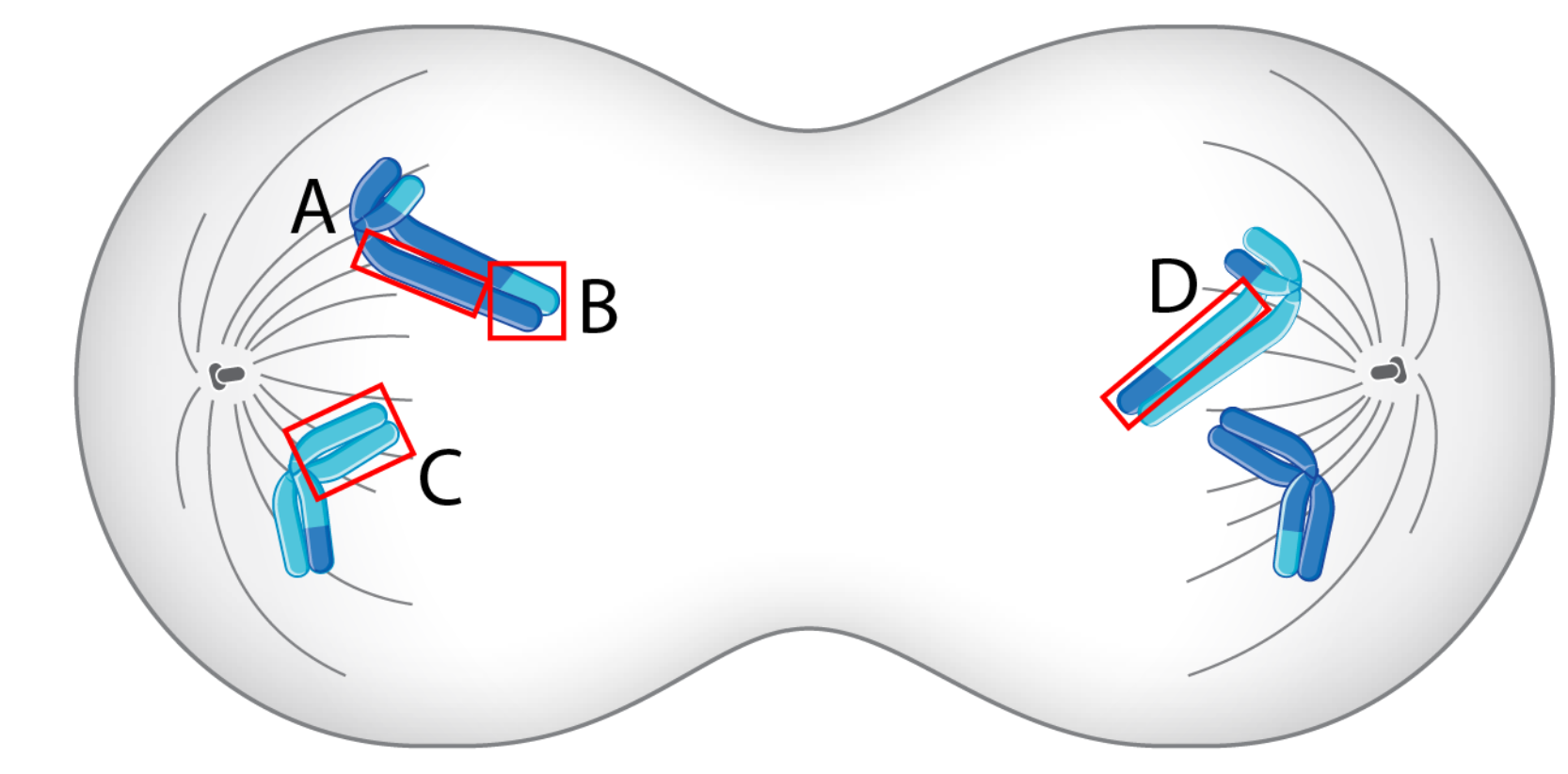
In the figure, which box contains only single gene copies from one of the parents?
box A
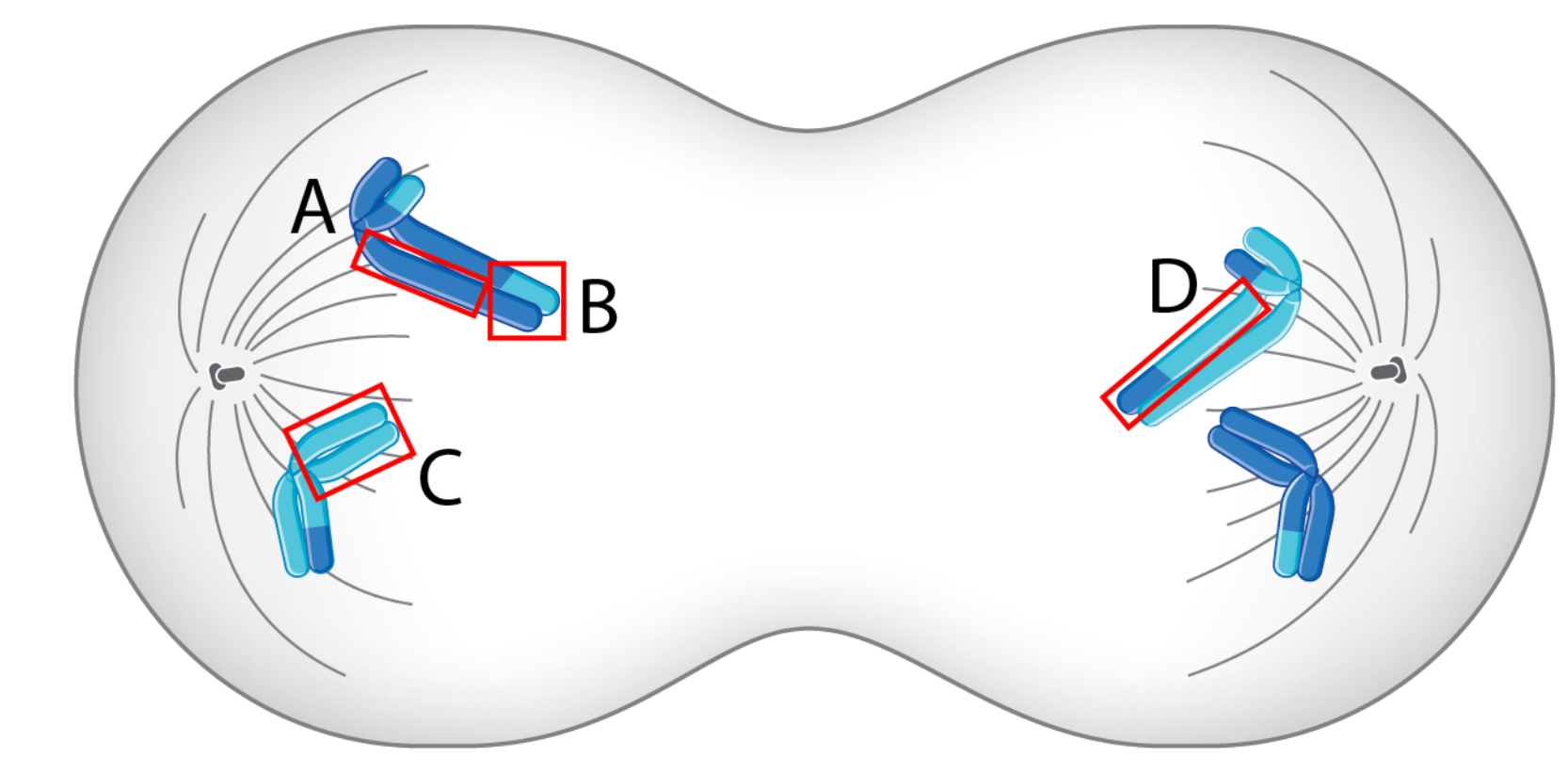
In the figure, which box contains some gene variants (alleles) from one parent and some from the other, but not variant alleles from the same gene?
box D
homologous chromosomes separate from each other in:
meiosis I
how does meiosis generate genetic diversity?
both crossing over at prophase I and random alignment of homologs at metaphase I
It is estimated that a human cell in G1 phase of the cell cycle contains 6 picograms of DNA in its nucleus. If you measure the DNA content at various stages of mitosis and meiosis, what amounts of DNA can be expected in nuclei at the following stages?
prophase mitosis: _____; prophase I meiosis: _____; prophase II meiosis: _____; telophase mitosis: _____; telophase meiosis II: _____. (All amounts are in picograms (10-12 g.)
12;12;6;6;3
What is true about both first and second division nondisjunction?
Gametes are produced with extra chromosomes.
Gametes are produced with missing chromosomes.
List four things about Mendel’s work
he used true-breeding pea plant strains
he provided numerical and statistical data for his experiments
he focused on a subset of easily discernible traits in pea plants
His work utilized several different traits and several different strains of pea plants, all of which were true breeding.
Which answer option represents the expected genotypes of an F2 generation consisting of eight individuals from an initial cross of a true‑breeding black (BB) rabbit and a true‑breeding white (bb) rabbit?
8 progeny: 2 BB, 2 bb, 4 Bb
Suppose you have a plant whose flowers have the dominant color phenotype, but you would like to know if the plant is homozygous or heterozygous. What cross, and with what predicted results, could you perform that would determine whether this plant has a heterozygous genotype?
testcross; ½ dominant phenotype: ½ recessive phenotype
In meiosis, allele separation during ______ is the chromosomal basis of segregation.
anaphase
The cellular mechanism that determines the independent assortment of homologous chromosomes is:
orientation of homologous pairs at metaphase I of meiosis
Suppose that in humans the ability to roll the tongue (R) is dominant to being unable to roll it (r), and having freckles (F) is dominant to having no freckles (f). A man heterozygous for both traits marries a woman heterozygous for both traits.
What is the probability that they will have a child with freckles?
3/4